Angular Momentum of a Rigid Body Equation
Reference from the original Physics I textbook.
- Angular Momentum of a Rigid Body Equation
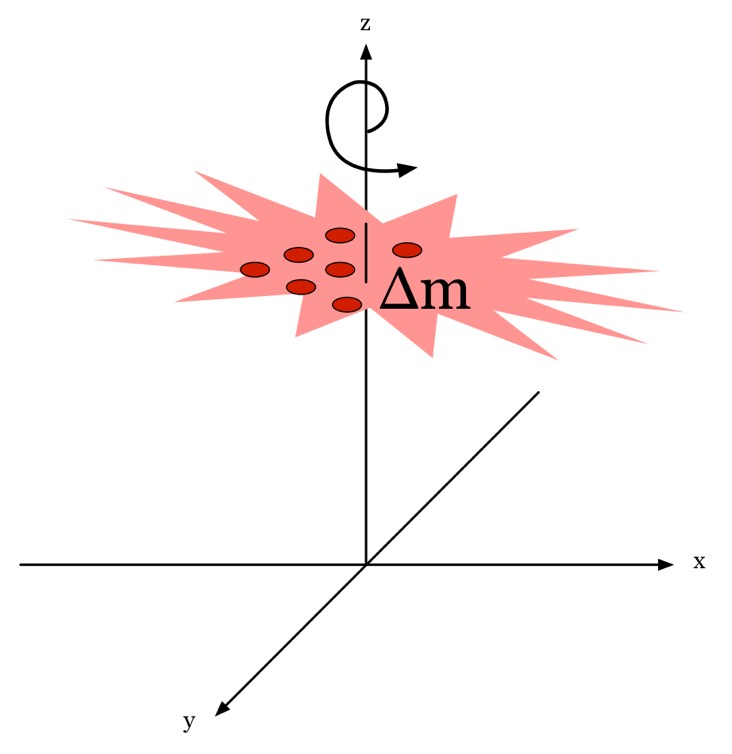
About a principal axis, H⃗_O = Iω⃗. For general rigid-body rotation, angular momentum and angular velocity need not be parallel.
- Related Glossary Terms
Angular Momentum, Conservation of Angular Momentum (Inertia Definition)
- Index
Reviewed physics notes (1)
These corrections keep the original lesson’s purpose while fixing errors in the source edition.
- Scalar I times ω⃗ is restricted to a principal axis. — Reference 1
Glossary and deeper reading · 1 refreshers
These editorial refreshers supplement the reading. Definitions and examples are added guidance; original source wording and recorded answers remain in their original context.
-
Angular momentum
Angular momentum describes motion about a specified point or axis. For rigid rotation about a fixed principal axis it can be written as rotational inertia times angular velocity; a translating particle can also have angular momentum about a point. For example, a ball moving past a pole has angular momentum about the pole even though the ball’s path is straight.