FFR - Rotational Energy
Original textbook reading.
Rotational energy and ideal rolling fit AP. Quantitative slipping-to-rolling and frictional transition calculations are extra exploration; AP treats slipping qualitatively.
Now that you know how to work with the basics behind rotating bodies, you will need to know how to combine the analysis of a rotating body with a moving one. The ‘moving’ referred to there is also described as ‘translation’, basically just moving along some path in space, instead of around a central point.
Now, when you work with problems that combine the two ideas, one of the most reliable equations is the energy balance. Recall that the energy balance as we know it is:
is work, is kinetic energy, is potential energy and is heat loss.
Also recall that the potential energy had two components, gravitational potential energyⓘ and spring potential energy.
If you want to use this equation for a rotating object, you have to learn the energy that a rotating object has.
This energy is called Rotational Energyⓘ, or Angular Kinetic Energy. The formula for it is given as:
This is very similar to the translational kinetic energy, so whenever you use the energy equation in situations that have a rotating object, you have to split the kinetic energy into the translational kinetic energy and the rotational kinetic energy.
A uniform solid disk wheel of mass 1.0 kg and diameter 0.50 m has zero center-of-mass speed and spin magnitude 50 rad/s when placed on a rough level floor. It slips until pure rolling begins and then rolls toward a 3.0 m-high hill without further losses. Does it reach the top? If not, find its maximum rise above the foot of the hill. Ignore the initial drop height.
The moment of inertia for a thin, solid disk spinning as a wheel would be is:
This makes the energy:
Initial spin energy is K_i = ½(0.03125)(50²) = 39.0625 J. During slipping, friction accelerates the center and reduces the spin; some energy becomes internal energy.
Step 2. Find the motion after slipping ends.
Let k = I/(mR²) = 1/2. A friction impulse J gives mv = J and I(ω_0 − ω) = JR. At rolling onset, v = Rω.
v = [k/(1 + k)]Rω_0 = (1/3)(0.25)(50) = 4.16667 m/s; ω = v/R = 16.6667 rad/s.
The rolling kinetic energy is K_roll = ½mv² + ½I(v/R)² = (3/4)mv².
K_roll = (3/4)(1.0)(4.16667²) = 13.0208 J. The slipping loss is 39.0625 − 13.0208 = 26.0417 J.
The 3.0 m hill requires mgh = 29.43 J, which exceeds the 13.0208 J remaining.
The wheel cannot reach the hilltop.
Step 3. Find the maximum rise.
While rolling up the hill without slipping or further losses, the post-slip kinetic energy converts into gravitational potential energy.
mgh_max = 13.0208 J.
h_max = 13.0208/(1.0 × 9.81) = 1.32730 m.
At the maximum rise, both the center-of-mass speed and spin speed are zero in the ideal rolling model.
Conclusion: the disk rises 1.33 m above the hill’s foot.
The slipping stage conserves the appropriate impulse relation, while dissipating mechanical energy.
The later ideal rolling stage conserves mechanical energy.
The relation v = Rω applies only after rolling without slipping begins.
The source’s 3.58 m/s hilltop result relied on an impossible lossless spin-to-roll transition.
Maximum rise: h_max ≈ 1.33 m; the 3.0 m hilltop is not reached.
(Equation 6.2.1)
(Equation 6.2.2)
(Equation 6.2.3)
τ = r × F; |τ| = rF sinθ; τ_net,z = I_zα; a_t = αr; v_t = ωr. The last two are magnitudes; their vector forms use cross products. (Equations 6.3.1–6.3.5)
Original problem 1
The plane and Tarzan cases require a specified plane of motion; the answer uses a level turn for the plane and a horizontal swing around the tree for Tarzan.
Problem text
Identify the physical forces whose inward components keep these objects on circular paths: (a) a plane in a level banked turn, (b) a car on a wet banked curve, (c) Tarzan swinging around a tree on a vine, and (d) a planet orbiting the Sun. Explain each; “centripetal force” alone is not an identification.
Drawing is temporarily unavailable. Work on paper if needed, then record your reasoning here.
Saving written working requires JavaScript. The problem remains available above; keep your work on paper or in your own notes.
Original problem 2
The prompt is explicitly reframed as a consistency check. “Tons” is interpreted as metric tonnes. The very distant speed-based calculation is only an Earth-only mathematical model; other celestial gravity would matter there.
Problem text
A shuttle of mass 40 metric tonnes is described as moving in a circular Earth orbit at 45 m/s while Earth’s gravitational force on it is 10 kN. Check whether these values describe one circular orbit. If they do not, find the altitude implied by the force and the circular speed required there. Use G = 6.67430 × 10⁻¹¹ N·m²/kg², M_E = 5.98 × 10²⁴ kg and R_E = 6.38 × 10⁶ m.
Drawing is temporarily unavailable. Work on paper if needed, then record your reasoning here.
Saving written working requires JavaScript. The problem remains available above; keep your work on paper or in your own notes.


Original problem 4
The source lacks a mass-distribution model. The model result is identified as conditional, not as an inferred physical inertia.
Problem text
A 75 kg ice skater spins at 30 rpm. The separation of her hands changes from 1.0 m to 0.40 m. With negligible external torque, determine what can be inferred about her final angular speed. Explain why hand separation alone is insufficient; also give the result for an explicitly idealized model in which the whole moment of inertia is proportional to the square of half the hand separation.
Drawing is temporarily unavailable. Work on paper if needed, then record your reasoning here.
Saving written working requires JavaScript. The problem remains available above; keep your work on paper or in your own notes.
Original problem 3
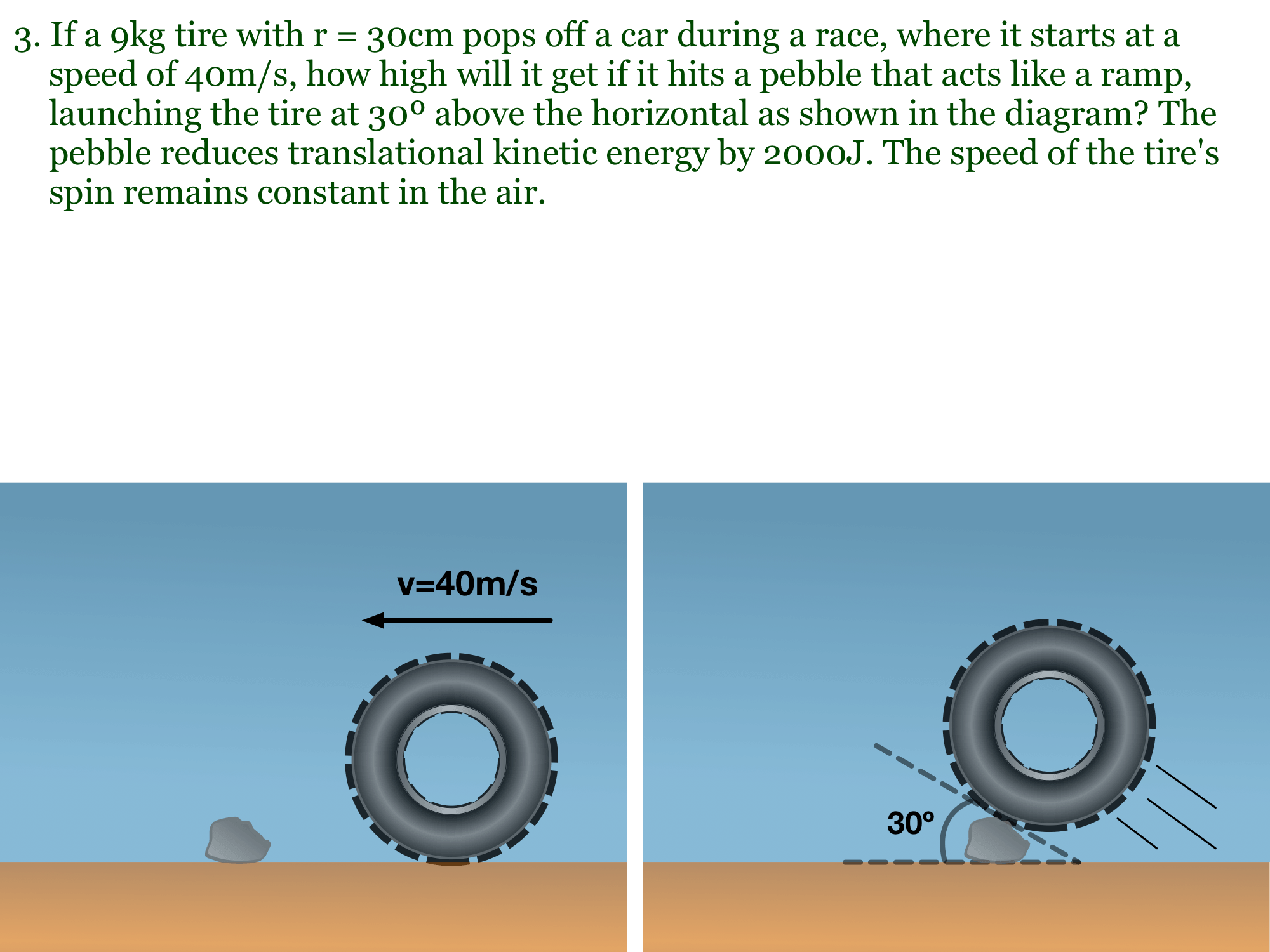
The source image confirms 9 kg. The radius is unnecessary because the spin energy is unchanged. Absolute height above the ground would also require the launch height of the center of mass.
Problem text
A 9 kg tire of radius 0.30 m moves at 40 m/s. A pebble redirects its center-of-mass velocity to 30° above horizontal and removes 2000 J of translational kinetic energy. During flight the spin speed stays constant. Neglect air resistance. Find the maximum rise of its center of mass above the launch position.
Drawing is temporarily unavailable. Work on paper if needed, then record your reasoning here.
Saving written working requires JavaScript. The problem remains available above; keep your work on paper or in your own notes.
Original problem 6
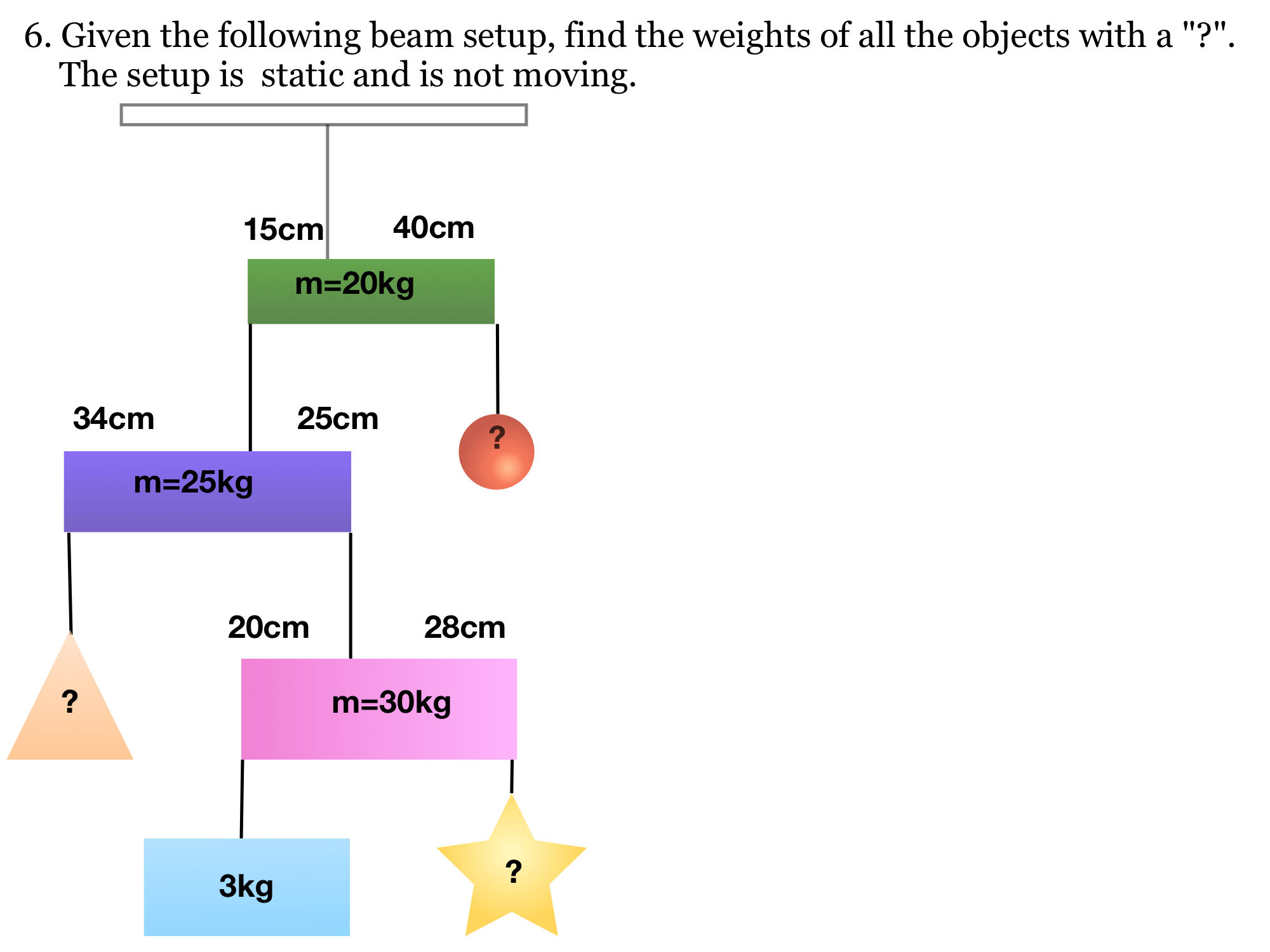
The source labels nonzero beam masses but omits their mass distribution and asserts equilibrium. This reviewed version diagnoses the contradiction under the conventional uniform-beam model instead of silently dropping beam weights.
Problem text
The source diagram shows three horizontal beams with masses 20 kg, 25 kg and 30 kg, suspended by flexible strings. Their left/right endpoint distances from their supports are respectively 15/40 cm, 34/25 cm and 20/28 cm. The bottom beam carries a 3 kg mass at its left end and an unknown star at its right end; the higher beams carry the connected lower assemblies and other unknown objects as shown. Assuming uniform beams, determine whether positive unknown weights can make the pictured configuration static.
Drawing is temporarily unavailable. Work on paper if needed, then record your reasoning here.
Saving written working requires JavaScript. The problem remains available above; keep your work on paper or in your own notes.
Original problem 5
Constant speed and a semicircular path are explicit assumptions. If “under” is strictly less than 62 m/s², 16.468 s is a limiting lower bound; any allowed turn takes slightly longer.
Problem text
A plane maintains a speed of 325 m/s while making a semicircular U-turn. Its centripetal acceleration must not exceed 62 m/s². Find the minimum radius and minimum turning time.
Drawing is temporarily unavailable. Work on paper if needed, then record your reasoning here.
Saving written working requires JavaScript. The problem remains available above; keep your work on paper or in your own notes.
Original problem 8
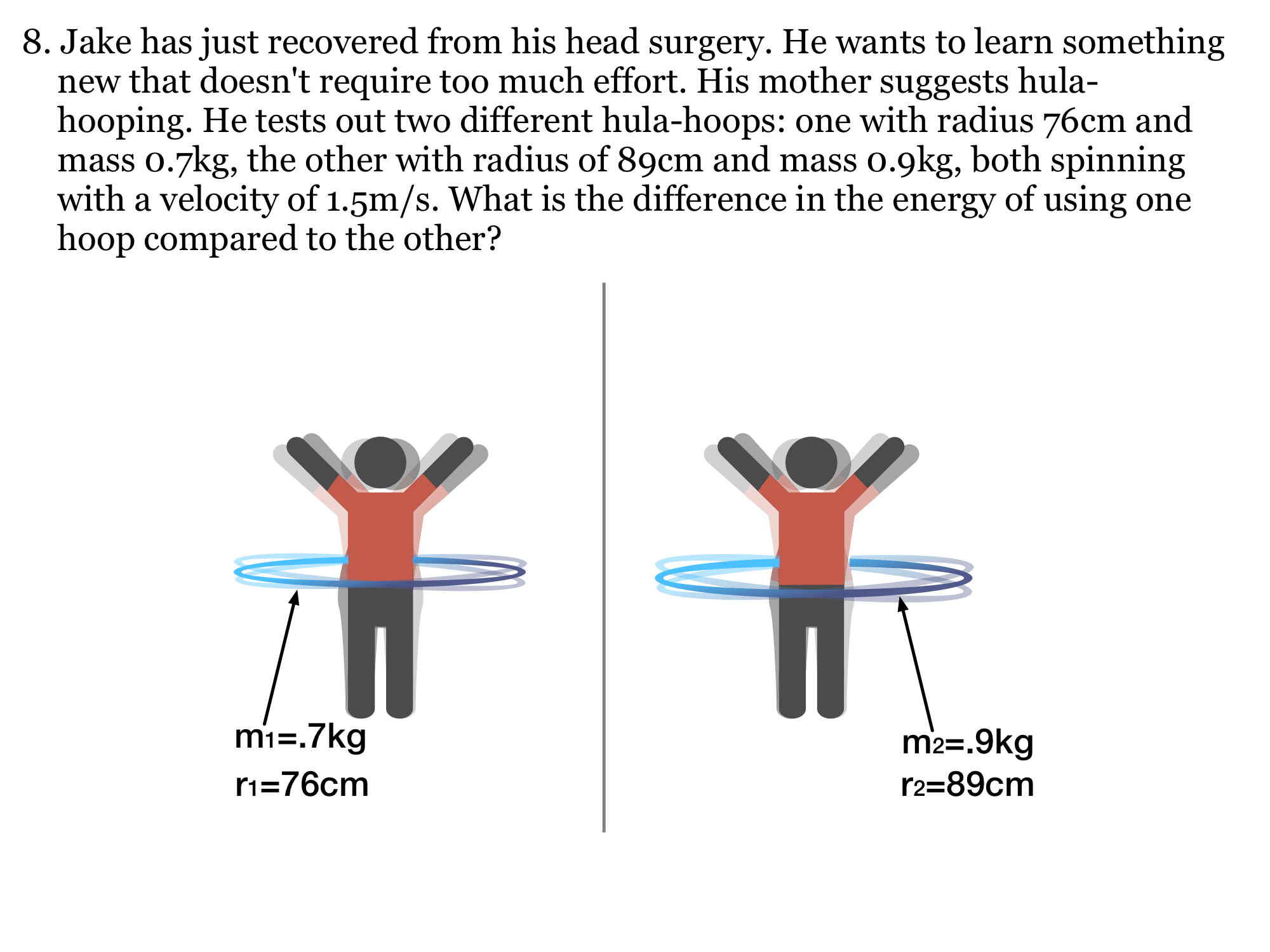
Real hula-hooping involves additional translation and body motion. The reviewed exercise explicitly uses the intended fixed-axis thin-hoop model.
Problem text
Two thin hoops rotate about fixed axes through their centers, perpendicular to their planes. One has radius 0.76 m and mass 0.70 kg; the other has radius 0.89 m and mass 0.90 kg. Each has rim speed 1.5 m/s. Find the difference in their rotational kinetic energies.
Drawing is temporarily unavailable. Work on paper if needed, then record your reasoning here.
Saving written working requires JavaScript. The problem remains available above; keep your work on paper or in your own notes.
Original problem 7
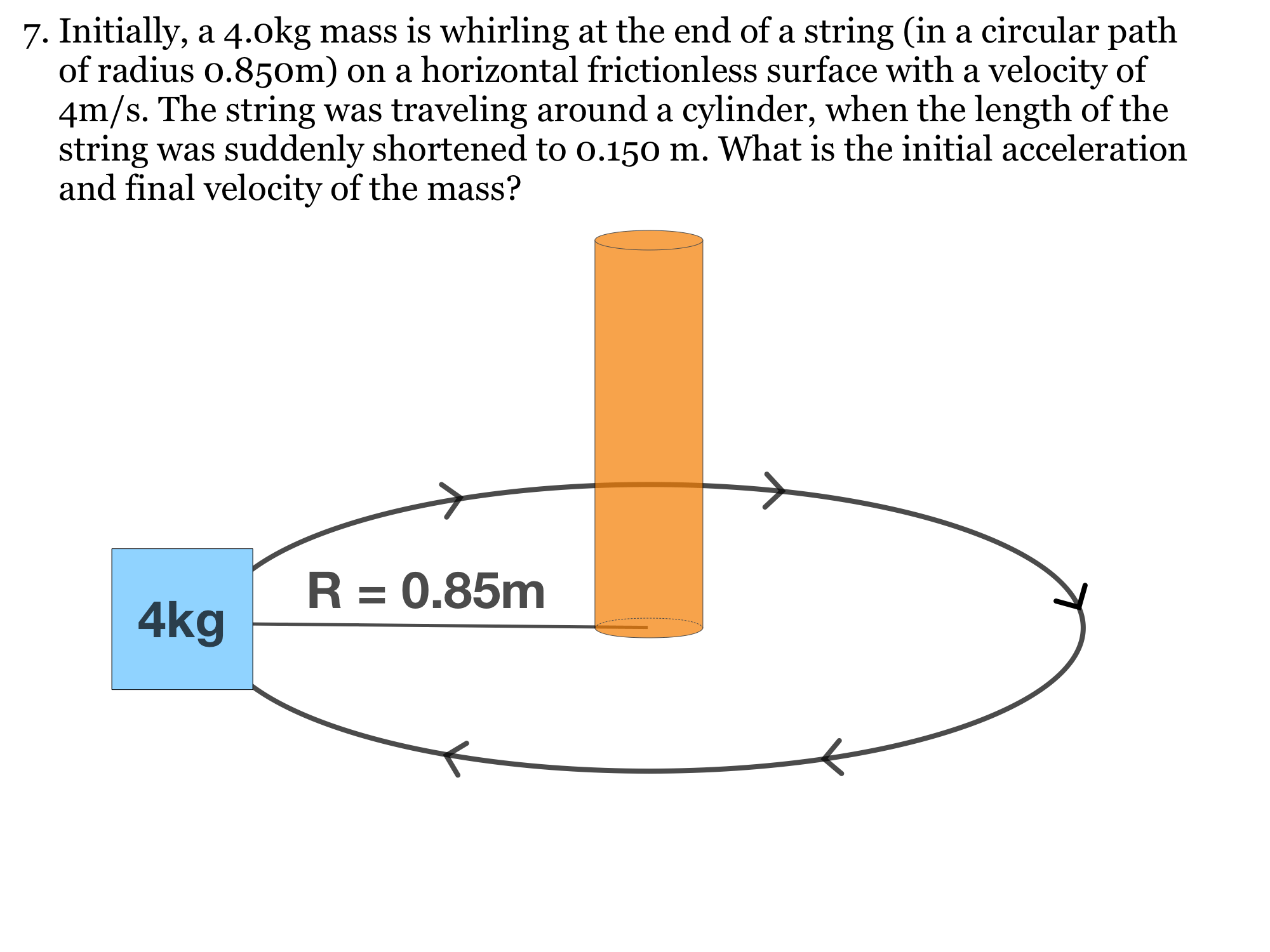
The central-pull geometry is an explicit repair. One cannot apply m r v conservation about a finite cylinder’s axis to its noncentral wrapping force. “Suddenly shortened” alone also does not specify the impulse or final radial velocity.
Problem text
A 4.0 kg mass initially moves at 4.0 m/s on a horizontal frictionless table in a circle of radius 0.850 m. For the central-pull model, a string is drawn inward through a small fixed hole so that the radius becomes 0.150 m; the force is always radial and the motion is circular at the initial and final instants. Find its initial centripetal acceleration and final speed. Then explain why this model differs from a string wrapping around a fixed finite cylinder, as suggested by the original illustration.
Drawing is temporarily unavailable. Work on paper if needed, then record your reasoning here.
Saving written working requires JavaScript. The problem remains available above; keep your work on paper or in your own notes.
Original problem 9
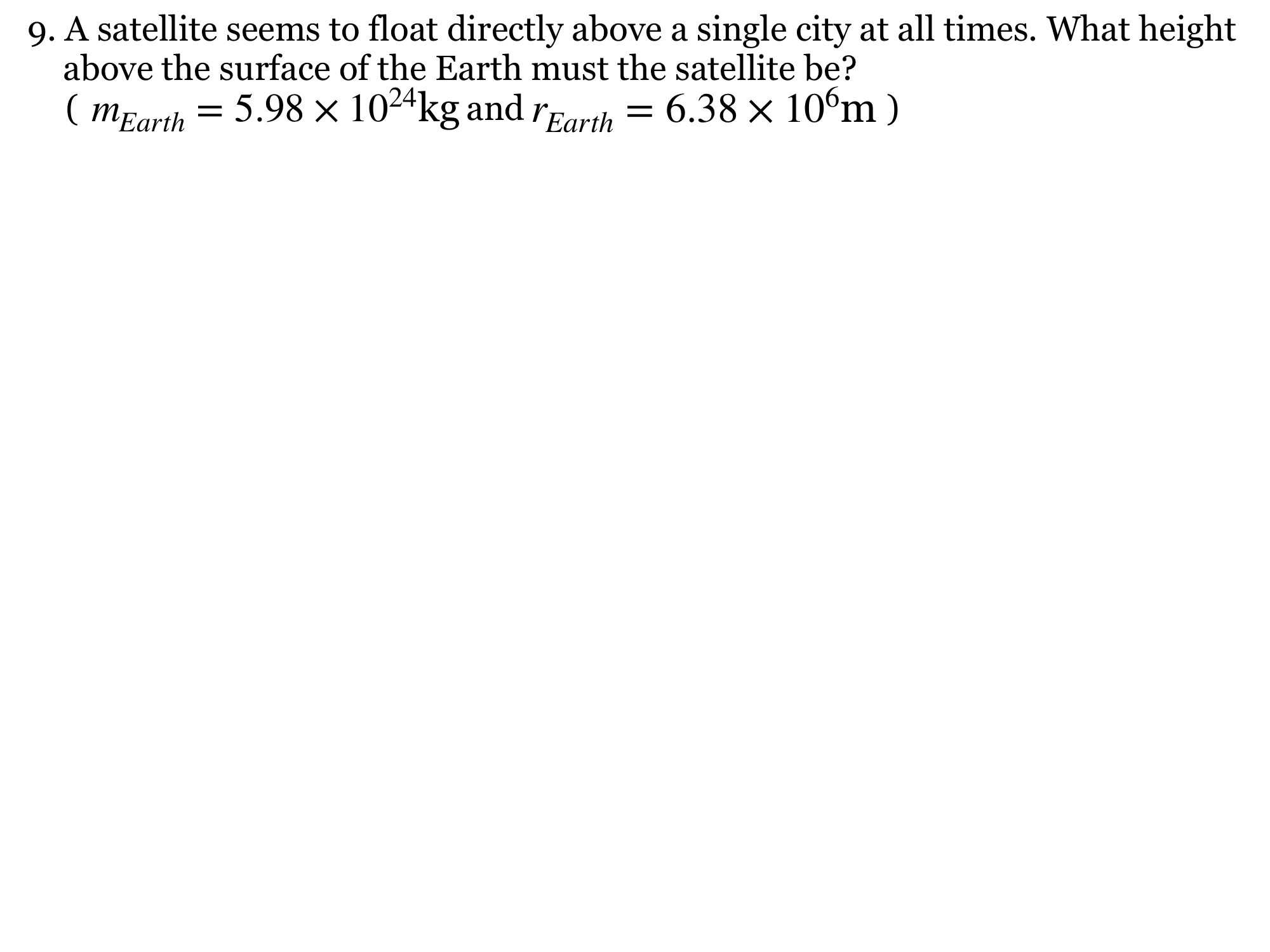
The original unspecified city is restricted to the equator. A 24-hour approximation gives a slightly different altitude; the sidereal period is the correct rotation period.
Problem text
A satellite appears fixed above a city on Earth’s equator. Find its altitude for a circular equatorial orbit in Earth’s direction of rotation. Use G = 6.67430 × 10⁻¹¹ N·m²/kg², M_E = 5.98 × 10²⁴ kg, R_E = 6.38 × 10⁶ m and Earth’s sidereal rotation period T = 86,164.1 s. Explain why this is impossible directly above a city away from the equator.
Drawing is temporarily unavailable. Work on paper if needed, then record your reasoning here.
Saving written working requires JavaScript. The problem remains available above; keep your work on paper or in your own notes.
Original problem 10
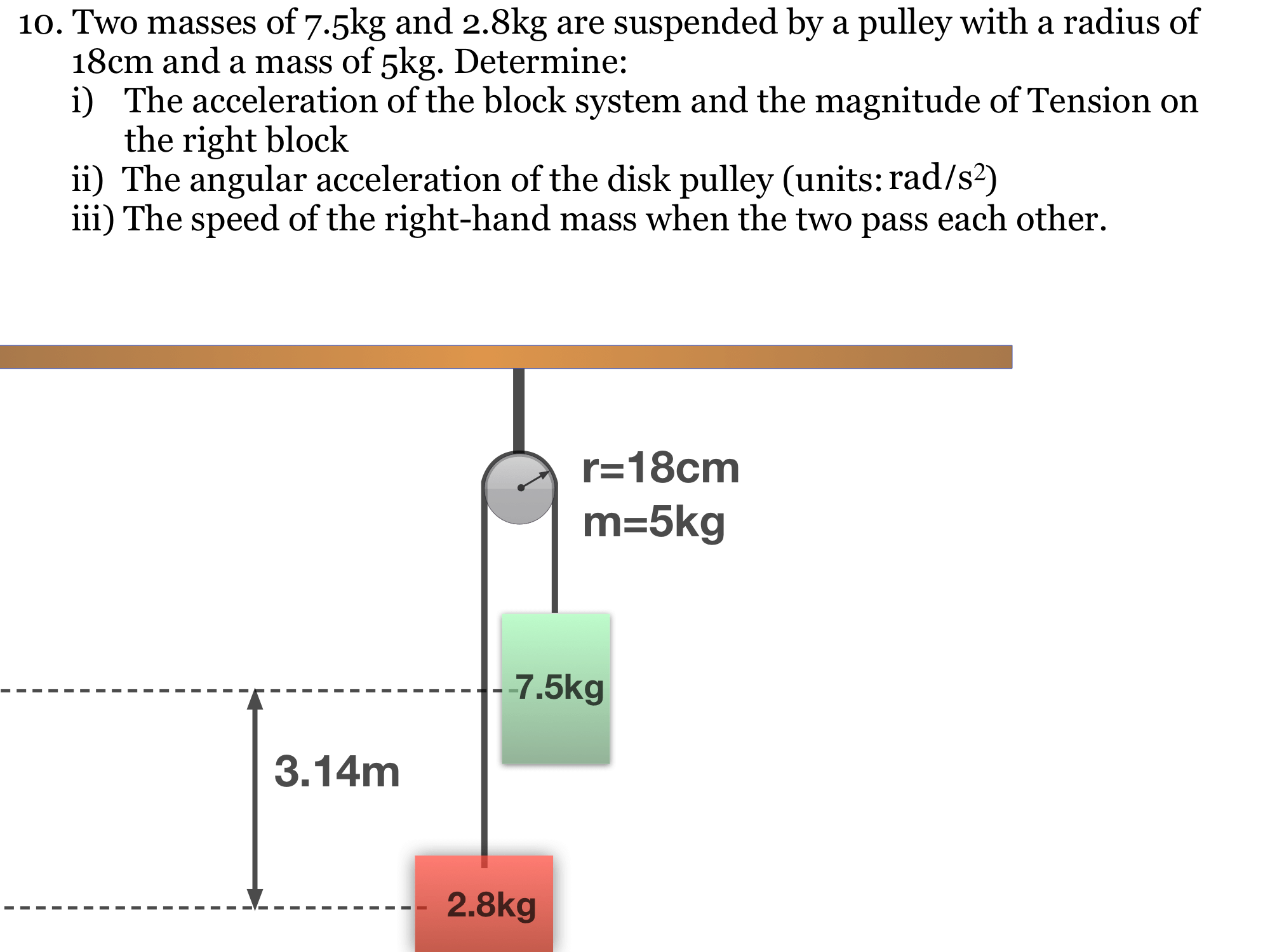
The image establishes that the 7.5 kg mass is on the right. Rest release and the uniform disk/no-slip assumptions are made explicit; angular-acceleration units are rad/s².
Problem text
A 7.5 kg block on the RIGHT and a 2.8 kg block on the LEFT hang from a massless inextensible string over a uniform disk pulley of radius 0.18 m and mass 5.0 kg. The axle is frictionless and the string does not slip. The system starts from rest with block centers separated vertically by 3.14 m. Find (i) the acceleration and right-block tension, (ii) the pulley’s angular acceleration in rad/s², and (iii) each block’s speed when their centers pass.
Drawing is temporarily unavailable. Work on paper if needed, then record your reasoning here.
Saving written working requires JavaScript. The problem remains available above; keep your work on paper or in your own notes.
Reviewed physics notes (25)
These corrections keep the original lesson’s purpose while fixing errors in the source edition.
- The original no-loss transition from spin only to rolling is not physically realizable on a passive fixed floor. — Reference 1
- Retain the initial rotational-energy calculation but do not conserve it through slipping. — Reference 1
- Replace the invalid no-loss landing stage. — Reference 1
- Impulse and angular impulse govern the passive spin-to-roll transition. — Reference 1
- The resulting speed follows from both translation and rotation, not energy conservation. — Reference 1
- Use the correct energy after slipping. — Reference 1
- Only one third of the initial spin energy remains for this solid-disk landing. — Reference 1
- The repaired physical model reverses the source reachability conclusion. — Reference 1
- It does not have enough post-slip rolling energy. — Reference 1
- Compute the reachable height. — Reference 1
- Separate the dissipative landing from the conservative rolling climb. — Reference 1
- Both types of rolling energy become gravitational energy at the turning point. — Reference 1
- Replace the invalid hilltop-speed calculation. — Reference 1
- This is a turning point, not a 3 m hilltop crossing. — Reference 1
- Replace the continuation of the invalid hilltop solution with the corrected conclusion. — Reference 1
- Repair the repeated vector-squared equation. — Reference 1
- Repair the repeated centripetal-force equation. — Reference 1
- The equation list repeats scalar expressions with invalid vector notation. — Reference 1
- The 7.4 m key requires a solid-disk model and no-slip rolling. — Reference 1
- Initial rest and constant torque are needed for this work/kinematics question. — Reference 1
- The 9.17 m/s key depends on a solid sphere and rest release. — Reference 1
- The passive floor transition necessarily dissipates energy; the source lossless assumption is contradictory. — Reference 1
- For I = mR², the no-spin slide-to-roll transition gives v_f = v_i/2 and ω_f = v_f/R. — Reference 1
- Specify the mass distribution, initial spin, and slipping stage. — Reference 1
- For a solid sphere, v_f = (5/7)v_i = 25/7 m/s; the source 1.2 m/s key is incorrect. — Reference 1
Glossary and deeper reading · 7 refreshers
These editorial refreshers supplement the reading. Definitions and examples are added guidance; original source wording and recorded answers remain in their original context.
-
Mechanical work
Mechanical work is energy transferred by a force through displacement of its point of application. For a constant force on a particle, it depends on the force component along the particle’s displacement, and it can be positive, negative, or zero. For example, a magnetic force perpendicular to a particle’s displacement does zero work on that particle.
-
Kinetic energy
Kinetic energy is energy associated with motion relative to a chosen reference frame. For a nonrelativistic translating object it is one half of its mass times speed squared. For example, doubling a cart’s speed quadruples its translational kinetic energy when its mass stays fixed.
-
Potential energy
Potential energy describes energy associated with the configuration of interacting parts of a system. Its numerical zero is a chosen reference, while differences in potential energy determine physical energy changes. For example, separating Earth and a ball changes their gravitational potential energy even though the energy belongs to their interaction.
-
Gravitational potential energy
Gravitational potential energy is energy associated with the relative positions of attracting masses. Near Earth, changes can be approximated by mass times gravitational field strength times height change when that field is nearly constant. For example, lifting a book increases the gravitational potential energy of the book–Earth system.
-
Rotational kinetic energy
Rotational kinetic energy is the kinetic energy associated with rotation about an axis. For a rigid body about a fixed axis it is one half of rotational inertia times angular speed squared. For example, a rolling wheel can possess both translational kinetic energy of its center of mass and rotational kinetic energy about that center.
-
Magnitude
Magnitude is the nonnegative size of a vector quantity. It does not specify direction, and it differs from a signed component. For example, a westward velocity can have a negative x component while its speed, the velocity magnitude, stays positive.
-
Vector
A vector is a quantity with a magnitude and a direction, represented by an arrow or by components along chosen axes. Vectors add by adding corresponding components rather than simply adding their magnitudes. For example, an eastward displacement followed by a northward displacement produces a resultant pointing northeast. The zero vector has zero magnitude and no unique direction.