Dampening Harmonics Equation
Reference from the original Physics I textbook.
- Dampening Harmonics Equation
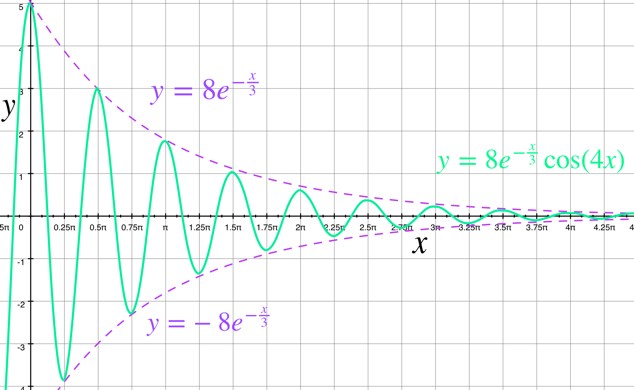
For an underdamped oscillator with viscous damping:
y(t) = y_m e^(−bt/(2m)) cos(ω′t − α).y(t) = displacement from equilibrium (m); y_m = initial amplitude-envelope scale (m); t = time (s); ω′ = damped angular frequency (rad/s); b = viscous damping constant (kg/s); m = mass (kg); α = phase constant (rad).
- Related Glossary Terms
- Index
Reviewed physics notes (2)
These corrections keep the original lesson’s purpose while fixing errors in the source edition.
- Source uses displacement x as time inside the damping exponent and phase, making dimensions inconsistent. — Reference 1
- Independent variable must be time. — Reference 1
Glossary and deeper reading · 2 refreshers
These editorial refreshers supplement the reading. Definitions and examples are added guidance; original source wording and recorded answers remain in their original context.
-
Damping
Damping is a process that transfers energy out of an oscillation and reduces its amplitude over time. The motion can remain oscillatory or approach equilibrium without oscillating, depending on the damping strength. For example, an oscillator moving through a viscous liquid loses mechanical energy to the liquid.
-
Simple harmonic motion
Simple harmonic motion occurs when the net restoring force is proportional to displacement from equilibrium and points in the opposite direction. The resulting position varies sinusoidally with time in the ideal model. For example, a mass attached to an ideal spring can execute simple harmonic motion when damping is negligible.