Simple Harmonic Motion: The Force That Brings You Back
Identify equilibrium and test the restoring-force condition for simple harmonic motion.
The force that brings you back
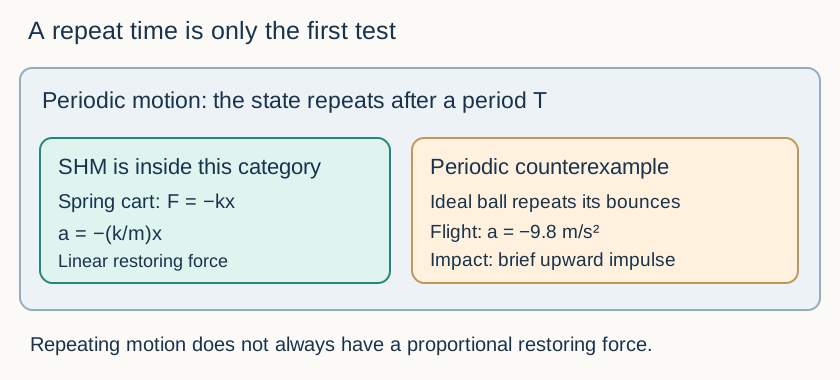
Imagine giving a cart on a spring a gentle pull, letting go, and watching it slide back and forth. It repeats its motion, so it is periodic. But repeating alone doesn’t make it simple harmonic motion. A bouncing ball repeats too, and its acceleration doesn’t follow the same rule. SHM is a particular kind of periodic motion: the net restoring force is proportional to displacement from equilibrium, with the opposite sign.
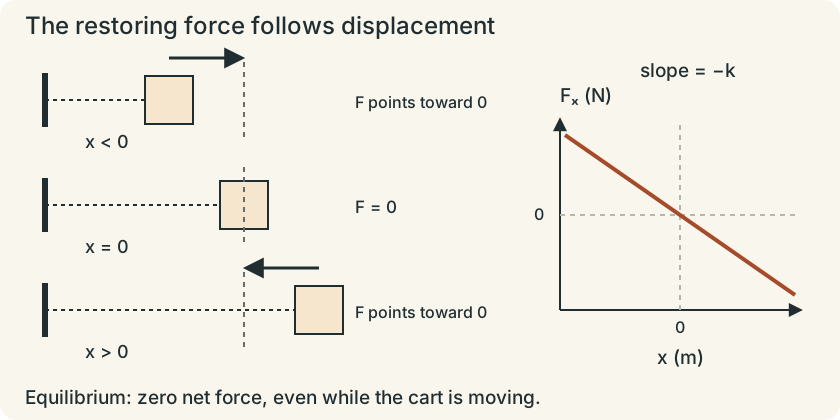
Equilibrium is the position where the net force is zero. It doesn’t mean every force is zero, and it doesn’t mean the object has to be sitting still. Our cart passes through equilibrium at its greatest speed. Its acceleration is zero at that instant, but its momentum keeps it moving. Now, take the equilibrium position as x = 0 and right as positive. An ideal spring gives us:
Fₓ = −kx, so aₓ = −(k/m)x.
The spring constant k has units N/m. Pull farther to the right and the force becomes larger to the left. Push to the left and the force points right. The minus sign tells us which way; it doesn’t tell us that the cart is slowing down. A leftward force speeds up a cart already moving left, but slows down a cart moving right.
How do we check the rule?
We can look for a straight-line Fₓ versus x graph through the origin, with negative slope. That slope is −k. If we instead plot acceleration versus displacement, the slope is −k/m. Notice that a graph of force magnitude versus distance from equilibrium is positive; a graph of signed force versus signed displacement is negative. They tell the same story using different quantities.
Suppose a 0.40 kg cart is 0.060 m right of equilibrium on a 25 N/m spring. Its force is −(25)(0.060) = −1.50 N, and its acceleration is −1.50/0.40 = −3.75 m/s². At x = −0.030 m, the acceleration becomes +1.875 m/s². Half the displacement gives half the acceleration magnitude, and changing the displacement’s sign changes the acceleration’s sign. That’s a useful check before reaching for a calculator.
A force can point toward equilibrium without being proportional to displacement. For example, a hypothetical force with magnitude proportional to x² grows too quickly to satisfy the SHM rule. Likewise, a clock hand makes periodic circles, but the hand itself isn’t sliding back and forth under a one-dimensional −kx force. A projection of uniform circular motion can help represent SHM; don’t confuse that representation with the physical force on our cart.
What about a pendulum?
Now think about a small playground swing. Gravity has a component along the arc that brings the seat back toward the bottom. For a pointlike bob on a light string of length L, gravity’s restoring torque about the pivot is τ = −mgL sinθ. For a small angle measured in radians, sinθ is approximately θ. Then τ ≈ −mgLθ, which is proportional to angular displacement and points toward equilibrium. That’s why a small-angle pendulum can be modeled as SHM. At large angles, that approximation breaks down. OpenStax’s pendulum discussion supports the small-angle model; the examples and diagram here are original.
Don’t call the string tension the restoring torque. Ideal tension points along the string toward the pivot and has zero torque about that pivot. At the bottom, gravity and tension need not balance while the bob moves: tension also supplies the radial acceleration. The equilibrium coordinate refers to the tangential restoring behavior. We will use the small-angle model in period and frequency.
A spring hanging vertically
A hanging mass stretches its spring until the upward spring force balances its weight. Let y measure downward extension from the spring’s unstretched length. Then F_net = mg − ky. At equilibrium, y₀ = mg/k. If we measure displacement from that equilibrium as x = y − y₀, substitution gives F_net = mg − k(x + mg/k) = −kx. Gravity moved the equilibrium; it didn’t destroy the harmonic rule. This choice of coordinate will matter again when we discuss energy.
Try it with measurements
Measure signed displacement from a cart’s equilibrium and the spring force at several positions on both sides. Plot force vertically in N and displacement horizontally in m. Include zero, a scale, and a best-fit line. If the line’s slope is −30 N/m, k is 30 N/m. If the data curve noticeably, discuss whether the spring is outside its elastic range or the force sensor was misaligned. A small force offset may come from sensor zeroing; it isn’t evidence that k itself changed. Explain what the plot supports, rather than just saying it “looks harmonic.”
A repeating motion can fail the harmonic test
Let’s compare two idealized motions rather than judge by how regularly they repeat. A frictionless 0.50 kg spring cart repeats every 1.0 s. Measured displacements x = −0.040, 0, and +0.040 m give accelerations +1.58, 0, and −1.58 m/s². Its acceleration graph is a straight line through zero with slope about −39.5 s⁻²: a = −39.5x. Newton’s second law then gives F = ma = −19.8x, with spring constant about 19.8 N/m. Displacement determines a proportional restoring acceleration, so this periodic motion is SHM.
Now imagine an ideal ball bouncing vertically to the same height after every collision. Its motion repeats, but while airborne its acceleration is always downward, approximately −9.8 m/s². At impact the floor gives a brief upward impulse. Neither stage gives a = −constant × displacement from one equilibrium. The bouncing motion is periodic under the stated idealization, but it is not SHM. We would need a different model for energy lost on real bounces.
Inspect diagram labels
The diagram keeps its full size here. Focus the view and use the arrow keys, or scroll across it, to inspect every label.
When a problem says a motion repeats, first call it periodic. Then test whether its net restoring force is linear in signed displacement about equilibrium before calling it SHM. The implication works one way: ideal SHM repeats; a repeating motion need not be ideal SHM.
Check the restoring force
Pause & try it
Let's see what stuck.
Choose an answer, then check the reasoning. Try the written problems below before opening their solutions.
0 of 3 checked · 0 correct
Written practice: from graph slope to motion
A signed acceleration-versus-displacement graph has slope −64 s⁻² for a 0.50 kg cart. Find k and the acceleration at x = −0.025 m. Explain what happens if the cart is moving left there.
Open the separate worked solution.
For the original chapter’s wave examples and existing quizzes, see Simple Harmonics. Standing waves and normal modes are useful enrichment beyond this AP oscillations topic; keep the SHM force model clear before moving there.
Teaching reference: CED topic 7.1, printed page 124.
Written practice: a force graph with a different origin
A 0.30 kg cart moves horizontally on an ideal spring with negligible friction. A position sensor reports coordinate s from a mark on the track, rather than from spring equilibrium. Measurements of the spring’s signed horizontal force are listed below; right is positive. Plot F vertically in N against s horizontally in m, with labeled scales. Find the equilibrium sensor reading and spring constant. Then derive acceleration as a function of s, calculate it at s = 0.230 m, and explain whether a cart moving right there speeds up or slows down.
| Sensor coordinate s (m) | Spring force F (N) |
|---|---|
| 0.160 | +1.20 |
| 0.200 | 0.00 |
| 0.240 | −1.20 |
Open the separate worked solution.
Explain and apply the model
Try these problems before opening the solutions. State your assumptions, show the diagram or calculation, and explain what makes your answer follow.
Repeating is only the first test
Motion A is a frictionless 0.50 kg cart on a light ideal horizontal spring. Its signed force measurements are: x = −0.030 m, F = +1.20 N; x = 0, F = 0; x = +0.030 m, F = −1.20 N. Assume the straight-line relation holds throughout its motion. Motion B is an ideal vertically bouncing ball that returns to the same maximum height after each lossless bounce. During flight, a = −9.8 m/s² with upward positive; floor collisions provide brief upward impulses. Both motions repeat.
(a) Describe the relationship between periodic motion and SHM. Classify both A and B, and use the restoring-acceleration rule to explain why one repeating motion is a counterexample to the claim that all periodic motion is SHM.
(b) Sketch a signed force-versus-displacement graph for A with numerical axis labels and identify the equilibrium position from the zero net force. Calculate k and the acceleration at x = +0.015 m. If the cart is moving left there, explain whether it speeds up or slows down.
Your written working
Drawing is temporarily unavailable. Work on paper if needed, then record your reasoning here.
Saving written working requires JavaScript. The problem remains available above; keep your work on paper or in your own notes.
Related source reading
These alternative explanations and examples retain their source context. Draft placement does not add accepted exam coverage.
- shm definition · alternative source explanation
- A viscously damped oscillator · source context; placement review pending
Glossary and deeper reading · 15 refreshers
These editorial refreshers supplement the reading. Definitions and examples are added guidance; original source wording and recorded answers remain in their original context.
-
Acceleration
Acceleration is the vector rate of change of velocity with time. It can change an object’s speed, direction, or both, and it is measured in meters per second squared. For example, a satellite moving at constant speed in a circular orbit accelerates toward the center.
-
Restoring force
A restoring force points toward an equilibrium position when an object is displaced from it. Simple harmonic motion requires the net restoring force to be proportional to displacement and opposite in direction. For example, a compressed ideal spring pushes its attached object back toward the spring’s relaxed length.
-
Mechanical equilibrium
Mechanical equilibrium means there is no translational or angular acceleration for the system being considered. For a rigid body, both the net external force and the net external torque must vanish. For example, a stationary ladder supported against a wall requires both force balance and torque balance.
-
Net force
Net force is the vector sum of all forces acting on the object or system under consideration. For constant mass in an inertial frame, it equals mass times acceleration. For example, equal upward and downward forces give zero net force even though neither force is zero.
-
Spring constant
A spring constant measures the stiffness of a spring within its approximately linear range. Its units are newtons per meter, and a larger value means more force is needed for the same deformation. For example, two springs stretched by the same distance exert different forces if one is stiffer.
-
Force
A force describes an interaction that can change an object’s momentum. It is a vector measured in newtons, so both size and direction matter when forces are added. For example, a rope can pull a cart while the floor exerts friction in another direction.
-
Displacement
Displacement is the vector change in position from the start of an interval to its end. It depends on those endpoints rather than the length or shape of the path traveled. For example, walking around a closed track and returning to the start gives zero displacement but a nonzero distance traveled.
-
Magnitude
Magnitude is the nonnegative size of a vector quantity. It does not specify direction, and it differs from a signed component. For example, a westward velocity can have a negative x component while its speed, the velocity magnitude, stays positive.
-
Gravity
Gravity is the attractive interaction between masses in the Newtonian model. For spherical bodies or point-mass approximations, its strength decreases with the square of the separation between their centers. For example, Earth’s gravity provides the inward force that keeps a satellite in orbit.
-
Torque
Torque describes a force’s turning effect about a chosen axis or point. Its magnitude is force times the perpendicular lever arm, and its direction or sign describes the rotation tendency. For example, pushing near the handle of a door produces more torque than the same perpendicular push near the hinge.
-
Tension
Tension is a pulling force transmitted through a stretched rope, string, or similar connector. It acts along the connector away from the object it pulls, and an ideal massless rope has the same tension throughout an uninterrupted segment. For example, a rope supporting an accelerating load can have a tension different from the load’s weight.
-
Centripetal acceleration
Centripetal acceleration is the inward acceleration component that changes the direction of motion along a curved path. For circular motion its magnitude is speed squared divided by the circle’s radius. For example, a car moving at constant speed around a bend still has centripetal acceleration.
-
Weight
Weight is the gravitational force exerted on an object by a specified attracting body. Near Earth’s surface its magnitude is approximately mass times the local gravitational field strength, and it is measured in newtons. For example, an astronaut has less weight on the Moon while retaining the same mass.
-
Impulse
Impulse is the change in linear momentum produced by a force over a time interval. It equals the signed vector area under a force-versus-time graph and is measured in newton-seconds. For example, a padded landing spreads the stopping impulse over more time, reducing the average force for the same momentum change.
-
Equilibrium position
An equilibrium position is a position at which the net force in the modeled coordinate is zero. In a stable oscillator, displacement to either side produces a restoring force back toward that position. For example, a mass on a vertical spring oscillates about a position below the spring’s relaxed-length position because gravity shifts the balance.