Moles Equation
Reference from the original Physics I textbook.
- Moles Equation
n = amount of substance (mol); m = mass (kg); M = molar mass (kg/mol). If M is supplied in g/mol, convert m to grams or M to kg/mol before using n = m/M.
- Related Glossary Terms
Ideal Gas Law↗, Ideal Gas Law Equation, Moles, Two-State Gas Law Equation
- Index
Reviewed physics notes (1)
These corrections keep the original lesson’s purpose while fixing errors in the source edition.
- Source combines kg mass with g/mol molar mass. — Reference 1
Glossary and deeper reading · 2 refreshers
These editorial refreshers supplement the reading. Definitions and examples are added guidance; original source wording and recorded answers remain in their original context.
-
Mole
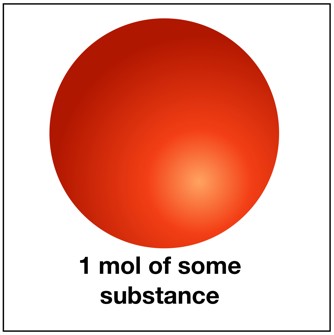
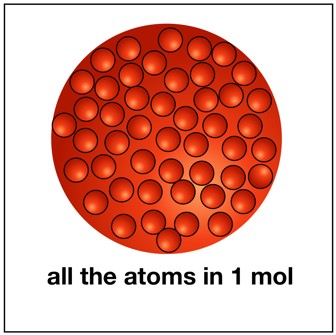
A mole is an amount of substance containing Avogadro’s number of specified entities. Those entities must be named, such as atoms, molecules, or ions, and a mole is not itself a mass unit. For example, one mole of helium atoms and one mole of oxygen molecules contain the same number of specified entities but have different masses.
-
Ideal gas law
The ideal gas law relates absolute pressure, occupied volume, amount of gas, and kelvin temperature. The forms using moles and using particle count express the same state relationship with different constants. For example, heating a fixed amount of ideal gas in a rigid sealed container raises its pressure.