Ideal Gas Law
Original textbook reading.
Enrichment beyond the AP course.
Ideal-gas thermodynamics is extra exploration beyond the supplied AP Physics 1 fluid unit. The AP path focuses on density, pressure, buoyancy and ideal flow.
So far in this course, we’ve only been discussing solid bodies. In most cases, there wasn’t any modification of the shape of these bodies (except for perhaps thermal expansion). This chapter will introduce you to the physics of fluids.
The term fluids is not limited to liquids, in fact, a fluid is simply any mass that will take the shape of its container. This means that fluids include both liquids and gases. This section in particular will deal with gases.
An ideal gas model treats molecules as particles of negligible volume with negligible forces between collisions. Collisions with each other and the walls are elastic. It usually approximates a dilute gas well, far from condensation; real-gas effects can matter at high density or low temperature.
The assumption of a gas as fitting the ideal gas description allows us to use the ideal gas law. This law is defined as:
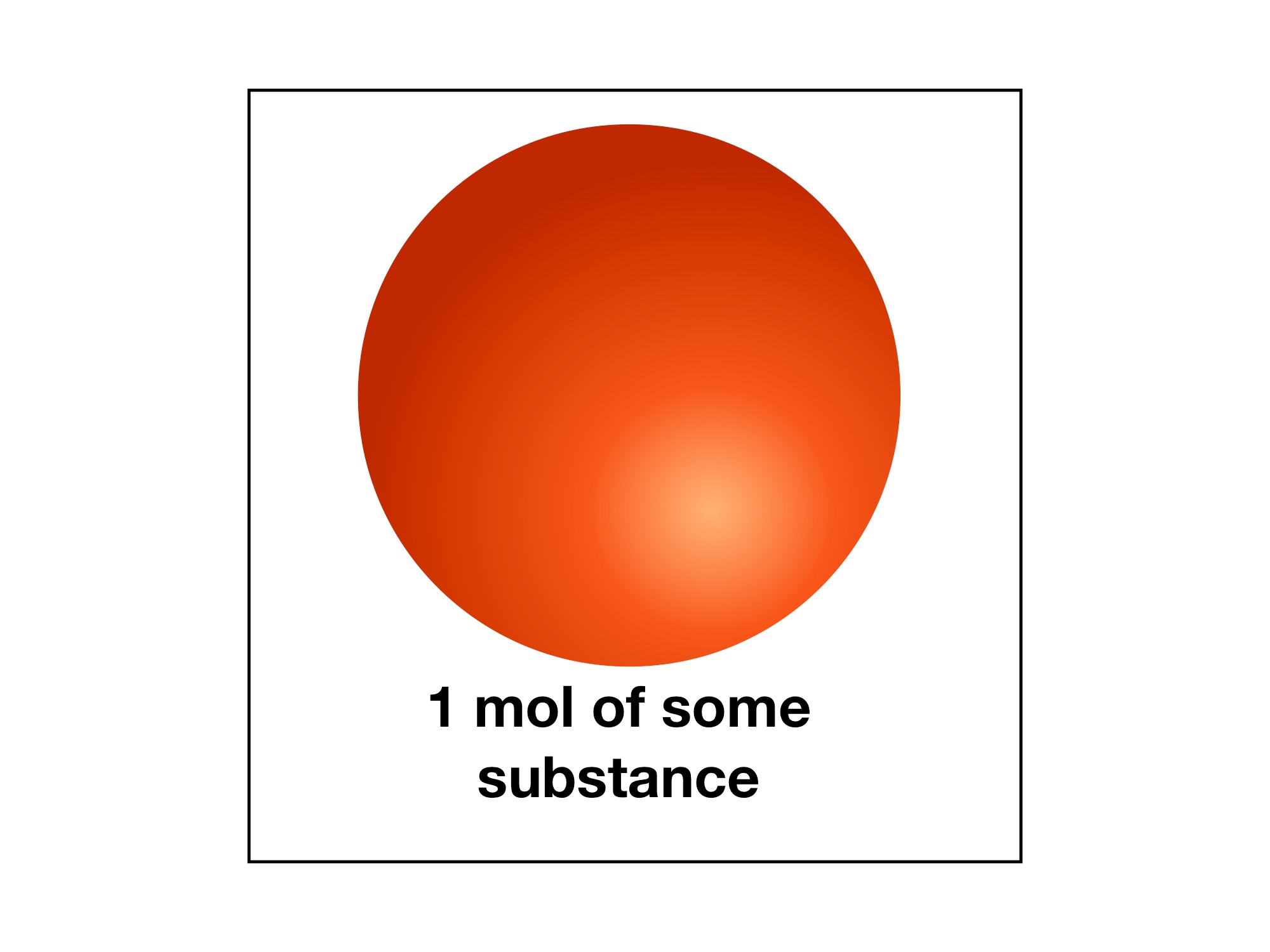
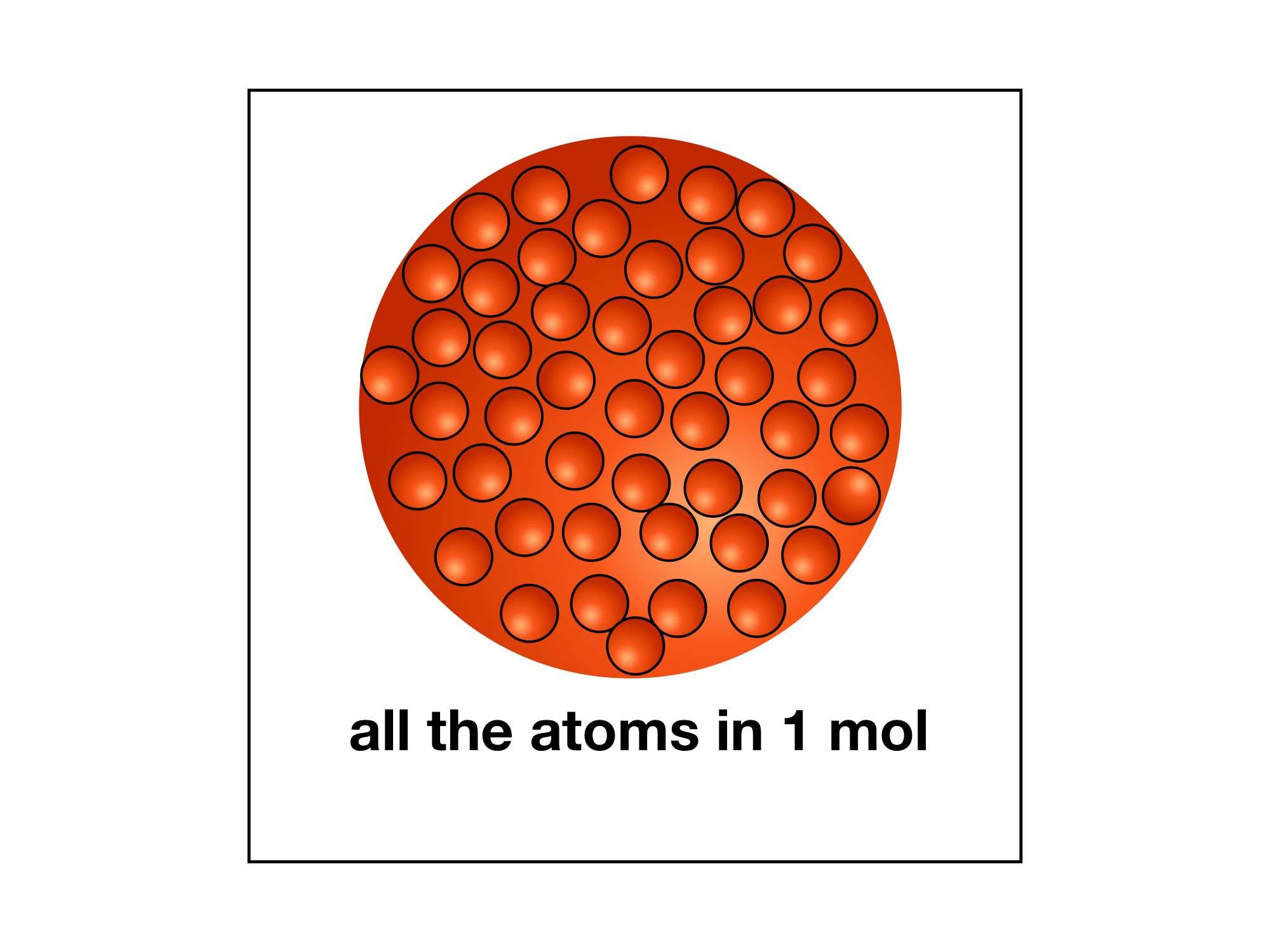
Basic idea behind moles. Think of it as a representation of a whole substance.
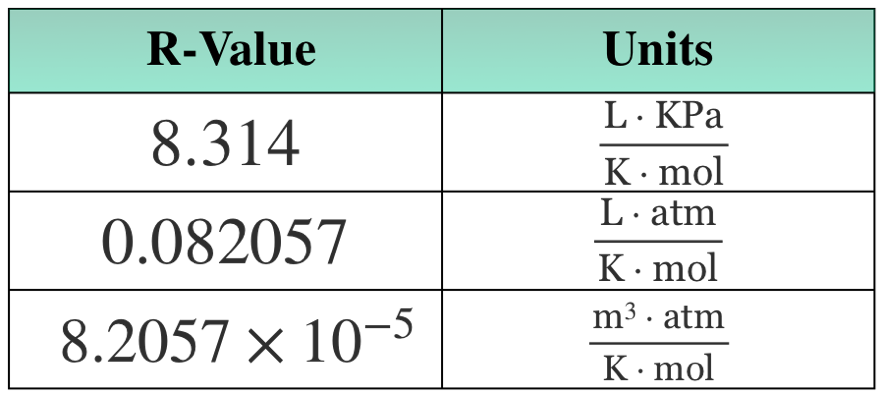
In PV = nRT, P is absolute pressure, V is volume, n is amount in moles, R is the universal gas constant, and T is absolute temperature in kelvins. Use a value of R consistent with the pressure and volume units.
A mole is an amount containing exactly 6.02214076 × 10²³ specified entities. One mole of oxygen gas contains that many O₂ molecules and twice that many oxygen atoms. The molar mass is the mass per mole of the specified substance; atomic and molecular molar masses must be distinguished.
The is the mass of the total amount, is the number of moles, and is the molar mass of the substance.
The other factor to account for is diatomic gases. These gases don’t exist as a single atom, but are in fact molecules of two atoms. For example, if you had mole of Oxygen gas, you would have grams of the gas.
The value of depends on the units you will be using for the other components of the equation. A few of the common values you’ll use are in the following table :
Table 8.1.1: R-Values
Example Problem 8.1.1
Example Problem 8.1.1
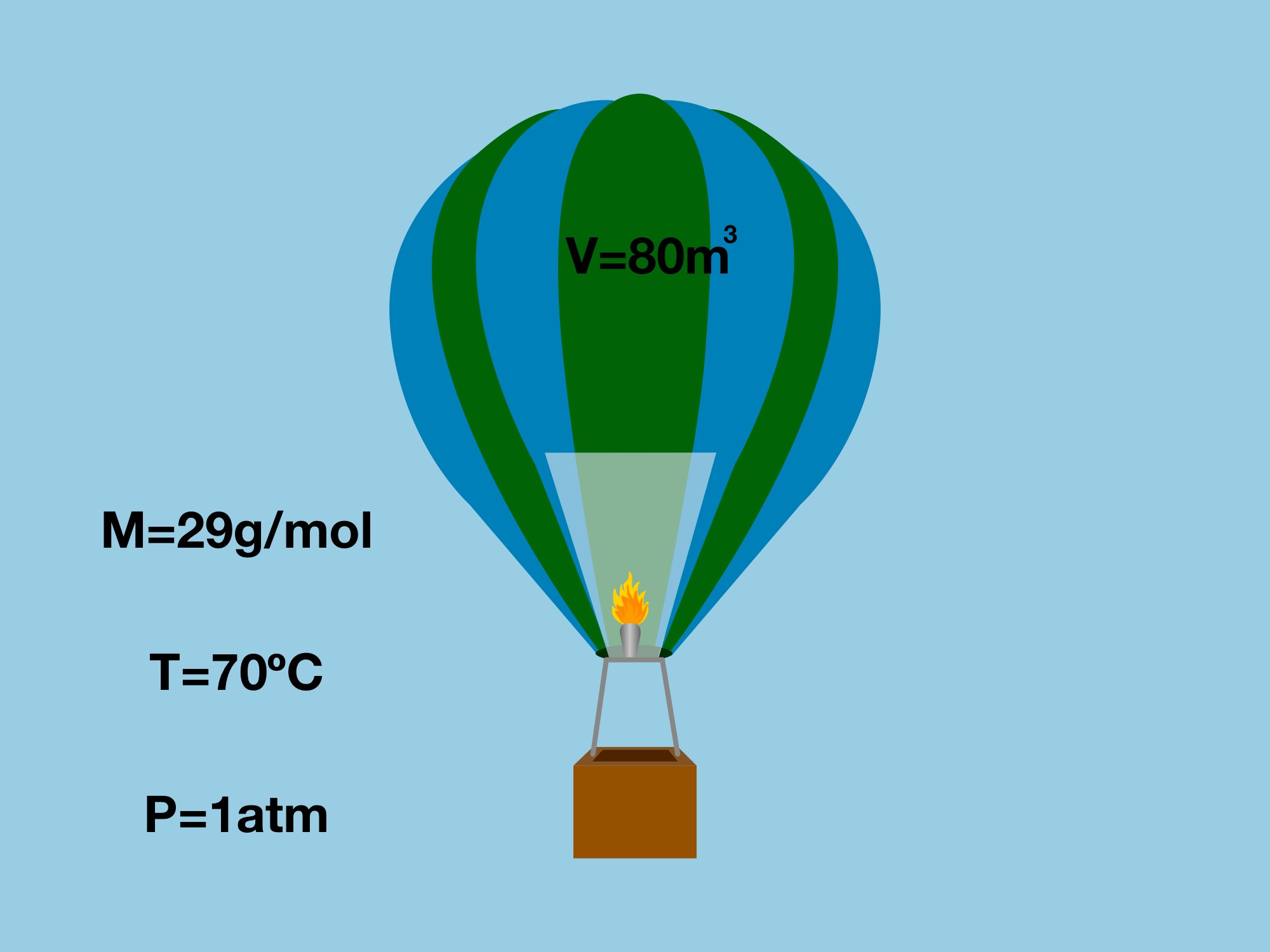
If a hot air balloon is filled with of air at , what is the mass of the air? Assume pressure is 1 atmosphere.
The other equations you will be using to work with gases are derived from this ideal gas law.
Let’s assume that we know the temperature, volume, and pressure about a certain parcel of gas, and we change something, and we want to see how that affects the gas.
If we just use the ideal gas law, we would have to use it twice. The first time we’d solve for and the second time we’d determine the new values.
Why do we need to split it up, though?
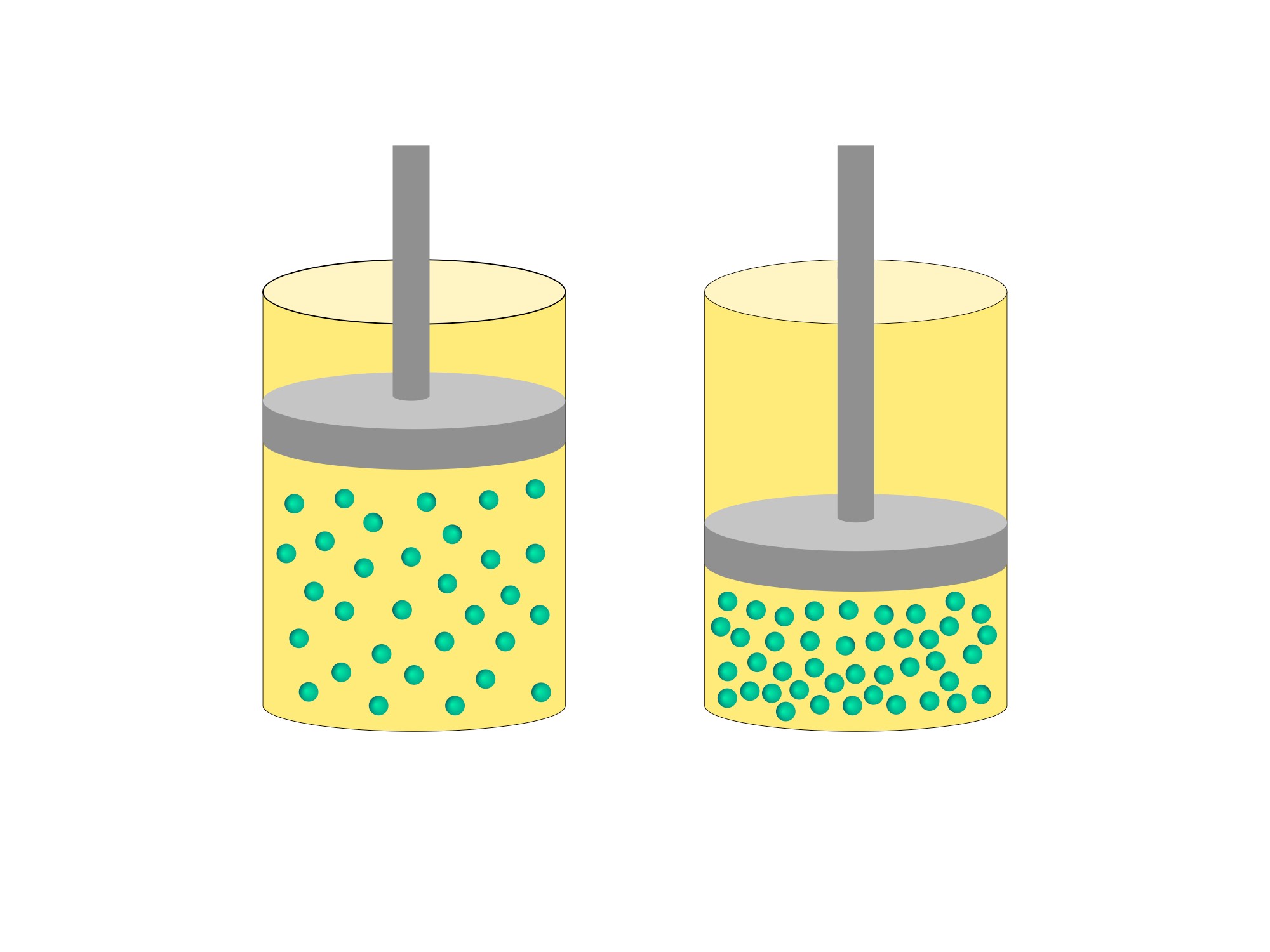
If we know that is constant throughout the change, then we can re-arrange the equation:
Now, we can set the first conditions equal to the second conditions using this.
If we can assume that we are working in the same units in both cases, will be the same, allowing us to cancel it out. This leaves us with:
Figure 8.1.1 Two States of a Piston
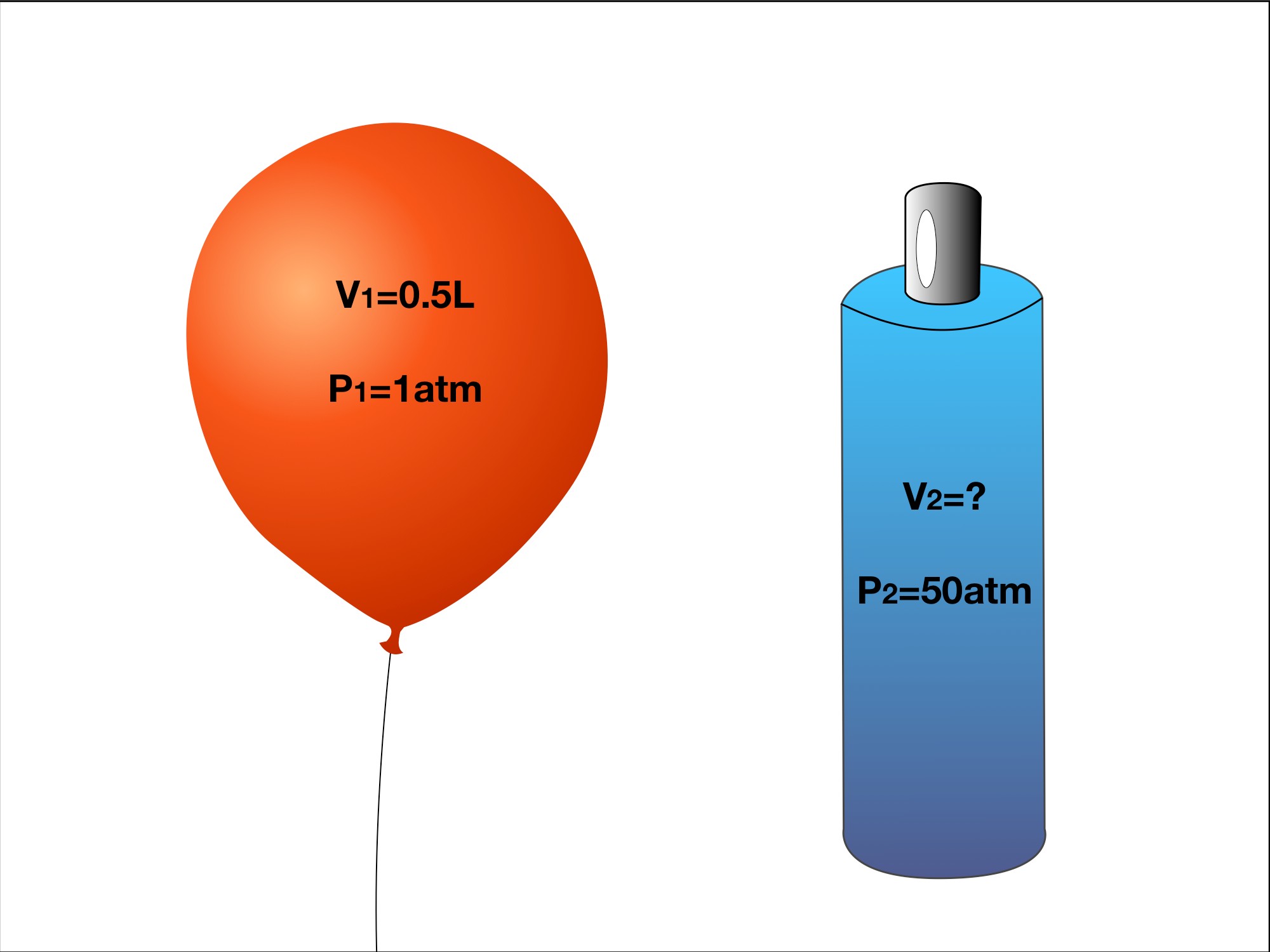
If a balloon is filled with of gas, and the gas inside the balloon is at , what was the volume of the same amount of gas inside a compressed gas cylinder, if that gas was at ?
Example 8.1.2


Reviewed physics notes (8)
These corrections keep the original lesson’s purpose while fixing errors in the source edition.
- The source incorrectly says ideal particles do not interact at all and implies real-gas errors are always negligible. — Reference 1
- R is the universal or molar gas constant, not the “real gas constant”; the pressure and temperature conventions are essential. — Reference 1
- Corrects 6.002 × 10²³ and the confusion between oxygen molecules and atoms. — Reference 1
- The isothermal assumption must be stated; omission of a temperature change does not itself prove equal temperatures. — Reference 1
- Avoids treating one historical STP convention as universal, and makes ideal-gas status explicit. — Reference 1
- Molar mass needs units of mass per mole. — Reference 1
- Using 28 g/mol for nitrogen and 32 g/mol for oxygen gives 7.31653 g, which rounds to 7.32 g rather than the source’s 7.30 g. — Reference 1
- The marked 1447 full balloons uses the entire initial gas inventory; passive transfer would leave residual gas. The assumption is now explicit without changing the data. — Reference 1
Glossary and deeper reading · 7 refreshers
These editorial refreshers supplement the reading. Definitions and examples are added guidance; original source wording and recorded answers remain in their original context.
-
Thermal expansion
Thermal expansion is a change in a material’s dimensions as its temperature changes. A simple coefficient model approximates the change over a limited temperature range and depends on the material and geometry. For example, leaving gaps between sections of a metal rail allows space for expansion in warmer conditions.
-
Fluid
A fluid is a material that flows and continuously deforms under a sustained shear stress. Liquids and gases are both fluids, although their compressibility and other properties can differ greatly. For example, both water in a pipe and air flowing through a duct are fluids.
-
Mass density
Mass density is mass per unit volume of a material or sample. It is commonly measured in kilograms per cubic meter and can vary with temperature or pressure. For example, equal-volume samples of water and oil generally have different masses because their densities differ.
-
Temperature
Temperature is a state quantity that determines the direction of net energy transfer through thermal contact. For a classical ideal gas it is proportional to the average translational kinetic energy per particle, rather than to the total energy of the sample. For example, a small hot metal sample can have a higher temperature but less total internal energy than a large cooler sample.
-
Absolute pressure
Absolute pressure is pressure measured relative to a perfect vacuum. It includes the atmospheric contribution that gauge pressure omits and is required in the ideal gas law. For example, a tire’s absolute pressure is its gauge reading plus the surrounding atmospheric pressure.
-
Mole
A mole is an amount of substance containing Avogadro’s number of specified entities. Those entities must be named, such as atoms, molecules, or ions, and a mole is not itself a mass unit. For example, one mole of helium atoms and one mole of oxygen molecules contain the same number of specified entities but have different masses.
-
Pressure
Pressure is the normal force per unit area exerted on a surface. It is a scalar measured in pascals, with one pascal equal to one newton per square meter. For example, a gas exerts pressure throughout its volume through many microscopic collisions, even when its bulk motion is zero.