Transverse Wave
Reference from the original Physics I textbook.
- Transverse Wave
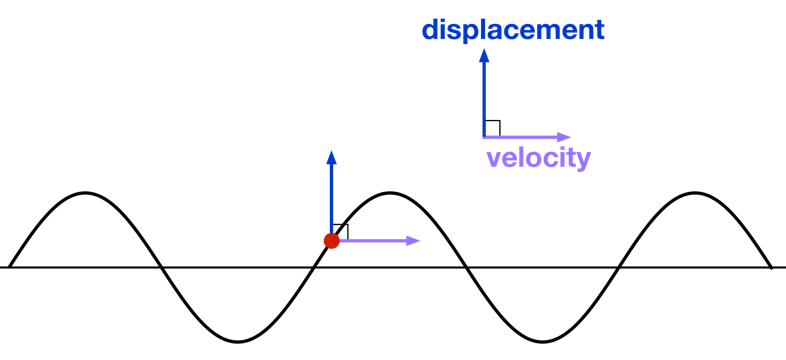
In a transverse wave, the disturbance oscillates perpendicular to the direction in which the wave propagates. A transverse wave on a string is an example.
- Related Glossary Terms
- Index
Reviewed physics notes (1)
These corrections keep the original lesson’s purpose while fixing errors in the source edition.
- Propagation is not perpendicular to itself; visibility is not the defining property. — Reference 1
Glossary and deeper reading · 2 refreshers
These editorial refreshers supplement the reading. Definitions and examples are added guidance; original source wording and recorded answers remain in their original context.
-
Transverse wave
In a transverse wave, the disturbance is perpendicular to the direction of propagation. The disturbance direction and the energy-transfer direction must therefore be distinguished. For example, a rope pulse can travel horizontally while rope segments move up and down.
-
Longitudinal wave
In a longitudinal wave, the disturbance is parallel to the direction of propagation. Compression and rarefaction can travel while particles oscillate locally along that direction. For example, sound in air is a longitudinal pressure disturbance rather than a stream of air traveling all the way from source to listener.