Sound Waves
Original textbook reading.
Enrichment beyond the AP course.
This original chapter is extra exploration beyond the supplied AP Physics 1 course. Keep it if you're curious about where these ideas go next.
In this section we will look over one of the fundamental applications of wave theory. Sound waves. It’s a wave that occurs in our everyday lives and we can model it’s behavior through physics!
What is a Sound Wave?
Sound in air and liquids is ordinarily a longitudinal pressure disturbance: particles oscillate parallel to propagation. An ideal point source emits spherical wavefronts; far from it, a small patch of a wavefront can be approximated as planar. Solids can support both longitudinal and transverse elastic waves.
Figure 9.2.1 What does a Sound Wave Look Like?
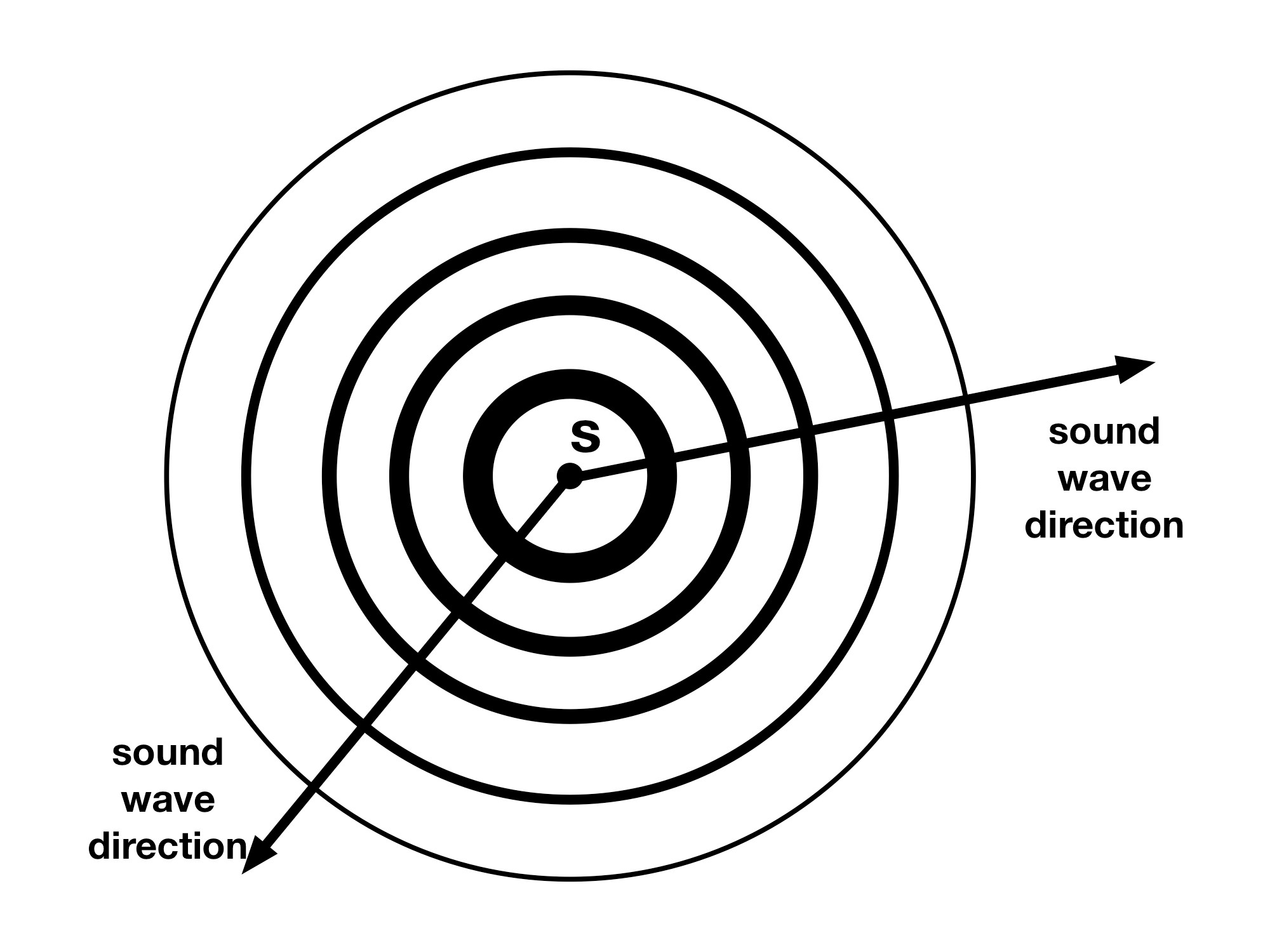
Sound speed depends on the medium’s elastic response and density. In a fluid, use the bulk modulus appropriate to the rapid acoustic compression. For gases, the acoustic response is approximately adiabatic. Hearing underwater also depends on coupling to the ear, not just sound speed.
Where is the density of the medium and is the Bulk Modulusⓘ of the medium. The bulk modulus measures the extent of how much a volume of a medium changes when a pressure is exerted. It too has an equation:
The negative value represents how pressure and volume are closely related to each other. As pressure increases, volume decreases and vice versa.
Traveling Sound Waves
Traveling sound waves can be represented by a displacement function and a pressure function. Because of the natural way that waves operate, we can model these functions as either a sine or cosine function.
Figure 9.2.3 Displacement Wave Function
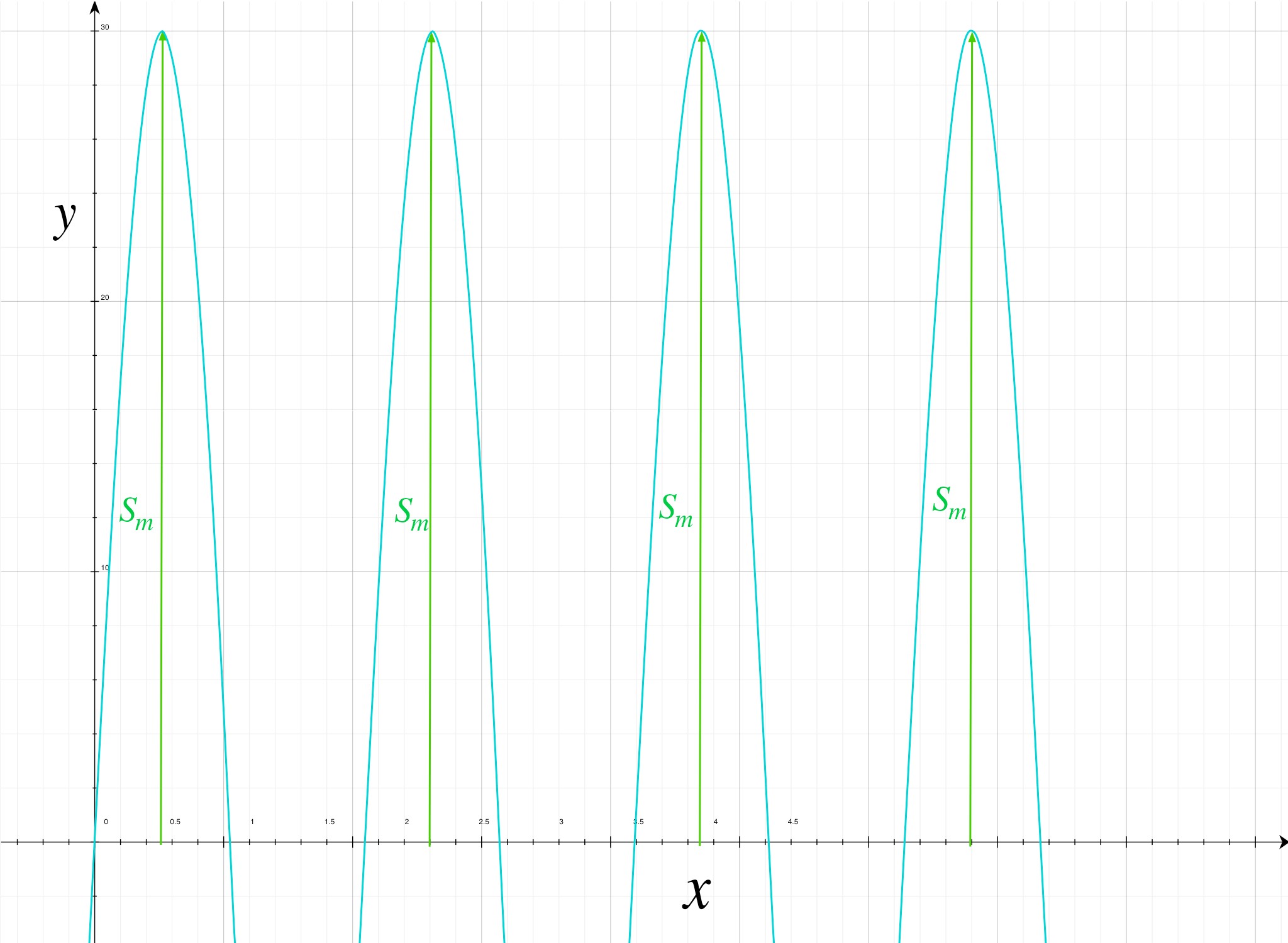
Figure 9.2.2 Bulk Modulus
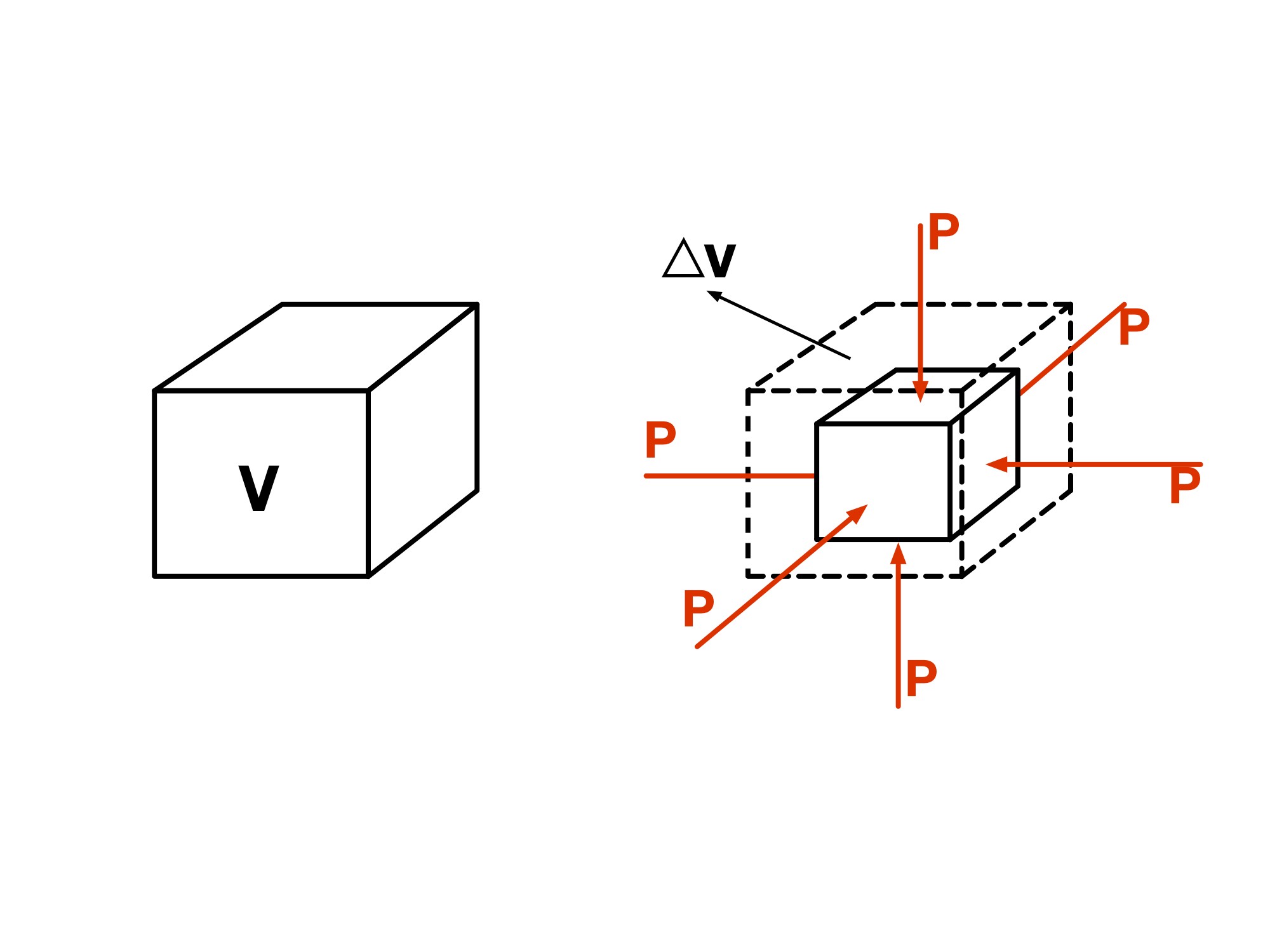
The displacement function can be written as:
The variables x and t are position and time. Here k is wavenumber, ω is angular frequency, and s_m is the maximum local displacement of a medium particle from equilibrium. It is not the distance traveled by the sound disturbance.
The pressure function can be written as:
Equation 9.2.4 represents how the pressure of air changes in a sinusoidal motion as the sound waves travel through a medium. Therefore a negative value of means that air is expanding such that the pressure is decreasing, while a positive value means that pressure is increasing due to the compression of air.
We can relate both the pressure and displacement amplitudes to each other by the following equation:
where represents the velocity of the wave, is the density of the medium, and being the angular frequency.
Example Problem 9.2.1
Given the following pressure function on the next page, we want to know what the displacement amplitude is, given that a certain sound wave travels at a velocity of through a medium with density of and a frequency of .
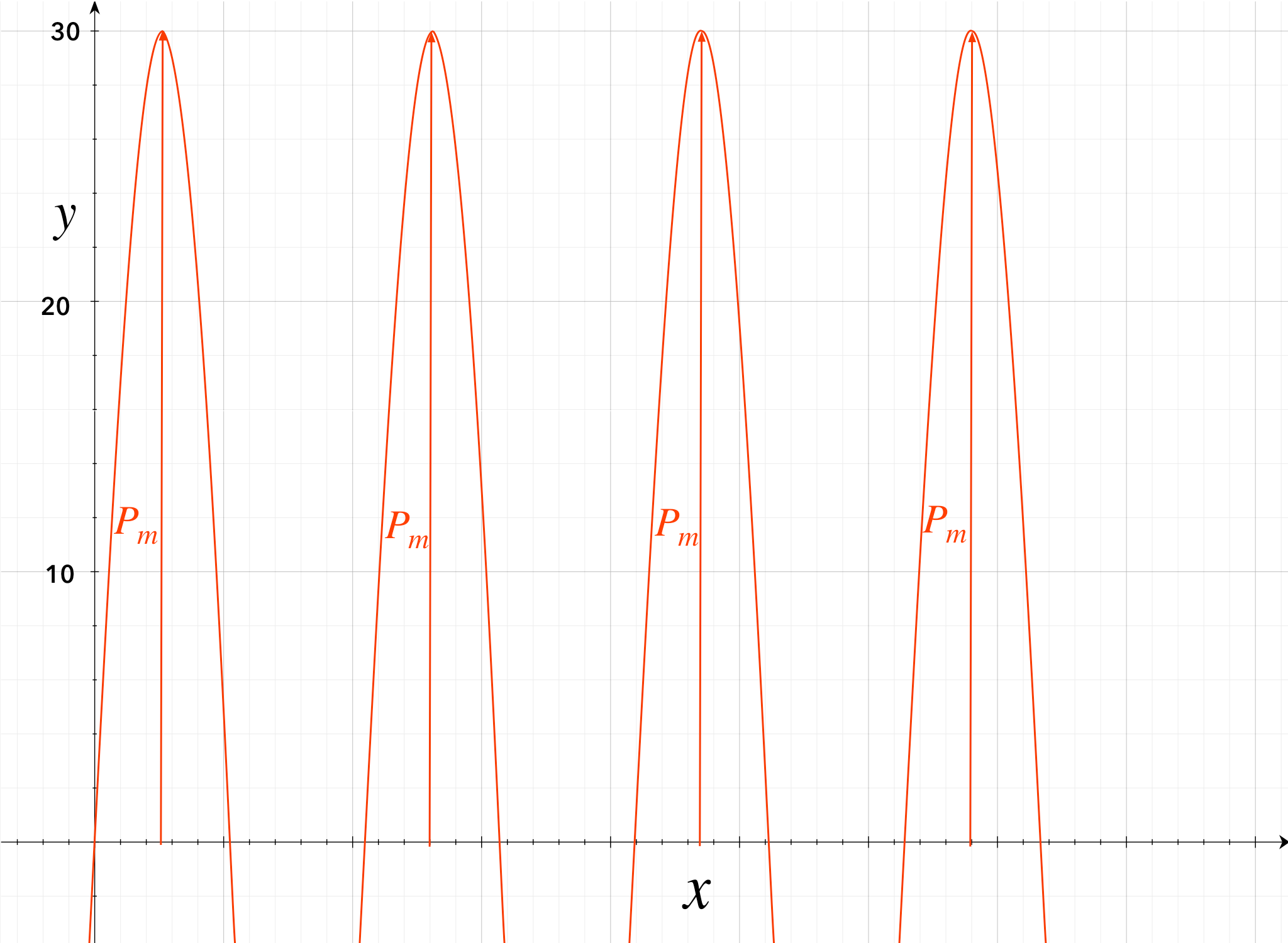
Shown is the pressure graph for this function. Use the amplitudes to your advantage
Step 1: Understand the graph
This problem is actually really easy. The problem statement already gives you all that you need to know, but if you don’t understand the graph, then you can’t solve the problem.
The graph is a sine function that represents our pressure fluctuations in our system. Remember our equation for pressure functions:
Now the only thing we need to concern ourselves with is finding the pressure amplitude which is represented by .
Looking at the graph, the amplitude seems to be at .
Step 2: Solve for the displacement amplitude
We now have to implement Equation 9.2.5 that relates pressure amplitude to displacement amplitude:
Rearranging this and plugging in Equation 9.1.2 for , we get:
Step 3: Plug in the values
Now, let’s plug in what we know:
s_m = 30 Pa/[(253 m/s)(0.500 kg/m³)(2π × 300 s⁻¹)].
s_m = 1.258 × 10⁻⁴ m = 126 μm.
If you’ve ever been to a house party, which we’re sure all of you students have, you will notice waves aren’t all about frequencies, velocities, and what not. Intensityⓘ is a measure of the rate of energy transferred to a surface per unit area and it is defined as:
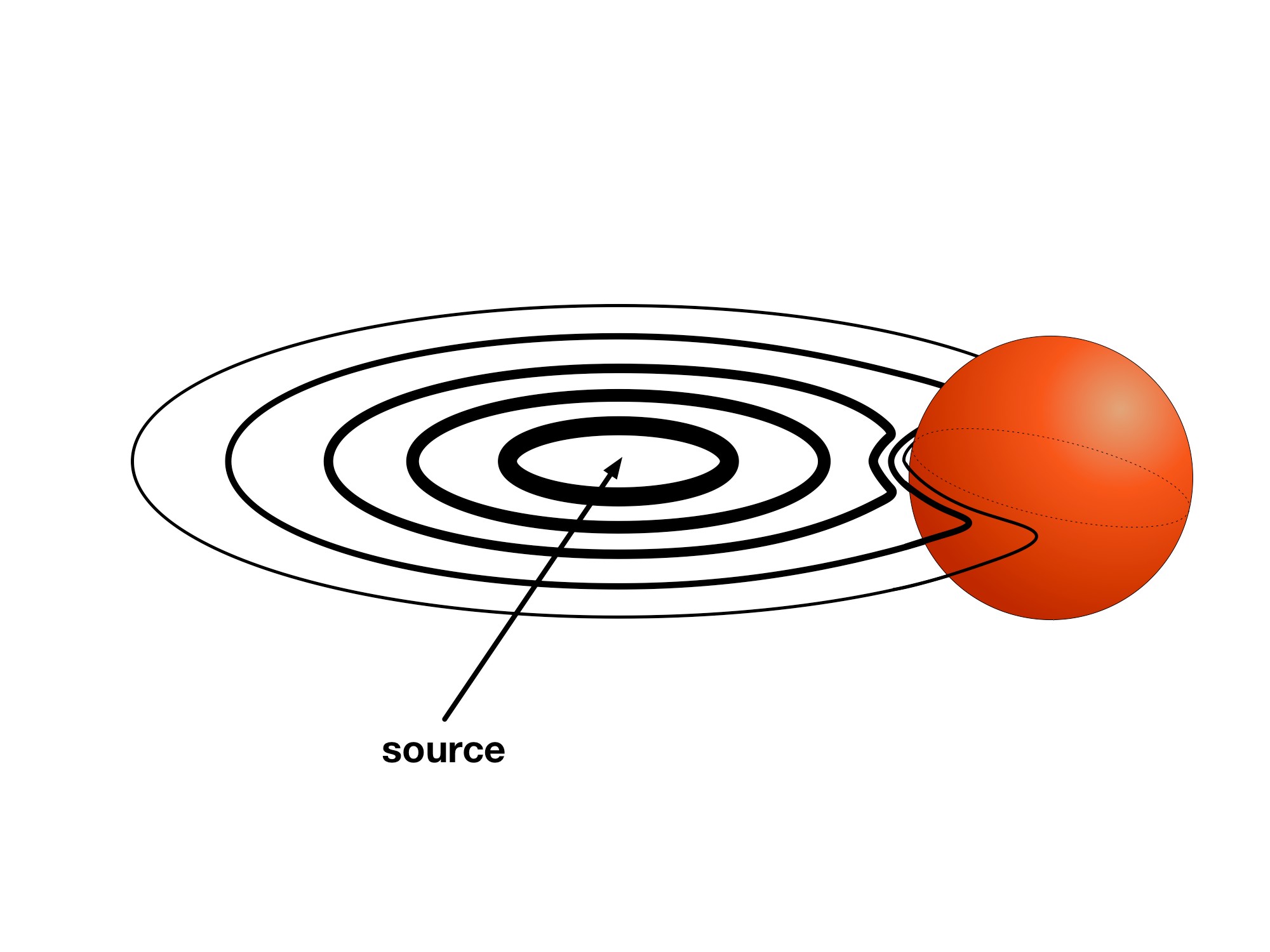
3D view of how intensity affects a sphere. Sound wave travels getting weaker the further it is away from the source.
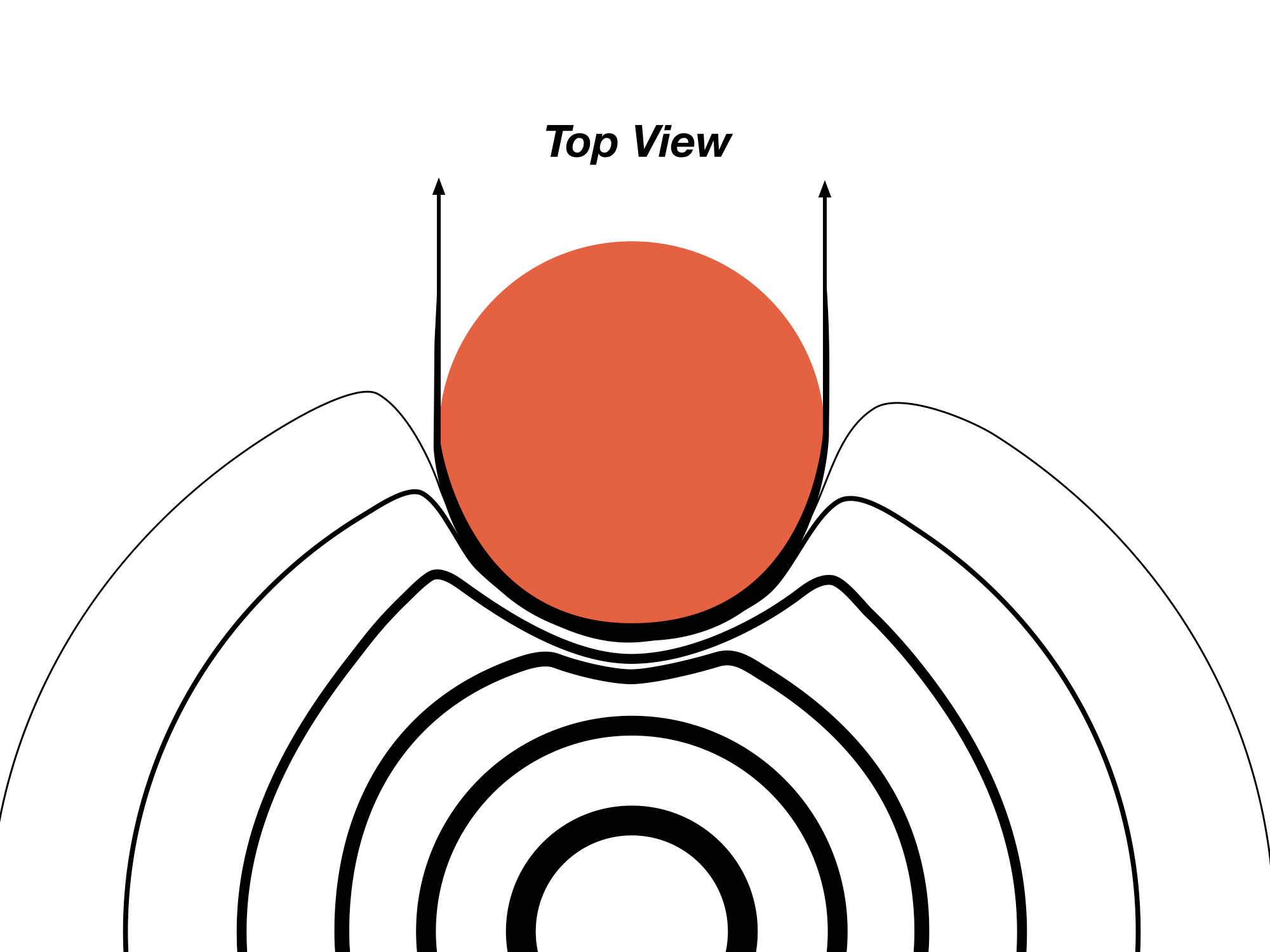
I is intensity and P is the acoustic power crossing area A. For an isotropic point source without absorption, A = 4πr² and I = P/(4πr²). Thus intensity varies inversely with the square of distance.
Decibels are important because it provides us a scale of which to measure sound. Humans can hear a variety of sound frequencies and intensities. For this reason it was ideal to try and model sound levels through the use of logarithms. Which is why we have to equation for sound levels:
= the standard reference intensity and this was chosen because it is near the lowest level of intensity that is detectible by the human ear. dB is the abbreviation for decibel, which is the unit of sound levels.
Example Problem 9.2.2
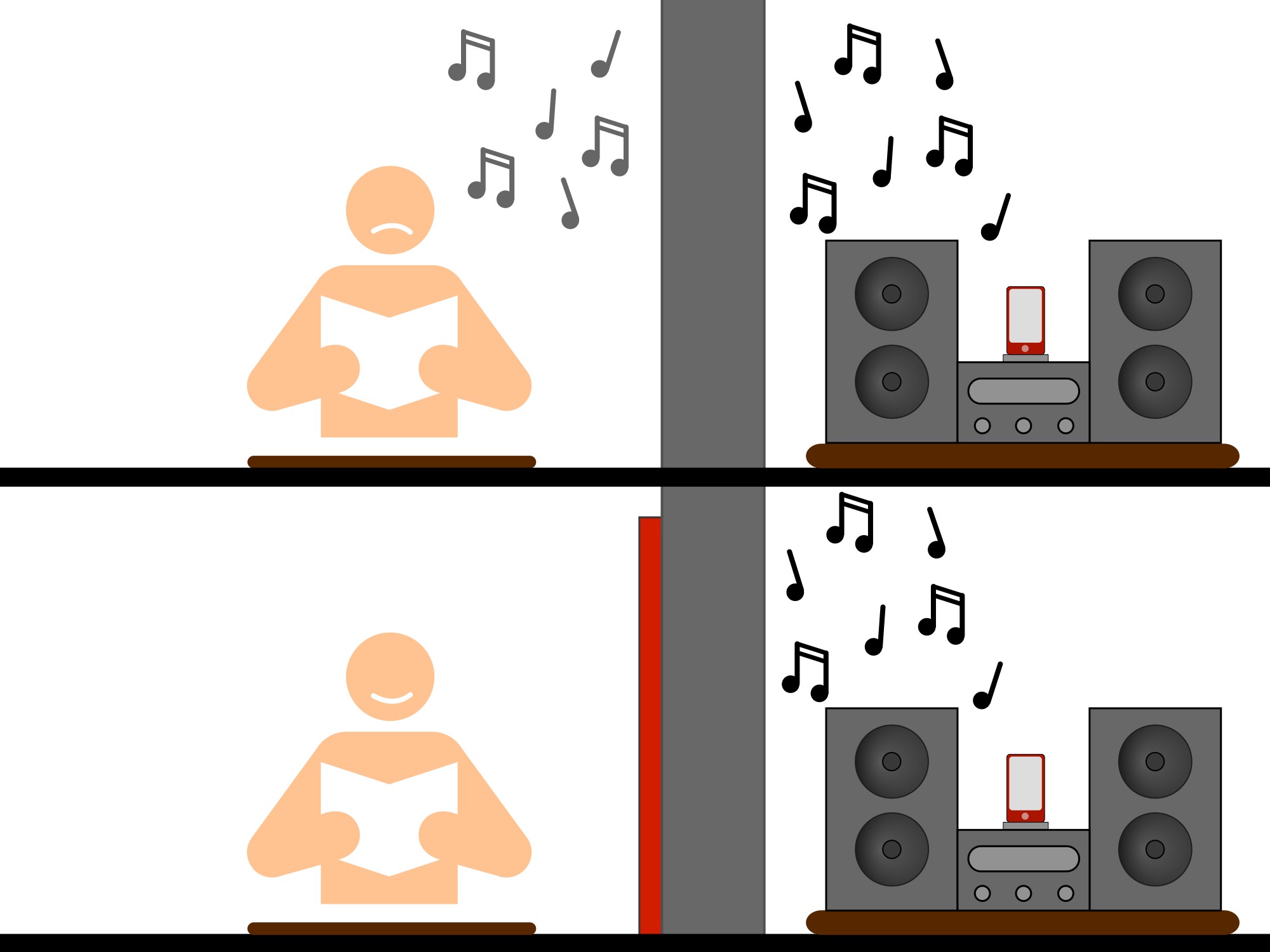
You notice Yatit is a person who dislikes the music being played next door. The solution? Place a new material on the wall to reduce sound levels!
Let’s imagine that Yatit lives in a dorm and he has an annoying person playing loud music in the room next to him. Yatit then decides to put an insulating material over his wall as a way to help block the sound. If this new material decreases the sound level of the sound waves from the music by , what is the ratio of the final intensity to the initial intensity?
Step 1: Set up your equations
We know that we’re going to be dealing with final and initial sound levels, therefore we can set up the Sound Level Equations separately (one for final conditions, the other for initial conditions).
Initially, we have:
For the final, we have:
Step 2: Find the difference in the sound levels
This is an important step, because in order to find the ratio of the intensities, we need to subtract due to the logarithmic part of the
sound level equation. You’ll see what we mean. But for now, we have the following calculation for the difference in the sound levels:
Using the following logarithmic identity:
With this we can simplify the equation down even further to:
From the problem statement we know that the final sound level is decibels lower, so:
Plugging this in gives us:


Reviewed physics notes (13)
These corrections keep the original lesson’s purpose while fixing errors in the source edition.
- The source makes every source isotropic and every sound wave exclusively longitudinal. — Reference 1
- The source confuses sound speed with how well a person hears in air versus water. — Reference 1
- Corrects the meaning of displacement amplitude. — Reference 1
- The source calls the inverse-square relationship parabolic. — Reference 1
- 500 g/m³ must be converted to 0.500 kg/m³. — Reference 1
- The original result is too small by a factor of 1000 because it uses grams as kilograms. — Reference 1
- Division by 10 is outside the logarithm; there is no logarithm of a negative dB ratio. — Reference 1
- The inverse-log exponent must retain its negative sign. — Reference 1
- The source reports the reciprocal, implying increased intensity despite attenuation. — Reference 1
- Corrects the parabolic description in the interactive caption. — Reference 1
- Subjective loudness also depends on frequency and the listener; the marked amplitude is correct for the revised physical comparison. — Reference 1
- The 480 m/s value is retained as a stipulated medium speed, and the geometry needed for Δd = vΔt is supplied explicitly. — Reference 1
- Corrects density units from kg/m² to kg/m³. The marked 5.11 × 10⁻³ Pa is valid. — Reference 1
Glossary and deeper reading · 13 refreshers
These editorial refreshers supplement the reading. Definitions and examples are added guidance; original source wording and recorded answers remain in their original context.
-
Wave
A wave is a propagating disturbance that can transfer energy without transporting the medium as a whole. Mechanical waves require a material medium, while electromagnetic waves can propagate through vacuum. For example, a pulse travels along a rope while individual rope segments move locally around their equilibrium positions.
-
Pressure
Pressure is the normal force per unit area exerted on a surface. It is a scalar measured in pascals, with one pascal equal to one newton per square meter. For example, a gas exerts pressure throughout its volume through many microscopic collisions, even when its bulk motion is zero.
-
Wavefront
A wavefront is a surface joining points of equal wave phase at a given time. Rays are perpendicular to wavefronts in the uniform isotropic ray model used here. For example, a distant source can be approximated by nearly plane wavefronts over a small region.
-
Mass density
Mass density is mass per unit volume of a material or sample. It is commonly measured in kilograms per cubic meter and can vary with temperature or pressure. For example, equal-volume samples of water and oil generally have different masses because their densities differ.
-
Fluid
A fluid is a material that flows and continuously deforms under a sustained shear stress. Liquids and gases are both fluids, although their compressibility and other properties can differ greatly. For example, both water in a pipe and air flowing through a duct are fluids.
-
Bulk modulus
Bulk modulus measures resistance to compression through pressure change divided by fractional volume decrease. A larger modulus means a smaller volume change for the same pressure increase within the model’s range. For example, a liquid with a high bulk modulus can often be approximated as incompressible in modest-pressure flow problems.
-
Displacement
Displacement is the vector change in position from the start of an interval to its end. It depends on those endpoints rather than the length or shape of the path traveled. For example, walking around a closed track and returning to the start gives zero displacement but a nonzero distance traveled.
-
Wavenumber
Angular wavenumber measures the change of wave phase per unit distance. In the sinusoidal convention used in the source reading, it equals two pi divided by wavelength and is measured in radians per meter. For example, shortening a wave’s wavelength increases its angular wavenumber.
-
Angular frequency
Angular frequency measures how rapidly the phase of a sinusoidal oscillation advances. It equals two pi times the ordinary frequency and is measured in radians per second. For example, two oscillators at the same ordinary frequency also have the same angular frequency even if their amplitudes differ.
-
Amplitude
Amplitude is the maximum magnitude of a repeating disturbance measured from its equilibrium value. It describes the size of the oscillation rather than its frequency or propagation speed. For example, pulling a spring-mounted mass farther from equilibrium increases its oscillation amplitude when it is released from rest.
-
Velocity
Velocity describes how position changes with time and includes direction. Instantaneous velocity describes one moment, while average velocity is displacement divided by elapsed time. For example, a car turning a corner can change velocity while maintaining the same speed.
-
Frequency
Frequency is the number of complete repeating cycles per unit time. It is measured in hertz, meaning cycles per second, and is the reciprocal of the period. For example, a vibrating string with a higher frequency produces more cycles each second.
-
Wave intensity
Wave intensity is the time-averaged energy-transfer rate per area perpendicular to propagation. It is measured in watts per square meter and differs from total power because area matters. For example, spreading the same sound power over a larger area reduces the intensity there.