Sine Wave Function
Reference from the original Physics I textbook.
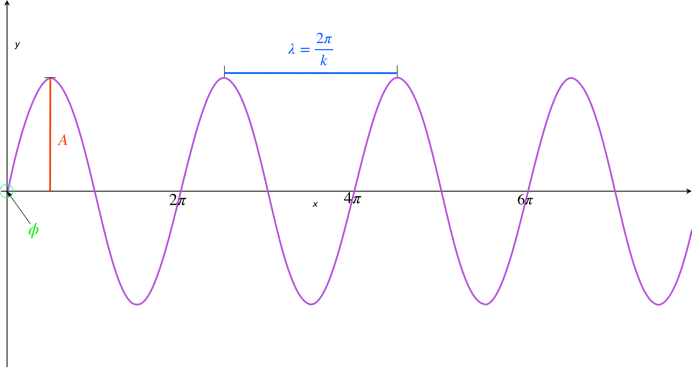
- Sine Wave Function
y(x,t) = instantaneous displacement (m); A = amplitude (m); k = angular wavenumber (rad/m); x = position (m); ω = angular frequency (rad/s); t = time (s); ϕ = phase constant (rad).
- Related Glossary Terms
Amplitudeⓘ, Angular Frequency Equation, Frequencyⓘ, Transverse Wave, Wavelength, Wavenumber
- Index
Reviewed physics notes (1)
These corrections keep the original lesson’s purpose while fixing errors in the source edition.
- Wave displacement at (x,t) is not the amplitude; position x is not particle displacement. — Reference 1
Glossary and deeper reading · 2 refreshers
These editorial refreshers supplement the reading. Definitions and examples are added guidance; original source wording and recorded answers remain in their original context.
-
Amplitude
Amplitude is the maximum magnitude of a repeating disturbance measured from its equilibrium value. It describes the size of the oscillation rather than its frequency or propagation speed. For example, pulling a spring-mounted mass farther from equilibrium increases its oscillation amplitude when it is released from rest.
-
Frequency
Frequency is the number of complete repeating cycles per unit time. It is measured in hertz, meaning cycles per second, and is the reciprocal of the period. For example, a vibrating string with a higher frequency produces more cycles each second.