Connecting Limits at Infinity and Horizontal Asymptotes
Compare end behavior and relative growth using justified limits, rather than a finite plotting window.
College Board Topic 1.15 · CED p. 47 (PDF p. 52) · CED effective Fall 2020; project course outline 2026–27.
Limits at infinity ask about inputs far out along the domain, rather than near a finite point. If f(x)→L as x→∞ or x→−∞, y=L is a horizontal asymptote for that end. The two ends may have different asymptotes, and a graph may cross a horizontal asymptote.
For rational functions compare highest powers. Divide numerator and denominator by the highest denominator power: (3x²−1)/(2x²+5)=(3−1/x²)/(2+5/x²)→3/2 at either end. A lower-degree numerator tends to 0; a higher-degree numerator may be unbounded or need a different end-behavior description.
Keep signs when roots appear: √(x²+1)/x=√(1+1/x²) for positive x, but equals −√(1+1/x²) for negative x because √(x²)=|x|. Growth comparisons use ratios: ln x/x→0 and x²/eˣ→0 as x→∞. Thus exponential growth eventually dominates this polynomial, which dominates this logarithm. A small-window graph cannot establish “eventually.”
The same comparison works when rate functions are supplied: if a quadratic model has rate 2x and an exponential model has rate eˣ, the established limit 2x/eˣ→0 shows the exponential rate eventually dominates that quadratic rate. Unit 2 explains why these are the corresponding derivative functions.
Let's work through it
- To find lim(x→−∞)√(x²+1)/x, write √(x²+1)=|x|√(1+1/x²). Reason: a square root is nonnegative.
- For negative x, |x|/x=−1. Reason: the end of the domain determines the sign.
- The limit is −1·√1=−1. Reason: 1/x²→0 and the remaining square root is continuous.
Try it from memory
Pause & retrieve
Try it before you peek.
Write your answer and the reason from memory. Then compare with the worked answer. Your self-assessment is a study decision, not an automatically graded score.
Question 1
What is the horizontal asymptote of (5x+2)/(2x−1)?
See every recall question with its answer
These references preserve each prompt and its answer for direct evidence links. Try the interactive questions above before opening the worked reasoning.
Retrieval 1
What is the horizontal asymptote of (5x+2)/(2x−1)?
Worked answer and reason
y=5/2 at both ends.
Divide by x or compare equal-degree leading coefficients.
Retrieval 2
If f(x)/g(x)→0 for positive-growing functions, which grows faster eventually?
Worked answer and reason
g grows faster in the ratio sense.
f becomes small compared with g; absolute sizes at one input do not decide the limit.
Catch the tempting mistake
- A horizontal asymptote can never be crossed.
- The asymptote describes end behavior; a graph may cross it at finite inputs.
Calculator workspace and limits
For calculus, set the angle selector to Radians. This scientific calculator evaluates arithmetic and functions. It does not graph arbitrary functions, find numerical roots, evaluate numerical derivatives, or compute definite integrals. Those tasks need an approved graphing tool; the May 2027 exam permits approved handheld graphing calculators and Bluebook’s built-in Desmos on calculator-required parts. A graph or decimal estimate helps you check a conclusion; your setup, hypotheses, units and justification still do the explaining.
Scientific calculator
This calculator requires JavaScript. Use the physics formula sheets and show your working manually.
+ − * / ^ ! · pi · e · sqrt · sin, cos, tan · asin, acos, atan · atan2(y,x) · ln, log · abs · exp · hypot(x,y). Use * between factors. Keep units in your written working.
Put it to work
- Unit 1 problem 25 · No calculator · analytic
- Unit 1 problem 26 · No calculator · analytic
- Unit 1 problem 27 · Graphing calculator required · numerical
Explain and apply the mathematics
Try these problems before opening the solutions. Show your setup, the hypotheses behind your method, and what your answer means.
Compare a model and its supplied rate separately
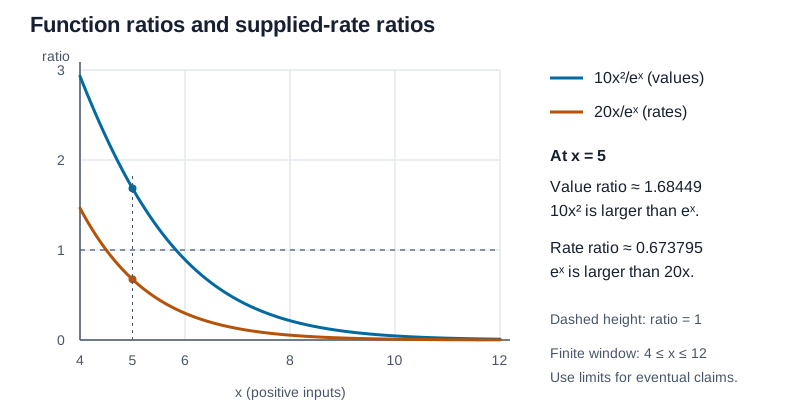
Inspect diagram labels
The diagram keeps its full size here. Focus the view and use the arrow keys, or scroll across it, to inspect every label.
Written working workspace
Drawing is temporarily unavailable. Work on paper if needed, then record your reasoning here.
Saving written working requires JavaScript. Keep your work on paper or in your own notes; the source problem above remains available.
Worked solution and rubric →Revisit the explanation →Revisit the explanation →
What does a vanishing ratio say?
For the teacher
- Show both positive and negative end behavior for a radical quotient.
- Compare growth using ratios and a table with expanding input ranges, while distinguishing numerical evidence from a proof.
Glossary and deeper reading · 8 refreshers
These editorial refreshers supplement the reading. Definitions and examples are added guidance; original source wording and recorded answers remain in their original context.
-
Limit
A limit describes the value approached by outputs as inputs approach a specified target or grow without bound. For an input approaching a finite target, its value at that exact input does not determine the limit. For example, (x²−1)/(x−1) approaches 2 as x approaches 1 even though the original expression is undefined at 1. A finite two-sided limit requires the left and right approaches to agree.
-
Domain
The domain of a function is the set of inputs for which the function is defined. An expression and its context can both restrict the allowed inputs. For example, the real function f(x)=1/(x−2) has domain all real numbers except 2. For a model of elapsed time, a sensible domain may also require t≥0.
-
Rational function
A rational function is a quotient of two polynomials. Its domain excludes inputs that make the original denominator zero. For example, (x²−1)/(x−1) agrees with x+1 away from x=1, but remains undefined there. Canceling a common factor does not automatically restore an excluded input.
-
Exponential growth and decay
An exponential growth or decay model makes a quantity’s instantaneous rate proportional to the quantity itself. The differential equation y′=ky gives y=Ceᵏˣ, with positive k describing growth and negative k describing decay for positive y. For example, a population with a constant relative growth rate doubles in equal time intervals. Its relative rate stays constant, while its absolute rate changes with the amount present.
-
Polynomial
A polynomial in one variable is a finite sum of constant multiples of nonnegative integer powers of that variable. The degree is the highest exponent with a nonzero coefficient. For example, 2x³−x+5 is a polynomial of degree 3. Expressions containing 1/x or √x are not polynomials in x.
-
Function
A mathematical function assigns exactly one output to each input in its domain. Inputs can share an output, but one input cannot have two different outputs. For example, f(x)=x² assigns the output 9 to both 3 and −3. Function notation names the rule and its input; f(3) means the output when the input is 3.
-
Derivative
A derivative gives the instantaneous rate of change of a function with respect to its input. At a point, it is the finite limit of the difference quotient when that limit exists. For example, the derivative of x² is 2x, so the tangent slope at x=3 is 6. A derivative function collects those rates across the inputs where the function is differentiable.
-
Limit laws
Limit laws allow limits of sums, products, and suitable quotients to be assembled from the limits of their parts. The component limits must exist as required, and a quotient law needs a nonzero denominator limit. For example, if f approaches 2 and g approaches 3, then f+g approaches 5 and fg approaches 6. Direct substitution into a quotient with denominator limit 0 is not justified by the quotient limit law.