AP Unit 1 Solutions
Worked solutions to all thirty Unit 1 problems. Each solution gives the mathematical steps and the reason for using them. Compare your setup and justification as well as the final answer.
Problem 1
A cart has position s(t)=t²+3t meters. At t=2 seconds, find the average rate from 2 to 2+h (h≠0), then the instantaneous rate suggested by its limit.
- Compute s(2)=10 and s(2+h)=10+7h+h². Reason: substitution and expansion keep the same position model.
- Divide the change by h: [s(2+h)−s(2)]/h=7+h for h≠0. Reason: average rate is change per elapsed time.
- Take h→0 to obtain 7 m/s. Reason: the instantaneous rate is the limiting average rate, not a zero-length quotient.
Answer: Average rate 7+h m/s; instantaneous rate 7 m/s.
Final answer
Average rate 7+h m/s; instantaneous rate 7 m/s.
Review the teaching: Topic 1.1
Problem 2
Write “the concentration C(t), in milligrams per liter, approaches 8 as t approaches 5 minutes from the left” in limit notation. Explain what this says about C(5).
- Use t→5⁻ to indicate approach from smaller time inputs. Reason: the superscript minus specifies the side.
- Write lim(t→5⁻)C(t)=8 mg/L. Reason: a limit records the approached output and its units.
- No value for C(5) is determined. Reason: one-sided nearby behavior does not specify the actual target value.
Answer: lim(t→5⁻)C(t)=8 mg/L; C(5) remains unspecified.
Final answer
lim(t→5⁻)C(t)=8 mg/L; C(5) remains unspecified.
Review the teaching: Topic 1.2
Problem 3
Suppose lim(x→4⁻)f(x)=2, lim(x→4⁺)f(x)=2 and f(4)=−1. State lim(x→4)f(x), and explain why it differs from f(4).
- Compare the two one-sided limits: both are 2. Reason: equality is required for a finite two-sided limit.
- Conclude lim(x→4)f(x)=2. Reason: both sides approach the same output.
- The value −1 occurs only at x=4. Reason: the definition of the limit excludes that one input.
Answer: The limit is 2 although f(4)=−1.
Final answer
The limit is 2 although f(4)=−1.
Review the teaching: Topic 1.2
Problem 4
Use the hole graph in Topic 1.3 (text equivalent: f(x)=x+1 for x≠2 and f(2)=5). State the left limit, right limit, two-sided limit and actual value at 2.
- Trace toward the open point from each side: both nearby heights approach 3. Reason: the graph follows y=x+1 away from 2.
- The two-sided limit is 3. Reason: the one-sided limits agree.
- Read the filled point to get f(2)=5. Reason: a filled point represents the included function value.
Answer: Left limit 3; right limit 3; two-sided limit 3; f(2)=5.
Final answer
Left limit 3; right limit 3; two-sided limit 3; f(2)=5.
Review the teaching: Topic 1.3
Problem 5
A calculator seems to draw sin(1/x) as a dark band near x=0. Decide whether its limit exists. Explain why the plotting window cannot settle the question.
- Choose xₙ=1/(π/2+2πn) and yₙ=1/(3π/2+2πn). Both approach 0 from the right. Reason: the denominators grow without bound.
- The corresponding outputs are 1 and −1 for every n. Reason: these angles are sine maxima and minima.
- The limit does not exist; the plot undersamples the oscillations. Reason: arbitrarily nearby inputs retain different output values.
Answer: No limit exists; graph scale and sampling can hide persistent oscillation.
Final answer
No limit exists; graph scale and sampling can hide persistent oscillation.
Review the teaching: Topic 1.3
Problem 6
| x | 0.9 | 0.99 | 1.01 | 1.1 |
|---|---|---|---|---|
| F(x) | 2.71 | 2.9701 | 3.0301 | 3.31 |
Estimate lim(x→1)F(x). State whether this finite table alone proves the limit.
- Read the left entries as x moves toward 1: 2.71 then 2.9701 approach 3. Reason: the inputs approach from below.
- Read the right entries toward 1: 3.31 then 3.0301 also approach 3. Reason: a two-sided estimate needs both sides.
- Estimate 3, but do not claim proof from only these samples. Reason: no finite table controls every sufficiently nearby input.
Answer: Estimated limit 3; the table alone does not prove it.
Final answer
Estimated limit 3; the table alone does not prove it.
Review the teaching: Topic 1.4
Problem 7
Evaluate lim(x→−1)(2x²+3)/(x²+4), stating the condition needed for the quotient limit rule.
- Numerator approaches 5 and denominator approaches 5. Reason: polynomials are continuous.
- The denominator limit is nonzero. Reason: this is the hypothesis for the quotient limit rule.
- Divide 5 by 5 to obtain 1. Reason: the quotient rule for limits now applies.
Answer: 1; the limiting denominator is 5≠0.
Final answer
1; the limiting denominator is 5≠0.
Review the teaching: Topic 1.5
Problem 8
Let f(x)=x² for x<1 and f(x)=2x+1 for x≥1. Find both one-sided limits and decide whether lim(x→1)f(x) exists.
- Use x² on the left: lim(x→1⁻)f(x)=1. Reason: the left-hand inputs use the first branch.
- Use 2x+1 on the right: lim(x→1⁺)f(x)=3. Reason: the right-hand inputs use the second branch.
- The two-sided limit does not exist. Reason: 1≠3.
Answer: Left 1; right 3; two-sided limit does not exist.
Final answer
Left 1; right 3; two-sided limit does not exist.
Review the teaching: Topic 1.5
Problem 9
Evaluate lim(x→−2)(x²+x−2)/(x+2).
- Factor x²+x−2=(x+2)(x−1). Reason: factoring reveals the zero-producing factor.
- For x≠−2, cancel x+2 to obtain x−1. Reason: nearby expressions may be replaced by equal expressions.
- Take x→−2 to get −3. Reason: the simplified linear function is continuous.
Answer: −3.
Final answer
−3.
Review the teaching: Topic 1.6
Problem 10
Evaluate lim(x→0)(√(9+x)−3)/x.
- Multiply by the conjugate √(9+x)+3 in numerator and denominator. Reason: a difference of squares removes the radical difference.
- For x≠0 the result is 1/(√(9+x)+3). Reason: the numerator simplifies to x and cancels.
- Substitute x=0 in the continuous simplified expression to get 1/6. Reason: its denominator approaches 6≠0.
Answer: 1/6.
Final answer
1/6.
Review the teaching: Topic 1.6
Problem 11
In radians, evaluate lim(x→0)sin(4x)/(3x).
- Rewrite as (4/3)[sin(4x)/(4x)]. Reason: the standard sine limit needs the same argument in numerator and denominator.
- As x→0, 4x→0 and sin(4x)/(4x)→1. Reason: the standard radian sine limit applies.
- Multiply by 4/3. Reason: constant multiples pass through finite limits.
Answer: 4/3.
Final answer
4/3.
Review the teaching: Topic 1.6
Problem 12
For each limit, name a suitable first method and then evaluate: (a) lim(x→2)(x²−4)/(x−2); (b) lim(x→0)(√(1+x)−1)/x; (c) lim(x→0⁺)1/x.
- (a) Choose factoring, then cancel x−2 to get x+2→4. Reason: a difference of squares resolves 0/0.
- (b) Choose a conjugate, producing 1/(√(1+x)+1)→1/2. Reason: the radical difference becomes a factor x.
- (c) Choose sign and magnitude analysis to get +∞. Reason: a positive denominator shrinking to 0 makes the quotient unbounded.
Answer: (a) Factoring: 4. (b) Conjugate: 1/2. (c) One-sided sign analysis: +∞.
Final answer
(a) Factoring: 4. (b) Conjugate: 1/2. (c) One-sided sign analysis: +∞.
Review the teaching: Topic 1.7 Topic 1.6 Topic 1.14
Problem 13
Prove lim(x→0)x²cos(1/x)=0 using the squeeze theorem.
- Use −1≤cos(1/x)≤1 for x≠0. Reason: cosine is bounded.
- Multiply by nonnegative x²: −x²≤x²cos(1/x)≤x². Reason: multiplication by a nonnegative number preserves inequality order.
- Both bounding limits are 0, so the middle limit is 0. Reason: the squeeze theorem applies near 0.
Answer: 0, justified by bounds −x² and x².
Final answer
0, justified by bounds −x² and x².
Review the teaching: Topic 1.8
Problem 14
A function satisfies 5−2|x−1|≤g(x)≤5+3|x−1| for 0<|x−1|<0.2. Find lim(x→1)g(x), and explain whether g(1) must be 5.
- The lower bound approaches 5 as x→1. Reason: |x−1|→0.
- The upper bound also approaches 5; conclude the middle limit is 5. Reason: the stated punctured neighborhood satisfies the squeeze hypotheses.
- No value of g(1) is forced. Reason: the inequality deliberately excludes the target input.
Answer: The limit is 5; g(1) need not be 5.
Final answer
The limit is 5; g(1) need not be 5.
Review the teaching: Topic 1.8
Problem 15
For x≠3, H(x)=(x²−9)/(x−3); H(3) is undefined. Describe its nearby table values at 2.99 and 3.01, the corresponding graph feature, its limit notation, and the verbal meaning.
- Factor and cancel to get H(x)=x+3 for x≠3. Reason: this expression gives the same nearby outputs.
- Compute H(2.99)=5.99 and H(3.01)=6.01; the graph is y=x+3 with a hole at (3,6). Reason: the missing input does not alter the rest of the line.
- Write lim(x→3)H(x)=6: the output approaches 6 as the input approaches 3. Reason: both sides approach the same height.
Answer: Table 5.99 and 6.01; hole at (3,6); limit 6; H(3) remains undefined.
Final answer
Table 5.99 and 6.01; hole at (3,6); limit 6; H(3) remains undefined.
Review the teaching: Topic 1.9
Problem 16
Classify the discontinuity at the indicated input: (a) (x²−4)/(x−2) at 2; (b) f(x)=−1 for x<0 and 1 for x≥0 at 0; (c) 1/(x+1)² at −1. Say whether one finite replacement value can repair each.
- (a) The nearby quotient equals x+2 and tends to 4. Reason: the common factor cancels, so this is removable and f(2)=4 repairs it.
- (b) The side limits are −1 and 1. Reason: they disagree, so this is a jump and one value cannot repair it.
- (c) Both sides are unbounded positive. Reason: a positive square denominator shrinks to 0, so this is infinite and cannot be repaired with a finite value.
Answer: (a) Removable, repair with 4. (b) Jump, no repair. (c) Infinite, no finite repair.
Final answer
(a) Removable, repair with 4. (b) Jump, no repair. (c) Infinite, no finite repair.
Review the teaching: Topic 1.10
Problem 17
Let f(x)=2x+1 for x≠2 and f(2)=4. Test all three continuity conditions at 2.
- f(2)=4 exists. Reason: the target rule defines it.
- The two-sided limit is 5. Reason: nearby values follow the continuous line 2x+1.
- Since 5≠4, continuity fails. Reason: the third condition requires equality of value and limit.
Answer: Not continuous; the value-limit equality fails.
Final answer
Not continuous; the value-limit equality fails.
Review the teaching: Topic 1.11
Problem 18
Let g(x)=x² when x≤1 and g(x)=2x−1 when x>1. Is g continuous at 1? Give a complete reason.
- Read g(1)=1 from x². Reason: that branch includes the target.
- The left limit is 1²=1 and the right limit is 2(1)−1=1. Reason: each branch is continuous on its side.
- Thus the finite limit exists and equals g(1)=1. Reason: all three continuity conditions hold.
Answer: Yes, g is continuous at 1.
Final answer
Yes, g is continuous at 1.
Review the teaching: Topic 1.11
Problem 19
Find the maximal intervals of continuity of R(x)=(x+2)/(x²−4). Does cancelling a factor add x=−2 to the original domain?
- Factor x²−4=(x−2)(x+2); the original denominator excludes x=−2 and x=2. Reason: the original expression must be defined.
- A rational function is continuous wherever its denominator is nonzero. Reason: the quotient of continuous functions is continuous on that domain.
- State (−∞,−2), (−2,2), (2,∞). Cancellation does not add −2. Reason: an equivalent nearby rule does not redefine the original function.
Answer: (−∞,−2), (−2,2), (2,∞); cancellation does not change the original domain.
Final answer
(−∞,−2), (−2,2), (2,∞); cancellation does not change the original domain.
Review the teaching: Topic 1.12
Problem 20
On which maximal interval is L(x)=ln(x−2) continuous? Explain the endpoint restriction.
- Require x−2>0, so x>2. Reason: the real logarithm needs a positive argument.
- ln is continuous for positive arguments and x−2 is continuous. Reason: a valid composition of continuous functions is continuous.
- The interval is (2,∞), excluding 2. Reason: ln 0 is undefined.
Answer: (2,∞).
Final answer
(2,∞).
Review the teaching: Topic 1.12
Problem 21
Define f(x)=(x³−8)/(x−2) for x≠2. Choose f(2) to make f continuous at 2.
- Factor x³−8=(x−2)(x²+2x+4). Reason: a difference of cubes reveals the common factor.
- The nearby function becomes x²+2x+4 and its limit at 2 is 12. Reason: cancellation is valid for x≠2 and the remaining polynomial is continuous.
- Set f(2)=12. Reason: continuity requires the actual value to equal that finite limit.
Answer: f(2)=12.
Final answer
f(2)=12.
Review the teaching: Topic 1.13
Problem 22
Find a so f(x)=ax+2 for x<1 and f(x)=x²+4 for x≥1 is continuous at 1.
- The target value and right limit equal 5. Reason: the second branch includes x=1 and is continuous.
- The left limit is a+2. Set a+2=5. Reason: both sides and the value must agree.
- Solve a=3, then check both branches give limiting value 5. Reason: substitution verifies the parameter repair.
Answer: a=3.
Final answer
a=3.
Review the teaching: Topic 1.13
Problem 23
For V(x)=−2/(x−3), find both one-sided limits at 3 and state the vertical asymptote.
- On the left, x−3 is negative and near 0, so −2/(x−3) is unbounded positive. Reason: dividing two negative quantities gives a positive quotient.
- On the right, x−3 is positive and near 0, so the quotient is unbounded negative. Reason: the fixed numerator is negative.
- State left limit +∞, right limit −∞ and asymptote x=3. Reason: unbounded one-sided behavior defines a vertical asymptote.
Answer: Left +∞; right −∞; vertical asymptote x=3.
Final answer
Left +∞; right −∞; vertical asymptote x=3.
Review the teaching: Topic 1.14
Problem 24
For W(x)=(x+1)/(x−2)², determine the two-sided infinite-limit behavior at 2. Is +∞ a finite real limit?
- Near 2 the numerator is positive and approaches 3. Reason: the linear numerator is continuous.
- The squared denominator is positive on both sides and approaches 0. Reason: a nonzero square is positive.
- The quotient grows without bound on both sides, so lim(x→2)W(x)=+∞ in infinite-limit notation. Reason: the signs agree; this describes unbounded growth, not a finite real limit.
Answer: Unbounded positive on both sides; +∞ is not a finite real limit.
Final answer
Unbounded positive on both sides; +∞ is not a finite real limit.
Review the teaching: Topic 1.14
Problem 25
Find both limits at infinity and any horizontal asymptote of F(x)=(4x²−3x+1)/(2x²+7).
- Divide top and bottom by x² for x≠0. Reason: highest powers control end behavior.
- The quotient becomes (4−3/x+1/x²)/(2+7/x²). Reason: division preserves the expression.
- At either end the inverse powers vanish, giving 4/2=2. Reason: the limiting denominator is nonzero.
Answer: Both limits are 2; horizontal asymptote y=2.
Final answer
Both limits are 2; horizontal asymptote y=2.
Review the teaching: Topic 1.15
Problem 26
Find lim(x→∞)√(4x²+1)/x and lim(x→−∞)√(4x²+1)/x.
- Write the quotient as (|x|/x)√(4+1/x²). Reason: √(x²)=|x|.
- For positive x, |x|/x=1 and the radical tends to 2. Reason: 1/x²→0.
- For negative x, |x|/x=−1, so the limit is −2. Reason: the sign factor differs at the two ends.
Answer: Positive end: 2; negative end: −2.
Final answer
Positive end: 2; negative end: −2.
Review the teaching: Topic 1.15
Problem 27
Use a calculator table at x=2,5,10,20 to inspect x²/eˣ. The established limit as x→∞ is 0. Interpret that limit as a growth comparison, and explain why the four rows alone do not prove it.
- Compute approximate ratios 0.541341, 0.168449, 0.004540 and 0.000000824. Reason: division compares the sizes in a common scale.
- The stated limit 0 means x² becomes negligible compared with eˣ. Reason: a vanishing ratio describes relative growth.
- The finite table supports the trend but does not prove all far-out behavior. Reason: four inputs cannot establish a statement about every sufficiently large input.
Answer: eˣ dominates x² in the ratio sense; four samples are evidence, not a proof.
Final answer
eˣ dominates x² in the ratio sense; four samples are evidence, not a proof.
Review the teaching: Topic 1.15
Problem 28
Prove x³−2x−2=0 has at least one solution in (1,2), without finding the solution.
- Let f(x)=x³−2x−2; it is continuous on [1,2]. Reason: it is a polynomial.
- f(1)=−3 and f(2)=2, so 0 lies strictly between them. Reason: the desired output is bracketed.
- IVT guarantees a c in (1,2) with f(c)=0. Reason: continuity and the intermediate output condition hold.
Answer: At least one root lies in (1,2), by IVT.
Final answer
At least one root lies in (1,2), by IVT.
Review the teaching: Topic 1.16
Problem 29
A continuous tank-temperature function T(t) has T(0)=14°C and T(8)=22°C. Must it reach 19°C during (0,8)? Must it do so exactly once?
- 19 lies strictly between 14 and 22. Reason: the endpoint temperatures bracket the target.
- Continuity on [0,8] lets IVT guarantee at least one t in (0,8) with T(t)=19. Reason: a continuous function cannot skip that output.
- Uniqueness is not guaranteed. Reason: temperature could rise and fall and cross 19 more than once.
Answer: Yes, at least once; exactly once is not guaranteed.
Final answer
Yes, at least once; exactly once is not guaranteed.
Review the teaching: Topic 1.16
Problem 30
A graph consists of y=−1 for x<0 and y=1 for x≥0. Its endpoint values at −2 and 2 have opposite signs. Explain why IVT cannot establish a zero, and decide whether any zero actually exists.
- The left limit at 0 is −1 and the right limit is 1. Reason: each side is a constant horizontal graph.
- The function is not continuous on [−2,2], so IVT does not apply. Reason: continuity on the complete interval is a required hypothesis.
- Its only output values are −1 and 1, so no zero exists. Reason: the explicit rule never outputs 0.
Answer: IVT fails because of the jump; the function has no zero.
Final answer
IVT fails because of the jump; the function has no zero.
Review the teaching: Topic 1.16
Explain and apply: worked solutions
Compare the setup and the reasoning, as well as the final answer. Use the rubric to find your next step; equivalent correct reasoning earns the same credit.
Compare a model and its supplied rate separately
For x > 0, f(x) = 10x² and g(x) = eˣ. Their rate functions are supplied as r(x) = 20x and s(x) = eˣ; do not derive them. You may use the established limit lim(x → +∞) x²/eˣ = 0 and ordinary limit laws. No L’Hôpital rule, series expansion or later derivative method is needed.
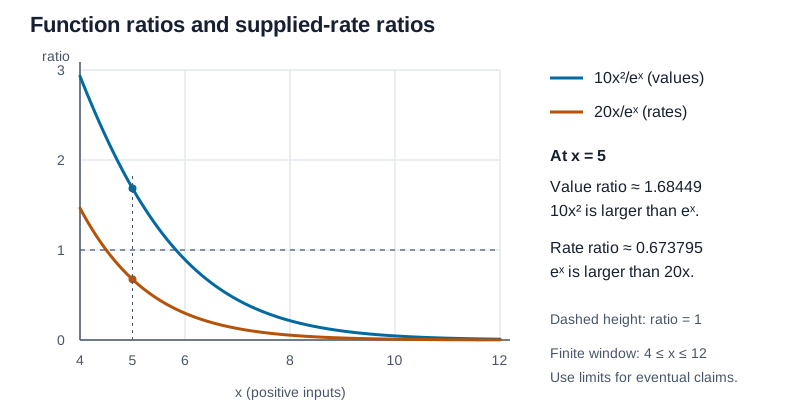
Inspect diagram labels
The diagram keeps its full size here. Focus the view and use the arrow keys, or scroll across it, to inspect every label.
Return to the unit problem →Try this problem in its lesson →
What does a vanishing ratio say?
For positive x, F(x) = 10x² and G(x) = eˣ have supplied rates R(x) = 20x and S(x) = eˣ. It is established that F/G → 0 and R/S → 0 as x → +∞.
Return to the unit problem →Try this problem in its lesson →
Estimate nearby behavior from two displays
The supplied graph is a finite-resolution observation of F near x = 2. A separate table gives F(1.90) = 2.672, F(1.99) = 2.78702, F(2.01) = 2.81302 and F(2.10) = 2.932. The filled point records F(2) = 4. No analytic rule or guarantee about unsampled behavior is supplied.
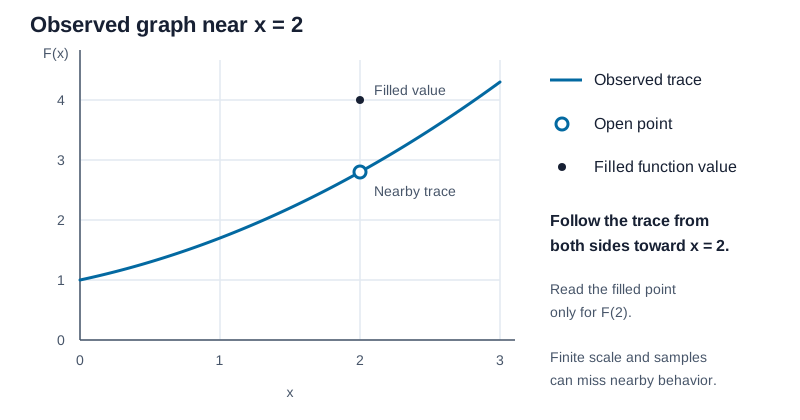
Inspect diagram labels
The diagram keeps its full size here. Focus the view and use the arrow keys, or scroll across it, to inspect every label.
Return to the unit problem →Try this problem in its lesson →