AP Unit 8 Solutions
Worked solutions to all thirty Unit 8 problems. Each solution gives the mathematical steps and the reason for using them. Compare your setup and justification as well as the final answer.
Problem 1
Find the average value of f(x)=x² on [0,3] and a point where f takes that value.
- Compute ∫₀³ x²dx=9 and divide by 3−0=3. Reason: Average value is integral divided by interval length.
- Solve c²=3 and retain c=√3 in [0,3]. Reason: The point must lie in the specified interval.
Answer: Average 3; c=√3.
Final answer
Average 3; c=√3.
Review the teaching: Topic 8.1
Problem 2
| t (min) | 0 | 2 | 5 |
|---|---|---|---|
| T(t) (°C) | 10 | 14 | 20 |
- Approximate ∫Tdt by ½(10+14)·2+½(14+20)·3=75 °C·min. Reason: Use the nonuniform widths and average endpoint temperatures.
- Divide by 5 min to get 15°C. Reason: Average value normalizes by the full interval length.
Answer: 15°C.
Final answer
15°C.
Review the teaching: Topic 8.1
Problem 3
A particle has v(t)=2t−2 m/s on [0,3] and s(0)=5 m. Find its final position and total distance.
- Displacement ∫₀³vdt=[t²−2t]₀³=3 m, so final position is 5+3=8 m. Reason: Position is initial position plus velocity accumulation.
- Velocity changes sign at t=1; distance=−∫₀¹v+∫₁³v=1+4=5 m. Reason: Speed is the absolute value of velocity.
Answer: s(3)=8 m; distance 5 m.
Final answer
s(3)=8 m; distance 5 m.
Review the teaching: Topic 8.2
Problem 4
Acceleration is a(t)=6t m/s² and v(0)=−2 m/s. Find v(2) and the first nonnegative time the particle changes direction.
- Integrate to v(t)=3t²−2. Reason: Include the initial velocity in the acceleration integral.
- At t=2, v=12−2=10. Solve 3t²−2=0 for t≥0. Reason: A direction change requires velocity zero with a sign change, which this increasing velocity has.
Answer: v(2)=10 m/s; direction changes at t=√(2/3) s.
Final answer
v(2)=10 m/s; direction changes at t=√(2/3) s.
Review the teaching: Topic 8.2
Problem 5
A velocity graph consists of a triangle above the axis on [0,2] with height 4 m/s and a triangle below on [2,5] with depth 2 m/s. Find displacement and distance.
- Signed areas are ½·2·4=4 and −½·3·2=−3. Reason: Velocity area represents displacement with signs.
- Add signed areas for 1 m and their magnitudes for 7 m. Reason: Distance integrates speed.
Answer: Displacement 1 m; distance 7 m.
Final answer
Displacement 1 m; distance 7 m.
Review the teaching: Topic 8.2
Problem 6
A tank starts with 10 L and has net rate 6−2t L/min for 0≤t≤4. Find its maximum volume and the time it occurs.
- V(t)=10+∫₀ᵗ(6−2u)du=10+6t−t². Reason: Integrate net rate and include the initial amount.
- Critical time is 3; compare V(0)=10,V(3)=19,V(4)=18. Reason: A maximum on a closed interval occurs among endpoints and derivative-zero candidates.
Answer: 19 L at t=3 min.
Final answer
19 L at t=3 min.
Review the teaching: Topic 8.3
Problem 7
Inventory starts at 50 items. Inflow is 5t items/hour and outflow is 2 items/hour on [0,3]. Find the inventory at hour 3.
- Net rate is 5t−2. Reason: Subtract outflow from inflow.
- Net change is ∫₀³(5t−2)dt=22.5−6=16.5. Reason: Integrate the net rate over the time interval.
- Add 50 to obtain 66.5. Reason: The integral gives change rather than final inventory; the model treats inventory continuously.
Answer: 66.5 items in the continuous model.
Final answer
66.5 items in the continuous model.
Review the teaching: Topic 8.3
Problem 8
A rate r(t) is measured in dollars/day. Explain the meaning and units of ∫₂⁷ r(t)dt, and how to use it if the account balance at day 2 is $100.
- Rate units times day units produce dollars. Reason: Integral accumulation multiplies rate by elapsed time.
- Add the change to the starting balance. Reason: The net-change principle connects initial and final amounts.
Answer: Net balance change from day 2 to day 7, in dollars; final balance is 100+∫₂⁷ r(t)dt.
Final answer
Net balance change from day 2 to day 7, in dollars; final balance is 100+∫₂⁷ r(t)dt.
Review the teaching: Topic 8.3
Problem 9
Find the area enclosed by y=x and y=x².
- Intersections solve x=x², giving 0 and 1. Reason: These are the region’s bounds.
- On (0,1), x>x², so area=∫₀¹(x−x²)dx=1/2−1/3=1/6. Reason: Integrate top minus bottom.
Answer: 1/6 square unit.
Final answer
1/6 square unit.
Review the teaching: Topic 8.4
Problem 10
Find the area enclosed by y=4 and y=x².
- Solve x²=4 to find −2 and 2; the constant curve is above. Reason: Intersections and ordering determine vertical strips.
- Evaluate ∫₋₂²(4−x²)dx=16−16/3=32/3. Reason: Area is the integral of positive strip height.
Answer: 32/3 square units.
Final answer
32/3 square units.
Review the teaching: Topic 8.4
Problem 11
Find the area between x=y and x=y² using horizontal strips.
- Intersections are y=0 and y=1; y is right of y² between them. Reason: Horizontal strips use right minus left.
- Integrate ∫₀¹(y−y²)dy=1/6. Reason: Use y-bounds and dy consistently.
Answer: 1/6 square unit.
Final answer
1/6 square unit.
Review the teaching: Topic 8.5
Problem 12
Find the area of the region 0≤y≤2, 0≤x≤y².
- A horizontal strip extends from x=0 to x=y². Reason: Its width is right minus left.
- Area=∫₀² y²dy=8/3. Reason: Integrate the horizontal strip width in y.
Answer: 8/3 square units.
Final answer
8/3 square units.
Review the teaching: Topic 8.5
Problem 13
Find the total area between y=x and y=x³ on [−1,1].
- Crossings occur at −1,0,1. The cubic is above on [−1,0] and the line above on [0,1]. Reason: Order changes at the interior crossing.
- Use symmetry: area=2∫₀¹(x−x³)dx=2(1/2−1/4)=1/2. Reason: Both lobes have equal positive area.
Answer: 1/2 square unit.
Final answer
1/2 square unit.
Review the teaching: Topic 8.6
Problem 14
Find the area between y=sin x and the x-axis on [0,2π]. Also give the signed integral.
- Sine is positive on (0,π) and negative on (π,2π). Reason: Split at the sign change.
- The two lobe magnitudes are 2 each; signed values are +2 and −2. Reason: Geometric area adds magnitudes while the integral retains signs.
Answer: Area 4; signed integral 0.
Final answer
Area 4; signed integral 0.
Review the teaching: Topic 8.6
Problem 15
The base lies between y=x and y=x² on [0,1]. Cross sections perpendicular to the x-axis are squares. Find the volume.
- The side is s=x−x², so A=(x−x²)². Reason: The base segment supplies the square’s side.
- Integrate ∫₀¹(x²−2x³+x⁴)dx=1/3−1/2+1/5=1/30. Reason: Volume integrates cross-sectional area.
Answer: 1/30 cubic unit.
Final answer
1/30 cubic unit.
Review the teaching: Topic 8.7
Problem 16
On 0≤x≤2, each rectangular cross section has base 2−x and height three times its base. Find the volume.
- Area is 3(2−x)². Reason: Rectangle area is base times height.
- V=3∫₀²(2−x)²dx=3·8/3=8. Reason: Integrate the known slice area.
Answer: 8 cubic units.
Final answer
8 cubic units.
Review the teaching: Topic 8.7
Problem 17
The base lies between y=x and y=x² on [0,1]. Perpendicular-to-x slices are equilateral triangles with this vertical segment as a side. Find the volume.
- For side s=x−x², triangle area is √3·s²/4. Reason: The equilateral-triangle geometry specifies height.
- V=(√3/4)∫₀¹(x−x²)²dx=(√3/4)(1/30). Reason: Use the same base-strip length in the triangle area formula.
Answer: √3/120 cubic unit.
Final answer
√3/120 cubic unit.
Review the teaching: Topic 8.8
Problem 18
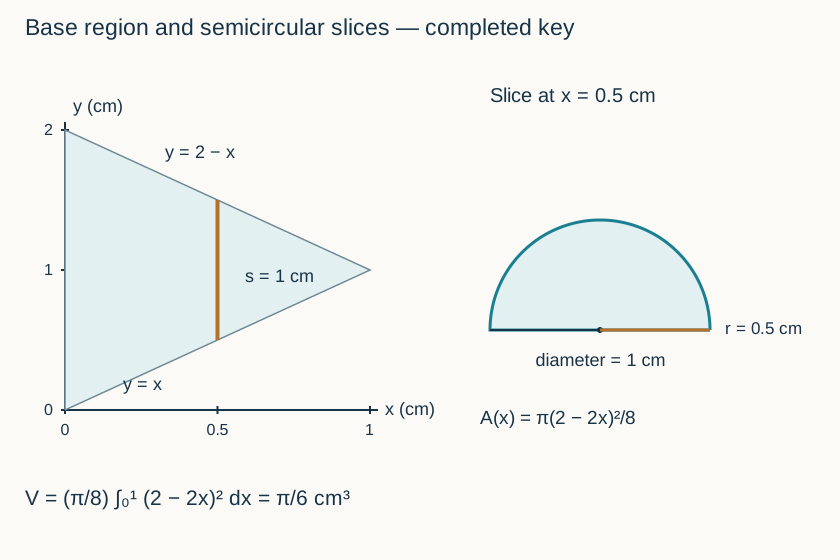
The base lies between y=0 and y=2−x on [0,2]. Perpendicular-to-x sections are semicircles with diameter 2−x. Find the volume.
- Radius=(2−x)/2, giving A=π(2−x)²/8. Reason: A semicircle is half a disc; the given segment is diameter.
- Integrate V=(π/8)(8/3)=π/3. Reason: Volume is the integral of slice area.
Answer: π/3 cubic units.
Final answer
π/3 cubic units.
Review the teaching: Topic 8.8
Problem 19
A solid has circular cross sections perpendicular to the x-axis, with radius √x for 0≤x≤2. Find its volume.
- The section area is π(√x)²=πx. Reason: Use the full circle area because these sections are circles.
- V=π∫₀²x dx=2π. Reason: Integrate the known area function.
Answer: 2π cubic units.
Final answer
2π cubic units.
Review the teaching: Topic 8.8
Problem 20
Rotate the region 0≤y≤√x, 0≤x≤4, about the x-axis. Find the volume.
- A perpendicular slice forms a disc of radius √x. Reason: The region reaches the x-axis.
- V=π∫₀⁴x dx=8π. Reason: Square the radius to get slice area.
Answer: 8π cubic units.
Final answer
8π cubic units.
Review the teaching: Topic 8.9
Problem 21
Rotate the region 0≤x≤√y, 0≤y≤4, about the y-axis. Find the volume.
- Use horizontal slices with radius √y. Reason: Discs must be perpendicular to the vertical axis.
- V=π∫₀⁴y dy=8π. Reason: Use the y-bounds with dy.
Answer: 8π cubic units.
Final answer
8π cubic units.
Review the teaching: Topic 8.9
Problem 22
Rotate the region 1≤y≤1+x, 0≤x≤2, about y=1. Find the volume.
- Radius is (1+x)−1=x; the region reaches the axis. Reason: Distance from the shifted axis determines the disc radius.
- V=π∫₀²x²dx=8π/3. Reason: Integrate the disc areas.
Answer: 8π/3 cubic units.
Final answer
8π/3 cubic units.
Review the teaching: Topic 8.10
Problem 23
Rotate the region −1≤x≤y−1, 0≤y≤2, about x=−1. Find the volume.
- Use horizontal slices with radius (y−1)−(−1)=y. Reason: The axis is vertical and the region reaches it.
- V=π∫₀²y²dy=8π/3. Reason: The disc formula uses the radial distance squared.
Answer: 8π/3 cubic units.
Final answer
8π/3 cubic units.
Review the teaching: Topic 8.10
Problem 24
Rotate the region x≤y≤2, 0≤x≤2, about the x-axis. Find the volume.
- Outer radius is 2, inner radius is x. Reason: Both are distances from y=0, with a hole for x>0.
- V=π∫₀²(4−x²)dx=π(8−8/3)=16π/3. Reason: Subtract inner disc area from outer disc area.
Answer: 16π/3 cubic units.
Final answer
16π/3 cubic units.
Review the teaching: Topic 8.11
Problem 25
Rotate the region y²≤x≤y, 0≤y≤1, about the y-axis. Find the volume.
- Horizontal slices have outer radius y and inner radius y². Reason: The right boundary is farther from x=0.
- V=π∫₀¹(y²−y⁴)dy=π(1/3−1/5)=2π/15. Reason: Use washer areas with dy.
Answer: 2π/15 cubic unit.
Final answer
2π/15 cubic unit.
Review the teaching: Topic 8.11
Problem 26
Rotate the region x≤y≤2, 0≤x≤2, about y=3. Find the volume.
- Outer radius is 3−x and inner radius is 1. Reason: The lower boundary is farther from the axis above the region.
- V=π∫₀²[(3−x)²−1]dx=π∫₀²(8−6x+x²)dx=20π/3. Reason: Square each distance separately, then subtract.
Answer: 20π/3 cubic units.
Final answer
20π/3 cubic units.
Review the teaching: Topic 8.12
Problem 27
Rotate the region y²≤x≤y, 0≤y≤1, about x=−1. Find the volume.
- Outer radius is y+1 and inner radius is y²+1. Reason: Both distances start at the same shifted vertical axis.
- V=π∫₀¹[(y+1)²−(y²+1)²]dy=π∫₀¹(2y−y²−y⁴)dy. Reason: Use horizontal washers.
- The value is π(1−1/3−1/5)=7π/15. Reason: Evaluate the polynomial antiderivative.
Answer: 7π/15 cubic unit.
Final answer
7π/15 cubic unit.
Review the teaching: Topic 8.12
Problem 28
Use a calculator to find the area between y=e^(−x²) and y=x on [0,1], to three decimal places. Show the intersection and the integral setup.
- Solve e^(−c²)=c in [0,1], giving c≈0.6529186404. Reason: The curves exchange order at their unique crossing; e^(−x²)−x is strictly decreasing for x≥0.
- Use ∫₀ᶜ[e^(−x²)−x]dx+∫꜀¹[x−e^(−x²)]dx. Reason: Area needs positive height on both pieces.
- Numerically evaluate the sum, approximately 0.4686590006, and round to 0.469. Reason: Keep the unrounded root and integrals in calculator memory.
Answer: Intersection c≈0.652919; area ≈0.469 square unit.
Final answer
Intersection c≈0.652919; area ≈0.469 square unit.
Review the teaching: Topic 8.4
Problem 29
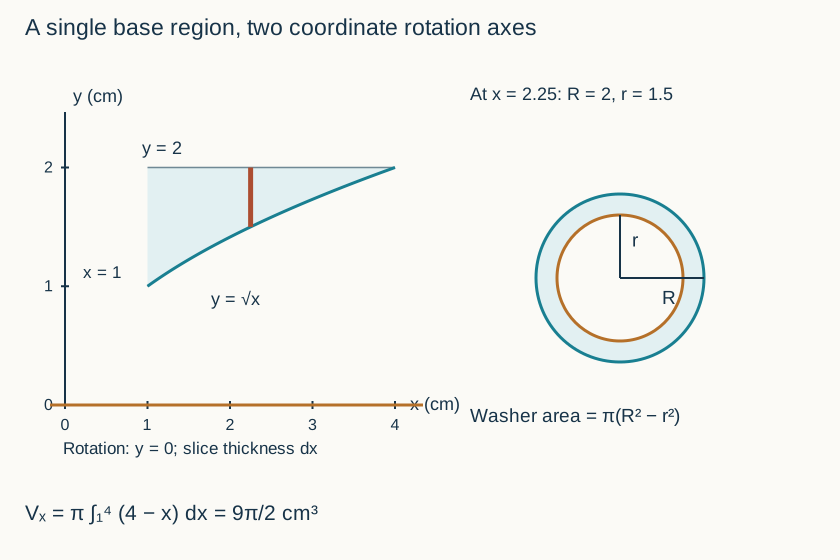
A washer has outer radius 3 cm and inner radius 1 cm. A student uses π(3−1)². Give the correct area and explain the error.
- Outer disc area is 9π; inner hole area is π. Reason: Each radius determines a separate disc area.
- Subtract to obtain 8π. Reason: A washer is outer area minus the hole, not a disc with radius 2.
Answer: 8π cm²; the student’s 4π cm² squares the ring’s thickness instead of subtracting disc areas.
Final answer
8π cm²; the student’s 4π cm² squares the ring’s thickness instead of subtracting disc areas.
Review the teaching: Topic 8.11
Problem 30
For a base segment of length s(x), compare a triangle of height 2s(x), a semicircle whose diameter is s(x), and a circle whose radius is s(x). Give each cross-sectional area function.
- Triangle area is ½·s·2s=s². Reason: Use the stated base-height relationship.
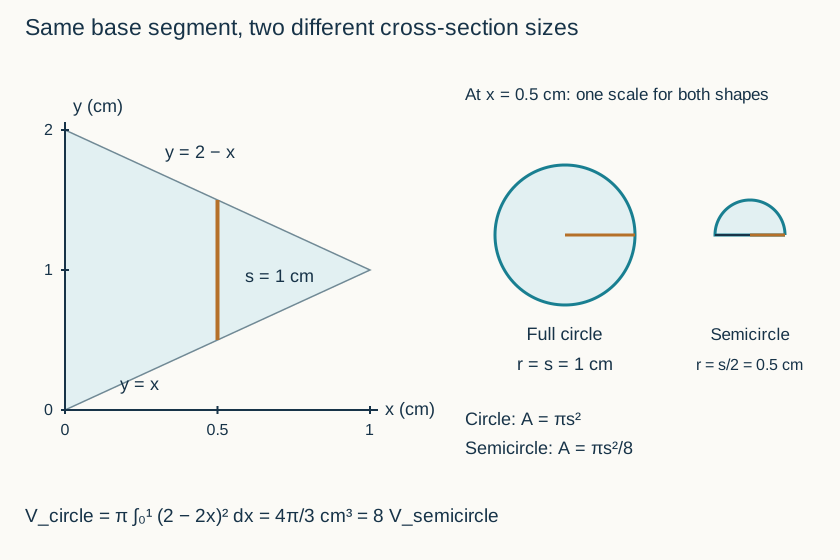
- Semicircle radius is s/2, so its area is ½π(s/2)²=πs²/8. Reason: The supplied segment is diameter, not radius.
- Circle area is πs². Reason: Here the supplied segment is explicitly the radius.
Answer: Triangle: s²; semicircle: πs²/8; circle: πs².
Final answer
Triangle: s²; semicircle: πs²/8; circle: πs².
Review the teaching: Topic 8.8
Explain and apply: worked solutions
Compare the setup and the reasoning, as well as the final answer. Use the rubric to find your next step; equivalent correct reasoning earns the same credit.
Build a triangular solid from a curved base
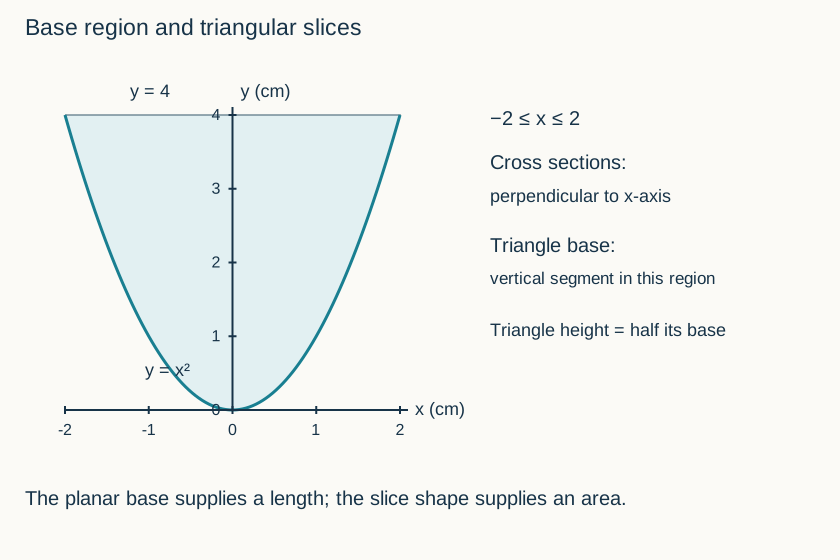
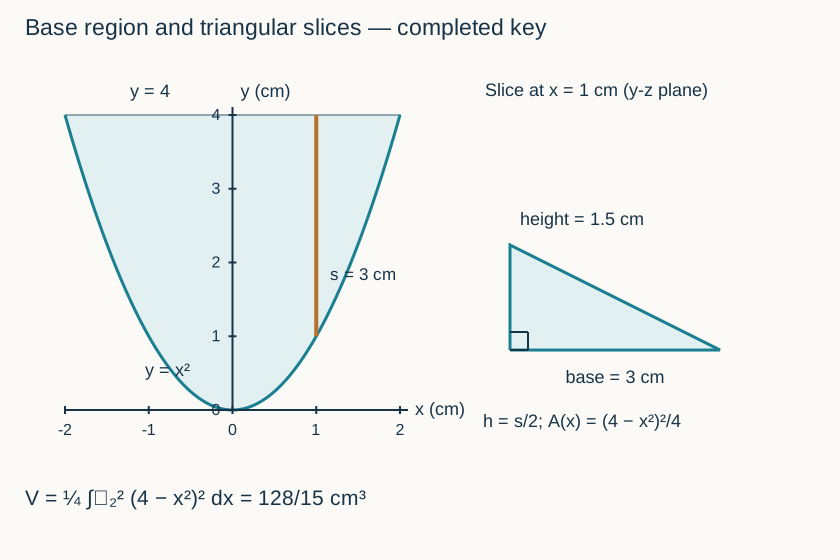
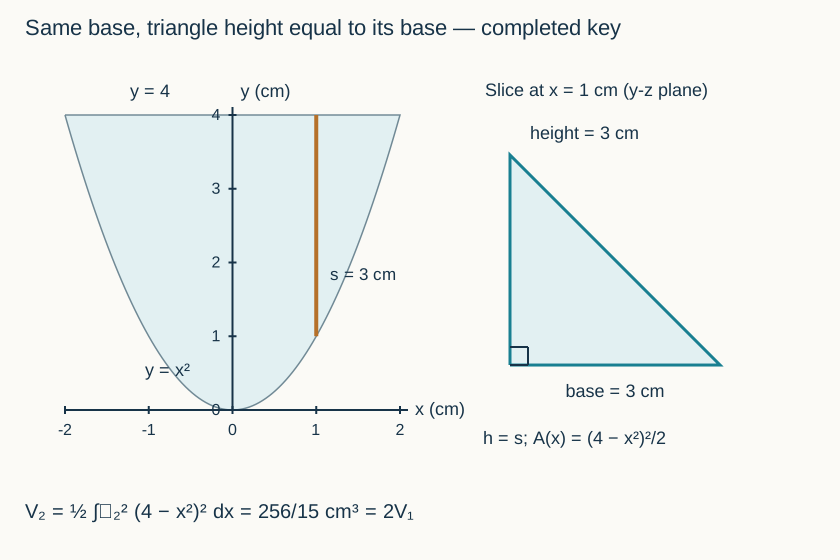
The planar base is bounded by y = x² and y = 4 on −2 ≤ x ≤ 2. Coordinates are in centimeters. Sections perpendicular to the x-axis are right triangles whose base is the vertical segment in the region and whose height is half that base. The supplied figure shows the actual base region.
Inspect diagram labels
The diagram keeps its full size here. Focus the view and use the arrow keys, or scroll across it, to inspect every label.
Inspect diagram labels
The diagram keeps its full size here. Focus the view and use the arrow keys, or scroll across it, to inspect every label.
Inspect diagram labels
The diagram keeps its full size here. Focus the view and use the arrow keys, or scroll across it, to inspect every label.
Return to the unit problem →Try this problem in its lesson →
A diameter makes a semicircular volume
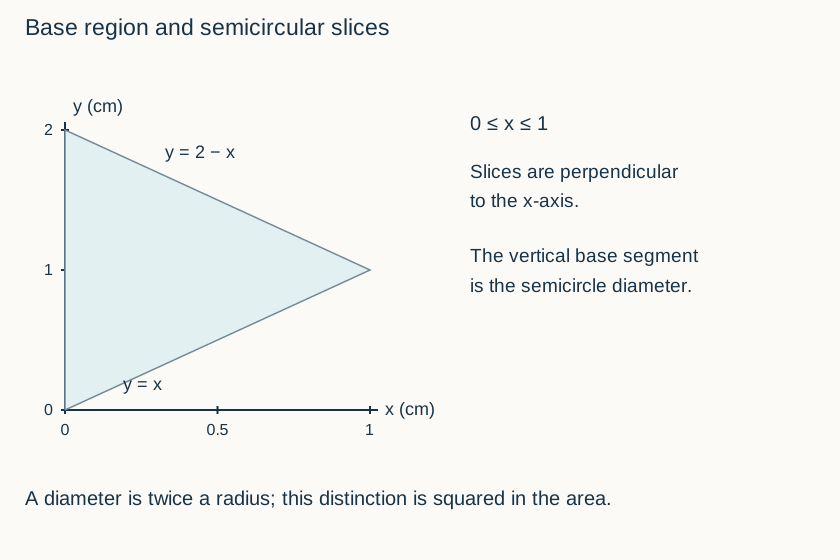
The base lies between y = x and y = 2 − x on 0 ≤ x ≤ 1, with coordinates in centimeters. Sections perpendicular to the x-axis are semicircles whose diameter is the vertical segment between these curves.
Inspect diagram labels
The diagram keeps its full size here. Focus the view and use the arrow keys, or scroll across it, to inspect every label.
Inspect diagram labels
The diagram keeps its full size here. Focus the view and use the arrow keys, or scroll across it, to inspect every label.
Inspect diagram labels
The diagram keeps its full size here. Focus the view and use the arrow keys, or scroll across it, to inspect every label.
Return to the unit problem →Try this problem in its lesson →
Rotate one actual base about two axes
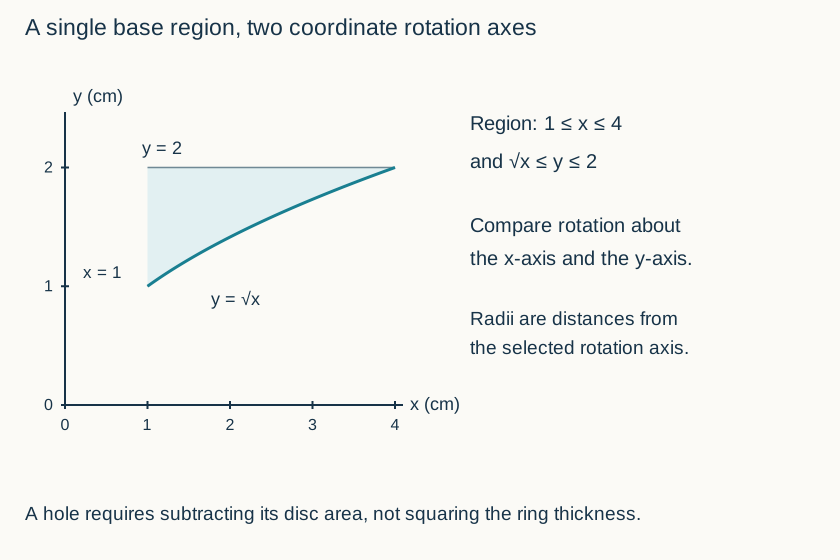
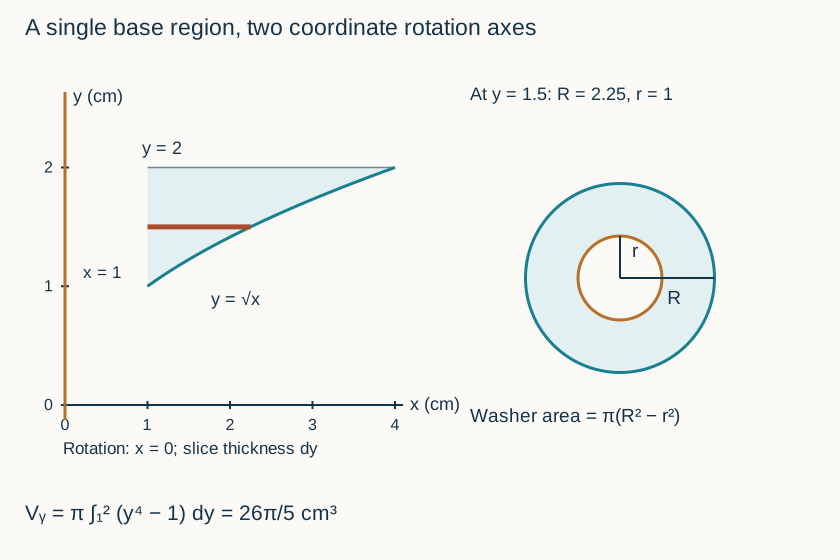
The base region is 1 ≤ x ≤ 4 and √x ≤ y ≤ 2. Coordinates are in centimeters. Compare solids made by rotating this actual region about the x-axis and about the y-axis; use washers perpendicular to each selected axis.
Inspect diagram labels
The diagram keeps its full size here. Focus the view and use the arrow keys, or scroll across it, to inspect every label.
Inspect diagram labels
The diagram keeps its full size here. Focus the view and use the arrow keys, or scroll across it, to inspect every label.
Inspect diagram labels
The diagram keeps its full size here. Focus the view and use the arrow keys, or scroll across it, to inspect every label.
Return to the unit problem →Try this problem in its lesson →
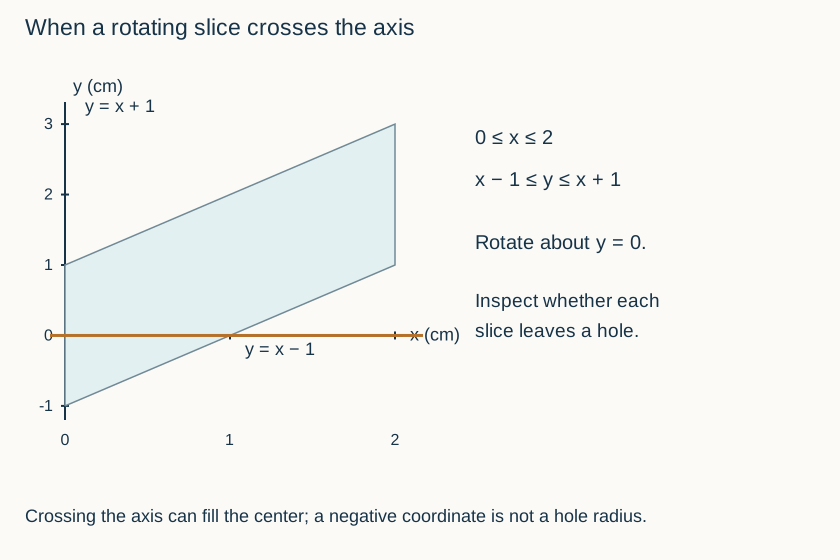
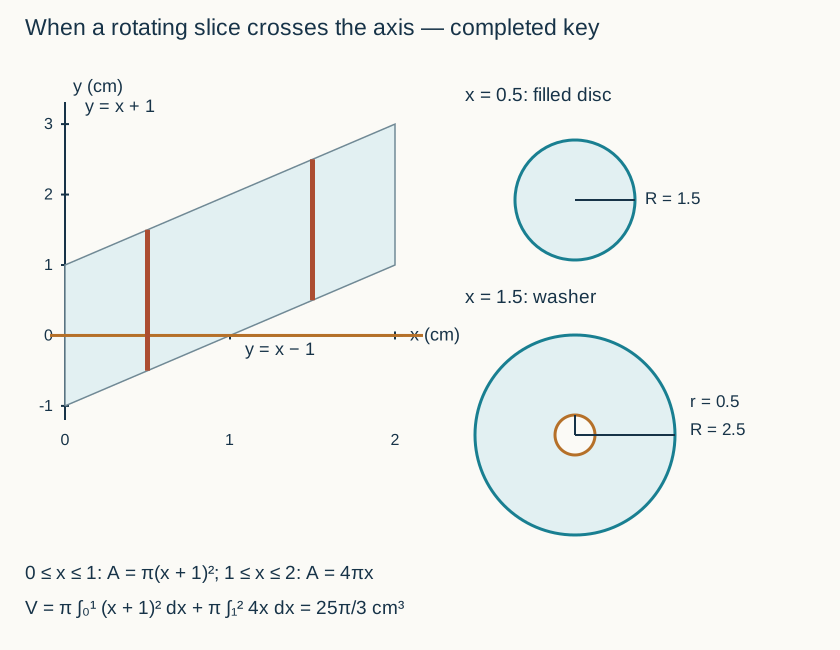
Does the rotating segment actually leave a hole?
The supplied figure shows the region 0 ≤ x ≤ 2 and x − 1 ≤ y ≤ x + 1. Coordinates are in centimeters, and the rotation axis is y = 0. Inspect the actual geometry before choosing a formula.
Inspect diagram labels
The diagram keeps its full size here. Focus the view and use the arrow keys, or scroll across it, to inspect every label.
Inspect diagram labels
The diagram keeps its full size here. Focus the view and use the arrow keys, or scroll across it, to inspect every label.
Return to the unit problem →Try this problem in its lesson →