Volumes with Cross Sections: Triangles and Semicircles
Use the specified triangle, semicircle, or circular geometry, distinguishing a supplied radius from a diameter.
College Board Topic 8.8 · CED p. 154 (PDF p. 159) · CED effective Fall 2020; project course outline 2026–27.
Keep V=∫A; change only the geometry of a slice. A triangle has area ½bh, so the problem must tell you the relationship between its base and height. An equilateral triangle with side s has area √3·s²/4. A semicircle with diameter s has radius s/2 and area ½π(s/2)²=πs²/8.
Other specified shapes work the same way: a circle of radius r has A=πr², or the problem may supply A(x) directly. A funnel with circular sections is a cross-section problem even when it is not described as a rotation. Distinguish a base segment described as a diameter from one described as a radius; that factor of 2 changes area by a factor of 4. State the slice direction and keep matching bounds.
Let's work through it
- A base segment has length s=2−x on 0≤x≤2, and semicircular slices use it as diameter. Reason: The geometry fixes radius s/2.
- Set A(x)=π(2−x)²/8. Reason: A semicircle is half a circle, with the radius squared.
- V=(π/8)∫₀²(2−x)²dx=π/3. Reason: Integrate the slice area over its extent.
Try it from memory
Pause & retrieve
Try it before you peek.
Write your answer and the reason from memory. Then compare with the worked answer. Your self-assessment is a study decision, not an automatically graded score.
Question 1
If a semicircle’s diameter is 4, what is its area?
See every recall question with its answer
These references preserve each prompt and its answer for direct evidence links. Try the interactive questions above before opening the worked reasoning.
Retrieval 1
If a semicircle’s diameter is 4, what is its area?
Worked answer and reason
2π.
Radius is 2, so half-circle area is ½π·2².
Retrieval 2
A triangle has base s and height 2s. What is its area?
Worked answer and reason
s².
Use ½·s·2s.
Catch the tempting mistake
- All triangular cross sections have the same area formula in s.
- The relation of height to the stated base matters. Equilateral, isosceles, and right triangles require their specified geometry.
Calculator workspace and limits
For calculus, set the angle selector to Radians. This scientific calculator evaluates arithmetic and functions. It does not graph arbitrary functions, find numerical roots, evaluate numerical derivatives, or compute definite integrals. Those tasks need an approved graphing tool; the May 2027 exam permits approved handheld graphing calculators and Bluebook’s built-in Desmos on calculator-required parts. A graph or decimal estimate helps you check a conclusion; your setup, hypotheses, units and justification still do the explaining.
Scientific calculator
This calculator requires JavaScript. Use the physics formula sheets and show your working manually.
+ − * / ^ ! · pi · e · sqrt · sin, cos, tan · asin, acos, atan · atan2(y,x) · ln, log · abs · exp · hypot(x,y). Use * between factors. Keep units in your written working.
Put it to work
- Unit 8 problem 17 · No calculator · analytic
- Unit 8 problem 18 · No calculator · analytic
- Unit 8 problem 19 · No calculator · analytic
- Unit 8 problem 30 · No calculator · verbal
Explain and apply the mathematics
Try these problems before opening the solutions. Show your setup, the hypotheses behind your method, and what your answer means.
Build a triangular solid from a curved base
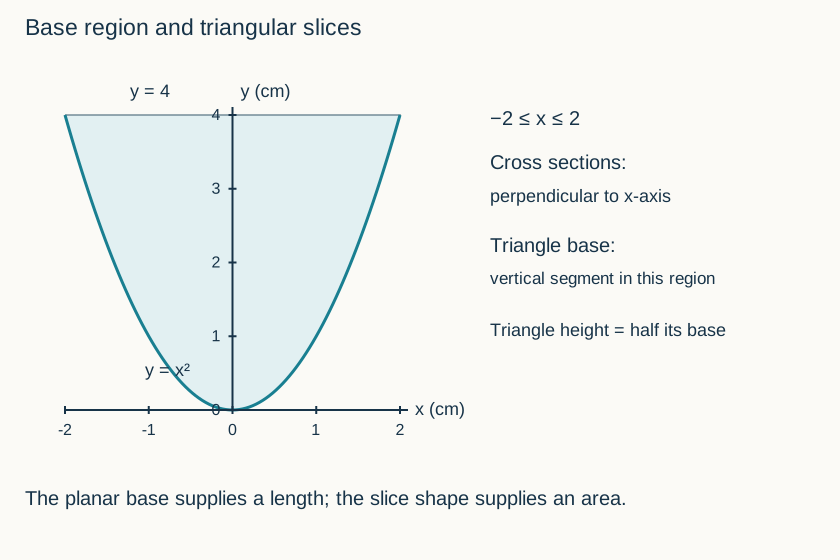
Inspect diagram labels
The diagram keeps its full size here. Focus the view and use the arrow keys, or scroll across it, to inspect every label.
Written working workspace
Drawing is temporarily unavailable. Work on paper if needed, then record your reasoning here.
Saving written working requires JavaScript. Keep your work on paper or in your own notes; the source problem above remains available.
Worked solution and rubric →Revisit the explanation →Revisit the explanation →
A diameter makes a semicircular volume
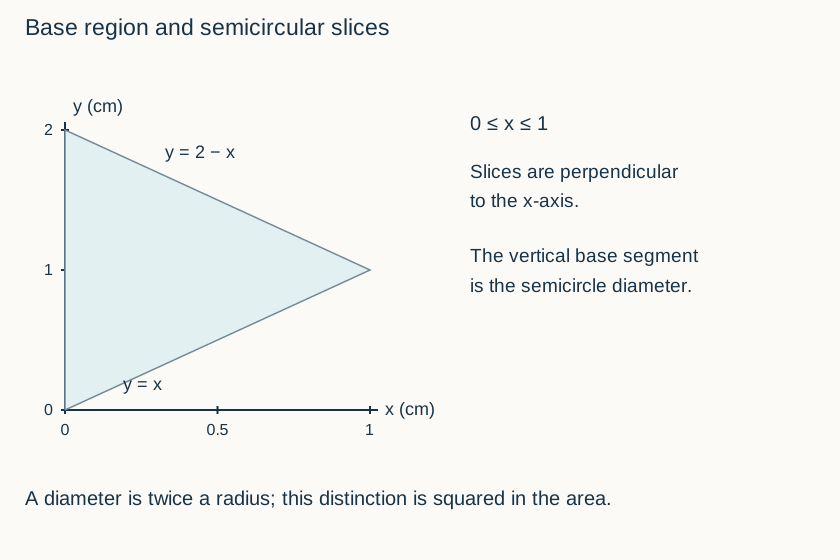
Inspect diagram labels
The diagram keeps its full size here. Focus the view and use the arrow keys, or scroll across it, to inspect every label.
Written working workspace
Drawing is temporarily unavailable. Work on paper if needed, then record your reasoning here.
Saving written working requires JavaScript. Keep your work on paper or in your own notes; the source problem above remains available.
Worked solution and rubric →Revisit the explanation →Revisit the explanation →
For the teacher
- Pair triangle and semicircle problems with the same base region. Ask students to identify the geometric coefficient before integration. Include one directly supplied A(x) to emphasize the general slice principle.
Glossary and deeper reading · 3 refreshers
These editorial refreshers supplement the reading. Definitions and examples are added guidance; original source wording and recorded answers remain in their original context.
-
Cross section
A cross section is the planar slice of a solid made by a specified cutting plane. For volume by integration, its area must be expressed as a function of the position along the slicing direction. For example, a square slice with side s(x) has area s(x)². Integrating those areas over the allowed positions yields volume under the method’s assumptions.
-
Integral
Integration can mean accumulating a function over an interval or finding an antiderivative. A definite integral gives a number, while an indefinite integral represents a family of antiderivatives. For example, integrating 2x indefinitely gives x²+C, and integrating it from 0 to 2 gives 4. The Fundamental Theorem of Calculus connects these two operations under its hypotheses.
-
Definite integral
A definite integral accumulates a function over a specified interval as a limit of Riemann sums when that limit exists. Its sign includes the function’s sign and the orientation of the limits. For example, the integral of the constant −2 from 0 to 3 is −6, although the geometric area is 6. In a rate model, the result has rate units multiplied by input units.