Access this content offline
Omniguides
Skip to the reading

AP Unit 8 Solutions

Worked solutions to all thirty Unit 8 problems. Each solution gives the mathematical steps and the reason for using them. Compare your setup and justification as well as the final answer.

Return to the problems →

Problem 1

Find the average value of f(x)=x² on [0,3] and a point where f takes that value.

Shared AB/BC problem; the same mathematical solution applies in both courses.

  1. Compute ∫₀³ x²dx=9 and divide by 3−0=3. Reason: Average value is integral divided by interval length.
  2. Solve c²=3 and retain c=√3 in [0,3]. Reason: The point must lie in the specified interval.

Answer: Average 3; c=√3.

Final answer

Average 3; c=√3.

Return to problem 1 →

Review the teaching: Topic 8.1

Problem 2

Temperature samples
t (min)025
T(t) (°C)101420
Use trapezoidal approximation to estimate the average temperature on [0,5].

Shared AB/BC problem; the same mathematical solution applies in both courses.

  1. Approximate ∫Tdt by ½(10+14)·2+½(14+20)·3=75 °C·min. Reason: Use the nonuniform widths and average endpoint temperatures.
  2. Divide by 5 min to get 15°C. Reason: Average value normalizes by the full interval length.

Answer: 15°C.

Final answer

15°C.

Return to problem 2 →

Review the teaching: Topic 8.1

Problem 3

A particle has v(t)=2t−2 m/s on [0,3] and s(0)=5 m. Find its final position and total distance.

Shared AB/BC problem; the same mathematical solution applies in both courses.

  1. Displacement ∫₀³vdt=[t²−2t]₀³=3 m, so final position is 5+3=8 m. Reason: Position is initial position plus velocity accumulation.
  2. Velocity changes sign at t=1; distance=−∫₀¹v+∫₁³v=1+4=5 m. Reason: Speed is the absolute value of velocity.

Answer: s(3)=8 m; distance 5 m.

Final answer

s(3)=8 m; distance 5 m.

Return to problem 3 →

Review the teaching: Topic 8.2

Problem 4

Acceleration is a(t)=6t m/s² and v(0)=−2 m/s. Find v(2) and the first nonnegative time the particle changes direction.

Shared AB/BC problem; the same mathematical solution applies in both courses.

  1. Integrate to v(t)=3t²−2. Reason: Include the initial velocity in the acceleration integral.
  2. At t=2, v=12−2=10. Solve 3t²−2=0 for t≥0. Reason: A direction change requires velocity zero with a sign change, which this increasing velocity has.

Answer: v(2)=10 m/s; direction changes at t=√(2/3) s.

Final answer

v(2)=10 m/s; direction changes at t=√(2/3) s.

Return to problem 4 →

Review the teaching: Topic 8.2

Problem 5

A velocity graph consists of a triangle above the axis on [0,2] with height 4 m/s and a triangle below on [2,5] with depth 2 m/s. Find displacement and distance.

Shared AB/BC problem; the same mathematical solution applies in both courses.

  1. Signed areas are ½·2·4=4 and −½·3·2=−3. Reason: Velocity area represents displacement with signs.
  2. Add signed areas for 1 m and their magnitudes for 7 m. Reason: Distance integrates speed.

Answer: Displacement 1 m; distance 7 m.

Final answer

Displacement 1 m; distance 7 m.

Return to problem 5 →

Review the teaching: Topic 8.2

Problem 6

A tank starts with 10 L and has net rate 6−2t L/min for 0≤t≤4. Find its maximum volume and the time it occurs.

Shared AB/BC problem; the same mathematical solution applies in both courses.

  1. V(t)=10+∫₀ᵗ(6−2u)du=10+6t−t². Reason: Integrate net rate and include the initial amount.
  2. Critical time is 3; compare V(0)=10,V(3)=19,V(4)=18. Reason: A maximum on a closed interval occurs among endpoints and derivative-zero candidates.

Answer: 19 L at t=3 min.

Final answer

19 L at t=3 min.

Return to problem 6 →

Review the teaching: Topic 8.3

Problem 7

Inventory starts at 50 items. Inflow is 5t items/hour and outflow is 2 items/hour on [0,3]. Find the inventory at hour 3.

Shared AB/BC problem; the same mathematical solution applies in both courses.

  1. Net rate is 5t−2. Reason: Subtract outflow from inflow.
  2. Net change is ∫₀³(5t−2)dt=22.5−6=16.5. Reason: Integrate the net rate over the time interval.
  3. Add 50 to obtain 66.5. Reason: The integral gives change rather than final inventory; the model treats inventory continuously.

Answer: 66.5 items in the continuous model.

Final answer

66.5 items in the continuous model.

Return to problem 7 →

Review the teaching: Topic 8.3

Problem 8

A rate r(t) is measured in dollars/day. Explain the meaning and units of ∫₂⁷ r(t)dt, and how to use it if the account balance at day 2 is $100.

Shared AB/BC problem; the same mathematical solution applies in both courses.

  1. Rate units times day units produce dollars. Reason: Integral accumulation multiplies rate by elapsed time.
  2. Add the change to the starting balance. Reason: The net-change principle connects initial and final amounts.

Answer: Net balance change from day 2 to day 7, in dollars; final balance is 100+∫₂⁷ r(t)dt.

Final answer

Net balance change from day 2 to day 7, in dollars; final balance is 100+∫₂⁷ r(t)dt.

Return to problem 8 →

Review the teaching: Topic 8.3

Problem 9

Find the area enclosed by y=x and y=x².

Shared AB/BC problem; the same mathematical solution applies in both courses.

  1. Intersections solve x=x², giving 0 and 1. Reason: These are the region’s bounds.
  2. On (0,1), x>x², so area=∫₀¹(x−x²)dx=1/2−1/3=1/6. Reason: Integrate top minus bottom.

Answer: 1/6 square unit.

Final answer

1/6 square unit.

Return to problem 9 →

Review the teaching: Topic 8.4

Problem 10

Find the area enclosed by y=4 and y=x².

Shared AB/BC problem; the same mathematical solution applies in both courses.

  1. Solve x²=4 to find −2 and 2; the constant curve is above. Reason: Intersections and ordering determine vertical strips.
  2. Evaluate ∫₋₂²(4−x²)dx=16−16/3=32/3. Reason: Area is the integral of positive strip height.

Answer: 32/3 square units.

Final answer

32/3 square units.

Return to problem 10 →

Review the teaching: Topic 8.4

Problem 11

Find the area between x=y and x=y² using horizontal strips.

Shared AB/BC problem; the same mathematical solution applies in both courses.

  1. Intersections are y=0 and y=1; y is right of y² between them. Reason: Horizontal strips use right minus left.
  2. Integrate ∫₀¹(y−y²)dy=1/6. Reason: Use y-bounds and dy consistently.

Answer: 1/6 square unit.

Final answer

1/6 square unit.

Return to problem 11 →

Review the teaching: Topic 8.5

Problem 12

Find the area of the region 0≤y≤2, 0≤x≤y².

Shared AB/BC problem; the same mathematical solution applies in both courses.

  1. A horizontal strip extends from x=0 to x=y². Reason: Its width is right minus left.
  2. Area=∫₀² y²dy=8/3. Reason: Integrate the horizontal strip width in y.

Answer: 8/3 square units.

Final answer

8/3 square units.

Return to problem 12 →

Review the teaching: Topic 8.5

Problem 13

Find the total area between y=x and y=x³ on [−1,1].

Shared AB/BC problem; the same mathematical solution applies in both courses.

  1. Crossings occur at −1,0,1. The cubic is above on [−1,0] and the line above on [0,1]. Reason: Order changes at the interior crossing.
  2. Use symmetry: area=2∫₀¹(x−x³)dx=2(1/2−1/4)=1/2. Reason: Both lobes have equal positive area.

Answer: 1/2 square unit.

Final answer

1/2 square unit.

Return to problem 13 →

Review the teaching: Topic 8.6

Problem 14

Find the area between y=sin x and the x-axis on [0,2π]. Also give the signed integral.

Shared AB/BC problem; the same mathematical solution applies in both courses.

  1. Sine is positive on (0,π) and negative on (π,2π). Reason: Split at the sign change.
  2. The two lobe magnitudes are 2 each; signed values are +2 and −2. Reason: Geometric area adds magnitudes while the integral retains signs.

Answer: Area 4; signed integral 0.

Final answer

Area 4; signed integral 0.

Return to problem 14 →

Review the teaching: Topic 8.6

Problem 15

The base lies between y=x and y=x² on [0,1]. Cross sections perpendicular to the x-axis are squares. Find the volume.

Shared AB/BC problem; the same mathematical solution applies in both courses.

  1. The side is s=x−x², so A=(x−x²)². Reason: The base segment supplies the square’s side.
  2. Integrate ∫₀¹(x²−2x³+x⁴)dx=1/3−1/2+1/5=1/30. Reason: Volume integrates cross-sectional area.

Answer: 1/30 cubic unit.

Final answer

1/30 cubic unit.

Return to problem 15 →

Review the teaching: Topic 8.7

Problem 16

On 0≤x≤2, each rectangular cross section has base 2−x and height three times its base. Find the volume.

Shared AB/BC problem; the same mathematical solution applies in both courses.

  1. Area is 3(2−x)². Reason: Rectangle area is base times height.
  2. V=3∫₀²(2−x)²dx=3·8/3=8. Reason: Integrate the known slice area.

Answer: 8 cubic units.

Final answer

8 cubic units.

Return to problem 16 →

Review the teaching: Topic 8.7

Problem 17

The base lies between y=x and y=x² on [0,1]. Perpendicular-to-x slices are equilateral triangles with this vertical segment as a side. Find the volume.

Shared AB/BC problem; the same mathematical solution applies in both courses.

  1. For side s=x−x², triangle area is √3·s²/4. Reason: The equilateral-triangle geometry specifies height.
  2. V=(√3/4)∫₀¹(x−x²)²dx=(√3/4)(1/30). Reason: Use the same base-strip length in the triangle area formula.

Answer: √3/120 cubic unit.

Final answer

√3/120 cubic unit.

Return to problem 17 →

Review the teaching: Topic 8.8

Problem 18

The base lies between y=0 and y=2−x on [0,2]. Perpendicular-to-x sections are semicircles with diameter 2−x. Find the volume.

Shared AB/BC problem; the same mathematical solution applies in both courses.

  1. Radius=(2−x)/2, giving A=π(2−x)²/8. Reason: A semicircle is half a disc; the given segment is diameter.
  2. Integrate V=(π/8)(8/3)=π/3. Reason: Volume is the integral of slice area.

Answer: π/3 cubic units.

Final answer

π/3 cubic units.

Return to problem 18 →

Review the teaching: Topic 8.8

Problem 19

Rotate the region 0≤y≤√x, 0≤x≤4, about the x-axis. Find the volume.

Shared AB/BC problem; the same mathematical solution applies in both courses.

  1. A perpendicular slice forms a disc of radius √x. Reason: The region reaches the x-axis.
  2. V=π∫₀⁴x dx=8π. Reason: Square the radius to get slice area.

Answer: 8π cubic units.

Final answer

8π cubic units.

Return to problem 19 →

Review the teaching: Topic 8.9

Problem 20

Rotate the region 0≤x≤√y, 0≤y≤4, about the y-axis. Find the volume.

Shared AB/BC problem; the same mathematical solution applies in both courses.

  1. Use horizontal slices with radius √y. Reason: Discs must be perpendicular to the vertical axis.
  2. V=π∫₀⁴y dy=8π. Reason: Use the y-bounds with dy.

Answer: 8π cubic units.

Final answer

8π cubic units.

Return to problem 20 →

Review the teaching: Topic 8.9

Problem 21

Rotate the region 1≤y≤1+x, 0≤x≤2, about y=1. Find the volume.

Shared AB/BC problem; the same mathematical solution applies in both courses.

  1. Radius is (1+x)−1=x; the region reaches the axis. Reason: Distance from the shifted axis determines the disc radius.
  2. V=π∫₀²x²dx=8π/3. Reason: Integrate the disc areas.

Answer: 8π/3 cubic units.

Final answer

8π/3 cubic units.

Return to problem 21 →

Review the teaching: Topic 8.10

Problem 22

Rotate the region x≤y≤2, 0≤x≤2, about the x-axis. Find the volume.

Shared AB/BC problem; the same mathematical solution applies in both courses.

  1. Outer radius is 2, inner radius is x. Reason: Both are distances from y=0, with a hole for x>0.
  2. V=π∫₀²(4−x²)dx=π(8−8/3)=16π/3. Reason: Subtract inner disc area from outer disc area.

Answer: 16π/3 cubic units.

Final answer

16π/3 cubic units.

Return to problem 22 →

Review the teaching: Topic 8.11

Problem 23

Rotate the region x≤y≤2, 0≤x≤2, about y=3. Find the volume.

Shared AB/BC problem; the same mathematical solution applies in both courses.

  1. Outer radius is 3−x and inner radius is 1. Reason: The lower boundary is farther from the axis above the region.
  2. V=π∫₀²[(3−x)²−1]dx=π∫₀²(8−6x+x²)dx=20π/3. Reason: Square each distance separately, then subtract.

Answer: 20π/3 cubic units.

Final answer

20π/3 cubic units.

Return to problem 23 →

Review the teaching: Topic 8.12

Problem 24

Use a calculator to find the area between y=e^(−x²) and y=x on [0,1], to three decimal places. Show the intersection and the integral setup.

Shared AB/BC problem; the same mathematical solution applies in both courses.

  1. Solve e^(−c²)=c in [0,1], giving c≈0.6529186404. Reason: The curves exchange order at their unique crossing; e^(−x²)−x is strictly decreasing for x≥0.
  2. Use ∫₀ᶜ[e^(−x²)−x]dx+∫꜀¹[x−e^(−x²)]dx. Reason: Area needs positive height on both pieces.
  3. Numerically evaluate the sum, approximately 0.4686590006, and round to 0.469. Reason: Keep the unrounded root and integrals in calculator memory.

Answer: Intersection c≈0.652919; area ≈0.469 square unit.

Final answer

Intersection c≈0.652919; area ≈0.469 square unit.

Return to problem 24 →

Review the teaching: Topic 8.4

Problem 25

Find the length of y=3x+1 on [0,2]. Verify it using endpoint distance.

  1. Derivative is 3, so L=∫₀²√(1+9)dx=2√10. Reason: Use the smooth graph arc-length formula.
  2. Endpoints are (0,1) and (2,7); distance is √(2²+6²)=2√10. Reason: A straight segment’s length equals its endpoint distance.

Answer: 2√10 length units.

Final answer

2√10 length units.

Return to problem 25 →

Review the teaching: Topic 8.13

Problem 26

Find the arc length of y=(2/3)x^(3/2) on [0,3].

  1. Derivative is √x, continuous on [0,3], so L=∫₀³√(1+x)dx. Reason: The arc-length formula requires the derivative, squared.
  2. Evaluate (2/3)[(1+x)^(3/2)]₀³=(2/3)(8−1)=14/3. Reason: A linear substitution evaluates the length integral.

Answer: 14/3 length units.

Final answer

14/3 length units.

Return to problem 26 →

Review the teaching: Topic 8.13

Problem 27

Use a calculator to find the length of y=x²/2 on [0,2], to three decimals.

  1. Derivative is x, so enter ∫₀²√(1+x²)dx. Reason: The graph is smooth and the length integrand uses its slope.
  2. Numerical value is approximately 2.9578857151; round to 2.958. Reason: Round the final integration result.

Answer: 2.958 length units.

Final answer

2.958 length units.

Return to problem 27 →

Review the teaching: Topic 8.13

Problem 28

A curve is given by x=y²/2 for 0≤y≤2. Write a length integral and approximate it to three decimals with a calculator.

  1. Differentiate with respect to y: dx/dy=y. Reason: The curve is expressed as x=g(y), so y is the integration variable.
  2. Use L=∫₀²√(1+y²)dy≈2.9578857151. Reason: The horizontal and vertical small distances lead to the same length formula.

Answer: ∫₀²√(1+y²)dy ≈2.958 length units.

Final answer

∫₀²√(1+y²)dy ≈2.958 length units.

Return to problem 28 →

Review the teaching: Topic 8.13

Problem 29

For y=x on [0,1], compare horizontal distance, area under the graph, and arc length. Give units for each.

  1. Horizontal width is 1−0=1; area is ∫₀¹x dx=1/2. Reason: Width and area measure different geometric quantities.
  2. Arc length is ∫₀¹√(1+1²)dx=√2. Reason: The curve includes both horizontal and vertical motion.

Answer: Horizontal distance 1 length unit; area 1/2 square unit; arc length √2 length units.

Final answer

Horizontal distance 1 length unit; area 1/2 square unit; arc length √2 length units.

Return to problem 29 →

Review the teaching: Topic 8.13

Problem 30

The graph y=|x| on [−1,1] has a corner at 0. Find its length and explain why you split the interval.

  1. On (−1,0), slope is −1; on (0,1), slope is 1. Reason: The derivative fails at the corner, so apply the smooth formula separately.
  2. Each segment has length ∫√2 dx=√2 over a unit interval; add to get 2√2. Reason: Lengths of adjoining smooth pieces add.

Answer: 2√2 length units.

Final answer

2√2 length units.

Return to problem 30 →

Review the teaching: Topic 8.13

Explain and apply: worked solutions

Compare the setup and the reasoning, as well as the final answer. Use the rubric to find your next step; equivalent correct reasoning earns the same credit.

Build a triangular solid from a curved base

The planar base is bounded by y = x² and y = 4 on −2 ≤ x ≤ 2. Coordinates are in centimeters. Sections perpendicular to the x-axis are right triangles whose base is the vertical segment in the region and whose height is half that base. The supplied figure shows the actual base region.
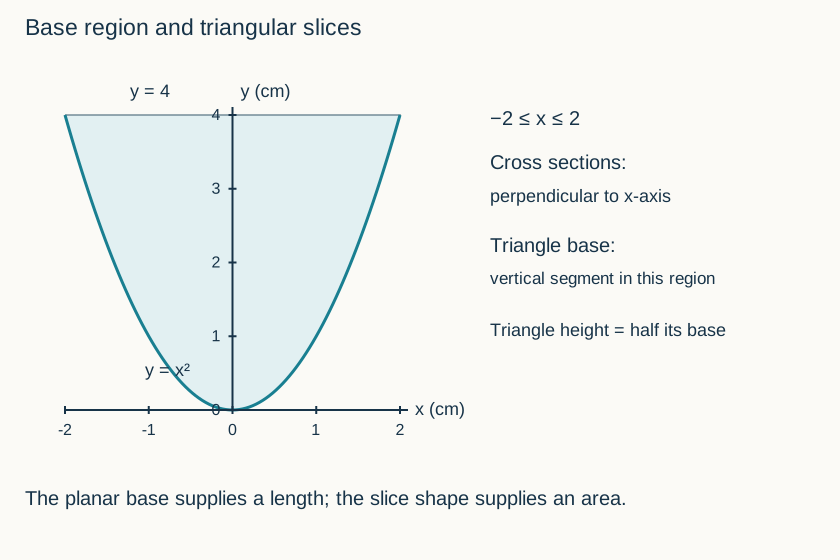
The base lies between y equals x squared and y equals 4 on minus 2 to 2 centimeters in x. Triangles are perpendicular to the x axis with height half their base.
Triangular slice geometry
Inspect diagram labels

The diagram keeps its full size here. Focus the view and use the arrow keys, or scroll across it, to inspect every label.
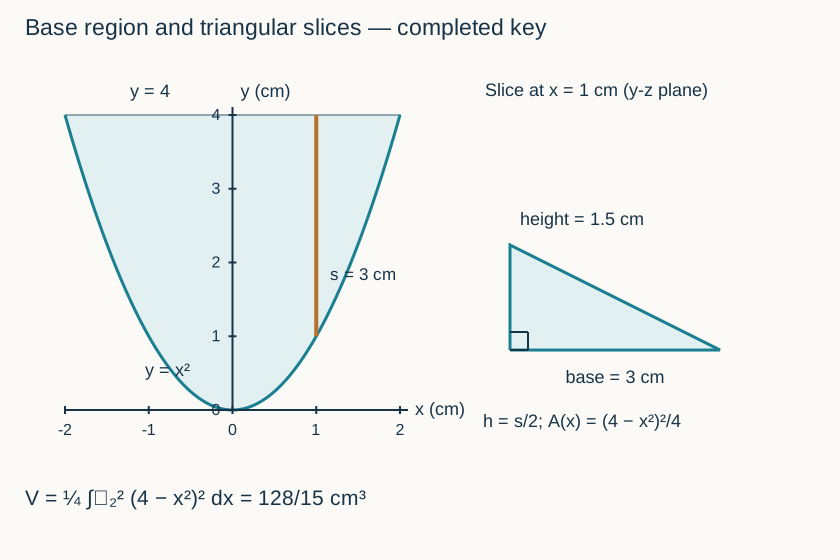
The base lies between y equals x squared and y equals 4 on minus 2 to 2 centimeters in x. Triangles are perpendicular to the x axis with height half their base.

View diagram in a separate tab ↗

Part a

Sketch and label a representative triangular cross section at x = 1, including its base and height. Find the general base length s(x), height h(x) and area A(x), and state the slice direction and thickness.

The general base length is s(x) = 4 − x² cm, height h(x) = (4 − x²)/2 cm, and area A(x) = (4 − x²)²/4 cm². At x = 1 the triangle has base 3 cm and height 1.5 cm, with a right angle between them. The section lies in a plane perpendicular to x and has thickness dx. The completed key shows the base strip and the correctly proportioned right triangle.

  1. Subtract lower from upper base boundary.
  2. Use the specified half-base height, not an assumed equilateral formula.
  3. Apply ½bh and identify the perpendicular slice thickness.
Scoring criteria
  • 1 point: correct labeled triangle at x = 1 with base 3 cm and height 1.5 cm.
  • 1 point: correct s, h and area formulas.
  • 1 point: correct perpendicular-to-x direction and dx thickness.

Part b

Construct the full definite integral for the solid’s volume with its actual bounds. Evaluate it exactly and explain the units. Do not stop at a cross-sectional area formula.

V = ¼∫₋₂²(4 − x²)² dx = ¼∫₋₂²(16 − 8x² + x⁴) dx. An antiderivative is ¼(16x − 8x³/3 + x⁵/5). Evaluating at 2 and −2 gives 128/15 cm³. Alternatively the even integrand gives ½[16x − 8x³/3 + x⁵/5]₀² = 128/15. Area in cm² multiplied by thickness in cm gives cubic centimeters.

  1. Use the full base extent −2 to 2.
  2. Square the whole base length and multiply by the triangle coefficient.
  3. Expand and integrate the polynomial.
  4. Evaluate both bounds, using symmetry only with a correct factor of two.
Scoring criteria
  • 1 point: correct definite integral with −2 and 2 bounds.
  • 1 point: correct expansion/antiderivative and evaluation 128/15.
  • 1 point: correct cm³ units with area-times-thickness explanation.

Part c

A second solid uses the same base and slice direction but triangle height equal to its base instead of half its base. Construct and evaluate its volume integral, then explain the factor change from the first solid.

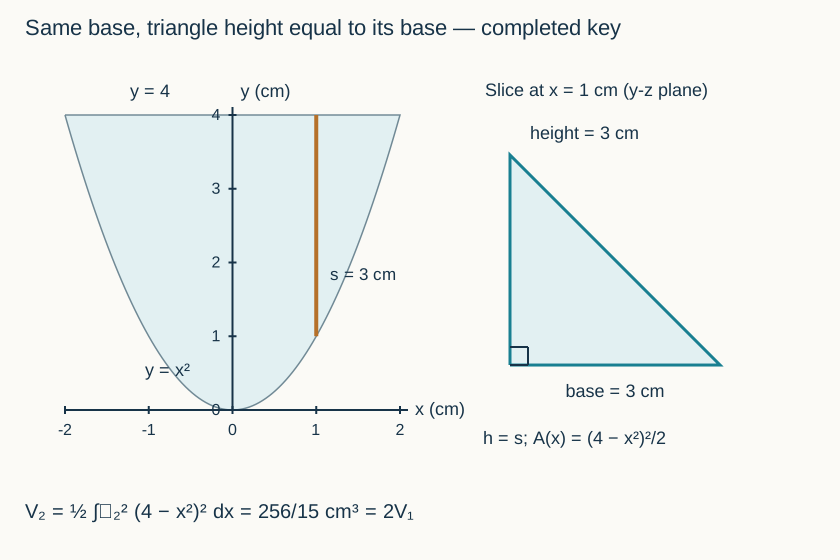
The second area is ½(4 − x²)². Its volume is V₂ = ½∫₋₂²(4 − x²)² dx = 256/15 cm³. The triangle height doubles while each base and slice thickness stay fixed, so each slice area and the total volume double.

  1. Apply the new height relation in ½bh.
  2. Write the full integral over the unchanged bounds.
  3. Use the previously evaluated squared-base integral and compare the coefficients.
Scoring criteria
  • 1 point: new area and full integral with correct coefficient and bounds.
  • 1 point: 256/15 cm³ and a geometric explanation of doubling.
The base lies between y equals x squared and y equals 4 on minus 2 to 2 centimeters in x. Triangles are perpendicular to the x axis with height half their base. A representative slice at x equals 1 has base 3 centimeters and height 1.5 centimeters. Its area model is one quarter of (4 minus x squared) squared and volume is 128/15 cubic centimeters.
Triangular slice geometry and volume key
Inspect diagram labels

The diagram keeps its full size here. Focus the view and use the arrow keys, or scroll across it, to inspect every label.
The base lies between y equals x squared and y equals 4 on minus 2 to 2 centimeters in x. Triangles are perpendicular to the x axis with height half their base. A representative slice at x equals 1 has base 3 centimeters and height 1.5 centimeters. Its area model is one quarter of (4 minus x squared) squared and volume is 128/15 cubic centimeters.

View diagram in a separate tab ↗

The base lies between y equals x squared and y equals 4 on minus 2 to 2 centimeters. At x equals 1 the changed triangular cross section has base 3 centimeters and height 3 centimeters, drawn at the same scale. Both lengths are s equals 4 minus x squared, so area is (4 minus x squared) squared divided by 2. The full volume integral is 256/15 cubic centimeters, twice the first triangular solid volume.
Equal-base-and-height triangular slice and volume key
Inspect diagram labels

The diagram keeps its full size here. Focus the view and use the arrow keys, or scroll across it, to inspect every label.

The base lies between y equals x squared and y equals 4 on minus 2 to 2 centimeters. At x equals 1 the changed triangular cross section has base 3 centimeters and height 3 centimeters, drawn at the same scale. Both lengths are s equals 4 minus x squared, so area is (4 minus x squared) squared divided by 2. The full volume integral is 256/15 cubic centimeters, twice the first triangular solid volume.

View diagram in a separate tab ↗

A diameter makes a semicircular volume

The base lies between y = x and y = 2 − x on 0 ≤ x ≤ 1, with coordinates in centimeters. Sections perpendicular to the x-axis are semicircles whose diameter is the vertical segment between these curves.
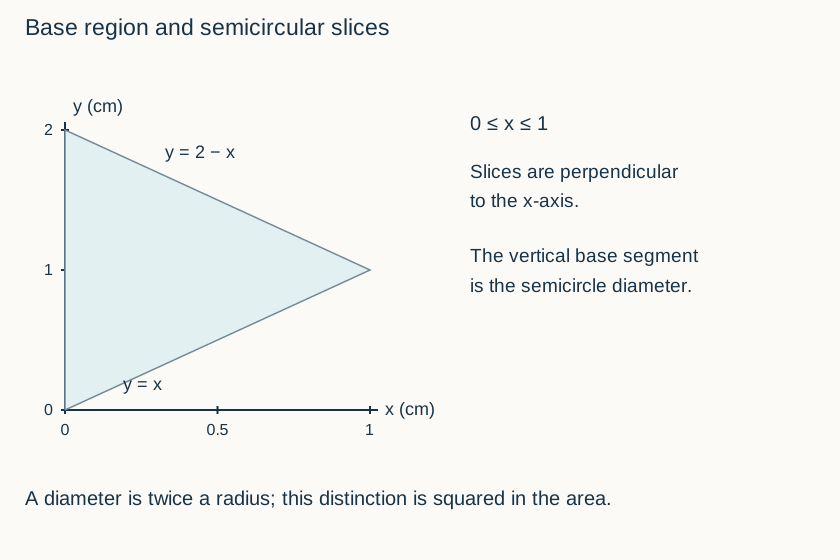
The base lies between y equals x and y equals 2 minus x on 0 to 1 centimeter in x. Perpendicular-to-x sections use the vertical segment as semicircle diameter.
Semicircular slice geometry
Inspect diagram labels

The diagram keeps its full size here. Focus the view and use the arrow keys, or scroll across it, to inspect every label.
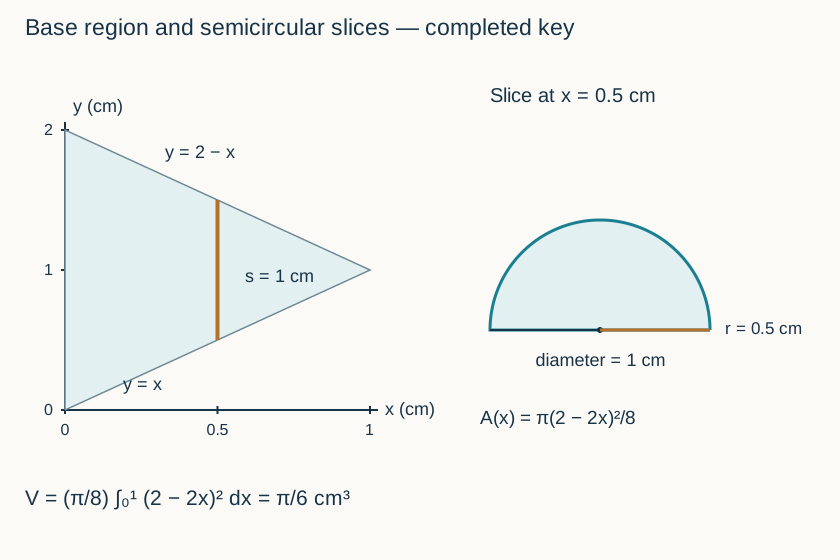
The base lies between y equals x and y equals 2 minus x on 0 to 1 centimeter in x. Perpendicular-to-x sections use the vertical segment as semicircle diameter.

View diagram in a separate tab ↗

Part a

Use the supplied base figure to determine the diameter s(x), radius r(x) and semicircle area A(x). Sketch a correctly proportioned cross section at x = 0.5, labeling its diameter and radius. Explain the factor 1/8 in the area coefficient.

s(x) = (2 − x) − x = 2 − 2x cm, r(x) = 1 − x cm, and A(x) = ½πr² = π(2 − 2x)²/8 cm². At x = 0.5 the diameter is 1 cm and radius 0.5 cm; the completed key shows a true semicircle with that ratio. The factor 1/8 combines half a circle with the squared factor (1/2)² from converting diameter to radius.

  1. Find the vertical distance between the two actual boundaries.
  2. Halve the diameter before squaring.
  3. Multiply the circular area by one half and draw the stated shape.
Scoring criteria
  • 1 point: correct diameter, radius and area functions.
  • 1 point: correctly proportioned labeled semicircle at x = 0.5.
  • 1 point: explains both factors making 1/8.

Part b

Construct and evaluate the full definite integral for the semicircular solid’s volume. State the actual interval, slice thickness and final units.

V = (π/8)∫₀¹(2 − 2x)² dx = (π/2)∫₀¹(1 − 2x + x²) dx = (π/2)[x − x² + x³/3]₀¹ = π/6 cm³. The thickness is dx and the bounds are 0 and 1 from the stated base interval.

  1. Use area πs²/8 and the actual x-bounds.
  2. Expand or factor the squared expression without dropping the factor 4.
  3. Evaluate the polynomial antiderivative and retain exact π.
Scoring criteria
  • 1 point: correct full integral, dx and bounds.
  • 1 point: evaluation π/6 cm³ with valid intermediate steps.

Part c

For a different solid on the same base and interval, suppose each cross section is a full circle whose radius, rather than diameter, is s(x). Construct and evaluate its volume integral, and explain its volume ratio to the semicircular solid.

The full circle has area πs² = π(2 − 2x)². Thus V_circle = π∫₀¹(2 − 2x)² dx = 4π/3 cm³. Its volume is 8 times π/6. The radius is twice the semicircle radius, making the area four times larger, and the full circle also replaces a half-circle with a whole circle, giving another factor 2. The base interval and thickness are unchanged.

  1. Respect the new statement that s itself is the radius.
  2. Use full-circle area and integrate it over 0 to 1.
  3. Compare the geometric coefficients π and π/8.
Scoring criteria
  • 1 point: correct circle integral and 4π/3 cm³.
  • 1 point: ratio 8 explained by both radius-squared and whole-versus-half factors.
The base lies between y equals x and y equals 2 minus x on 0 to 1 centimeter in x. Perpendicular-to-x sections use the vertical segment as semicircle diameter. At x equals 0.5 the diameter is 1 centimeter, radius is 0.5 centimeter, and the true semicircle shows that ratio. The slice area is pi times (2 minus 2x) squared divided by 8, giving volume pi/6 cubic centimeters.
Semicircular slice geometry and volume key
Inspect diagram labels

The diagram keeps its full size here. Focus the view and use the arrow keys, or scroll across it, to inspect every label.
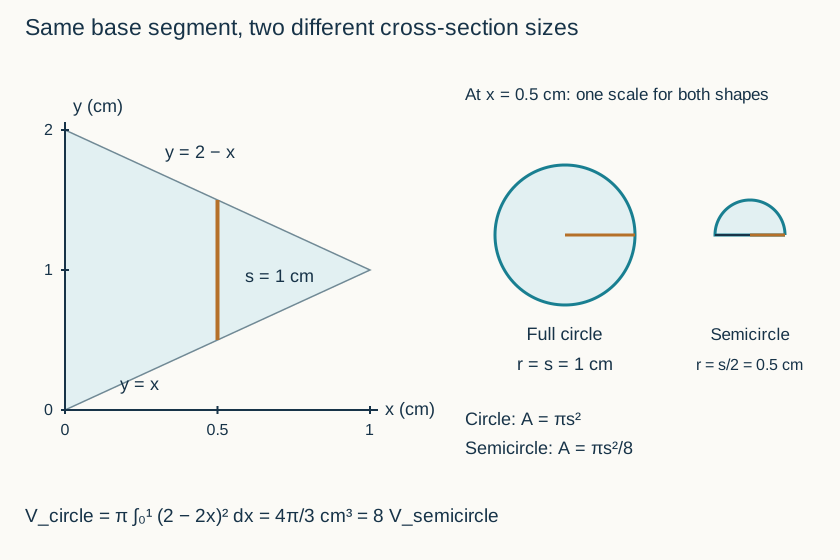
The base lies between y equals x and y equals 2 minus x on 0 to 1 centimeter in x. Perpendicular-to-x sections use the vertical segment as semicircle diameter. At x equals 0.5 the diameter is 1 centimeter, radius is 0.5 centimeter, and the true semicircle shows that ratio. The slice area is pi times (2 minus 2x) squared divided by 8, giving volume pi/6 cubic centimeters.

View diagram in a separate tab ↗

The same base between y equals x and y equals 2 minus x on 0 to 1 centimeter gives segment length s equals 2 minus 2x. At x equals 0.5 a full circle whose radius is s has radius 1 centimeter, while the semicircle whose diameter is s has radius 0.5 centimeter. Both shapes use the same drawing scale, demonstrating the area ratio eight. The circle volume integral evaluates to 4 pi/3 cubic centimeters.
Full-circle radius geometry and completed volume key
Inspect diagram labels

The diagram keeps its full size here. Focus the view and use the arrow keys, or scroll across it, to inspect every label.

The same base between y equals x and y equals 2 minus x on 0 to 1 centimeter gives segment length s equals 2 minus 2x. At x equals 0.5 a full circle whose radius is s has radius 1 centimeter, while the semicircle whose diameter is s has radius 0.5 centimeter. Both shapes use the same drawing scale, demonstrating the area ratio eight. The circle volume integral evaluates to 4 pi/3 cubic centimeters.

View diagram in a separate tab ↗

Rotate one actual base about two axes

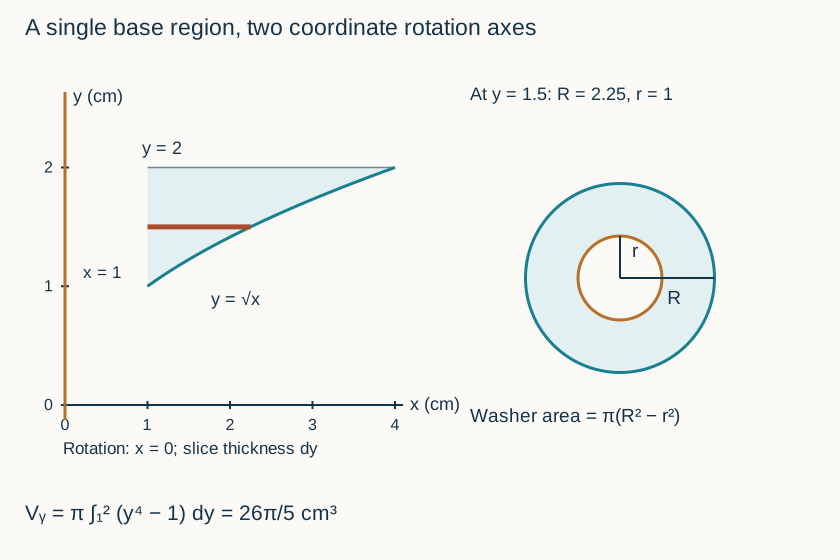
The base region is 1 ≤ x ≤ 4 and √x ≤ y ≤ 2. Coordinates are in centimeters. Compare solids made by rotating this actual region about the x-axis and about the y-axis; use washers perpendicular to each selected axis.
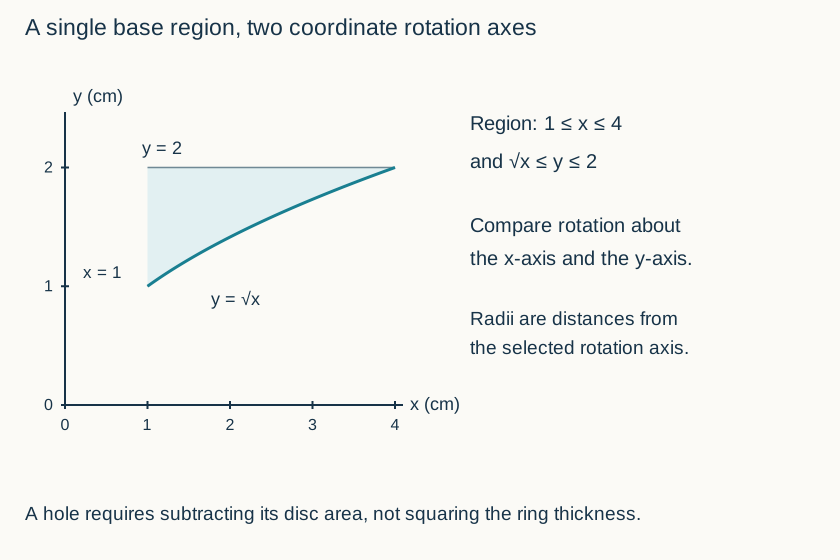
The base region is 1 to 4 centimeters in x, between y equals square root of x and y equals 2. Both coordinate axes are visible; the task asks for perpendicular slices and washers about each.
Coordinate-axis washer geometry
Inspect diagram labels

The diagram keeps its full size here. Focus the view and use the arrow keys, or scroll across it, to inspect every label.
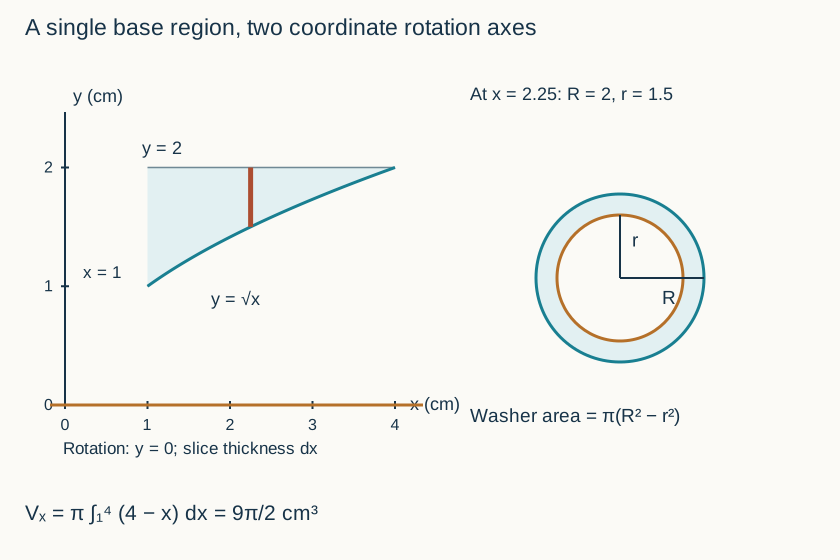
The base region is 1 to 4 centimeters in x, between y equals square root of x and y equals 2. Both coordinate axes are visible; the task asks for perpendicular slices and washers about each.

View diagram in a separate tab ↗

Part a

For rotation about the x-axis, sketch a representative vertical base slice and the resulting washer at x = 2.25. Label the rotation axis, outer and inner radii and slice thickness, then give R(x), r(x) and the area function. Explain why π(R − r)² is not this washer’s area.

The axis is y = 0. A vertical dx slice runs from y = √x to y = 2, giving R(x) = 2 cm, r(x) = √x cm and A(x) = π(4 − x) cm². At x = 2.25 the outer radius is 2 cm and inner radius 1.5 cm. The completed x-axis key shows those radii at their true ratio and the perpendicular base slice. Area is outer disc area minus inner hole area; π(R − r)² instead squares the ring thickness as if it were a filled disc radius.

  1. Measure both distances from y = 0.
  2. Identify the vertical slice and dx thickness.
  3. Subtract the two separately squared disc radii.
Scoring criteria
  • 1 point: correct labeled base slice and washer, including radii 2 and 1.5 cm.
  • 1 point: correct general radii and area function.
  • 1 point: explains the ring-thickness error and states dx.

Part b

Construct and evaluate the full volume integral for rotation about the x-axis. Include the actual bounds and units.

Vₓ = π∫₁⁴(4 − x) dx = π[4x − x²/2]₁⁴ = π(8 − 7/2) = 9π/2 cm³.

  1. Use the washer area from the two measured radii.
  2. Keep the original x-interval 1 to 4.
  3. Evaluate both endpoints and attach cubic units.
Scoring criteria
  • 1 point: correct full definite integral.
  • 1 point: evaluation 9π/2 cm³ with valid endpoint calculation.

Part c

For rotation about the y-axis, rewrite the same base with horizontal slices and actual y-bounds. Sketch the slice and its washer at y = 1.5, label both radii and thickness, then construct and evaluate the full volume integral. Explain why the x-axis integral cannot simply be reused.

The region is equivalently 1 ≤ y ≤ 2 and 1 ≤ x ≤ y². Horizontal dy slices give R(y) = y² cm and r(y) = 1 cm. At y = 1.5 the outer radius is 2.25 cm and inner radius is 1 cm, as shown in the completed y-axis key. Vᵧ = π∫₁²(y⁴ − 1) dy = π[y⁵/5 − y]₁² = 26π/5 cm³. The radius now measures horizontal distance from x = 0, the slice variable is y and the bounds are 1 to 2; these differ from the x-axis rotation.

  1. Solve y ≥ √x as x ≤ y² while respecting x ≥ 1 and y ≤ 2.
  2. Identify the full horizontal slice extent and y-bounds.
  3. Measure both horizontal distances from the y-axis.
  4. Subtract disc areas, integrate with dy and evaluate.
Scoring criteria
  • 1 point: correct horizontal region and y-bounds.
  • 1 point: labeled sketch with R = 2.25, r = 1 cm and dy.
  • 1 point: correct integral and evaluation 26π/5 cm³.
  • 1 point: explains why radii, variable and bounds change with the axis.
The base region is 1 to 4 centimeters in x, between y equals square root of x and y equals 2. About the x-axis a vertical slice rotates to a washer. The representative x equals 2.25 slice has outer radius 2 centimeters and inner radius 1.5 centimeters, shown by concentric circles at their true ratio. The integral pi from 1 to 4 of (4 minus x) dx evaluates to 9 pi/2 cubic centimeters.
Coordinate-axis washer geometry and x-axis completed key
Inspect diagram labels

The diagram keeps its full size here. Focus the view and use the arrow keys, or scroll across it, to inspect every label.
The base region is 1 to 4 centimeters in x, between y equals square root of x and y equals 2. About the x-axis a vertical slice rotates to a washer. The representative x equals 2.25 slice has outer radius 2 centimeters and inner radius 1.5 centimeters, shown by concentric circles at their true ratio. The integral pi from 1 to 4 of (4 minus x) dx evaluates to 9 pi/2 cubic centimeters.

View diagram in a separate tab ↗

The base region is 1 to 4 centimeters in x, between y equals square root of x and y equals 2. About the y-axis a horizontal slice runs from x equals 1 to x equals y squared. At y equals 1.5 its outer radius is 2.25 centimeters and inner radius 1 centimeter, shown at their true ratio. The integral pi from 1 to 2 of (y to the fourth minus 1) dy is 26 pi/5 cubic centimeters.
Coordinate-axis washer geometry and y-axis completed key
Inspect diagram labels

The diagram keeps its full size here. Focus the view and use the arrow keys, or scroll across it, to inspect every label.

The base region is 1 to 4 centimeters in x, between y equals square root of x and y equals 2. About the y-axis a horizontal slice runs from x equals 1 to x equals y squared. At y equals 1.5 its outer radius is 2.25 centimeters and inner radius 1 centimeter, shown at their true ratio. The integral pi from 1 to 2 of (y to the fourth minus 1) dy is 26 pi/5 cubic centimeters.

View diagram in a separate tab ↗

Does the rotating segment actually leave a hole?

The supplied figure shows the region 0 ≤ x ≤ 2 and x − 1 ≤ y ≤ x + 1. Coordinates are in centimeters, and the rotation axis is y = 0. Inspect the actual geometry before choosing a formula.
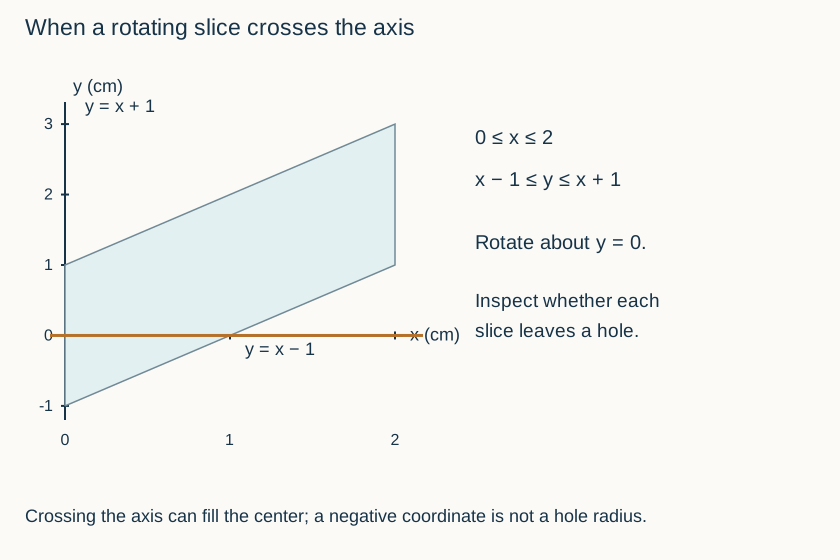
The base lies from x equals 0 to 2 centimeters between y equals x minus 1 and y equals x plus 1, rotated about the x-axis. The lower boundary crosses the rotation axis at x equals 1.
Axis-crossing geometry
Inspect diagram labels

The diagram keeps its full size here. Focus the view and use the arrow keys, or scroll across it, to inspect every label.
The base lies from x equals 0 to 2 centimeters between y equals x minus 1 and y equals x plus 1, rotated about the x-axis. The lower boundary crosses the rotation axis at x equals 1.

View diagram in a separate tab ↗

Part a

Rotate 0 ≤ x ≤ 2 and x − 1 ≤ y ≤ x + 1 about the x-axis. Which complete volume setup and value correctly account for the slice crossing the axis?

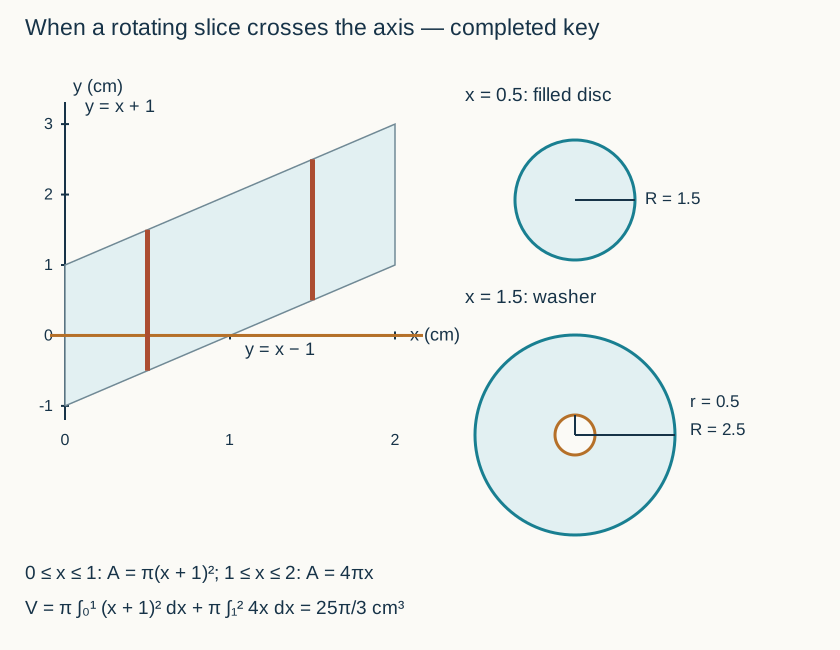
V = π∫₀¹(x + 1)² dx + π∫₁²[(x + 1)² − (x − 1)²] dx = 25π/3 cm³. From 0 to 1 the slice crosses y = 0 and fills the center, so it is a disc with R = x + 1. From 1 to 2 it leaves a hole and is a washer with R = x + 1 and r = x − 1. The two contributions are 7π/3 and 6π.

  1. For 0 ≤ x ≤ 1 the segment crosses the axis; the farthest endpoint has distance x + 1, so the full disc is filled.
  2. For 1 ≤ x ≤ 2 both endpoints are above the axis, giving a washer.
  3. Integrate π(x + 1)² on 0 to 1 to get 7π/3.
  4. Integrate π[(x + 1)² − (x − 1)²] = 4πx on 1 to 2 to get 6π.
  5. Add the two volumes to obtain 25π/3 cm³.
Scoring criteria
  • 1 point: chooses the correct split integral and value 25π/3 cm³.
The base lies from x equals 0 to 2 centimeters between y equals x minus 1 and y equals x plus 1, rotated about the x-axis. For x from 0 to 1 the slice crosses the axis and forms a filled disc with outer radius x plus 1. For x from 1 to 2 there is a washer of outer radius x plus 1 and inner radius x minus 1. Representative disc and washer have correctly scaled radii. The sum of the two volume integrals is 25 pi/3 cubic centimeters.
Axis-crossing geometry and completed volume key
Inspect diagram labels

The diagram keeps its full size here. Focus the view and use the arrow keys, or scroll across it, to inspect every label.

The base lies from x equals 0 to 2 centimeters between y equals x minus 1 and y equals x plus 1, rotated about the x-axis. For x from 0 to 1 the slice crosses the axis and forms a filled disc with outer radius x plus 1. For x from 1 to 2 there is a washer of outer radius x plus 1 and inner radius x minus 1. Representative disc and washer have correctly scaled radii. The sum of the two volume integrals is 25 pi/3 cubic centimeters.

View diagram in a separate tab ↗

Search lessons, terms and problems