Chapter 5 Solutions
Worked solutions to all thirty problems, with the reason for each step. These explanations were added for this edition; the chapter answer key and original worked examples follow below.
Problem 1
Original problem · added worked solution
What is required for a series to pass the alternating series test?
- Write the terms as (or with the opposite initial sign), with . This identifies the alternating sign pattern.
- Check that eventually and that . The alternating series test then gives convergence. A finite initial segment does not change convergence.
Final answer
Alternating signs, eventually nonincreasing nonnegative magnitudes, and magnitudes tending to zero.
Problem 2
Original problem · added worked solution
What is required for a series to pass the test for absolute convergence?
- For , form the series of magnitudes . This removes cancellation.
- Use a valid convergence test on . If it converges, the original series is absolutely convergent and therefore convergent.
Final answer
The series must converge.
Problem 3
Original problem · added worked solution
Do the following sums define alternating series?
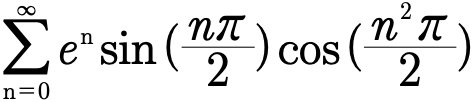
(a)
- For integer , is 1 for odd n and 0 for even n.
- The terms are , all nonnegative. The nonzero signs do not alternate, so this is not an alternating series.
(b)
- If n is even, . If n is odd, n² is odd and .
- Every summand is therefore zero. The zero series converges to zero, but has no nonzero alternating sign pattern.
Final answer
(a) No. (b) All terms are zero; it is not a nontrivial alternating series.
Problem 4
Original problem · added worked solution
Determine if the following sums converge.
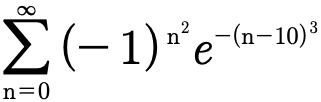
(a)
- The identity follows because n² and n have the same parity.
- The first eleven terms are finite numbers even though some are large. For , , so .
- The geometric comparison converges. Thus the sum of magnitudes converges and the original series converges absolutely.
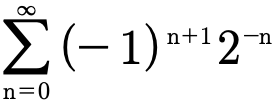
(b)
- The series is geometric: .
- Its ratio has magnitude 1/2, so it converges absolutely. Its sum is .
Final answer
Both converge absolutely; (b) sums to .
Problem 5
Original problem · added worked solution
Determine whether the following series are absolutely convergent, conditionally convergent, or neither.
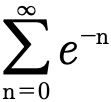
(a)
- The terms are positive and form a geometric series with ratio .
- The magnitudes have the same convergent sum, . This is absolute convergence.
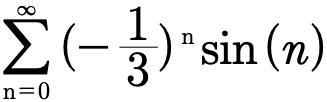
(b)
- Use to get .
- The comparison geometric series converges, so this series is absolutely convergent.
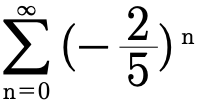
(c)
- The magnitudes are , a convergent geometric series.
- Therefore the original geometric series is absolutely convergent; its sum is .
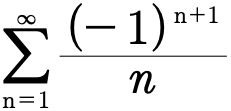
(d)
- The magnitudes decrease to zero, so the alternating series test gives convergence.
- The absolute-value series is the harmonic series, which diverges. Therefore convergence is conditional.
Final answer
(a), (b), and (c) are absolutely convergent. (d) is conditionally convergent.
Problem 6
Original problem · added worked solution
4. Show that the alternating series may be arranged so that it may converge to a value other than the value of example 5.3.2
- Use the alternating harmonic terms, but place two unused positive terms before each unused negative term: . Every odd reciprocal occurs positively and every even reciprocal occurs negatively exactly once.
- After N complete blocks, the sum is , where .
- Since tends to the same constant as m grows, the constant terms cancel. The limit is .
- The one or two leftover terms between block endpoints tend to zero, so the whole sequence of partial sums has this limit. It differs from both and the example’s .
Final answer
One rearrangement converges to .
Problem 7
Added problem and worked solution
Classify as absolutely convergent, conditionally convergent, or divergent.
- The magnitudes decrease to zero. The alternating series test therefore gives convergence.
- The absolute-value series is a p-series with , so it diverges.
Final answer
Conditionally convergent.
Problem 8
Added problem and worked solution
Classify .
- Taking absolute values gives .
- This p-series converges because , so the original series is absolutely convergent.
Final answer
Absolutely convergent.
Problem 9
Added problem and worked solution
Does converge? Explain.
- The magnitudes satisfy .
- The terms therefore alternate near −1 and 1 and do not tend to zero. The necessary term test for convergence fails.
Final answer
Divergent.
Problem 10
Added problem and worked solution
Classify .
- For , the derivative of is , so the magnitudes eventually decrease. Also . The alternating series test gives convergence.
- For , , so . Harmonic comparison proves divergence of the magnitudes.
Final answer
Conditionally convergent.
Problem 11
Added problem and worked solution
Classify .
- The positive magnitudes decrease to zero, so the alternating series test applies.
- Because for , the magnitude series diverges by comparison with the harmonic series.
Final answer
Conditionally convergent.
Problem 12
Added problem and worked solution
How many terms of guarantee an error less than 0.01 using the alternating error bound?
- The alternating harmonic magnitudes decrease to zero, so the remainder after N terms satisfies .
- Require . This gives , so is the smallest integer guaranteed by this bound.
Final answer
100 terms guarantee error less than 0.01.
Problem 13
Added problem and worked solution
Approximate using four terms and bound the error.
- The first four terms give .
- The next magnitude is . The alternating error bound gives . Since the fifth term is positive, .
Final answer
, with error at most .
Problem 14
Added problem and worked solution
Use the alternating error bound to find the smallest N guaranteeing error less than 0.0001 for .
- Here decreases to zero. Thus .
- To have , require , so the smallest bound-based choice is .
Final answer
100 terms.
Problem 15
Added problem and worked solution
Does every alternating series converge? Give a counterexample and explain.
- Alternating signs alone do not ensure that the terms tend to zero. In , they do not.
- Its partial sums alternate between 1 and 0, so no limit exists. The zero-limit and monotonicity conditions in the alternating series test must be checked.
Final answer
No; is a counterexample.
Problem 16
Added problem and worked solution
Find the sum and degree of convergence of .
- The magnitude series is geometric with ratio , whose magnitude is less than 1.
- The original sum is . The convergent magnitude series makes convergence absolute.
Final answer
Absolutely convergent, with sum .
Problem 17
Added problem and worked solution
Classify .
- Since , the term magnitude is at most .
- The comparison p-series converges, so this series is absolutely convergent.
Final answer
Absolutely convergent.
Problem 18
Added problem and worked solution
Classify .
- For the magnitude , .
- Because the ratio-test limit is less than 1, the magnitude series converges and the original series converges absolutely.
Final answer
Absolutely convergent.
Problem 19
Added problem and worked solution
Classify as absolutely convergent, conditionally convergent, or divergent.
- Take absolute values and set . The ratio of consecutive magnitudes is .
- As n grows, this ratio tends to zero, which is less than 1. The ratio test therefore proves that the magnitude series converges, so the original series is absolutely convergent.
Final answer
Absolutely convergent.
Problem 20
Added problem and worked solution
What does absolute convergence tell you about rearranging a series? Explain using its tail.
- Absolute convergence means has a finite sum. Every rearranged partial sum is controlled by the same summable tail of magnitudes.
- After enough of the original initial terms have appeared, omitted or newly included tail terms have arbitrarily small total magnitude. Thus every rearrangement has the original sum.
Final answer
Every rearrangement converges to the same sum.
Problem 21
Added problem and worked solution
Does convergence imply absolute convergence? Give an example.
- The alternating harmonic series converges by the alternating series test.
- Its magnitude series diverges. This gives a convergent series that is not absolutely convergent.
Final answer
No. The alternating harmonic series is conditionally convergent.
Problem 22
Added problem and worked solution
Classify .
- For , decreases to zero, so the alternating series test gives convergence.
- The integral grows without bound. Thus the magnitude series diverges by the integral test.
Final answer
Conditionally convergent.
Problem 23
Added problem and worked solution
Classify .
- For , the positive function decreases.
- The improper integral equals , which is finite. Thus the magnitude series converges by the integral test.
Final answer
Absolutely convergent.
Problem 24
Added problem and worked solution
Can a conditionally convergent series be rearranged to have sum zero? Explain.
- Conditional convergence means the signed sum converges but the magnitude sum does not. Its positive and negative subseries must both have infinite total magnitude.
- The Riemann rearrangement theorem then permits a rearrangement converging to any prescribed real number. In particular, zero is allowed.
Final answer
Yes; a rearrangement can converge to zero.
Problem 25
Added problem and worked solution
Describe how to rearrange the alternating harmonic series to converge to a chosen real number L.
- Take unused positive terms in their original order until the partial sum first exceeds the target . Then take unused negative terms until it first falls below L. Repeat.
- Both sign subseries have infinite total magnitude, so each crossing is possible. Terms tend to zero, so the crossing errors shrink to zero.
- Every term is eventually used: both sign indices increase without bound. Between crossings, partial sums stay between neighboring crossings, so all partial sums tend to L.
Final answer
Alternate blocks crossing above and below L; shrinking terms force convergence to L.
Problem 26
Added problem and worked solution
Find the sum of , using one positive term followed by two negatives.
- The first N blocks of one positive term followed by two negatives use positive reciprocals through and negative even reciprocals through .
- Their sum is .
- Since , the block sums tend to . The intervening individual terms vanish, so this is the full sum.
Final answer
.
Problem 27
Added problem and worked solution
Can rearranging change its sum? Why?
- The magnitudes of form a convergent p-series.
- Absolute convergence preserves the sum under every rearrangement. The Riemann freedom to change the sum applies to conditional convergence.
Final answer
No rearrangement can change its sum.
Problem 28
Added problem and worked solution
Classify .
- For , . The derivative of is , nonpositive for , so the magnitudes decrease.
- The alternating series test gives convergence. For , , so the magnitude series diverges.
Final answer
Conditionally convergent.
Problem 29
Added problem and worked solution
For , compare the actual error after three terms with the alternating error bound.
- The series is geometric with ratio , and its sum is .
- The first three terms sum to . The actual error is .
- The alternating bound is the next magnitude, , which is larger than the actual error.
Final answer
Sum ; three-term approximation ; actual error .
Problem 30
Added problem and worked solution
Find both and .
- The signed geometric ratio is , so its sum is .
- The magnitude ratio is , so its sum is . Both are finite, proving absolute convergence.
Final answer
Signed sum ; magnitude sum .