Chapter 1 Solutions
Worked solutions to all thirty problems, with the reason for each step. These explanations were added for this edition; the chapter answer key and original worked examples follow below.
Problem 1
Original problem · added worked solution
1. 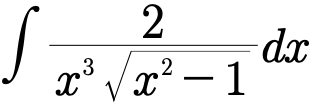
- The real integrand is defined on or . Let , so and .
- The integral becomes . Put ; then , giving .
- Use and integrate: .
- Since and , substitute back. The same formula differentiates correctly on each real domain interval.
Final answer
, for .
Problem 2
Original problem · added worked solution
2. 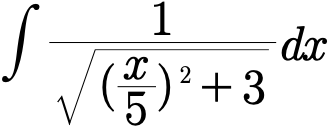
- Rewrite , so the integral is .
- Let with . Then the radical is and the integral is .
- Integrate to obtain . Replacing the trigonometric functions and absorbing the positive constant inside the logarithm into gives the result.
Final answer
, for all real .
Problem 3
Original problem · added worked solution
3. 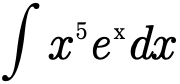
- Let . Integration by parts with and gives .
- Apply this recurrence five times, reducing the polynomial degree at each step: .
- Since , collect the terms. Differentiating gives ; here the lower degree terms cancel, leaving .
Final answer
.
Problem 4
Original problem · added worked solution
4. 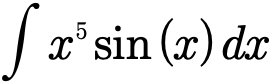
- Let . Two integrations by parts give .
- Use the recurrence first at and then at : .
- One final integration by parts gives . Substitute this expression and include the integration constant.
Final answer
.
Problem 5
Original problem · added worked solution
5. 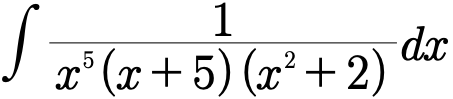
- For , use one term for every power of the repeated linear factor and a linear numerator for the irreducible quadratic: .
- Multiply by and equate polynomial coefficients. This gives , , , , , , , and .
- Integrate the powers using for , and integrate the two linear-factor reciprocals with logarithms.
- Split the quadratic numerator. Use and . Combine all contributions.
Final answer
, on intervals avoiding and .
Problem 6
Original problem · added worked solution
6. 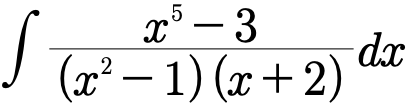
- The numerator has higher degree than the denominator. Divide by to obtain .
- Write the proper fraction as . Multiplying by the denominator and substituting gives , , and .
- Integrate the polynomial term by term and each reciprocal linear factor with a logarithm. The antiderivative is valid on each interval that avoids the three poles.
Final answer
, for .
Problem 7
Original problem · added worked solution
7. Find the arclength of  from
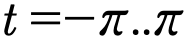 .
- Differentiate the coordinates: and .
- The speed is , by the Pythagorean identity.
- Integrate the speed over the displayed interval : .
Final answer
units.
Problem 8
Original problem · clarified · added worked solution
8. Parametrize an ellipse centered at the origin, with a horizontal major axis of 4 units and a minor axis of 2 units, which has a clockwise orientation
Clarification: the ellipse is centered at the origin and its major axis is horizontal. These conventions make the problem agree with the stated parametrization.
- The specified full axis lengths are and , so the horizontal and vertical semiaxes are and . With center , the ellipse equation is .
- Choose and , with . The identity verifies the ellipse.
- At , the point is and its velocity is . The motion therefore moves downward from the rightmost point, giving a clockwise traversal.
Final answer
, , .
Problem 9
Original problem · added worked solution
9. 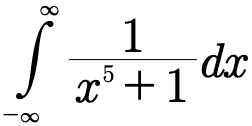
- The denominator vanishes at , inside the integration interval. An ordinary improper integral must converge separately on both sides of this pole.
- Near , , so the integrand has the same leading singularity as .
- The integral of that comparison expression tends to from the left and from the right. Each one-sided integral fails to be finite, so the ordinary improper integral diverges. Opposite infinities cannot be cancelled in this definition.
Final answer
The improper integral diverges because of the pole at .
Problem 10
Original problem · added worked solution
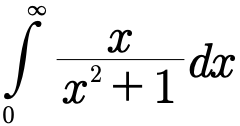
- Replace the infinite endpoint by a limit: .
- Let , so . The integral to is .
- Because , the finite-endpoint integrals increase without bound.
Final answer
Diverges to .
Problem 11
Added problem and worked solution
Evaluate on .
- Let with . Then and .
- The factors cancel, leaving .
- Replace with . The derivative of this expression is the original integrand for .
Final answer
.
Problem 12
Added problem and worked solution
Evaluate on .
- Let , so and the radical is . The integral becomes .
- Use to obtain .
- Since , return to .
Final answer
.
Problem 13
Added problem and worked solution
Evaluate .
- Put . Then the integral becomes .
- Integration by parts on gives . Replace by and rearrange: .
- Multiply by 4 and substitute and . A constant logarithmic factor is absorbed into .
Final answer
.
Problem 14
Added problem and worked solution
Evaluate .
- Let , so and the denominator is . The integrand becomes .
- The endpoints correspond to .
- Integrate: .
Final answer
.
Problem 15
Added problem and worked solution
Evaluate for .
- Choose and , so and .
- Integration by parts gives .
- Integrate the remaining power to obtain the result on .
Final answer
.
Problem 16
Added problem and worked solution
Evaluate .
- Use and to obtain .
- For the remaining integral use , : .
- Substitute this expression and collect terms.
Final answer
.
Problem 17
Added problem and worked solution
Evaluate .
- Let . With and , , where .
- Integrating by parts gives .
- Substitute into the first equation: . Divide by 2 and include .
Final answer
.
Problem 18
Added problem and worked solution
Evaluate .
- Let and . Then and .
- An antiderivative is .
- Evaluate at and : .
Final answer
.
Problem 19
Added problem and worked solution
Evaluate on intervals avoiding the poles.
- Factor . Write .
- Equate coefficients in : and . Thus and .
- Integrate both reciprocal linear terms with logarithms.
Final answer
.
Problem 20
Added problem and worked solution
Evaluate for .
- Write .
- Multiplying by the denominator gives . Substituting and yields , ; the quadratic coefficient gives .
- Integrate term by term.
Final answer
.
Problem 21
Added problem and worked solution
Evaluate .
- Divide the numerator by the denominator: .
- The first integral is . For the second use , .
- Subtract the resulting logarithmic term.
Final answer
.
Problem 22
Added problem and worked solution
Evaluate for .
- Set .
- Multiplication gives . Comparing coefficients gives , , .
- Integrate , using logarithms for both terms.
Final answer
.
Problem 23
Added problem and worked solution
Eliminate the parameter from , , , and describe the direction of travel.
- From , solve .
- Substitute into to obtain .
- As increases, increases because ; the motion travels from left to right along the parabola.
Final answer
, traced from left to right.
Problem 24
Added problem and worked solution
Find the tangent line to , at .
- At , the point is .
- Compute and . Since at , there.
- Use point-slope form through .
Final answer
, or .
Problem 25
Added problem and worked solution
Find the arclength of , for .
- Differentiate: , . On , the speed is .
- Set , . The arclength is .
- Evaluate .
Final answer
.
Problem 26
Added problem and worked solution
Parametrize counterclockwise, beginning at its rightmost point.
- The horizontal and vertical semiaxes are and , with center .
- Choose , . At the point is and the velocity points upward.
- Thus the traversal is counterclockwise, and substitution verifies the displayed ellipse.
Final answer
, , .
Problem 27
Added problem and worked solution
Determine convergence and evaluate if it converges.
- Write the integral as .
- An antiderivative is , so the finite integral equals .
- The second term tends to zero, so the limit is finite.
Final answer
Converges to .
Problem 28
Added problem and worked solution
Determine convergence and evaluate if it converges.
- Replace the singular lower endpoint by : .
- Integrate to get .
- Since , the improper integral has a finite limit.
Final answer
Converges to .
Problem 29
Added problem and worked solution
Determine convergence and evaluate if it converges.
- Integrate from to 1. Integration by parts gives the antiderivative .
- The finite integral is . To evaluate the endpoint limit, put ; then .
- Taking gives a finite result.
Final answer
Converges to .
Problem 30
Added problem and worked solution
Does the ordinary improper integral converge? Explain using its one-sided limits.
- The integrand has a pole at inside the interval, so split the improper integral into separate limits on and .
- On the left, . On the right, .
- Both one-sided integrals must be finite for the ordinary improper integral to converge. They are not, even though symmetric truncations cancel.
Final answer
The ordinary improper integral diverges.