Chapter 3 Solutions
Worked solutions to all thirty problems, with the reason for each step. These explanations were added for this edition; the chapter answer key and original worked examples follow below.
Problem 1
Original problem · clarified · added worked solution
Determine the type of each of the following series.
- Clarified pattern: (terms for ).
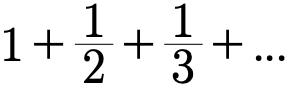

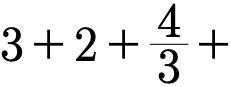
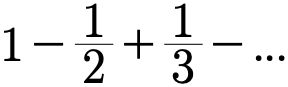
Clarification for part (a): this web edition explicitly uses 1/2−1/3+1/4−… . The source’s displayed 1/2−1/3+1/3−… does not specify an unambiguous continuation. Parts (b)–(e) retain their source expressions.
- Part (a): the clarified term is for . Its signs alternate and its magnitudes follow the harmonic denominators , so it is an alternating harmonic tail.
- Part (b): is the harmonic series, with terms .
- Part (c): is geometric with first term and ratio .
- Part (d): the listed consecutive ratios are and , identifying the usual geometric pattern with , .
- Part (e): is the alternating harmonic series with term .
Final answer
(a) Alternating harmonic tail starting with denominator 2; (b) harmonic; (c) geometric, , ; (d) geometric, , ; (e) alternating harmonic.
Problem 2
Original problem · added worked solution
Determine if the following series are convergent or divergent.
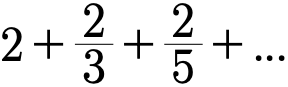

- Part (a): the usual odd-denominator pattern has term . Since and the harmonic series diverges, this positive series diverges.
- Part (b): is geometric with and . Since , it converges to .
Final answer
(a) Diverges; (b) converges to .
Problem 3
Original problem · added worked solution
Use partial fraction decomposition to determine if the following series is telescopic.
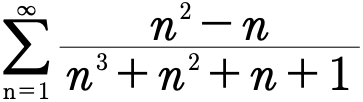
- Factor . Write .
- Multiplying through gives . Comparing coefficients yields , , .
- Thus the terms are . These are not consecutive shifts of the same reciprocal expression, so they do not cancel in a telescoping pattern.
- Indeed, the ratio of the original term to tends to 1, so the nonnegative series diverges by limit comparison with the harmonic series.
Final answer
Not telescoping; . The series diverges.
Problem 4
Original problem · added worked solution
Determine the value of the following series to the 30th term.
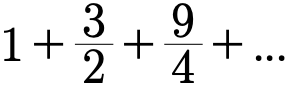

- For a geometric series with first term and ratio , the first terms sum to .
- Part (a): , . At , .
- Part (b): , . At , .
Final answer
(a) ; (b) .
Problem 5
Original problem · added worked solution
Determine the value of the following series to an infinite number of terms.
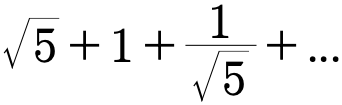
- The first term is and the constant ratio is .
- Since , the sum is .
- Rationalize the denominator to obtain .
Final answer
.
Problem 6
Original problem · added worked solution
Create Fourier Series for the following periodic functions.


- Use on , with and the analogous sine formula.
- Part (a): and is odd, so . Integration by parts gives .
- Thus part (a) has series . It equals for ; at the periodic jumps it converges to the midpoint .
- Part (b): and is even, so . Calculate . Two integrations by parts give .
- Therefore part (b) has series . The periodic extension is continuous at , so the series converges to there and to the periodic function elsewhere.
Final answer
(a) ; (b) , with convergence as stated.
Problem 7
Added problem and worked solution
Find the sum of .
- The first term is 6 and the ratio is . Its absolute value is less than 1.
- Use the infinite geometric formula: .
Final answer
.
Problem 8
Added problem and worked solution
For , find the sum of its first four terms and its infinite sum.
- Because the starting index is 0, the first term is 5, with ratio .
- The first four terms sum to .
- For the infinite sum, and .
Final answer
and .
Problem 9
Added problem and worked solution
Evaluate .
- The first term is 1 and the ratio is , whose absolute value is less than 1.
- Compute .
- Multiply by the conjugate to obtain .
Final answer
.
Problem 10
Added problem and worked solution
Find the first-N-term sum of and determine whether the infinite series converges.
- The first term is 3 and the ratio is . For terms, .
- These partial sums alternate with unbounded magnitudes, so they do not approach a finite value.
Final answer
; the infinite series diverges.
Problem 11
Added problem and worked solution
Evaluate .
- At , the first included term is . Each following term is half the preceding term.
- Use .
Final answer
.
Problem 12
Added problem and worked solution
Use a geometric series to express as a reduced fraction.
- Write the decimal as the geometric series .
- The first term is and the ratio is , so the sum is .
- Reduce the fraction by dividing numerator and denominator by 9.
Final answer
.
Problem 13
Added problem and worked solution
Evaluate by telescoping.
- Decompose .
- Summing the first terms cancels all but .
- Take to get .
Final answer
.
Problem 14
Added problem and worked solution
Evaluate .
- Write out the shifted sums. The negative terms beginning with cancel matching positive terms.
- The first-N-term sum is .
- The last three terms tend to zero, so the sum is .
Final answer
.
Problem 15
Added problem and worked solution
Find the partial sums and determine convergence of .
- Use .
- The first terms telescope to .
- This tends to , so telescoping does not by itself guarantee convergence.
Final answer
; diverges to .
Problem 16
Added problem and worked solution
Evaluate .
- In , every negative term cancels the next positive term.
- Thus .
- As , the remaining reciprocal tends to zero.
Final answer
.
Problem 17
Added problem and worked solution
What is the smallest number of terms needed to approximate with absolute error strictly less than ?
- The decomposition gives and total sum 1.
- The exact remainder after terms is .
- Require . This means , so the smallest integer is 1000.
Final answer
Use at least terms.
Problem 18
Added problem and worked solution
Evaluate .
- Factor out 2. The remaining sum has partial sum .
- Therefore , which tends to 2.
Final answer
.
Problem 19
Added problem and worked solution
Prove that diverges by grouping terms in blocks whose endpoints are powers of 2.
- In the block from to , there are terms and each is at least .
- Each block therefore contributes at least .
- After blocks, , which tends to infinity. Since all terms are positive, the full partial-sum sequence diverges to infinity.
Final answer
The harmonic series diverges.
Problem 20
Added problem and worked solution
Determine whether converges. Give a comparison with the harmonic series.
- For every , , so .
- The comparison series diverges. A positive series larger term by term also diverges.
Final answer
Diverges.
Problem 21
Added problem and worked solution
Show that the alternating harmonic series sums to by integrating a finite geometric identity.
- Use the finite geometric identity for .
- Integrating term by term over this finite sum gives .
- The second integral has absolute value at most . The first integral equals .
Final answer
.
Problem 22
Added problem and worked solution
Evaluate the paired series and explain why its finite partial sums matter.
- Keep the terms paired in each finite partial sum, rather than subtracting two separately divergent infinite sums.
- Cancellation gives .
- The two reciprocal tail terms vanish, so the paired series has sum .
Final answer
.
Problem 23
Added problem and worked solution
Find the real Fourier series of the -periodic function .
- Use the real Fourier convention on : .
- For , . Integrals of and over a whole period are zero for every integer .
- Thus all nonconstant coefficients vanish, and the series equals 1 at every point.
Final answer
, for ; Fourier series .
Problem 24
Added problem and worked solution
Find the Fourier series of the -periodic extension of on , including its value at the periodic jumps.
- The function is odd, so . Its sine coefficient is .
- Integration by parts gives , hence .
- At interior points the series equals . At each periodic jump , the two limits are and , so the Fourier series equals their average, zero.
Final answer
; endpoint value .
Problem 25
Added problem and worked solution
Find the Fourier series of the -periodic extension of on .
- The function is even, so . Compute .
- Integration by parts gives . Thus even indices vanish and odd indices give .
- Substitute these coefficients. The periodic extension is continuous at , so the series equals there as well as inside the interval.
Final answer
.
Problem 26
Added problem and worked solution
Find the Fourier series of the -periodic function equal to for and for . State the sum at each jump.
- The function is odd, so only sine coefficients can be nonzero. Use .
- The integral gives : it is zero for even and for odd .
- The Fourier series equals 1 or −1 at points of continuity. At , the two one-sided values are opposite, so the series converges to zero.
Final answer
; value at .
Problem 27
Added problem and worked solution
Find the Fourier series of the -periodic extension of on , including the endpoint sum.
- Evenness gives . Also .
- Two integrations by parts yield , so .
- The periodic extension is continuous at the endpoints, and the series equals there.
Final answer
.
Problem 28
Added problem and worked solution
List the real Fourier coefficients of in the convention .
- Compare the function with .
- There is no constant term; the cosine of frequency 2 has coefficient 3 and the sine of frequency 3 has coefficient −2.
- All other coefficients vanish by orthogonality of the trigonometric functions over a full period.
Final answer
, , , and all other are zero.
Problem 29
Added problem and worked solution
Find the Fourier series of the 4-periodic extension of on , and state its sum at the jumps.
- The period is 4, so use and basis functions . Oddness makes all cosine coefficients zero.
- Compute . Integration by parts with gives .
- The series equals on . At the periodic jumps , the average of the one-sided limits is zero.
Final answer
, with value at the jumps.
Problem 30
Added problem and worked solution
A square wave has Fourier series . Write its first three nonzero terms and evaluate that approximation at .
- The first three nonzero terms occur at the odd frequencies 1, 3, and 5, so .
- At , the sine values are 1, −1, and 1.
- Therefore . This is an approximation to the square wave’s value 1 there.
Final answer
and .