Chapter 6 Solutions
Worked solutions to all thirty problems, with the reason for each step. These explanations were added for this edition; the chapter answer key and original worked examples follow below.
Problem 1
Original problem · added worked solution
What is the definition of a power series?
- Choose a center c and a fixed sequence of coefficients .
- A power series has the form . Each term is a constant coefficient times a nonnegative integer power of the distance from the center.
- Convergence is assessed at each x; the center always converges to .
Final answer
A series with constant coefficients and center c.
Problem 2
Original problem · added worked solution
What is the definition of a power series?
- Choose a center c and a fixed sequence of coefficients .
- A power series has the form . Each term is a constant coefficient times a nonnegative integer power of the distance from the center.
- Convergence is assessed at each x; the center always converges to .
Final answer
A series with constant coefficients and center c.
Problem 3
Original problem · clarified · added worked solution
Prove that .
Clarified version: the inner sum ends at n, so it includes exactly the coefficient pairs whose indices add to n.
- Write and . Work where both series converge absolutely, in particular inside their common radius.
- Set . The product of the i-th and j-th terms is . A term has total degree n exactly when .
- For a fixed n, the possible indices are , with . Therefore the coefficient of tⁿ is .
- The absolute double sum is . Absolute convergence permits grouping terms by total degree. This proves the stated product identity.
Final answer
, wherever both power series converge absolutely.
Problem 4
Original problem · clarified · added worked solution
For and compute the following.
Clarified version: g(x) includes the factor xⁿ in each term, making it a power series in x.
Both power series converge for and diverge at x=±1 because their terms do not tend to zero. Perform the following operations inside .
(a)
- Add coefficients of matching powers: .
- Differentiate the geometric series to obtain and . Also .
- Combining these rational functions gives .
(b)
- Subtract coefficients of matching powers: .
- Using the rational forms from part (a), the common-denominator numerator is .
- Thus .
(c)
- A power series can be differentiated term by term inside its radius. The n=0 term is zero, so .
- Differentiating by the product and chain rules gives .
(d)
- Integrate each term and include an arbitrary constant: .
- Rewrite . Choose as an antiderivative of the first term; its derivative is . The second term integrates to . Both chosen antiderivatives are zero at x=0, matching the integrated power series.
- Therefore an antiderivative is . On , , so the logarithm is real.
Final answer
For : (a) ; (b) ; (c) ; (d) .
Problem 5
Original problem · added worked solution
Taylor expand the following function around the given value and note which are Maclaurin Series.

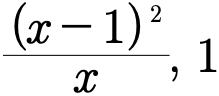
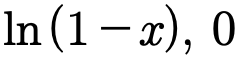
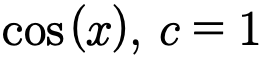
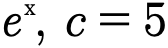

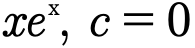
(a)
- Set , so the polynomial is .
- Use the binomial theorem and collect like powers. The result is . This finite Taylor series is valid for every real x. The center is 3, so it is not Maclaurin.
(b)
- Set . Then .
- Expand for . Thus the answer is . The terms do not vanish at either h endpoint. Its center is 1, so it is not Maclaurin.
(c)
- Integrate from zero to x and change the sign.
- This gives . It converges for : at −1 the alternating harmonic series converges, while at 1 the harmonic series diverges. Its center is 0, so it is Maclaurin.
(d)
- Set and use .
- Substitute the ordinary cosine and sine series: . It converges for all real h. The center is 1, so it is not Maclaurin.
(e)
- Set . Since , substitute the exponential series.
- The result is , valid for all real x. The center is 5, so it is not Maclaurin.
(f)
- Expand inside and integrate from 0 to x.
- This gives . Both endpoints converge by the alternating series test, so the interval is . The center is 0, so it is Maclaurin.
(g)
- Start with and multiply each term by x.
- The result is , valid for every real x. Its center is 0, so it is Maclaurin.
Final answer
The expansions are shown by part. Parts (c), (f), and (g) are Maclaurin series.
Problem 6
Added problem and worked solution
Find the radius and interval of convergence of .
- For , the geometric ratio is x, so convergence requires .
- At x=1 the terms are 1; at x=−1 they alternate ±1. Neither endpoint has terms tending to zero.
Final answer
Radius 1, interval .
Problem 7
Added problem and worked solution
Find the center, radius, and interval of convergence of .
- The series is geometric with ratio .
- Convergence requires , or . At each endpoint the ratio is ±1, so the terms fail the zero-limit test.
Final answer
Center 2, radius 3, interval .
Problem 8
Added problem and worked solution
Find the radius and interval of convergence of .
- The ratio test gives a limit of , so the radius is 1.
- At x=1, the harmonic series diverges. At x=−1, the alternating harmonic series converges. Outside radius 1 the terms do not approach zero.
Final answer
Radius 1, interval .
Problem 9
Added problem and worked solution
Find the radius and interval of convergence of .
- The ratio of consecutive magnitudes tends to , giving radius 1.
- At both endpoints the magnitudes are , whose p-series converges. Both endpoints are included.
Final answer
Radius 1, interval .
Problem 10
Added problem and worked solution
Find the radius of convergence of .
- The ratio of consecutive magnitudes is .
- This tends to zero for every fixed x. The ratio test therefore gives convergence for every real x.
Final answer
Infinite radius; all real x.
Problem 11
Added problem and worked solution
For which real x does converge?
- For nonzero x, the ratio of consecutive term magnitudes is , which tends to infinity. The terms eventually grow and the series diverges.
- At x=0, all positive-degree terms vanish and the constant term is 1.
Final answer
Radius 0; convergence only at x=0.
Problem 12
Added problem and worked solution
Differentiate the geometric power series to represent . State the interval of convergence.
- The geometric series holds for .
- Differentiate term by term within the radius to obtain .
- The differentiated series still has radius 1, and its terms fail to approach zero at either endpoint.
Final answer
, for .
Problem 13
Added problem and worked solution
Integrate from 0 to x and state the resulting function and interval.
- Integrate the geometric series from 0 to x inside .
- This gives .
- The resulting series converges at x=−1 by the alternating test but diverges at x=1. Thus its interval is .
Final answer
, for .
Problem 14
Added problem and worked solution
Find the cubic Taylor polynomial for centered at 1.
- For , every derivative at x=1 equals e.
- Insert those values in .
Final answer
.
Problem 15
Added problem and worked solution
Find the cubic Taylor polynomial of centered at 2.
- For , the first four derivative values at 2 are , , , and .
- Divide the second and third derivative values by 2! and 3!, respectively, in the Taylor formula.
Final answer
.
Problem 16
Added problem and worked solution
Taylor expand centered at 1.
- Set , so .
- The binomial theorem gives . There are no higher terms.
Final answer
.
Problem 17
Added problem and worked solution
Taylor expand centered at 2 and state where the series converges.
- Write . Then .
- Use the geometric series with ratio . The answer is .
- The series converges when . At either endpoint its terms fail to tend to zero.
Final answer
, for .
Problem 18
Added problem and worked solution
Taylor expand centered at .
- Set . The angle-addition identity gives .
- Substitute the cosine Maclaurin series to get . It converges for every real x.
Final answer
.
Problem 19
Added problem and worked solution
A Taylor series starts . Find and .
- In a Taylor series centered at 3, the coefficient of equals .
- The linear coefficient gives . The quadratic coefficient 4 gives .
Final answer
and .
Problem 20
Added problem and worked solution
Use the cubic Maclaurin polynomial to approximate and bound the error with Taylor’s theorem.
- The cubic Taylor polynomial for at zero is .
- On , its fourth derivative is . Taylor’s remainder bound is .
- Evaluating the bound gives approximately , while the polynomial value is .
Final answer
Approximation , with error at most .
Problem 21
Added problem and worked solution
How is a Maclaurin series related to a Taylor series?
- A Taylor series uses derivative values at its center c.
- Choosing gives , which is called the Maclaurin series.
Final answer
A Maclaurin series is a Taylor series centered at zero.
Problem 22
Added problem and worked solution
Find the Maclaurin series for and its interval of convergence.
- Start from .
- Substitute to obtain . The exponential series converges for every real u, hence every real x.
Final answer
.
Problem 23
Added problem and worked solution
Find the Maclaurin series for .
- Use .
- Set , giving . The series converges for all real x.
Final answer
.
Problem 24
Added problem and worked solution
Find the Maclaurin series and interval of convergence of .
- Start with for .
- Substitute . This yields .
- At the alternating harmonic series converges; at the magnitude harmonic series diverges.
Final answer
, for .
Problem 25
Added problem and worked solution
Give the first three nonzero terms of the Maclaurin series of .
- Substitute into .
- The first three nonzero terms are . The full series has infinite radius.
Final answer
.
Problem 26
Added problem and worked solution
Find the cubic Maclaurin polynomial of .
- Use and .
- Collect terms through degree 3: the x coefficient is 1, the x² coefficient is 1, and the x³ coefficient is .
Final answer
.
Problem 27
Added problem and worked solution
Find the Maclaurin series of and its interval of convergence.
- The geometric formula applies when .
- Set , obtaining .
- At x=±1 the terms alternate ±1 and fail to tend to zero. The interval is .
Final answer
, for .
Problem 28
Added problem and worked solution
What is the coefficient of x⁵ in the Maclaurin series for ?
- Multiplying by x² gives .
- The x⁵ term requires , hence n=3. Its coefficient is .
Final answer
.
Problem 29
Added problem and worked solution
Must a Taylor series represent its function at every point in the function’s domain? Give a concrete example.
- The Maclaurin expansion of is the geometric series , whose radius is 1.
- The function itself exists for every , but the series diverges when . A function’s domain can therefore exceed the convergence interval of one Taylor expansion.
Final answer
No; exists at x=2, but its Maclaurin series diverges there.
Problem 30
Added problem and worked solution
Find the quadratic Maclaurin polynomial for .
- For , , , and .
- Divide the second derivative by 2! in the Taylor formula. This gives the quadratic Maclaurin polynomial .
Final answer
.