The Galvanic Cell
Alternative original cell, half-reaction and potential explanation with accepted revisions; use native tasks for the complete learner-created cell check.
Supporting original reading. Follow the AP topic pathway for reviewed scope, worked reasoning and targeted practice.
Chemistry II · original Chapter 8 · combined Chapter 16
Section Breakdown
- Redox reactions
- Electrolytes
- Cathodes and Anodes
Section 2
The Galvanic Cell
So redox reactions transfer electrons. Big whoop. They just move an electron off of one atom directly to another. How is that useful to us?
Well yes, most redox reactions occur with out being able to utilize the moving electrons as they move directly from the donor atom to the acceptor atom.
However, if we can somehow get a redox reaction going with some sort of way to separate the reducing agent and the oxidizing agent, we can utilize the electrons as they move from one place to the next. How might we do that?
The easiest way is by creating a pathway between the two reactants along which electrons can travel. When we have a system that allows for the electrons to move along one path, and the reacting ions to move along another, we can capture the flow of electrons as the ions react. This set-up is called a Galvanic Cell.
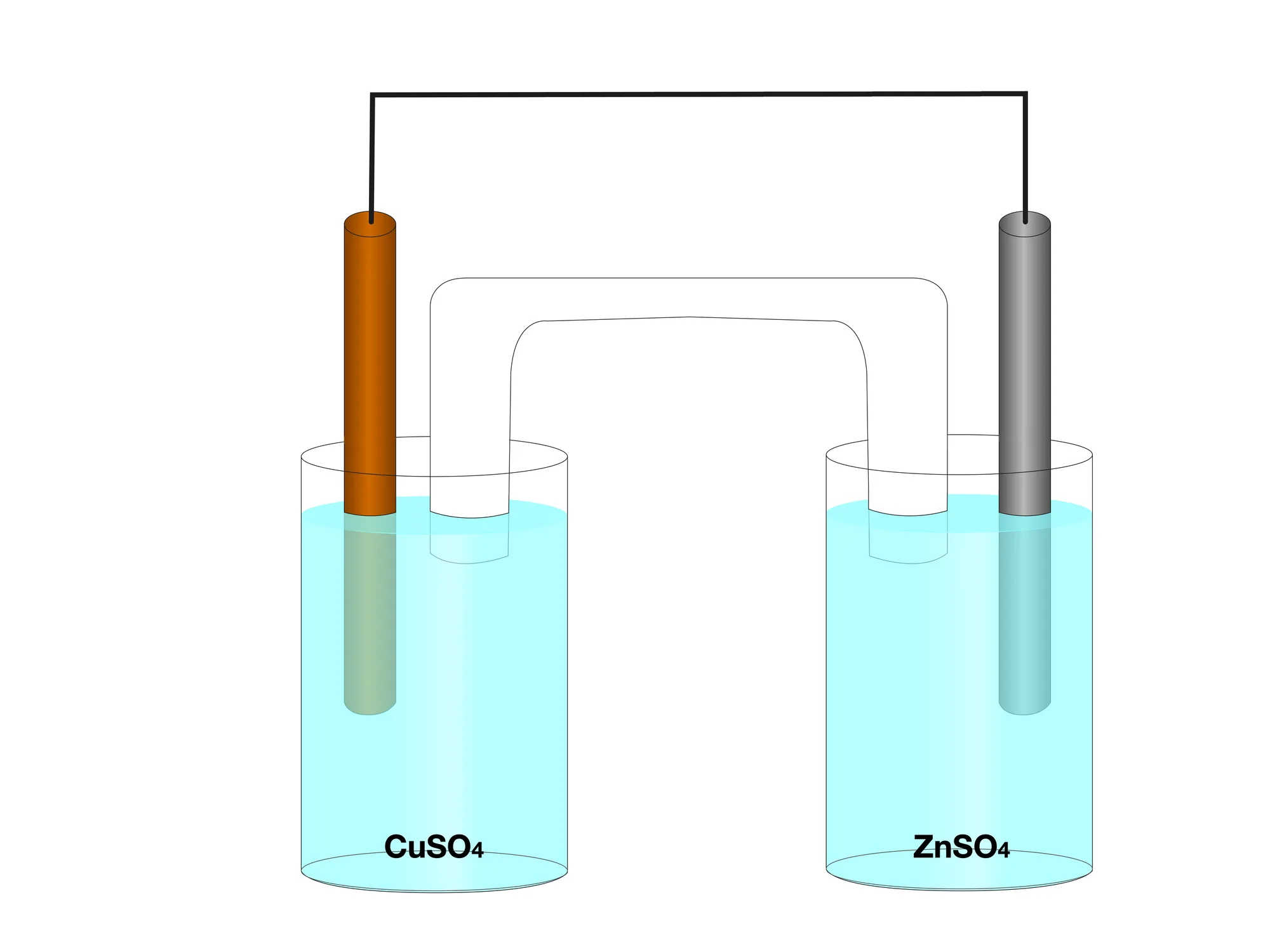
The galvanic cell has four main components, a pair of unlike metals, an electrolyte, a salt bridge, and a metal wire connecting the two metals. We’ll cover each component individually.
Interactive 8.2.1 The galvanic cell
Read all original figure notes
Gallery 8.2.1 Copper-Zinc galvanic cell in action
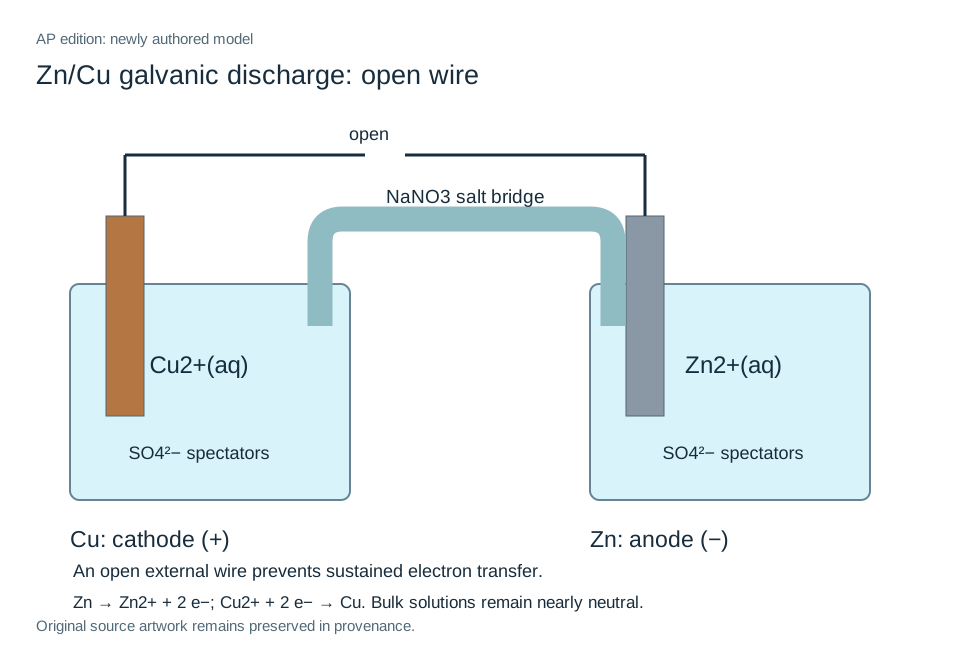
AP edition authored model. An open external wire prevents sustained electron transfer. The source Zn-to-Cu electron direction was correct. This replacement explicitly uses a NaNO3 inert-ion bridge: cations migrate toward the Cu cathode and anions toward the Zn anode. Species labels are schematic, not particle counts.
Read all reviewed image captions
Image 1
AP edition authored model. An open external wire prevents sustained electron transfer. The source Zn-to-Cu electron direction was correct. This replacement explicitly uses a NaNO3 inert-ion bridge: cations migrate toward the Cu cathode and anions toward the Zn anode. Species labels are schematic, not particle counts.
Image 2
AP edition authored model. Both electronic and ionic paths support sustained galvanic discharge. The source Zn-to-Cu electron direction was correct. This replacement explicitly uses a NaNO3 inert-ion bridge: cations migrate toward the Cu cathode and anions toward the Zn anode. Species labels are schematic, not particle counts.
Image 3
AP edition authored model. Both electronic and ionic paths support sustained galvanic discharge. The source Zn-to-Cu electron direction was correct. This replacement explicitly uses a NaNO3 inert-ion bridge: cations migrate toward the Cu cathode and anions toward the Zn anode. Species labels are schematic, not particle counts.
Zn(s)+Cu²⁺(aq)→Zn²⁺(aq)+Cu(s) is the usual standard Zn/Cu galvanic discharge reaction.
If we eliminate the spectator sulfate ion, we have:
In this standard galvanic direction, zinc loses electrons and copper ions gain them. Zinc is the reducing agent; Cu²⁺ is the oxidizing agent.
Zinc metal is oxidized at the anode: Zn→Zn²⁺+2 e⁻. Copper ions are reduced at the cathode: Cu²⁺+2 e⁻→Cu. Copper metal does not spontaneously plate zinc under these standard conditions. Actual cell direction depends on E under its current composition.
The two half-cells are then connected via a conductive wire strewn between the solid copper and zinc. Then the solutions are connected via a salt bridge. The salt bridge allows the two solution to exchange ions from one solution to the other.
Gallery 8.2.2 Salt Bridge
AP edition authored model. An open external wire prevents sustained electron transfer. A closed electronic path and ionic path are both needed for sustained discharge. The schematic labels are not equal-scale particle counts; the bulk solutions remain nearly electrically neutral during operation.
Read all reviewed image captions
Image 1
AP edition authored model. An open external wire prevents sustained electron transfer. A closed electronic path and ionic path are both needed for sustained discharge. The schematic labels are not equal-scale particle counts; the bulk solutions remain nearly electrically neutral during operation.
Image 2
AP edition authored model. Without an ionic path, a brief transient develops charge imbalance and current stops. A closed electronic path and ionic path are both needed for sustained discharge. The schematic labels are not equal-scale particle counts; the bulk solutions remain nearly electrically neutral during operation.
Image 3
AP edition authored model. Both electronic and ionic paths support sustained galvanic discharge. A closed electronic path and ionic path are both needed for sustained discharge. The schematic labels are not equal-scale particle counts; the bulk solutions remain nearly electrically neutral during operation.
Image 4
AP edition authored model. Both electronic and ionic paths support sustained galvanic discharge. A closed electronic path and ionic path are both needed for sustained discharge. The schematic labels are not equal-scale particle counts; the bulk solutions remain nearly electrically neutral during operation.
Unlike metals tend to readily form redox reactions. However, a redox reaction requires both a metal and another metal’s ion. Therefore, simply having two metals in electrical contact is not sufficient. There needs to be some medium for the metal to be able to dissolve into.
This solution is the electrolyte we introduced before. The electrolyte allows the metal to produce ions which can then be used in the redox reaction.
If we didn’t have any electrolyte, and just connected two metals, there would be no reaction, as both reactants aren’t present. In the copper-zinc cell, the reaction that occurs was:
If you only had zinc and copper, there would be no to react with the zinc. However, placing the two metals into a solution would permit the metal to dissolve somewhat, and form metal ions needed to permit the reaction.
With the two metal ions present, by connecting each half-cell with the other through a conductive wire, electrons flow from the zinc side to the copper side, causing the copper ions to reduce and form solid copper. Conversely, the solid zinc atoms, having given up their electrons, dissolve into solution as zinc ions.
A galvanic cell without a salt bridge will indeed generate a flow of electrons, however the life of such a setup is exceedingly shorter than the typical galvanic cell, which includes a salt bridge to transport ions from one half-cell to the other, equalizing the two.
Gallery 8.2.3 Piece-wise set-ups of galvanic cells.
AP edition authored model. An open external wire prevents sustained electron transfer. Unbridged stages cannot sustain current. Operating stages explicitly retain Cu²⁺ and an inert-ion bridge; if the cathodic reactant is exhausted, this stipulated Zn/Cu²⁺ reaction cannot sustain current.
Read all reviewed image captions
Image 1
AP edition authored model. An open external wire prevents sustained electron transfer. Unbridged stages cannot sustain current. Operating stages explicitly retain Cu²⁺ and an inert-ion bridge; if the cathodic reactant is exhausted, this stipulated Zn/Cu²⁺ reaction cannot sustain current.
Image 2
AP edition authored model. An open external wire prevents sustained electron transfer. Unbridged stages cannot sustain current. Operating stages explicitly retain Cu²⁺ and an inert-ion bridge; if the cathodic reactant is exhausted, this stipulated Zn/Cu²⁺ reaction cannot sustain current.
Image 3
AP edition authored model. Without an ionic path, a brief transient develops charge imbalance and current stops. Unbridged stages cannot sustain current. Operating stages explicitly retain Cu²⁺ and an inert-ion bridge; if the cathodic reactant is exhausted, this stipulated Zn/Cu²⁺ reaction cannot sustain current.
Image 4
AP edition authored model. Without an ionic path, a brief transient develops charge imbalance and current stops. Unbridged stages cannot sustain current. Operating stages explicitly retain Cu²⁺ and an inert-ion bridge; if the cathodic reactant is exhausted, this stipulated Zn/Cu²⁺ reaction cannot sustain current.
Image 5
AP edition authored model. Both electronic and ionic paths support sustained galvanic discharge. Unbridged stages cannot sustain current. Operating stages explicitly retain Cu²⁺ and an inert-ion bridge; if the cathodic reactant is exhausted, this stipulated Zn/Cu²⁺ reaction cannot sustain current.
Image 6
AP edition authored model. Both electronic and ionic paths support sustained galvanic discharge. Unbridged stages cannot sustain current. Operating stages explicitly retain Cu²⁺ and an inert-ion bridge; if the cathodic reactant is exhausted, this stipulated Zn/Cu²⁺ reaction cannot sustain current.
Each galvanic cell is composed of two different half-cells, and the overall performance of the galvanic cells is reliant upon the two half-cells involved. Some half-cells combine to give great voltage potential (electron movement) across the galvanic cell. Others aren’t so great. The actual performance of the cell is determined by the Gibb’s free energy , , of the cell reaction. The more negative the Gibb’s free energy, the more favorable the redox reaction, and the more powerful the cell.
Anode always means oxidation and cathode always means reduction. During galvanic discharge, the anode is negative and cathode positive. In an externally driven electrolytic cell, the anode is positive and cathode negative. A discharging battery is a galvanic cell; for a rechargeable battery, specify charging or discharging before assigning electrode roles.
As we covered before, the two half-cells that comprise the anode and the cathode are both needed for a redox reaction to occur. If we want to successfully measure the potential of the cell, we have to calculate it using the Gibb’s free energy of the reaction involved in the galvanic cell in question.
For any given cell, the Gibb’s free energy can be given as:
You already know to be the Gibb’s free energy, but you most likely do not know the rest.
In this equation, is the number of moles of electrons involved in each mole of reaction. For the reaction:
is 2, as there are 2 electrons that pass from each zinc to each copper.
In the Gibb’s free energy equation, refers to Faraday’s constant, the total charge carried by one mole of electrons, given as .
The final new concept is . This is the Standard Electrode Potential (SEP) of the cell, which determines the voltage of a galvanic cell.
The SEP is measured for half-cells, so the galvanic cell has an overall given as:
So what is the SEP, and how do we find it for each half-cell?
First off, the SEP is the voltage associated with one half-cell at standard conditions. For the purposes of this use, standard conditions are given to be the cell in an electrolyte containing is ions at concentration and under of pressure, while at .
One problem that arises with using these half-cell voltages is that a voltage can only be measured for a whole galvanic cell. For a half-cell to provide a voltage, it needs to be hooked up to another half-cell, so how can we standardize this?
Well, electrochemists decided that by using a standard half-cell as the anode in all SEP measurements, we can achieve useful data for our values.
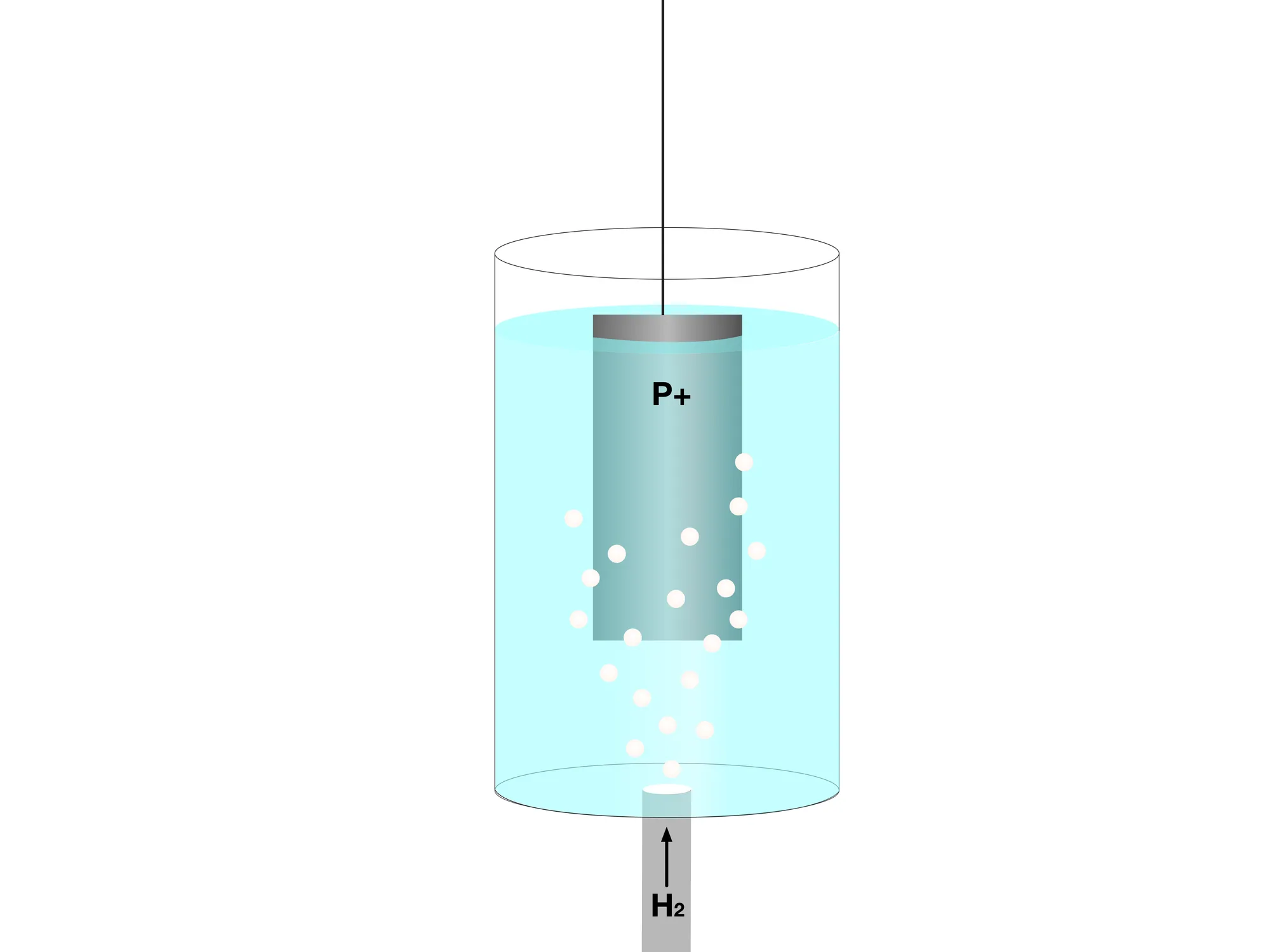
The chosen half-cell was the Standard Hydrogen Cell, SHC. Not all redox half-cells are based on metals. The hydrogen cell relies on the half reaction:
This is a unique cell, as neither part is a useful electrode (a conductive material for the transfer of electrons), so a secondary electrode must be used if you wish to have a working cell.
To get around that, we use a nonreactive electrode, typically platinum. This allows us to feed the half-cell with electrons, permitting the redox reaction to take place.
Notice that this reaction is given as a reduction reaction. Any half-cell will be shown based on its reduction half-reaction. You only reverse the reaction when you are describing a full galvanic cell, and in that case you have to decide which half-cell reaction to reverse. More on that shortly.
So how does the SHC allow us to calculate the SEP for other cells if we don’t even know the SEP for the SHC?
Well, as we are basing every half-cell off of the same SHC, we can simply set a value for the SHC’s SEP, and then use the following equation to solve for the SEP of the accompanying half-cell:
Interactive 8.2.2 The Standard Hydrogen Cell
Read all original figure notes
What would be an easy value to set as our reference potential? 10? -5? 42.44? The easiest value to use, and what is in fact used is 0. This way, we can determine the SEP for any half-cell by pairing that cell with the SHC, and then measuring the potential of the overall cell.
Under convention, the SHC always represents the anode. Practically, this is not always true. By assuming the SHC to be the anode, we may sometimes get negative voltages in our measurements of SEP. This just means that the reaction actually proceeds with the SHC as the cathode. By retaining the negative convention, we eliminate confusion when a half-cell’s SEP is lower than hydrogen’s.
When listing out the SEPs of various cells, the standard form of each half-cell (as a reduction reaction) is used. The SEP is also given relative to the SHC potential. The lower the SEP of the half-cell, the better that half-cell is at reducing other half-cells. This means that if two cells are combined into a single galvanic cell, a spontaneous redox reaction would occur, with the half-cell of lower SEP reducing the half-cell of higher SEP. In our copper-zinc galvanic cell, the zinc reduces the copper, so therefore the zinc half-cell must have a lower SEP. This is true, as the half-cell for copper has an SEP of , while zinc has .
Example Problem 8.2.1
What is the anode in a Mercury-Aluminum galvanic cell?
Step 1: Identify the of each half-cell
Mercury has .
Aluminum has .
Step 2: Identify which Electrode is the anode.
The anode of a galvanic cell is the electrode where oxidation occurs. This means it is the reducing agent. A lower the relates to a higher reducing potential, meaning the half-cell with the lower will be the anode, as it will reduce the other half-cell. Therefore, our anode is Aluminum.
The aluminum electrode is the anode.
Now that table is not comprehensive, it just covers many of the more common half-cells you might encounter. If we were to give you a problem regarding a half-cell not on that table, the for that half-cell will be provided if needed.
When you determine the of a galvanic cell, sometimes the redox equation for the cell is not balanced simply by using the half-reaction as it appears on the table.
If that is the case, you multiply the coefficients of the half-reaction by some number to balance the overall redox reaction, and then you can still use the same value for that half-cell.
Recall that the Gibb’s free energy equation for a galvanic cell can be found by:
The sign of the factor determines whether the reaction is spontaneous and will produce a positive voltage, or if the reaction requires energy to proceed.
Perhaps you remember from before, but for a reaction to be spontaneous, it needs to have a negative Gibb’s free energy. So how can that happen?
In this equation, is the stoichiometric number of electrons in the reaction. It can never be negative. is Faraday’s constant, always a positive .
That leaves . If this is negative, then the Gibb’s free energy will become positive. This means that in order for a galvanic cell to produce a useful voltage, the has to be positive.
Now, the stoichiometry of the redox reaction does not affect , but it does determine , so it is needed in determining the magnitude of Gibb’s free energy for the reaction.
The we use is the stoichiometric coefficient of the number of electrons passed in a fully balanced redox equation. This means that we have to find a balanced equation for a galvanic cell before we can know the cell’s Gibb’s free energy.
Example Problem 8.2.2
Reviewed standard-state model: a Ti/Ti³⁺ and Cu/Cu²⁺ galvanic cell uses E°(Cu²⁺/Cu)=+0.340 V and E°(Ti³⁺/Ti)=−1.370 V. With F=96485 C mol⁻¹, determine cathode and ΔG° per balanced reaction 3 Cu²⁺+2 Ti→3 Cu+2 Ti³⁺.
Cu²⁺+2 e⁻→Cu is reduction at the Cu cathode. Ti→Ti³⁺+3 e⁻ is oxidation at the Ti anode.
Multiply the copper reduction by 3 and titanium oxidation by 2: both half-reactions transfer six electrons. Their sum is 3 Cu²⁺+2 Ti→3 Cu+2 Ti³⁺.
E°cell=0.340−(−1.370)=1.710 V. Do not multiply a potential when multiplying a half-reaction.
ΔG°=−nFE°=−6×96485×1.710=−989936.1 J=−989.9361 kJ≈−990 kJ per written reaction. The sign is negative, and Cu is the cathode.
Glossary and deeper reading · 16 refreshers
These editorial refreshers supplement the reading. Definitions and examples are added guidance; original source wording and recorded answers remain in their original context.
-
Redox reaction
A redox reaction combines oxidation of one species with reduction of another. Electron loss and gain must balance in the net equation along with atoms and total charge. For example, zinc reducing copper ions involves zinc oxidation and copper-ion reduction.
-
Electrolyte
An electrolyte forms mobile ions when dissolved and can allow a solution to conduct electric current. Strong and weak electrolytes differ in the extent to which dissolved species form ions under the stated conditions. For example, dissolved sodium chloride supplies sodium and chloride ions to water.
-
Cathode
The cathode is the electrode where reduction occurs. It may deposit metal or host another reduction without necessarily gaining mass. For example, a copper electrode receiving electrons that reduce dissolved copper ions is a cathode.
-
Anode
The anode is the electrode where oxidation occurs. This definition applies to both galvanic and electrolytic cells. For example, a zinc electrode releasing zinc ions and electrons is an anode in the zinc–copper galvanic model.
-
Electrochemical cell
An electrochemical cell separates oxidation and reduction into electrode processes. A galvanic cell delivers electrical energy from a favored reaction, while an electrolytic cell uses supplied electrical energy to drive an unfavored direction. For example, a zinc–copper galvanic model transfers electrons through the external wire while ions carry charge through the solutions.
-
Reducing agent
A reducing agent causes another species to gain electrons. The agent supplies those electrons and is itself oxidized. For example, zinc acts as a reducing agent when it transfers electrons to copper ions.
-
Oxidizing agent
An oxidizing agent causes another species to lose electrons. The agent accepts those electrons and is itself reduced. For example, a copper ion acts as an oxidizing agent when it accepts electrons from zinc metal.
-
Ion
An ion is an atom or group of atoms with a net electric charge. Ordinary ion formation changes electron count without changing the element's proton count. For example, a sodium atom losing one electron becomes a sodium ion with charge +1.
-
Salt bridge
A salt bridge provides an ionic conducting path between separated half-cells. Ion movement helps prevent bulk charge buildup while electrons move through the external circuit. For example, bridge anions can move toward a half-cell where metal cations are being produced.
-
Oxidation
Oxidation is electron loss, represented by an increase in oxidation number. It occurs together with reduction so that electrons are conserved in the overall reaction. For example, a zinc atom becoming a zinc ion with charge +2 undergoes oxidation.
-
Gibbs free energy
Gibbs free energy combines enthalpy and entropy contributions to a system at specified temperature and pressure. For a reaction at constant temperature and pressure, a negative actual reaction free-energy change favors its forward direction, while standard and actual values must be distinguished. For example, a favorable reaction can still be slow if its pathway has a large activation barrier.
Read more: Gibbs Free Energy and Thermodynamic Favorability →
-
Reduction
Reduction is electron gain, represented by a decrease in oxidation number. It is paired with oxidation in an electron-transfer reaction. For example, a copper ion with charge +2 gaining two electrons to form copper metal undergoes reduction.
-
Mole
A mole is an amount of substance containing exactly 6.02214076 × 10²³ specified entities. The entities can be atoms, molecules, ions, or formula units, so the counted entity must be named. For example, one mole of oxygen molecules contains two moles of oxygen atoms.
-
Faraday’s constant
Faraday’s constant is the magnitude of electric charge carried by one mole of electrons. It is approximately 96485 coulombs per mole and connects measured charge to the amount of electrons transferred. For example, depositing one mole of a metal from ions with charge +2 requires two moles of electrons in the ideal model.
-
Half-reaction
A half-reaction describes either the oxidation or reduction part of a redox process. It includes electrons explicitly so that charge and electron transfer can be balanced. For example, zinc forming a zinc ion and two electrons is an oxidation half-reaction.
-
Thermodynamic favorability
Thermodynamic favorability describes whether a process has a driving force in the stated direction under specified conditions. It does not determine how quickly the process occurs. For example, a reaction with a favorable free-energy change can persist without visible progress when a large kinetic barrier blocks it.