Limiting Reactants
Alternative limiting-reactant and excess-ion examples with the accepted source revisions.
Before this connection: Moles, balanced equations and concentration; For excess hydronium/hydroxide reasoning, first read Acids, bases, and pH.
Supporting original reading. Follow the AP topic pathway for reviewed scope, worked reasoning and targeted practice.
Chemistry I · original Chapter 2 · combined Chapter 2
Section 4
Limiting reactants involve two or more reactants whose initial amounts are given. It is just an extension of the stoichiometry we have been practicing - instead of only being given the amount of one compound, we are given two (or more). Reactants can be used interchangeably with reagents.
A very simple analogy to understand this concept is as follows:
Interactive 2.4.1
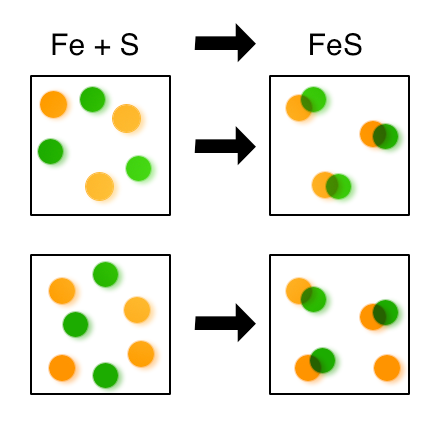
Read all original figure notes
Limiting
There is more Fe (yellow) than S, so only 3 FeS were produced with an excess Fe.
Equal
Both the Fe and S had equal quantities to begin with and they all combined.
This is obvious, but to understand, try changing either of the initial “reactant” amounts. Would that change the result? If we added one more tire, it would not be possible to make a second car. This balance is what stoichiometry is all about.
In these reactions, the limiting reactant will be completely used up and some excess (extra or leftover) reactant will be left when the reaction is complete. To identify which is the reactant we have too little of (limiting) and too much of (excess), we have to make two equations.
Example Problem 2.4.1
If 9 car chassis and 28 tires are available, how many cars can be made?
We set up two stoichiometry problems:


We pick the smallest number. That means we can only make 7 cars. That also means the tires are the limiting reactants and the chassis are the excess reactants.
The tires will be used up completely in the “reaction” and nothing will remain unused. But there were 2 extra chassis that were leftover.
We first write the overall equation to understand what is happening.
CO + O2 → CO2
Then we balance:
2CO + O2 → 2CO2
With the given initial amounts, we now write the two stoichiometry problems:


The limiting reactant is the reactant that gets used up first, producing less product. Which reactant produces less product in this case?
Any limiting reactant problem can be approached this way, and combines any past practice with stoichiometry equations. The biggest difference now will be setting up two equations instead of one to identify which of the reactants is limiting and which one is excess.
Example Problem 2.4.2
In the exhaust of a car, 15.8 grams of carbon monoxide reacts with 7.4 grams of oxygen gas. How much carbon dioxide is formed, and how much excess gas is left unreacted?
This reaction is pretty straightforward. It’s also known as a strong base, strong acid reaction. It goes something like this:

Notice that the Sodium and Chloride ions do not react because salt does not react with water, it just dissolves.
The limiting reactant is Oxygen, which yields 20.35 grams of carbon dioxide. That means some Carbon Monoxide is left over after the reaction. Let us now calculate the amount of CO that was actually used, then find how much was unused:

That means that 15.8 g CO - 12.95 g CO = 2.85 grams of CO was unused - it is leftover and is much like a product.
Production of carbon monoxide is toxic to the environment and therefore further precautions are taken to prevent this in car emissions.
Limiting reactant problems are tricky because they combine stoichiometry with another concept. So let’s try one more example.
Example 9.1.2
What is the final concentration of Na+, Cl–, H+, and OH– ions in the solution when 5 g of lye (NaOH) are added to 1 L of a 0.1 M HCl solution?
Note: The way the reaction is written might seem confusing at first, but recognize that I have just broken up each compound into its ions. After the periodic trends and orbitals chapter, this will make more sense. Chemists write the reaction this way because this is actually how a beaker looks if you were to zoom in reeeeeeally close into the molecules. You would not see a NaOH molecule, you would see Na+ ions and OH– ions.
The fact that the Sodium and Chloride ions do not react is very important because that tells us that the initial and final concentrations of sodium and chloride ions stay the same. What about Hydrogen and Hydroxide ions? One of them has to be the limiting reactant. Before finding out their concentration, let’s get the easy part out of the way and calculate the concentrations of Cl– ions and Na+ ions.
[Cl–] = 0.1M
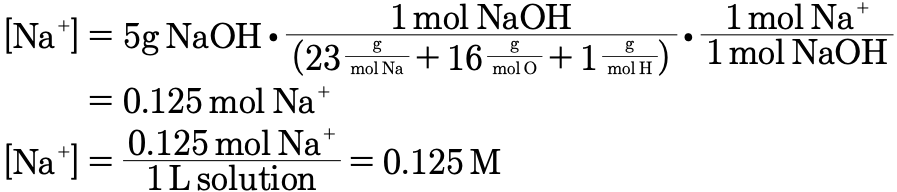 In short, [Na+] = 0.125 M
You probably could have skipped a few steps, but showing the whole process helps with understanding all of the different components that go into finding the concentration, when given the mass.
Next, we compare the moles of our limiting reactants.
Recognize that since OH– ions come from the same compound as the Na+ ions, the initial moles of Na+ and OH– are the same! We already calculated the initial moles of Na+ to be 0.125, moles of OH–=0.125 moles
To calculate the moles of H+ is easy, because we just multiply the concentration of the solution by the volume. So, H+ = 0.1M • 1L = 0.1 moles
Which one is the limiting reactant? It is H+ because there is less of it.
Since H+ is the limiting reactant, we know that all of it will react with the OH–, so there will be some OH– left over. The question is how much, and what is its final concentration as a result?
The added acid is the limiting reagent, so the stoichiometric bookkeeping leaves no excess added acid. That is not the same as a literal zero hydronium concentration: water remains in acid/base equilibrium. Use the excess hydroxide concentration for the equilibrium estimate at 25 °C.
At 25 °C, using the ideal dilute-solution model and [OH⁻]=0.025 M, [H⁺]=Kw/[OH⁻]=1.0×10⁻¹⁴/0.025=4.0×10⁻¹³ M. The amount of unreacted added strong acid is zero in the stoichiometric model, while equilibrium hydronium is small and nonzero.
Now we calculate how many moles of OH– are left over. This is simply the initial moles minus the moles that reacted with H+, or 0.125 – 0.1 = 0.025 moles OH– left over.
Since the volume of the solution stays the same, the final concentration of OH– ions is 0.025 moles/ 1 L. [OH–]=0.025M
Chapter Problems
- Calculate the molecular weight for: C12H9NO2
- 1 SO42- ion = ___ g SO42- = ___ amu SO42-
- How many moles of InBr2 are present in 50.2 g of InBr2 (MW = 274.6)? What is the mass percent of In in this compound?
- Balance the following: C3H6O2 + O2 → CO2 + H2O
- When the following equation is balanced, what is the sum of its coefficients: Na3PO4 + FeCl2 → NaCl + Fe3(PO4)2
- How many grams of KClO3 would be required to produce 10.0 g of O2: KClO3 → KCl + O2 (unbalanced)?
- If a 6.00 g sample of 97% pure H2 was reacted with 50.0g CO, how many moles of CH3OH are produced: H2 + CO → CH3OH (unbalanced)
- Using the same equation as above, how many grams of CO are needed to completely react with 10.0 g of H2?
- Reviewed problem: react 5.0 g H₂ with 3.00 g of a sample that is 96.5% CO by mass; assume the impurity is inert. Use CO(g)+2 H₂(g)→CH₃OH(g), M(CO)=28.01 g mol⁻¹ and M(H₂)=2.016 g mol⁻¹. Identify the limiting reactant and the theoretical amount of methanol. The CO amount is (3.00×0.965)/28.01=0.10336 mol. H₂ is in excess, so the theoretical methanol amount is 0.103 mol. This explicitly repairs the original oxygen/ethanol wording.
- Using the same equation as above, if 5.0 g of H2 are reacted with 10.00 g of 96.5% pure CO, how many grams of excess reactant are left unreacted?
- The atmosphere is composed of 21% molecular Oxygen and approximately 79% molecular Nitrogen. What is the molecular weight of dry air?
- Using the molar mass of dry air calculated above, what is the mass fraction of Oxygen present in 10 moles of air?
- Reviewed model problem: a 1.000 kg solution contains 0.1000 mol of a hypothetical diprotic acid H₂A. Assume its first dissociation is complete and exactly 10.0% of HA⁻ undergoes the second dissociation. This supplied model is not a claim about concentrated sulfuric acid. How much H⁺, in moles and as a formal hydrogen-ion mass percent, is produced? The two steps supply 0.1000+0.0100=0.1100 mol H⁺. Using 1.008 g mol⁻¹ for H, the corresponding mass is 0.11088 g and the formal mass percent is 0.011088%. Real aqueous protons are solvated, so this is explicit stoichiometric bookkeeping.
- The decomposition of organic matter (CH2O) to produce methane can be simplified by the following unbalanced reaction:

1 kg of organic matter is added to an enclosed environment that has 10 moles of Oxygen present.
What is the mass percent of Carbon before and after the reaction? (Hint: Do not violate the law of conservation of mass) - Based on the above reaction, what is the mass percent of methane (CH4) once the Oxygen is used up?
- Based on the reaction in #14, what is the mass percent of CO2 in the container after the Oxygen has reacted?
- Reviewed ideal material-balance model: completely react 1.000 kg glucose with just the required oxygen from dry air, modeled as 21.0 mol% O₂ and 79.0 mol% N₂. Use C₆H₁₂O₆+6 O₂→6 CO₂+6 H₂O and let nitrogen pass through unchanged. Treat every product as gas for the following bookkeeping, without claiming this models actual breathing. Use M(glucose)=180.156, M(O₂)=32.00 and M(N₂)=28.014 g mol⁻¹ and dry-air density 1.20 g L⁻¹. The glucose amount is 5.55074 mol, oxygen required is 33.30447 mol, and total air required is 158.59271 mol. Its mass is 4575.57 g, giving 3.8130 m³ of air.
- For the ideal product mixture in the reviewed previous problem, include CO₂, H₂O vapor and unchanged N₂. Their masses are 1465.73, 600.01 and 3509.82 g. The CO₂ mass percent is 100×1465.73/5575.57=26.288%. The total mass also equals the initial glucose plus dry-air mass. Actual exhaled air is a different physiological mixture and cannot be inferred from this ideal reaction alone.
- Using the same reviewed complete-reaction model with exactly stoichiometric oxygen, what is the final mole fraction of O₂ molecules? It is zero in the stoichiometric model because the supplied O₂ is fully consumed. Oxygen atoms are still present in CO₂ and H₂O. A mole fraction must specify the counted species; do not confuse oxygen molecules with oxygen atoms.
- Check oxygen-atom mass conservation in the reviewed ideal reaction. The incoming dry air contains 1065.74 g of oxygen, and the glucose itself contains 532.87 g of oxygen. The product mixture therefore contains 1598.61 g of oxygen atoms, or 28.672% of its total mass. The product oxygen mass fraction differs from the incoming air fraction because glucose was also added; no oxygen atoms disappeared.
Glossary and deeper reading · 2 refreshers
These editorial refreshers supplement the reading. Definitions and examples are added guidance; original source wording and recorded answers remain in their original context.
-
Limiting reactant
The limiting reactant is consumed first under the specified complete-reaction model and limits the product amount. Identifying it requires comparing available amounts with the balanced equation's ratios. For example, abundant hydrogen cannot produce more water after the available oxygen has been consumed.
-
Stoichiometry
Stoichiometry uses a balanced chemical equation to relate amounts of reactants and products. Equation coefficients provide mole ratios rather than direct mass ratios. For example, forming water from hydrogen and oxygen consumes two moles of hydrogen molecules per mole of oxygen molecules.