Stoichiometry
Alternative stoichiometric conversion examples after the mole and equation lessons.
Supporting original reading. Follow the AP topic pathway for reviewed scope, worked reasoning and targeted practice.
Chemistry I · original Chapter 2 · combined Chapter 2
Section 3
Gallery 2.3.1 Conversions
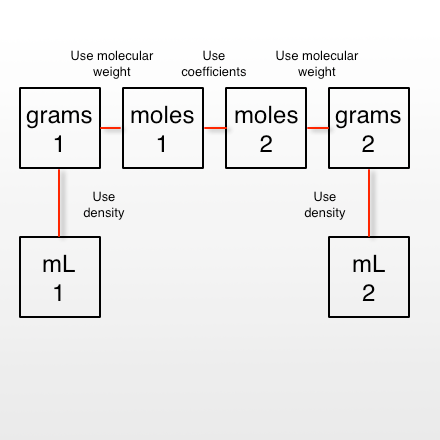
This shows a generalized way of converting from one unit to another, from compound “1” to compound “2”.
Read all original image captions
Image 1
This shows a generalized way of converting from one unit to another, from compound “1” to compound “2”.
This depicts a general way of how to go about going from one or more given pieces of information to get a desired value. We will use a common combustion reaction similar to the one presented in the last section and present a variety of questions that could be asked.
Given the following balanced equation, answer the following questions:
2C6H6 + 15O2 → 12CO2 + 6H2O
a) How many moles of O2 are required to completely react with 6 moles of C6H6?

This is a simple relationship taken from the given balanced equation and its coefficients. For every 2 mols of C6H6 there are a corresponding 15 mols of O2.
b) How many grams of CO2 will be formed from 4 moles of C6H6 reacting with excess O2?

Again, we start with the given information: 4 moles of C6H6 and go from there. The related coefficients from the balanced equation are 2 mols of C6H6 for every 12 mols of CO2. Using inventory we calculate how many grams one mole of CO2 weighs:
1 C atom = 1 x 12.0 amu = 12.0 amu
2 O atoms = 2 x 16.0 amu = 32.0 amu
1 CO2 molecule = 44.0 amu
Recall that one mole of a compound weighs the same in grams as one molecule of that compound weighs in amu, therefore, 1 mol of CO2 weighs 44.0 grams.
Excess means there is more than is necessary, so for now we do not worry about the excess element.
c) How many grams of H2O will be formed from 5.0 mL of C6H6 (density = 0.874 g/mL) reacting with excess O2?
To clarify, mL means milliliters. The prefix milli- means x 10-3. However, we do not need to convert to standard liters (L) because density is given, and gives a way to relate mL, a measure of volume, to g, a unit of weight. The density of a substance is a measure of its mass per unit of volume (such as grams per liter). In stoichiometry problems, density gives us a way to convert from volume to mass or vice-versa. Knowing this:


This problem is a good summary of all that has been mentioned about stoichiometry so far. We start with the given information like usual, 5 mL of C6H6. We want our answer to be in grams, a unit of weight, so using density will allow us to make that conversion. Since density is unit of mass per unit of volume (per meaning for every one unit) we say for every 1 mL of C6H6 there are 0.874 grams. We then use inventory again to find the molar mass of C6H6, which is 78.0 grams, to find moles of C6H6 and relate that to moles of H2O - this is again, found using the coefficients in the balanced equation. Finally, we calculate the molar mass of water to convert from moles to grams.
Molar mass is simply the mass of one mole of substance. It is just to introduce common terminology, but is the same as taking inventory.
Example Problem 2.3.1
Using the same balanced equation: How many grams of C6H6 are needed to react with 5.00 g of 96.5% pure O2?
We are presented with something we haven’t encountered before, percent purity of a compound. If no other information is given, we can make a simple assumption:
Since a percent is a part of a whole, or 100, we can assume we have 100 g of sample. After this relation, the problem is more or less the same we have been doing.

We start again with what is given, then we convert 96.5% into a fraction - 96.5 / 100 (with the 100 g of sample assumption).


Go from amount of O2 to mols of O2 using its molar mass. Then go to mols of C6H6 using the coefficients of the balanced equation, then finally the molar mass of C6H6 to find its yield in grams.
Glossary and deeper reading · 3 refreshers
These editorial refreshers supplement the reading. Definitions and examples are added guidance; original source wording and recorded answers remain in their original context.
-
Stoichiometry
Stoichiometry uses a balanced chemical equation to relate amounts of reactants and products. Equation coefficients provide mole ratios rather than direct mass ratios. For example, forming water from hydrogen and oxygen consumes two moles of hydrogen molecules per mole of oxygen molecules.
-
Mole
A mole is an amount of substance containing exactly 6.02214076 × 10²³ specified entities. The entities can be atoms, molecules, ions, or formula units, so the counted entity must be named. For example, one mole of oxygen molecules contains two moles of oxygen atoms.
-
Molar mass
Molar mass is the mass of one mole of a specified substance. It is commonly expressed in grams per mole and connects a sample's mass to its amount of substance. For example, water has a molar mass of approximately 18.02 grams per mole.