Solvation
Alternative original solvation reading with accepted viewing revisions; extended solubility-rule memorization is not added to the main path.
Before this connection: Chemical equilibrium: dissolution equations, Q versus K, and molar solubility.
Supporting original reading. Follow the AP topic pathway for reviewed scope, worked reasoning and targeted practice.
Chemistry II · original Chapter 2 · combined Chapter 10
Section Outline
- Salts
- Solubility Rules
- Process of Solvation
- Supersaturation
Section 1
Solvation
As we know it, salt is the ionic compound NaCl. In fact, any ionic compound created by neutralizing an acid with a base. We won’t get into that too much, but all you need to know right now is that most simple ionic compounds are considered salts. NaCl, Sodium Chloride, is just the most familiar salt to us, as we have it on out kitchen table.
A few more examples of salts include Calcium Chloride (CaCl2), Silver Oxide (Ag2O), Magnesium Sulfate (MgSO4), and even Ammonium Chloride (NH4Cl).
You know that salt dissolves readily in water. In fact, many salts also readily dissolve in water. However, a fair few have a lot of trouble, and are insoluble. For example, CaCO3, calcium carbonate is very insoluble. You know how to use the K sp to determine how much of a chemical you can dissolve into water, but what if you don’t know the Ksp?
Luckily, there are a few trends involved in solubility of compounds. To use these trends, you need to know the difference between a cation and an anion in an ionic compound. The cation is the positively charged ion which bonds to the negatively charged anion.
For example, a few common cations include: NH4+, Na+, Mg2+, K+, Ca2+, and Al3+. For the anions, we are looking at CO32-, SO42-, Cl-, NO3- and PO43-.
Let’s take a look at the periodic table and discuss these trends.
Interactive 2.1.1 Periodic Table

Read all original figure notes
- The Salts formed with an Alkaline Metal (the leftmost column: Rb, Na, K) or Hydrogen or Ammonium (NH4+) will be soluble UNLESS the salt is Li3PO4 or Li2CO3.
- Salts formed with Nitrate (NO3-) will be soluble.
- Salts formed with Silver (Ag+) will be insoluble.
- Acetate is CH₃COO⁻, the conjugate base of acetic acid CH₃COOH. The proton is absent from the ion formula and the negative charge belongs to the acetate group. Keep the ion’s atoms and charge consistent when predicting salt formulas and precipitation.
- Salts formed with S2-, OH-, CO32-, PO43- are insoluble.
- Salts formed with Lead (Pb2+) are insoluble.
Now for the tricky ones:
- Keep mercury oxidation states distinct. Mercury(I) commonly occurs as the dimeric Hg₂²⁺ ion, so its chloride is Hg₂Cl₂. Mercury(II) is Hg²⁺ and its chloride is HgCl₂. Naming the oxidation state identifies the ion and formula; a shorthand HgCl silently loses this distinction. Solubility predictions must use the actual compound.
- Salts formed with Sulfate (SO42-) are soluble UNLESS they are bonded with either Barium (Ba2+), Strontium (Sr2+), or Calcium (Ca2+).
Silver nitrate is a familiar soluble silver salt under the usual dilute aqueous convention, but it is not the only silver compound that can dissolve. Use the supplied rule or measured data for the stated conditions. Silver chloride is sparingly soluble, and complex formation can change dissolved silver concentration.
It is important to realize that these rules don’t mean a salt can’t dissolve at all in water, simply that very little will dissolve in water. For example, Calcium Carbonate, insoluble according to our rules, will dissolve up to 13mg/L at room temperature. Of course, that is extremely low, so we say it is insoluble.
I know that is a large set of rules, so let’s go through a lot of example problems to review how to use them, and then a lengthy quiz to test how well you know them.
Example Problem 2.1.1
Is MgSO4 soluble or insoluble?
Okay, time to go through the rules until we find mention of the relevant ions.
Rule 1 discusses cations, but Magnesium is not mentioned. Next.
Rule 2 discusses Nitrates, not Sulfates. Next.
Rule 3 covers Silver, but we have Magnesium. Next.
Rule 4 refers to Acetic Acid, which is not present. Next.
Rule 5 covers a lot of anions, but no Sulfate. Next.
Rule 6 is irrelevant as we don’t have lead. Next.
Rule 7 is only useful if we had a halogen. Next.
Rule 8 finally mentions one of our ions. It tells us that Sulfate salts are going to be soluble, unless it has an anion that we don’t have. Therefore, we can safely assert that MgSO4 is soluble.
Sodium carbonate has formula Na₂CO₃: two Na⁺ ions balance one CO₃²⁻ ion. Under the ordinary dilute aqueous solubility convention, it dissolves to supply those ions. NaCO₃ would not balance the charges of sodium(I) and carbonate.
This one’s easy. Right off the bat, rule 1 gives us our answer. As our cation is Sodium, we know that this salt will be soluble.
Example Problem 2.1.3
Is PbS soluble?
Time to go through our rules:
Rule 1 discusses cations, but Lead is not mentioned. Next.
Rule 2 discusses Nitrates, not Sulfur. Next.
Rule 3 covers Silver, but we have Lead. Next.
Rule 4 refers to Acetic Acid, which is not present. Next.
Rule 5 does indeed mention Sulfur as an anion. We note that this means our salt is insoluble.
For your convenience, here are the solubility rules:
- The Salts formed with an Alkaline Metal (the leftmost column: Rb, Na, K) or Hydrogen or Ammonium (NH4+) will be soluble UNLESS the salt is Li3PO4 or Li2CO3.
- Salts formed with Nitrate (NO3-) will be soluble.
- Salts formed with Silver (Ag+) will be insoluble.
- Under common introductory solubility conventions, many acetate salts are soluble. Write the acetate ion as CH₃COO⁻, not CH₃COOH⁻. A rule is a useful model for stated conditions; it does not replace a measured solubility when an exception, concentration limit or specific equilibrium is involved.
- Salts formed with S2-, OH-, CO32-, PO43- are insoluble.
- Salts formed with Lead (Pb2+) are insoluble.
- Salts with the first few halogens after Fluorine: Cl-, Br-, I- are soluble UNLESS they are bonded with Mercury (Hg2+).
- Salts formed with Sulfate (SO42-) are soluble UNLESS they are bonded with either Barium (Ba2+), Strontium (Sr2+), or Calcium (Ca2+).
Gallery 2.1.1 The Process of Solvation
Read all original image captions
Image 1
Image 2
Image 3
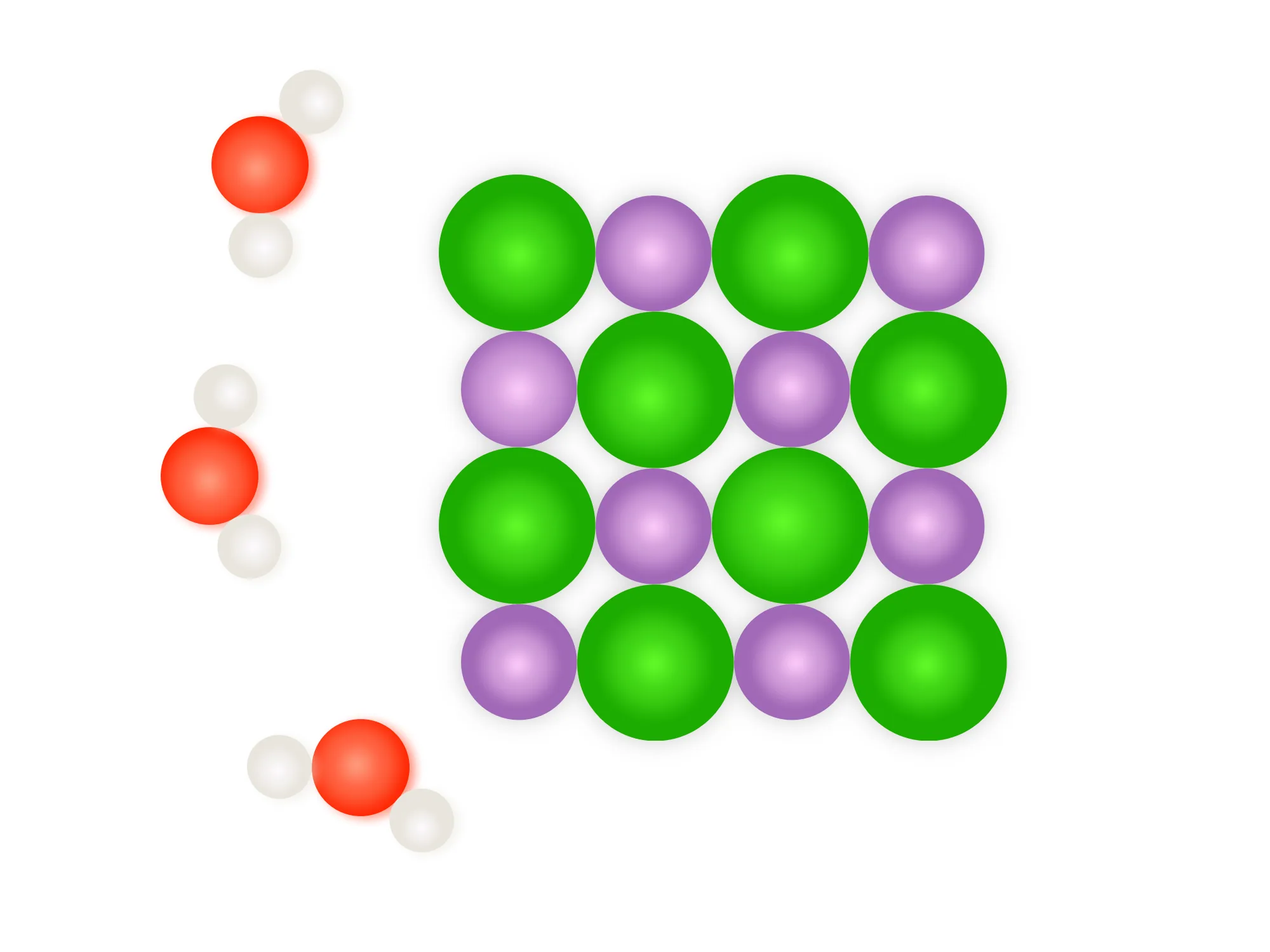
The process of a compound’s dissolving most likely is best explained through imagery, so if you’d prefer that, refer to the gallery in the next column. If you want a deeper explanation, then keep reading.
An ionic compound consists of ions in an extended solid lattice, not polar molecules. Polar water molecules can stabilize separated ions through ion–dipole interactions. Dissolution depends on the combined energetic and entropic changes, so polarity alone does not guarantee every ionic solid is highly soluble.
But just because it’s polar, why does that mean it dissolves in water? Well, that’s actually because the polarity allows water molecules to become attracted to it. Water has a very strong dipole thanks to Oxygen, and as such, it can readily form H-Bonds and Dipole-Dipole bonds. Of course, these bonds are typically lower in strength than the bonds holding together the molecule in the water.
Gallery 2.1.2 Surface Area
Read all original image captions
Image 1
Image 2
Image 3
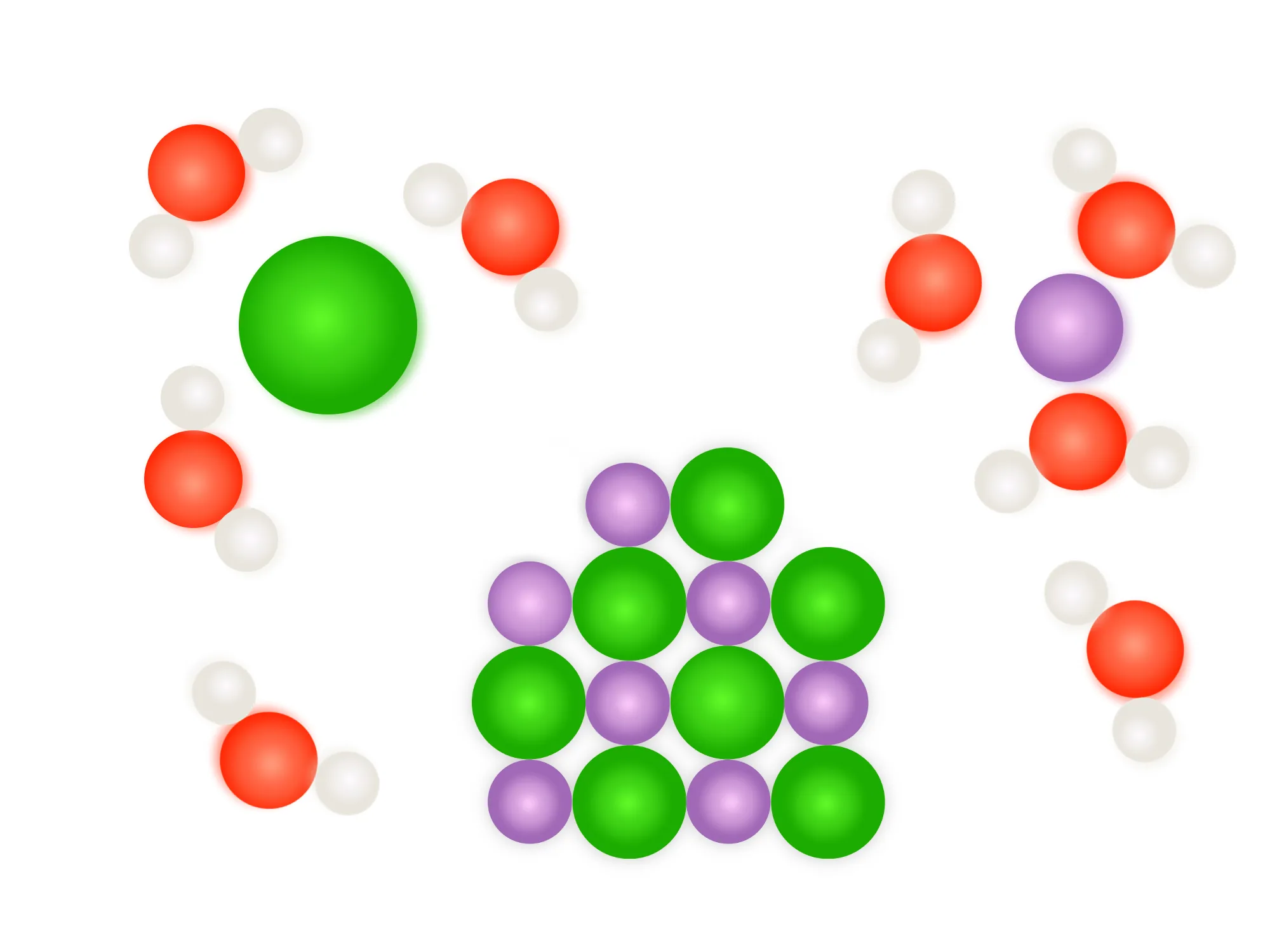
Once the ion gets pulled off, even more water molecules congregate around it, creating a sort of ‘net’ around the ion. This is the dissolved state.
Just because a compound is soluble doesn’t mean that it will instantly dissolve into solution. Furthermore, just because a compound is insoluble doesn’t mean that it won’t be affected by water.
Solubility tells us the equilibrium amount of a solute that can dissolve under specified conditions. Dissolution rate tells us how quickly the system approaches that state. A substance can dissolve slowly yet have substantial equilibrium solubility. Stirring or crushing a solid can speed dissolution without changing its equilibrium solubility at the same temperature and solvent composition.
The keyword in this case is equilibrium, meaning that this is after a lot of time has passed. If solvation occurred instantly, then you would never need to stir sugar into your tea. Instead, we need to look at the rate of dissolution.
As you will find later in this book, rates of chemical equations can be pretty complicated. Since we haven’t reached that point yet, we will simply speak in terms of relative speed.
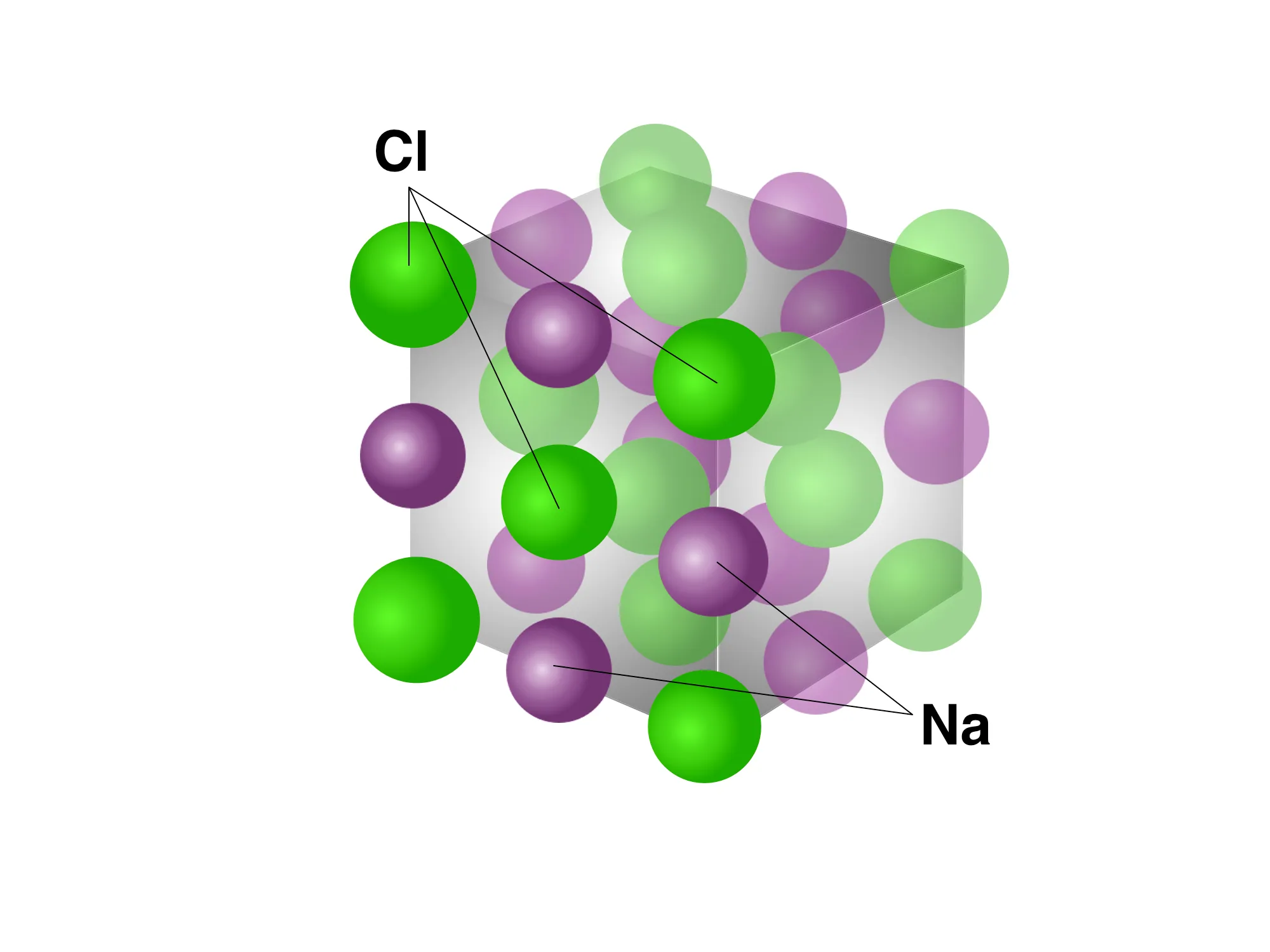
If you take a block of salt and just let it sit in water, what happens? Not much, really. Sure, the salt is dissolving, but it is so slow that it is hard to see any change being done to the block. Now say we break up the block. Then we see the smallest pieces start to disappear much more quickly than the larger ones. The reason for this is the surface area to mass ratio.
When you look at a large cube, it has a certain surface area. Take that cube and cut it into half. Now there is a new surface uncovered: the faces on the cut. This increase in surface area did nothing to decrease the mass of the cube. Therefore, the halved cube has a larger surface area to mass ratio.
So, How does this help?
Well, recall that for solvation to occur, you need the water to come up to the ion and interact with it. If you have a higher surface area, that means more ions are exposed to the water, allowing for more interaction to take place at the same time. This speeds up the rate of solvation. Great! So how else can we help to speed this up?
Gallery 2.1.3 Stirring
Read all original image captions
Image 1
Image 2
Image 3
Water molecules form dynamic solvation environments around dissolved ions. They do not become a permanent net that can never exchange or interact again. Near a dissolving surface, stirring transports dissolved species away and brings fresh unsaturated solution toward the surface. That can increase the dissolution rate without changing the eventual saturation amount.
Finally, heat plays a role too, and not just in the speed of dissolution. Heat can actually change the overall solubility of compounds.
When you heat up water, it increases the energy of the water. This means that if you look at the dissolution equation and determine whether it is exothermic or endothermic, you can write in energy on one side of the equation. For example, let’s take the dissolution of our favorite table salt: NaCl.
For the usual dissolution of solid KOH into a relatively dilute aqueous solution, the process is exothermic: KOH(s)→K⁺(aq)+OH⁻(aq), with ΔHsol<0 under those conditions. The original +58 kJ mol⁻¹ reactant-side equation is superseded; no universal numerical value is assigned here because dissolution enthalpy depends on temperature and final concentration.
An exothermic dissolution warms its surroundings as it proceeds. That does not by itself establish the entire saturation-solubility curve at every temperature or concentration. For a simple equilibrium model, adding heat favors the endothermic direction, but real solubility trends can involve changing solution activities or solid phases. Use measured solubility data for a temperature comparison, and keep rate separate from equilibrium.
Many solids become more soluble as temperature increases, but this is not universal. Measure or consult the solubility curve for the actual substance. Heating also often speeds the approach to equilibrium; a faster dissolution rate and a larger saturation concentration are different observations and require different explanations.
For a substance whose equilibrium solubility is higher at a warmer temperature, dissolving it warm and cooling it carefully can sometimes produce a supersaturated solution. That solution contains more dissolved material than the stable saturation amount at its final temperature and may crystallize when nucleation begins. It is a metastable state, not proof that stirring or heating always raises every solubility.
When you heat up a solution and then add so much of a compound, you can’t add anymore, you reach the saturation point. As the saturation point is elevated due to the heat, you can then carefully cool the solution, and two thing might happen.
First, the solution might start forming solids that fall to the bottom. This is called precipitation, and it can also occur if you have a reaction between previously soluble salts that forms an insoluble compound.
Second, the solution might simply cool without any sort of precipitant forming. This gives you a supersaturated solution. As you filled the solution to capacity at a high temperature, now that it’s at a low temperature it has a lower capacity, but it still contains the same amount of solute.
Typically this occurs when the solution is cooled without any remaining undissolved solute. When you have the particles of the compound, they provide a point of crystallization for the rest of the compound currently dissolved. This can be used towards your favor.
When you have a supersaturated solution of sugar, you can place into that solution a stick covered in a light layer of sugar. This results in the solventized sugar crystallizing onto the sugar on the stick, forming large sugar crystals. This process results in rock candy being formed, and that is awesome.
Glossary and deeper reading · 8 refreshers
These editorial refreshers supplement the reading. Definitions and examples are added guidance; original source wording and recorded answers remain in their original context.
-
Solubility
Solubility describes how much of a substance can dissolve in a specified solvent under stated conditions. It depends on the solute, solvent, temperature, and other relevant conditions and is distinct from how fast dissolution occurs. For example, two salts can have different equilibrium solubilities in water at the same temperature.
-
Cation
A cation is a positively charged ion. Its total positive nuclear charge exceeds its total electron charge. For example, calcium commonly forms a cation with charge +2 by losing two electrons.
-
Anion
An anion is a negatively charged ion. It has more electrons than needed to balance its positive nuclear charge. For example, a chlorine atom gaining one electron forms a chloride anion.
-
Conjugate acid–base pair
A conjugate acid–base pair consists of species differing by one proton. Losing a proton forms an acid's conjugate base, while gaining one forms a base's conjugate acid. For example, ammonium and ammonia form a conjugate acid–base pair.
-
Ion
An ion is an atom or group of atoms with a net electric charge. Ordinary ion formation changes electron count without changing the element's proton count. For example, a sodium atom losing one electron becomes a sodium ion with charge +1.
-
Oxidation number
An oxidation number is a formal electron-accounting value assigned using specified rules. Changes in oxidation number help identify oxidation and reduction but are not always actual atomic charges. For example, oxygen usually has oxidation number −2 in water while hydrogen has +1.
-
Dilution
Dilution lowers solute concentration by adding solvent while conserving the solute amount when no reaction or loss occurs. Concentration calculations use the final solution volume rather than simply the volume of solvent added. For example, increasing a solution's volume from 100 to 200 milliliters halves its concentration if its solute amount is unchanged.
-
Aqueous solution
An aqueous solution is a solution in which water is the solvent. The dissolved substance may originate as a solid, liquid, or gas, so aqueous does not mean that a solid has melted. For example, sodium chloride dissolved in water is aqueous even though the pure salt is solid.