Circular Motion
Distinguish radial from tangential acceleration and derive a circular-orbit period relation.
Constant speed can still mean changing velocity
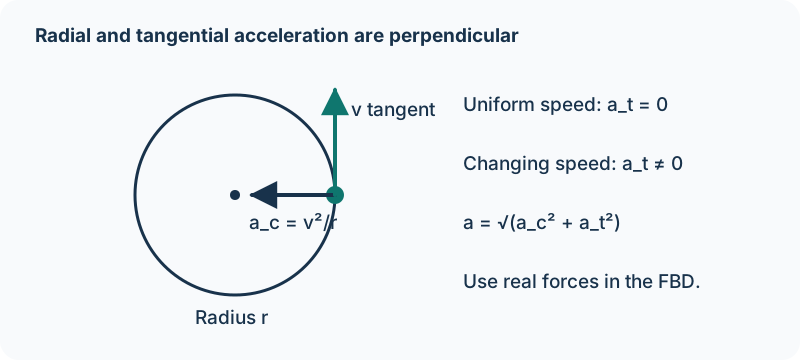
A car rounds a curve at constant speed. The speedometer stays steady, but the velocity direction changes continuously. The car therefore accelerates. The inward component is centripetal acceleration, with magnitude a_c = v²/r, where v is tangential speed and r is radius.
Centripetal means toward the center. It names a direction of acceleration, not a new force. A string, gravity, friction, normal force, or some combination of their components can provide the required inward net force. Don’t add a “centripetal force” arrow to an FBD that already shows the actual interactions.
When speed changes as well, there’s a tangential acceleration a_t pointing along or opposite the motion. The total acceleration is the vector sum of perpendicular radial and tangential components: a = √(a_c² + a_t²). Uniform circular motion has a_t = 0, but a_c is still nonzero.
Example 2.9.1 — Turning on level ground
A 1000 kg car travels at 10 m/s around a flat curve of radius 25 m. Its inward acceleration is 10²/25 = 4.0 m/s². Static friction provides the horizontal inward force, so f_s = ma_c = 4000 N. The tires roll without slipping in this model; their ground-contact interaction is static friction.
On level ground with no vertical acceleration, N = mg = 10,000 N using g = 10 m/s². Preventing slip requires μ_sN ≥ mv²/r, so v_max = √(μ_sgr). If μ_s = 0.40, the maximum speed is √(0.40·10·25) = 10 m/s. Doubling speed would require four times as much inward force at the same radius.
Vertical circles and contact
At the top of a vertical loop, inward is downward. For an object on the inside of a circular track, mg + N = mv²/r. The normal force can’t pull the object toward the track. At the minimum speed that maintains contact, N = 0, leaving v_min = √(gr).
This is a local speed at the top, not automatically the minimum launch speed at the bottom. Finding a bottom speed may require an energy comparison. At the bottom, inward is upward, so N − mg = mv²/r. The different equations come from changing the inward direction, not changing Newton’s law. A taut-string version has the same top threshold when tension first reaches zero.
A banked road and a tilted string
A frictionless banked curve uses the horizontal component of its normal force for inward acceleration. If the bank angle is θ, N cos θ = mg and N sin θ = mv²/r. Dividing gives tan θ = v²/(rg). If speed differs from the frictionless design speed, friction may help: its direction depends on whether the tendency is to slide up or down the bank. The supplied CED limits numerical banked-curve analysis to frictionless cases; friction on a bank is treated qualitatively.
For a conical pendulum, a mass travels in a horizontal circle while its string makes angle θ from vertical. Vertical balance is T cos θ = mg; inward balance is T sin θ = mv²/r. Here r = L sin θ, not the full string length L. Again, tension is the actual force and its component supplies the inward net force.
Period, frequency, and orbit
Period P is time per revolution; frequency f is revolutions per second: f = 1/P. For uniform circular motion, v = 2πr/P, or P = 2πr/v. We use P here to keep the period distinct from string tension T.
A satellite in a circular orbit is accelerated inward by gravity alone. Equating GMm/r² with mv²/r gives v = √(GM/r). Substitute into the period expression to get P² = 4π²r³/(GM). This is the circular-orbit form of Kepler’s third law. For orbits around the same central body, P²/r³ is constant and satellite mass cancels. If orbital radius doubles, period grows by 2√2, not by 2.
The supplied AP course doesn’t require Kepler’s first or second laws. The original book keeps those as clearly identified enrichment; this circular-orbit relation is the required quantitative target.
Build an experimental relationship
Use a safe low-speed rotating apparatus or recorded circular-motion video. Measure radius and time for several complete revolutions, then determine v and a_c. Timing many cycles reduces the fractional timing uncertainty compared with one revolution. If investigating force versus speed, keep radius and mass fixed, measure inward force directly, and plot F_inward versus v². The slope should be m/r. Label axes and units; don’t claim a v² dependence from one trial.
Example 2.9.2 — Construct both acceleration directions
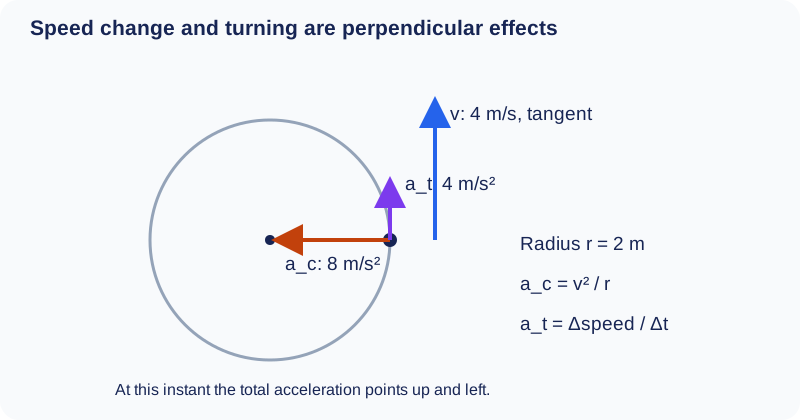
A bead is at the rightmost point of a 2 m radius circle, moving counterclockwise. Its velocity points upward tangent to the path. If its speed increases from 3 to 5 m/s during 0.50 s at a constant rate, its tangential acceleration is Δspeed/Δt = 4 m/s², upward tangent to the path at the stated point. At the instant its speed is 4 m/s, its centripetal acceleration is 4²/2 = 8 m/s², leftward toward the center. The total acceleration points up and left with magnitude √(8² + 4²) ≈ 8.94 m/s².
Tangential acceleration measures the rate of speed change and follows the local tangent; centripetal acceleration measures the turning of the velocity vector and points toward the center. If the bead instead slows at 4 m/s² while moving upward, the tangential component points downward. If its speed stays constant, the tangential component vanishes but the inward component remains.
At the top of an inside vertical circular track with radius 1.6 m, inward is downward. Contact requires N ≥ 0 in mg + N = mv²/r. At the limiting top speed N = 0, so mg = mv_min²/r and v_min = √(gr) = √(10·1.6) = 4.0 m/s. Gravity alone produces centripetal acceleration at that threshold. At a lower top speed the equation would demand a pulling normal force, so the object loses contact with the track. This threshold is a local top speed, not a bottom launch-speed result.
Inspect diagram labels
The diagram keeps its full size here. Focus the view and use the arrow keys, or scroll across it, to inspect every label.
Example 2.9.3 — Identify real forces on banks and cones
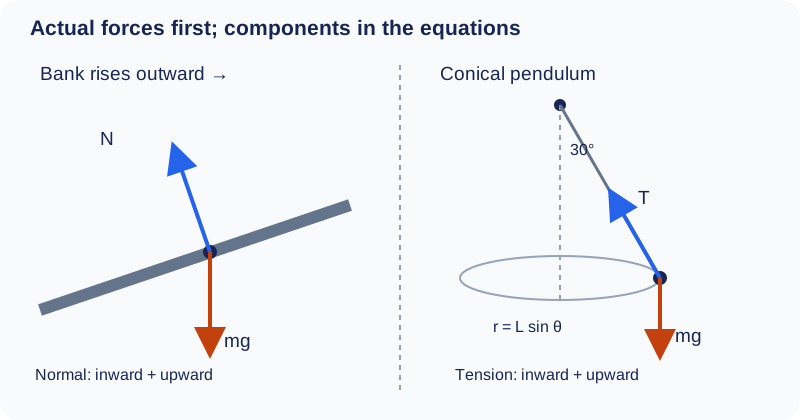
On a road bank that rises outward from the curve center, the normal force points perpendicular to the road with upward and inward components. At the frictionless design speed, its inward component supplies the required centripetal force while its upward component balances weight. Below that speed the car tends to slide down the bank; static friction points up the bank, with an outward horizontal component and upward vertical component. The net inward force is then the inward normal component minus the outward friction component.
Above the frictionless design speed the tendency is up the bank; static friction points down the bank, with inward and downward components. Its inward component adds to the normal force’s inward component, while its downward component increases the needed upward normal contribution. Thus components of both static friction and normal force can contribute to the radial net force. This frictional bank analysis is qualitative in AP Physics 1; numerical banked-curve calculations here use no friction.
For a 0.50 kg conical pendulum, a 1.0 m string makes 30° with vertical. Its circle radius is r = L sin 30° = 0.50 m. Tension points along the string toward the support. Vertical balance gives T cos 30° = mg = 5.0 N, so T ≈ 5.77 N. Its horizontal component T sin 30° ≈ 2.89 N points inward and supplies mv²/r; the speed is √[(2.89)(0.50)/0.50] ≈ 1.70 m/s. No extra centripetal force is added to gravity and tension on the FBD.
Inspect diagram labels
The diagram keeps its full size here. Focus the view and use the arrow keys, or scroll across it, to inspect every label.
Check what you know
Pause & try it
Let's see what stuck.
Choose an answer, then check the reasoning. Try the written problems below before opening their solutions.
0 of 3 checked · 0 correct
Give it a try
Practice 1
A 0.50 kg mass moves uniformly at 4 m/s in a circle of radius 2 m. Find inward acceleration, inward net force, and period. In a separate changing-speed case, its instantaneous speed is 4 m/s at the same radius and its tangential acceleration is 6 m/s². Find the total acceleration magnitude at that instant.
Practice 2
Derive tan θ = v²/(rg) for a frictionless banked curve. Explain why the normal force must exceed mg whenever θ is nonzero.
Practice 3
Derive the circular-orbit period equation by eliminating speed. Sketch P² versus r³ for satellites around one planet and identify the slope, including its units.
Keep exploring
The original Circular Motion supplies additional visual explanations and quizzes. Kepler’s Laws keeps the first and second laws as enrichment; its third-law orbit discussion connects to this AP section.
Course scope and standards: the supplied AP Physics 1 CED, printed pages 56, 57, 58; Topic 2.9 and its exact learning objectives. The official College Board CED is the public source; the project audit records the supplied edition.
Supporting physics references: OpenStax: centripetal acceleration; OpenStax: centripetal forces and banked curves; OpenStax: satellites and Kepler’s laws. These lessons, diagrams, examples, and practice questions were written for this book.
Explain and apply the model
Try these problems before opening the solutions. State your assumptions, show the diagram or calculation, and explain what makes your answer follow.
Construct acceleration and a contact threshold
A bead is at the rightmost point of a radius 3.0 m circle moving counterclockwise. Its speed increases at a constant rate from 4.0 to 8.0 m/s over 2.0 s; consider the instant its speed is 6.0 m/s. Separately, a 2.0 kg object moves on the inside of a vertical circular track of radius 2.5 m. Neglect drag and use g = 10 m/s².
(a) Draw the bead’s velocity, centripetal-acceleration, and tangential-acceleration directions at the stated point, separately from any force diagram. Obtain tangential acceleration as the rate of speed change and calculate centripetal acceleration and total acceleration magnitude. Explain which component changes speed and which changes direction.
(b) If instead the bead slows at the same speed-change magnitude while moving counterclockwise at that point, describe the new tangential and centripetal directions. Then state which acceleration component vanishes for constant speed and why the bead would still accelerate.
(c) At the top of the vertical track, derive and calculate the minimum local speed that maintains contact. Explain which force causes centripetal acceleration at this threshold. Test whether a top speed of 4.0 m/s could maintain contact using the normal-force sign; do not infer a bottom launch speed.
Your written working
Drawing is temporarily unavailable. Work on paper if needed, then record your reasoning here.
Saving written working requires JavaScript. The problem remains available above; keep your work on paper or in your own notes.
Explain friction’s contribution on a bank
A circular road is banked so that its outer edge is higher than its inner edge. Tires do not slip relative to the road when the required static friction lies within its available limit. The frictionless design speed is the speed at which normal force alone provides the needed horizontal radial force. Analyze friction qualitatively; no numerical frictional-bank calculation is requested.
(a) Draw the actual forces for a car at the frictionless design speed and describe the normal force’s inward and vertical components in a separate component construction. Explain which component provides centripetal acceleration and why normal force is not automatically equal to weight.
(b) For speeds below and above the frictionless design speed, predict the tendency to slide and the static-friction direction along the bank. For each case explain whether its horizontal component adds to or subtracts from the normal force’s inward component and how its vertical component changes the vertical force balance. State why actual slip cannot be excluded at arbitrarily high or low speeds.
Your written working
Drawing is temporarily unavailable. Work on paper if needed, then record your reasoning here.
Saving written working requires JavaScript. The problem remains available above; keep your work on paper or in your own notes.
Resolve tension in a conical pendulum
A 0.80 kg mass travels at constant speed in a horizontal circle on a taut 2.0 m ideal string. The string makes 60° with vertical, the support is fixed, and air resistance is negligible. Use g = 10 m/s². T denotes tension and P denotes period.
(a) Draw the actual force diagram and identify the component of tension that contributes to the net force producing centripetal acceleration. State the vertical and inward equations, and explain why no separate “centripetal force” interaction is added to the diagram.
(b) Calculate circle radius, tension, inward net-force magnitude, speed, and period. Explain why using string length as the circle radius would give the wrong result.
(c) At the same string length and angle, predict how doubling the mass changes tension, centripetal acceleration, and speed. Derive the cancellations that support your prediction.
Your written working
Drawing is temporarily unavailable. Work on paper if needed, then record your reasoning here.
Saving written working requires JavaScript. The problem remains available above; keep your work on paper or in your own notes.
Related source reading
These alternative explanations and examples retain their source context. Draft placement does not add accepted exam coverage.
- frictional bank · source context; placement review pending
Glossary and deeper reading · 17 refreshers
These editorial refreshers supplement the reading. Definitions and examples are added guidance; original source wording and recorded answers remain in their original context.
-
Velocity
Velocity describes how position changes with time and includes direction. Instantaneous velocity describes one moment, while average velocity is displacement divided by elapsed time. For example, a car turning a corner can change velocity while maintaining the same speed.
-
Centripetal acceleration
Centripetal acceleration is the inward acceleration component that changes the direction of motion along a curved path. For circular motion its magnitude is speed squared divided by the circle’s radius. For example, a car moving at constant speed around a bend still has centripetal acceleration.
-
Acceleration
Acceleration is the vector rate of change of velocity with time. It can change an object’s speed, direction, or both, and it is measured in meters per second squared. For example, a satellite moving at constant speed in a circular orbit accelerates toward the center.
-
Force
A force describes an interaction that can change an object’s momentum. It is a vector measured in newtons, so both size and direction matter when forces are added. For example, a rope can pull a cart while the floor exerts friction in another direction.
-
Vector
A vector is a quantity with a magnitude and a direction, represented by an arrow or by components along chosen axes. Vectors add by adding corresponding components rather than simply adding their magnitudes. For example, an eastward displacement followed by a northward displacement produces a resultant pointing northeast. The zero vector has zero magnitude and no unique direction.
-
Vector component
A vector component describes the part of a vector along a chosen axis. Its signed value changes when the axes change, even though the physical vector remains the same. For example, a diagonal launch velocity can be resolved into horizontal and vertical components that share the same elapsed time.
-
Normal force
A normal force is a contact force perpendicular to the local surface of contact. Its magnitude is set by the motion and the other forces, so it need not equal the object’s weight. For example, a wall’s normal force on a leaning ladder points horizontally rather than upward.
-
Tension
Tension is a pulling force transmitted through a stretched rope, string, or similar connector. It acts along the connector away from the object it pulls, and an ideal massless rope has the same tension throughout an uninterrupted segment. For example, a rope supporting an accelerating load can have a tension different from the load’s weight.
-
Pendulum
A pendulum is a system that swings about a support under a restoring torque. A simple pendulum approximates a small mass on a light string and follows simple harmonic motion only for sufficiently small angles. For example, a short string pendulum completes small swings more quickly than a longer one under the same gravitational field.
-
Net force
Net force is the vector sum of all forces acting on the object or system under consideration. For constant mass in an inertial frame, it equals mass times acceleration. For example, equal upward and downward forces give zero net force even though neither force is zero.
-
Oscillation period
An oscillation period is the time required for one complete repeating cycle. It is the reciprocal of frequency and is measured in seconds. For example, measuring the time for several pendulum swings and dividing by the number of cycles estimates the period.
-
Frequency
Frequency is the number of complete repeating cycles per unit time. It is measured in hertz, meaning cycles per second, and is the reciprocal of the period. For example, a vibrating string with a higher frequency produces more cycles each second.
-
Gravity
Gravity is the attractive interaction between masses in the Newtonian model. For spherical bodies or point-mass approximations, its strength decreases with the square of the separation between their centers. For example, Earth’s gravity provides the inward force that keeps a satellite in orbit.
-
Drag
Drag is a force from a fluid that opposes an object’s motion relative to that fluid. Its dependence on speed, shape, and fluid properties varies with the physical regime. For example, a parachute increases air drag by presenting a large area to the moving air.
-
Magnitude
Magnitude is the nonnegative size of a vector quantity. It does not specify direction, and it differs from a signed component. For example, a westward velocity can have a negative x component while its speed, the velocity magnitude, stays positive.
-
Static friction
Static friction opposes the tendency for relative sliding between surfaces that are not sliding at their contact. In the simple model it adjusts up to a maximum set by the coefficient of static friction and normal force. For example, static friction can push a walking person forward when the foot pushes backward on the ground.
-
Weight
Weight is the gravitational force exerted on an object by a specified attracting body. Near Earth’s surface its magnitude is approximately mass times the local gravitational field strength, and it is measured in newtons. For example, an astronaut has less weight on the Moon while retaining the same mass.