FFR - Kepler’s Laws
Original textbook reading.
Keep the period-radius and orbital-speed connections beside AP Topic 6.6. Ellipse geometry and Kepler's first and second laws go further than the required AP treatment.
In this section, we are going to spend all our time dealing with one of the most important Laws that govern the universe. It is known as Kepler’s Three Laws and was proposed by Johannes Kepler in the early 1600s. These laws are very important as they describe the very motion of the planets in our solar system. We deem it important for you to know this as a way to solidify your knowledge of planetary motion and recognize how what you’re learning can be applied to real life principles.
Also known as the Law of Ellipses, it states that the path (orbits) of the planets around the sun is elliptical in shape with the center of the sun being located at one of the foci. In the previous section, we assumed that the planets orbited that sun in a circular motion. But in reality, they actually follow an elliptical path. The equation of an ellipse is:
In that equation, and are the radii of the ellipse’s x and y-axes, respectively. The larger radius corresponds to the major axis, while the smaller axis corresponds to the minor axis.
An ellipse is a very special shape where the sum of the distances from every point on the elliptical curve to two other points are equal Let’s look at the Gallery 3.4.1 for a better understanding:
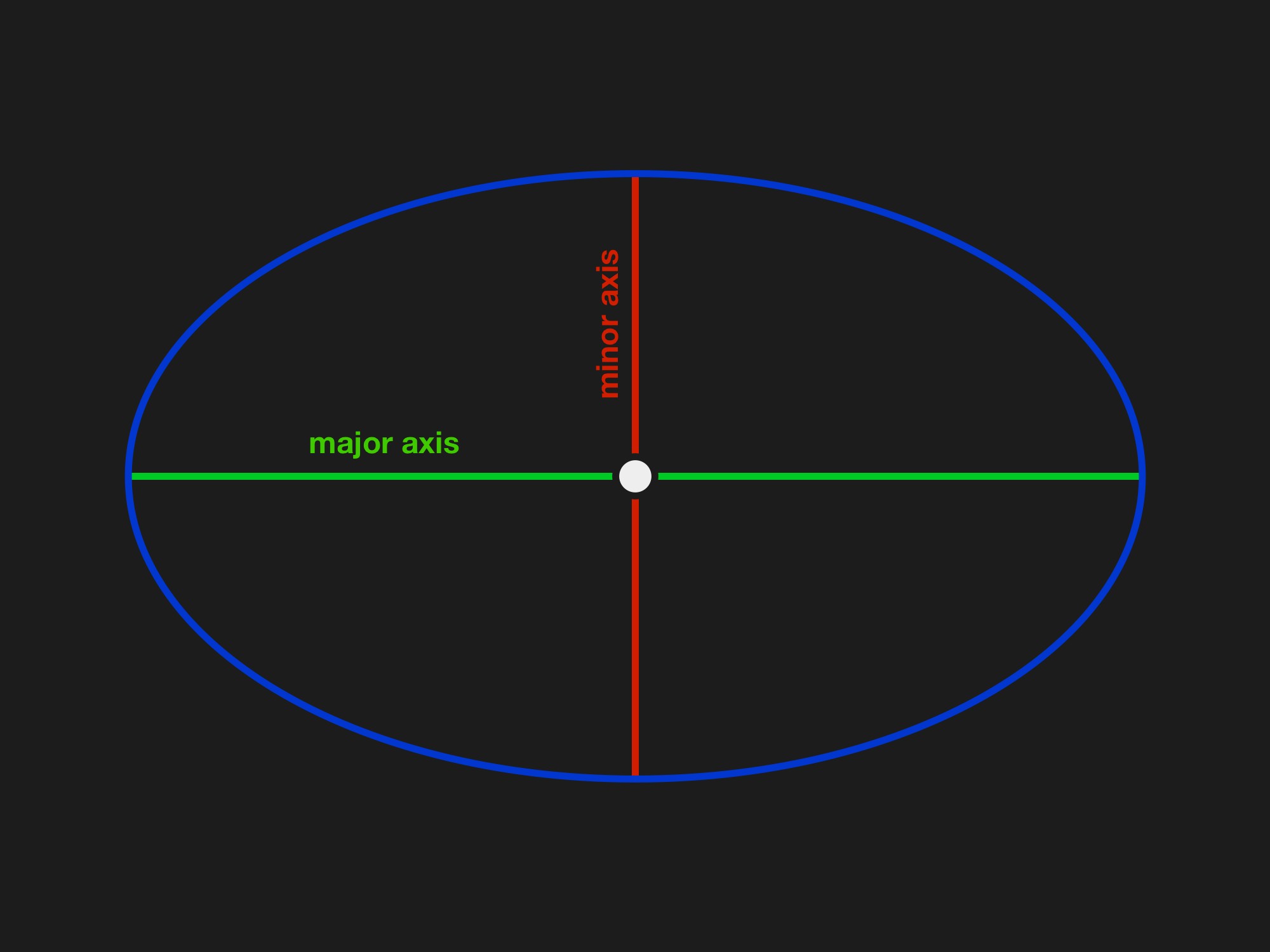
An ellipse is made up of a major and minor axis with a center point in the middle.
Read every step and figure
Step 1
Step 2
Step 3
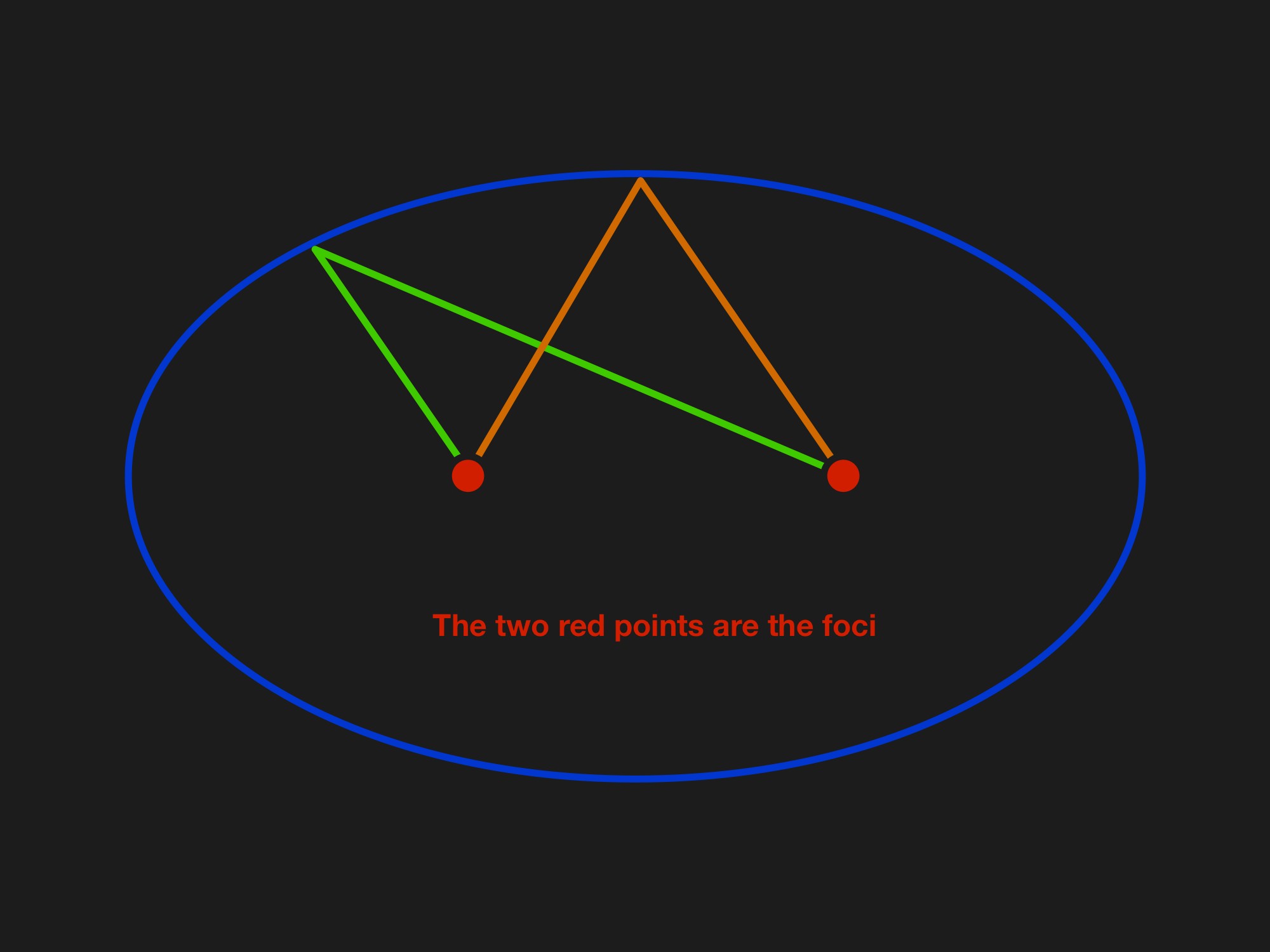
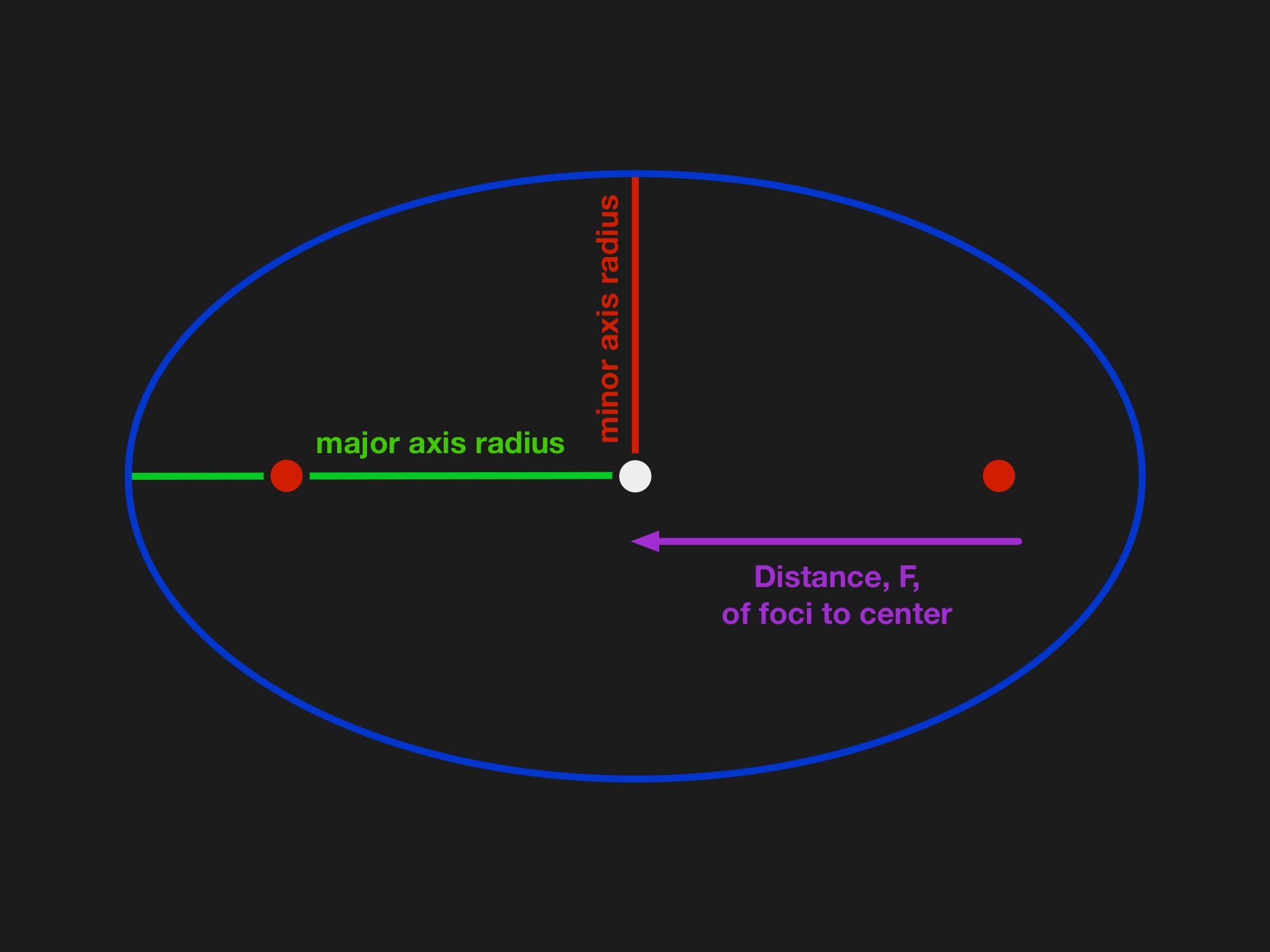
We can calculate the location of the foci if we know the radii of the major and minor axes. The equation for calculating the distance of a foci to the center of the ellipse is:
(Equation 3.4.2)
Here, is the radius of the major axis, is the radius of the minor axes, and is the distance of a foci to the center of the ellipse.
The foci are always along the major axis of the ellipse. The coordinates of the foci of an ellipse centered at and with a major axis along the x-axis are and
Also known as the Law of Equal Areas, it states that any imaginary line that is drawn from the center of the sun to a planet that lies on the orbital path sweeps the same amount of area in the same period of time. This helps characterize the velocity that the planet has at any given time while orbiting the sun. The green circles represent the planet at different time intervals and the blue and orange triangles are the areas that the planet covers from one instant of time to the next.
Figure 3.4.1 Kepler’s Second Law (The Law of Equal Areas)
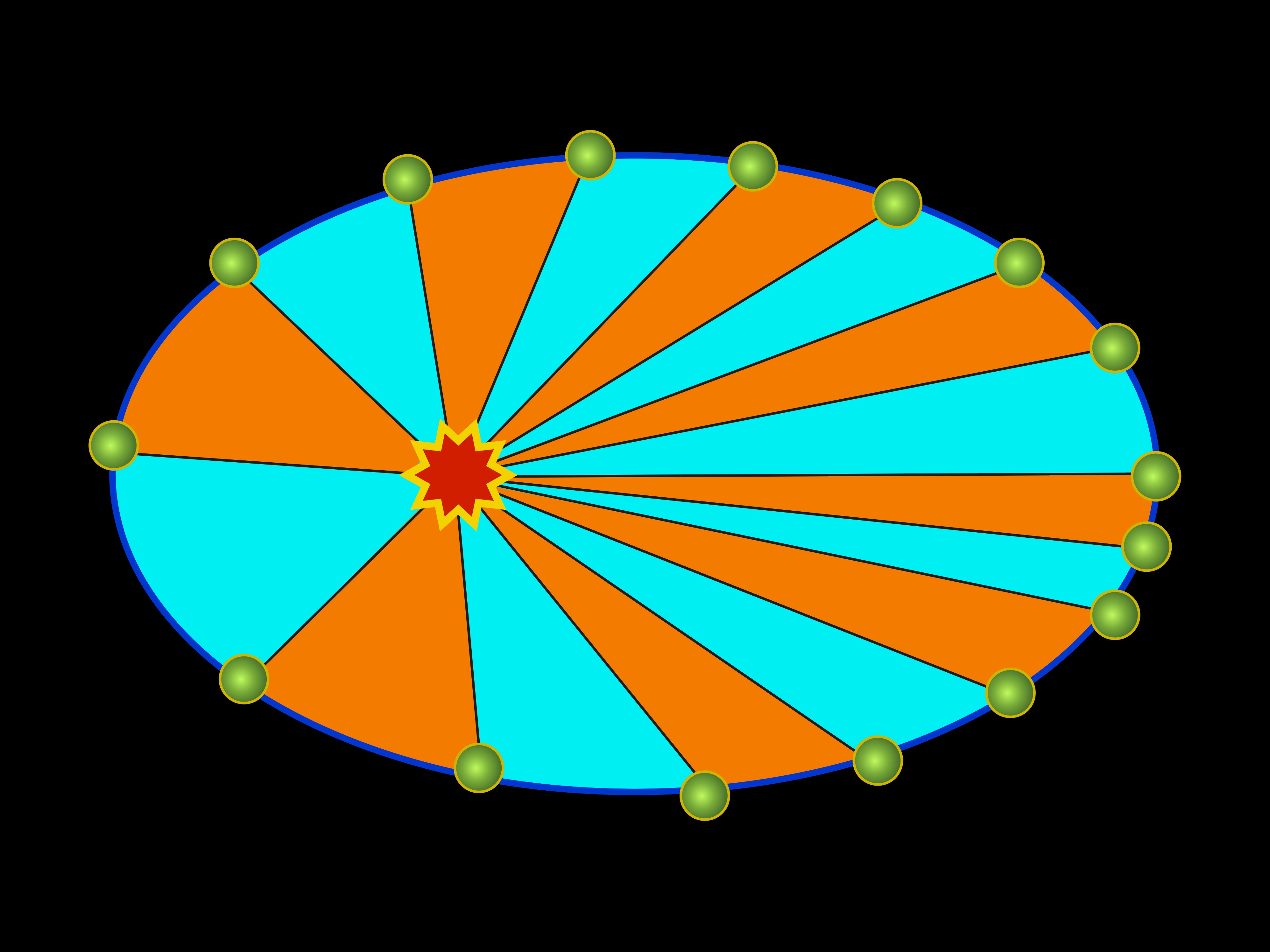
Along one elliptical orbit, the planet moves faster near the Sun and slower farther away. Conservation of angular momentum gives constant areal speed; conservation of orbital energy also relates speed to distance.
In equal time intervals, the radius from the Sun to the planet sweeps equal areas. These are orbital sectors bounded by the curved path; drawn triangles only approximate the sector areas when the intervals are small.
Kepler’s third law relates orbital period T to semimajor axis a: T²/a³ = 4π²/[G(M+m)] for an isolated Newtonian two-body system. When all orbiting bodies have negligible mass compared with the same central body M, this ratio is approximately the same. For a circular orbit, a equals the radius.
Planets, dwarf planets and other bodies orbiting the same dominant mass approximately share that constant. Satellites of a different central mass have a different constant. The observations support Kepler’s law; a table is not a proof that one constant applies to every orbit.
Table 3.4.1- Kepler’s Third Law
| Planet | Period T (yr) | Semimajor axis a (AU) | T²/a³ (yr²/AU³) |
|---|---|---|---|
| Mercury | 0.241 | 0.39 | 0.98 |
| Venus | 0.615 | 0.72 | 1.01 |
| Earth | 1.00 | 1.00 | 1.00 |
| Mars | 1.88 | 1.52 | 1.01 |
| Jupiter | 11.8 | 5.20 | 0.99 |
| Saturn | 29.5 | 9.54 | 1.00 |
| Uranus | 84 | 19.18 | 1.00 |
| Neptune | 165 | 30.06 | 1.00 |
For approximate solar-orbit calculations, express period in Earth years and semimajor axis in au, giving T² ≈ a³. Use 1 year ≈ 3.156 × 10⁷ s. One astronomical unit is exactly 149 597 870 700 m; it is close to Earth’s orbital semimajor axis, not its varying instantaneous distance from the Sun.
Pop Quiz 3.4.1 Kepler’s Laws
Question 1 of 5 · 0 correct
Extra exploration · Read the worked solution
Read every full question without answers
Question 1
Question 2
Question 3
Question 4
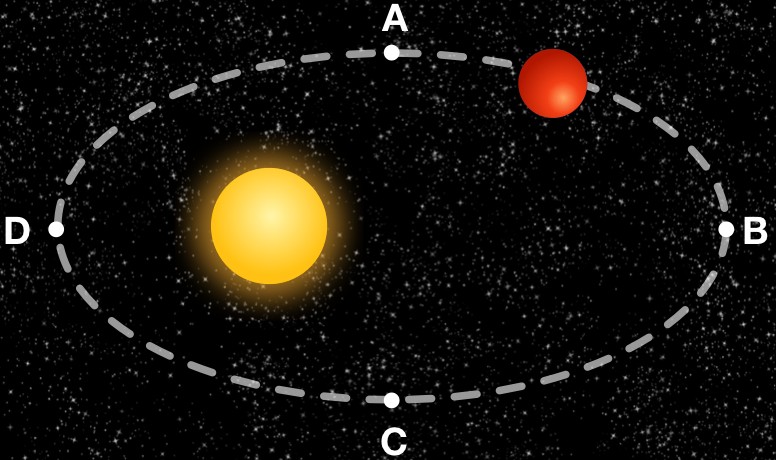
A planet has the shown orbit around a star. At which of the marked points would the planet be moving the fastest?
Question 5
Keep this in mind as we will later be able to provide a theoretical explanation to Kepler’s Third Law as we use Newton’s Law to prove it! This is where all the fun begins !
For any interval: v_avg = (x_f − x_i)/Δt (Equation 3.1.1), and a_avg = (v_f − v_i)/Δt (Equation 3.1.2). For constant acceleration in one coordinate: x = x₀ + v₀Δt + ½a(Δt)² (Equation 3.1.3); v² = v₀² + 2a(x − x₀) (Equation 3.1.4); v = v₀ + aΔt (Equation 3.1.5); x = x₀ + ½(v + v₀)Δt (Equation 3.1.6). Here v and a are signed scalar components.
(Equation 3.2.1)
(Equation 3.2.2)
(Equation 3.2.3)
(Equation 3.2.4)
x²/a² + y²/b² = 1 (Equation 3.4.1). The distance from the ellipse’s center to either focus is F = √(j² − i²) (Equation 3.4.2), where j is the semimajor axis and i is the semiminor axis.
Original problem 1
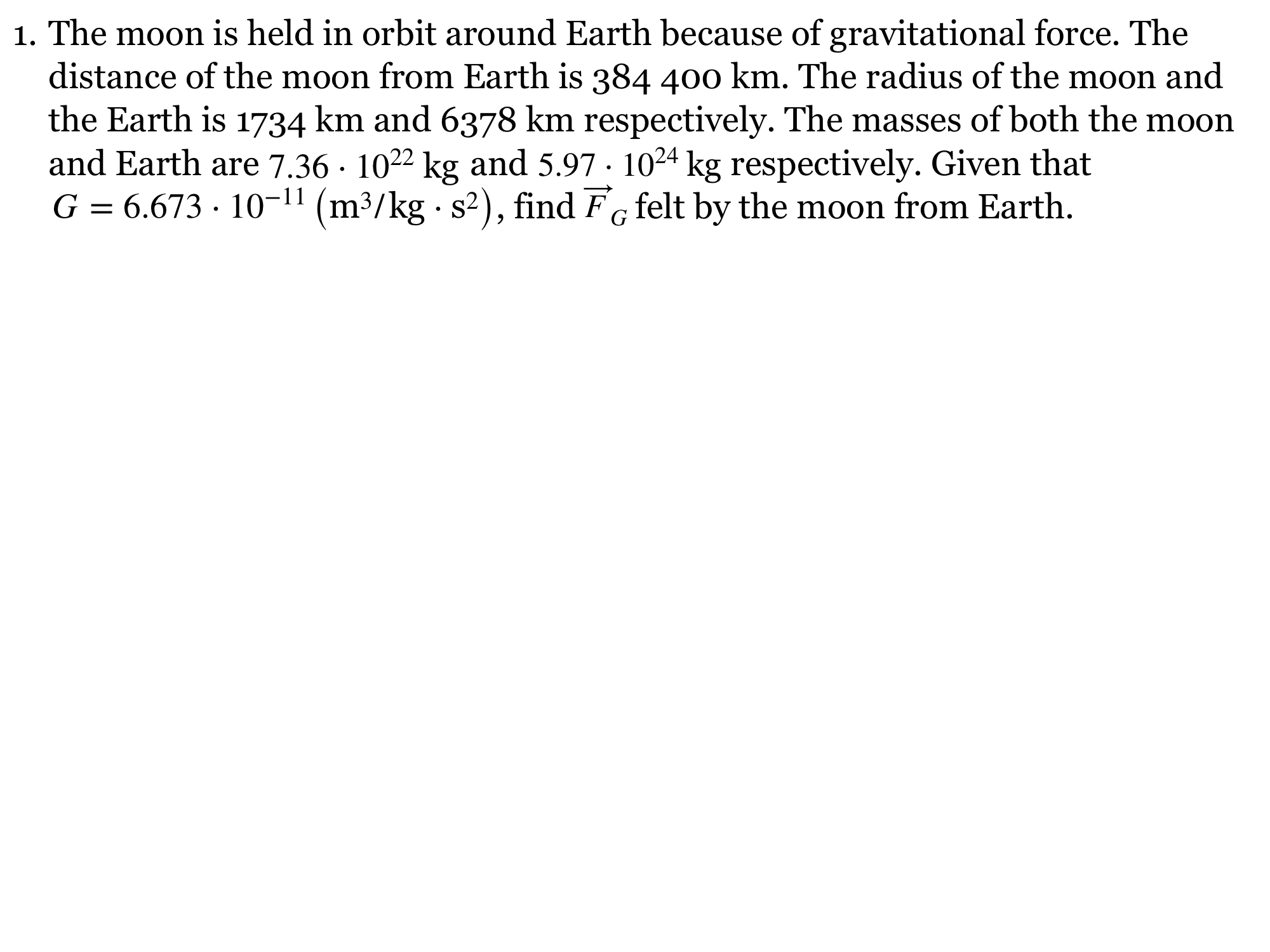
384 400 km is interpreted as center-to-center separation. The given Moon and Earth radii are not added to this standard lunar distance.
Problem text
The Moon’s center is 384 400 km from Earth’s center. Their masses are 7.36 × 10²² kg and 5.97 × 10²⁴ kg. Using G = 6.673 × 10⁻¹¹ m³/(kg·s²), find the gravitational force on the Moon from Earth.
Drawing is temporarily unavailable. Work on paper if needed, then record your reasoning here.
Saving written working requires JavaScript. The problem remains available above; keep your work on paper or in your own notes.
Original problem 2
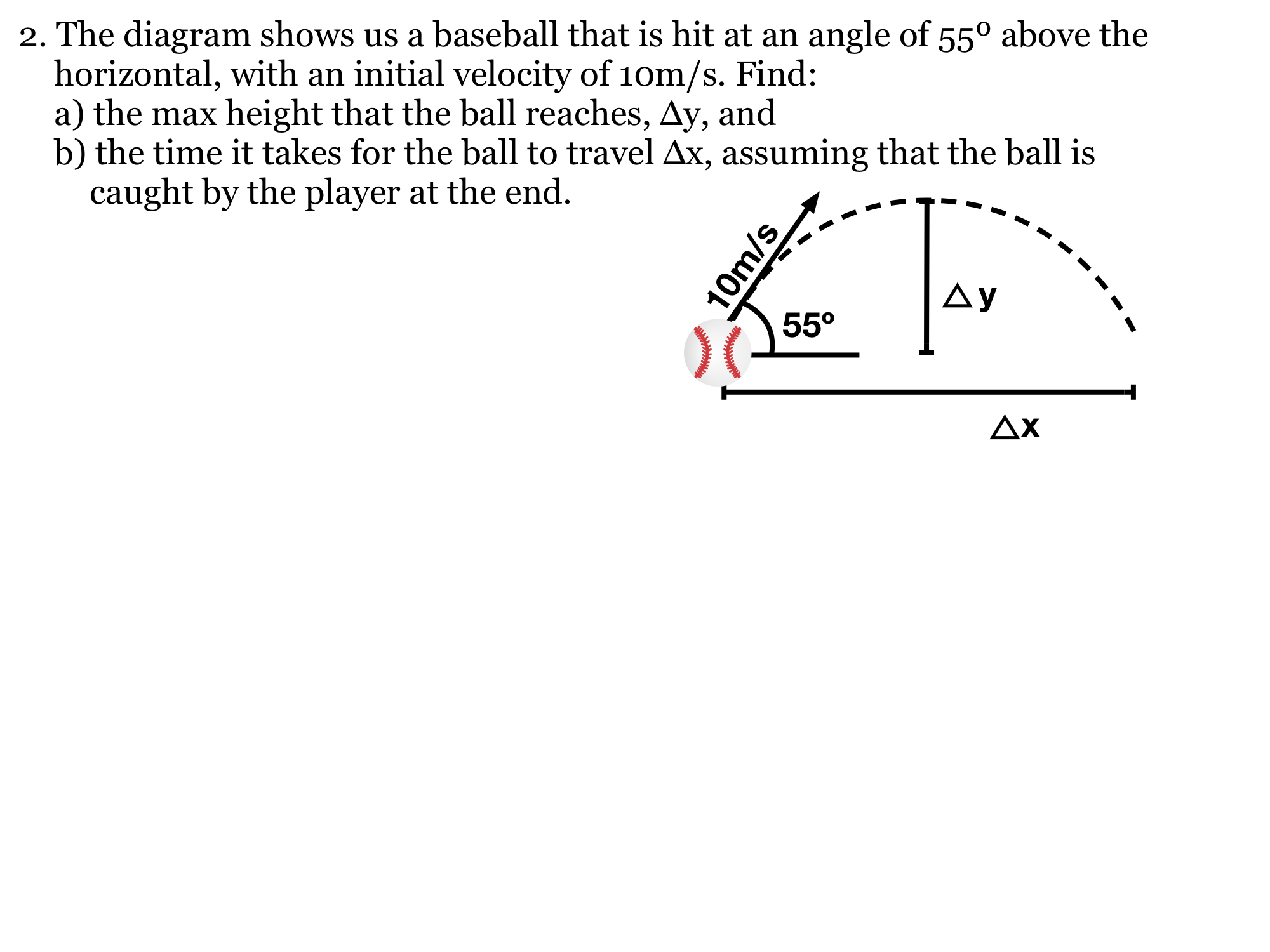
The diagram implies equal launch and catch height. Without a catch height, the flight time would be underdetermined.
Problem text
A baseball is launched at 10 m/s and 55° above horizontal and is caught at its launch height. Find (a) its maximum height above launch and (b) its flight time. Neglect air resistance and use g = 9.8 m/s².
Drawing is temporarily unavailable. Work on paper if needed, then record your reasoning here.
Saving written working requires JavaScript. The problem remains available above; keep your work on paper or in your own notes.

Original problem 3
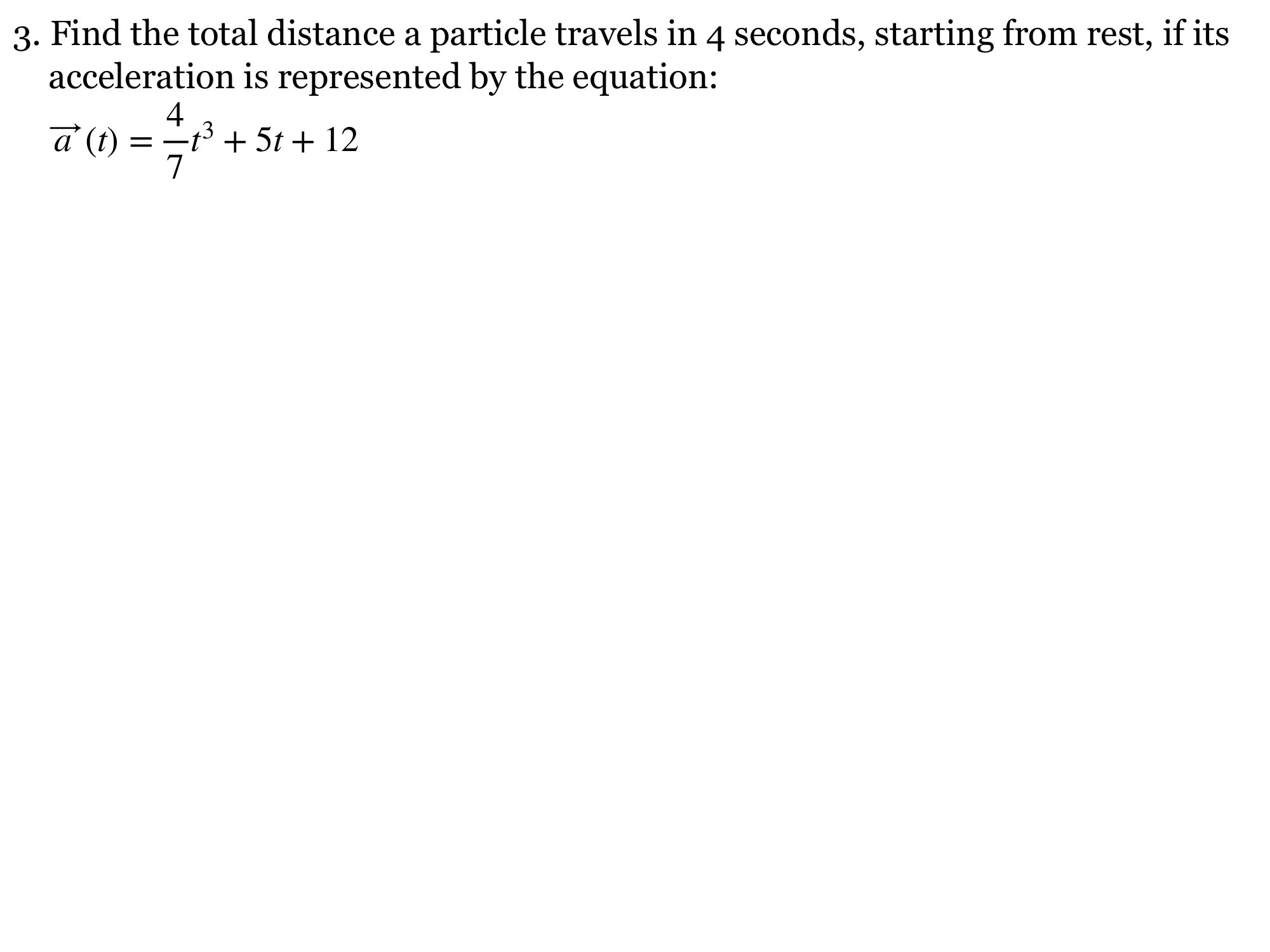
The original equation is (4/7)t³ + 5t + 12. The coefficients have the SI units required to produce m/s²; the polynomial is a component, not a squared vector.
Problem text
A particle starts from rest in one dimension. Its acceleration is aₓ(t) = (4/7)t³ + 5t + 12, with t in seconds and the numerical result in m/s². Find the total distance it travels from t = 0 to 4 s.
Drawing is temporarily unavailable. Work on paper if needed, then record your reasoning here.
Saving written working requires JavaScript. The problem remains available above; keep your work on paper or in your own notes.
Original problem 4
Problem text
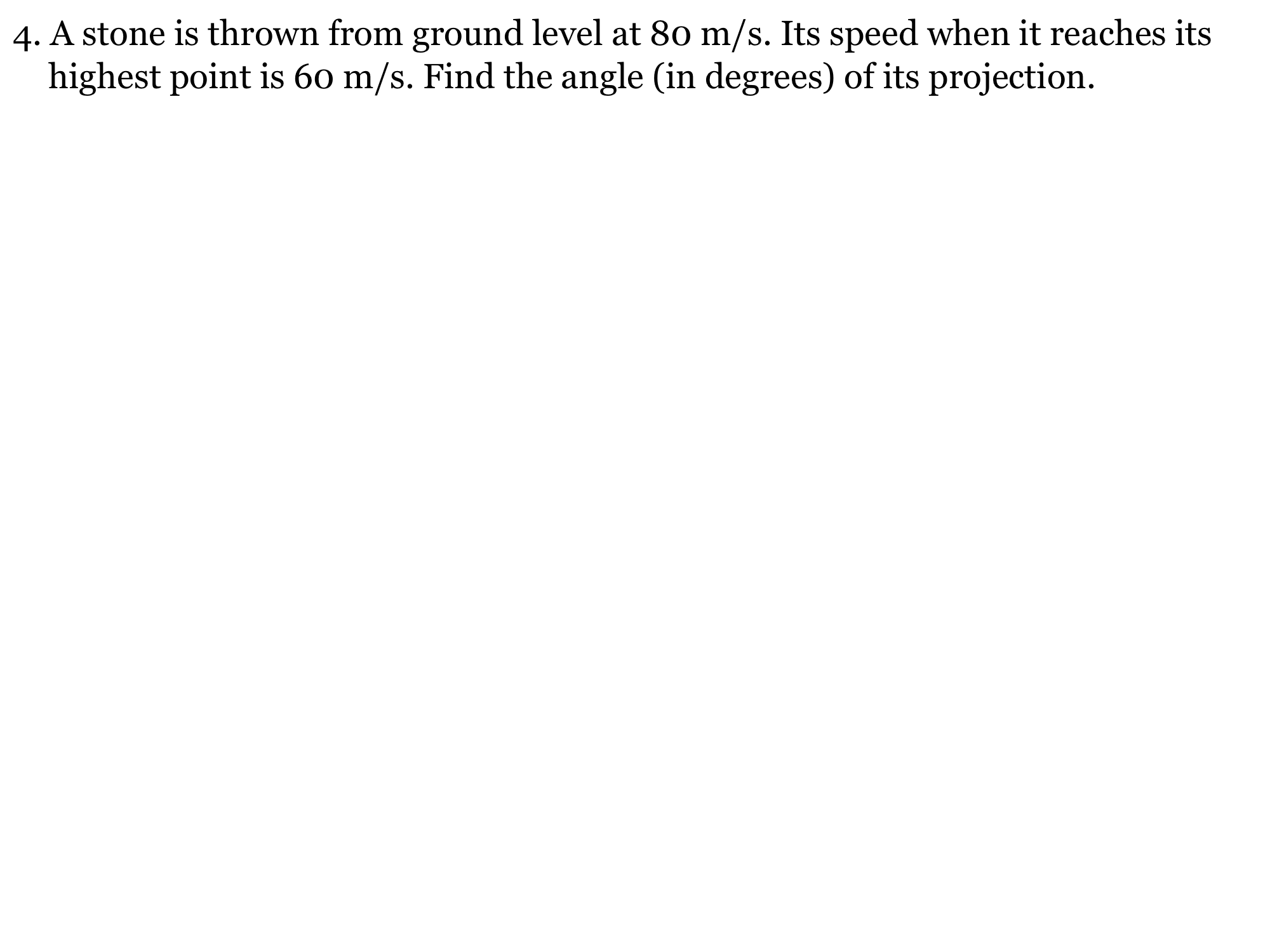
A stone is launched from ground level at 80 m/s. Its speed at the highest point is 60 m/s. Neglect air resistance. Find the launch angle above horizontal.
Drawing is temporarily unavailable. Work on paper if needed, then record your reasoning here.
Saving written working requires JavaScript. The problem remains available above; keep your work on paper or in your own notes.
Original problem 5
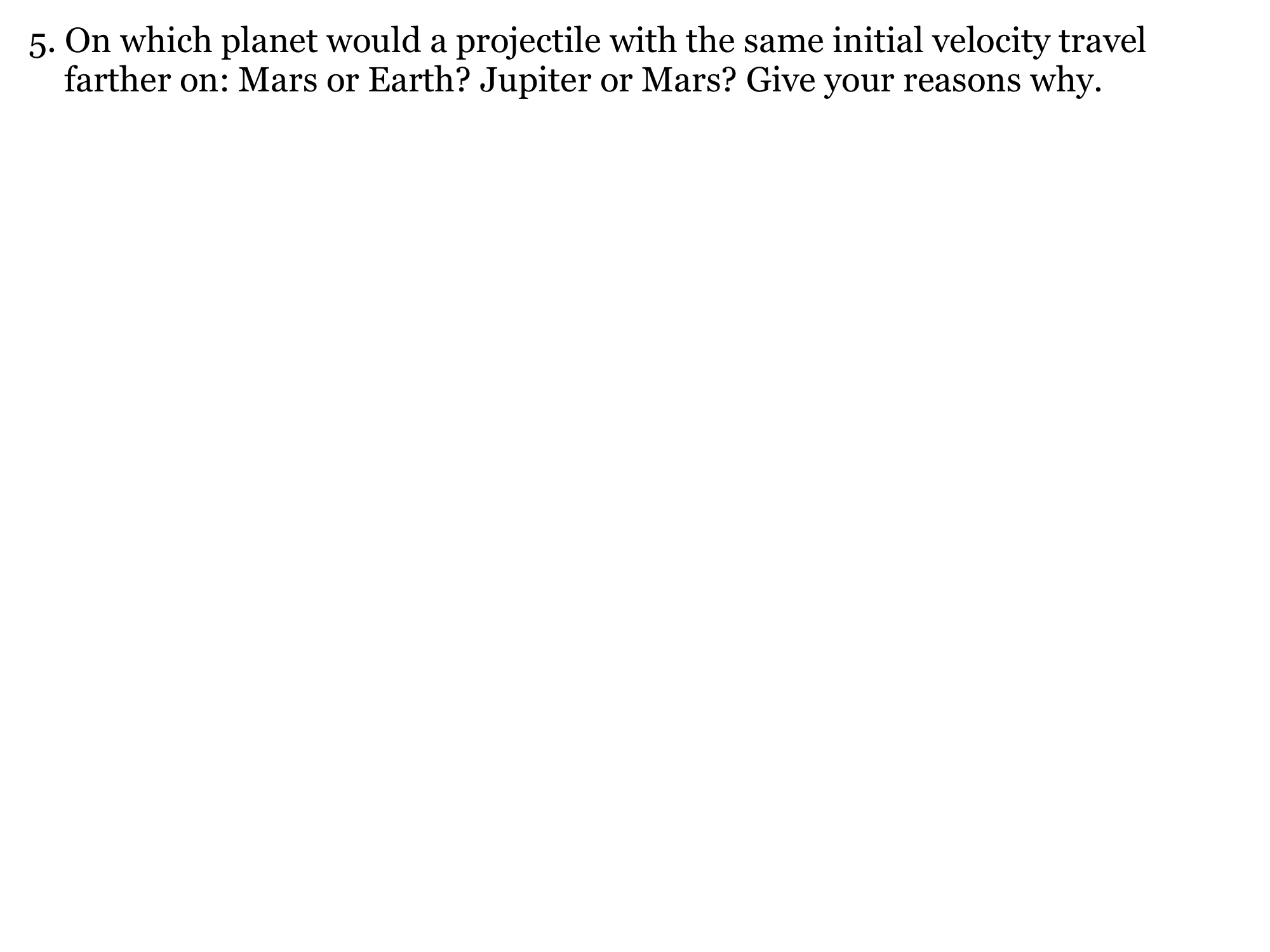
Use representative surface accelerations Mars 3.71 m/s², Earth 9.8 m/s² and Jupiter 24.79 m/s². Jupiter has no solid surface; “surface” here denotes its conventional reference level.
Problem text
For the same launch speed and angle and equal launch/landing height, would an ideal projectile travel farther on Mars or Earth? On Jupiter or Mars? Explain using gravitational acceleration. Neglect air resistance.
Drawing is temporarily unavailable. Work on paper if needed, then record your reasoning here.
Saving written working requires JavaScript. The problem remains available above; keep your work on paper or in your own notes.
Original problem 6
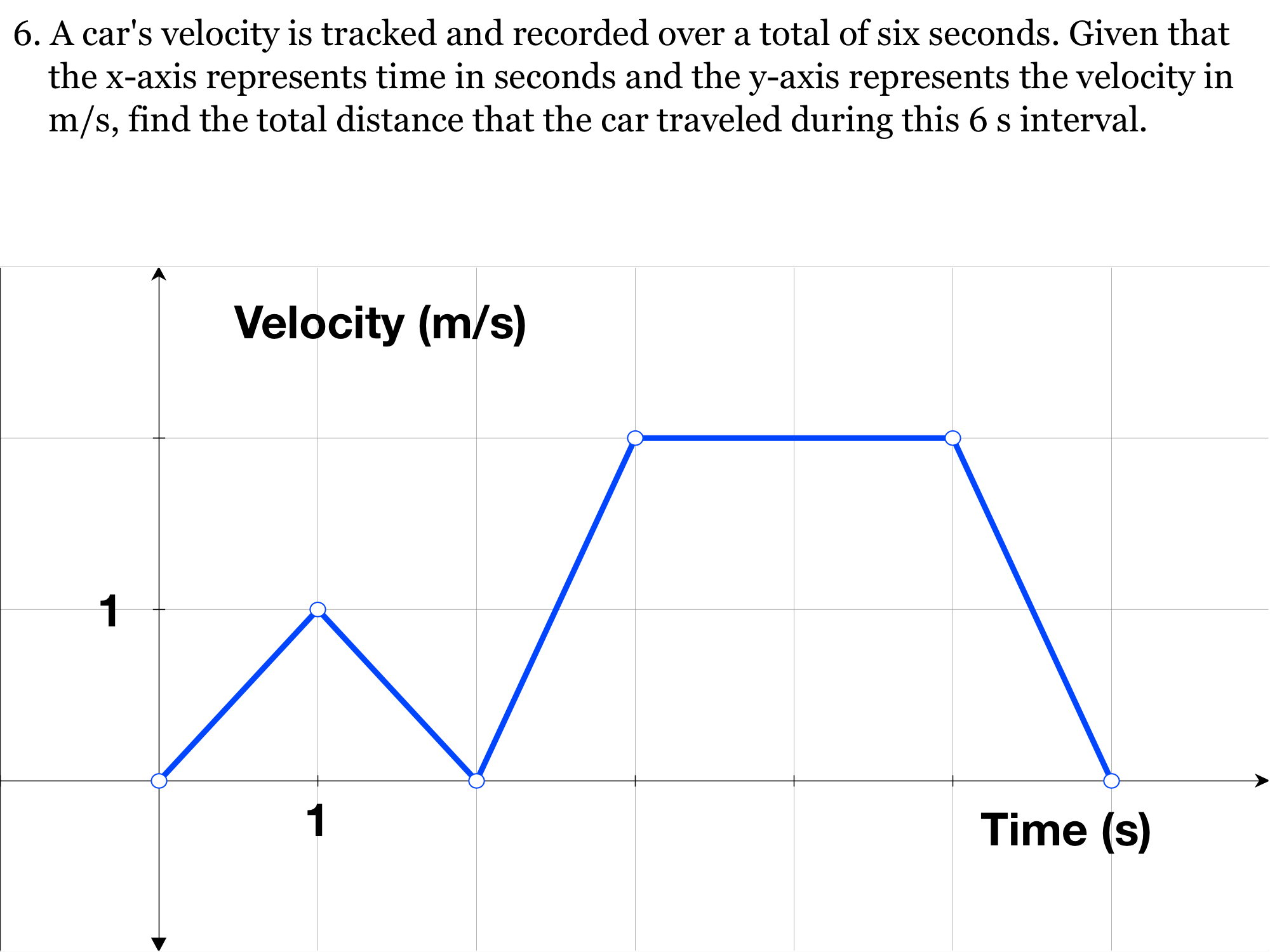
The inspected diagram has one-second horizontal grid spacing and one-metre-per-second vertical grid spacing.
Problem text
A velocity–time graph joins these points by straight lines: (t, vₓ) = (0 s, 0 m/s), (1 s, 1 m/s), (2 s, 0 m/s), (3 s, 2 m/s), (5 s, 2 m/s), (6 s, 0 m/s). Find the total distance traveled during the 6 s interval.
Drawing is temporarily unavailable. Work on paper if needed, then record your reasoning here.
Saving written working requires JavaScript. The problem remains available above; keep your work on paper or in your own notes.
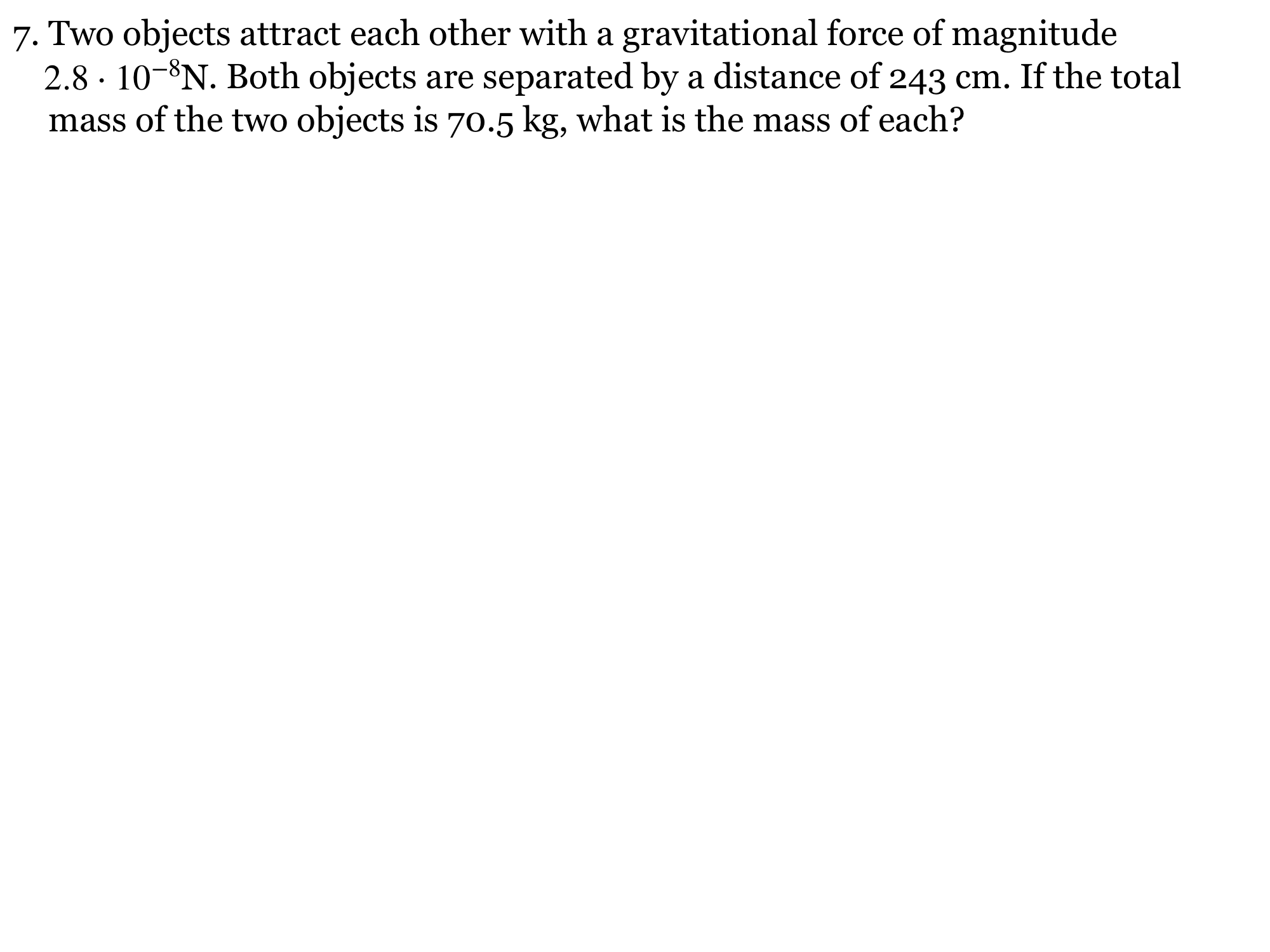
Original problem 7
This repairs the original request to find two masses into a consistency check. The stated data have no real mass solution; no numerical input has been guessed or silently changed.
Problem text
Two objects are stated to attract with force 2.8 × 10⁻⁸ N at a center separation of 243 cm, and their total mass is stated to be 70.5 kg. Using G = 6.673 × 10⁻¹¹ m³/(kg·s²), check whether any two positive masses can satisfy all these data.
Drawing is temporarily unavailable. Work on paper if needed, then record your reasoning here.
Saving written working requires JavaScript. The problem remains available above; keep your work on paper or in your own notes.
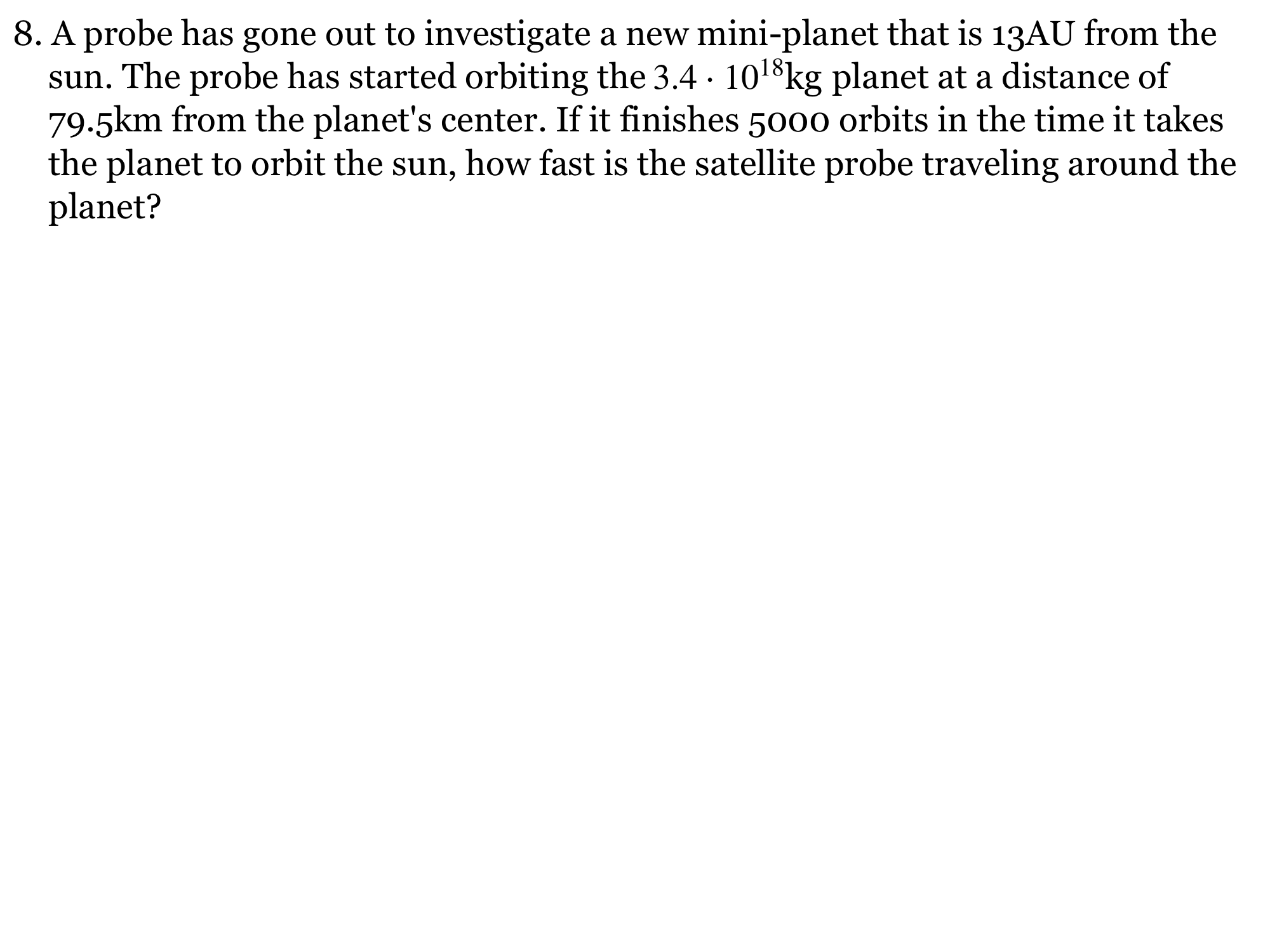
Original problem 8
The original data conflict for a freely orbiting circular probe. Treat 13 AU as the solar-orbit semimajor axis; the solar Kepler normalization uses years and AU.
Problem text
A mini-planet has solar-orbit semimajor axis 13 AU and mass 3.4 × 10¹⁸ kg. A probe is described as making a circular orbit of radius 79.5 km around its center and completing 5000 probe orbits per planet year. Find the speed implied by the stated orbit count, compare it with the circular speed required by the planet’s gravity, and check consistency. Use G = 6.673 × 10⁻¹¹ m³/(kg·s²) and 1 Earth year = 3.156 × 10⁷ s.
Drawing is temporarily unavailable. Work on paper if needed, then record your reasoning here.
Saving written working requires JavaScript. The problem remains available above; keep your work on paper or in your own notes.
Original problem 9
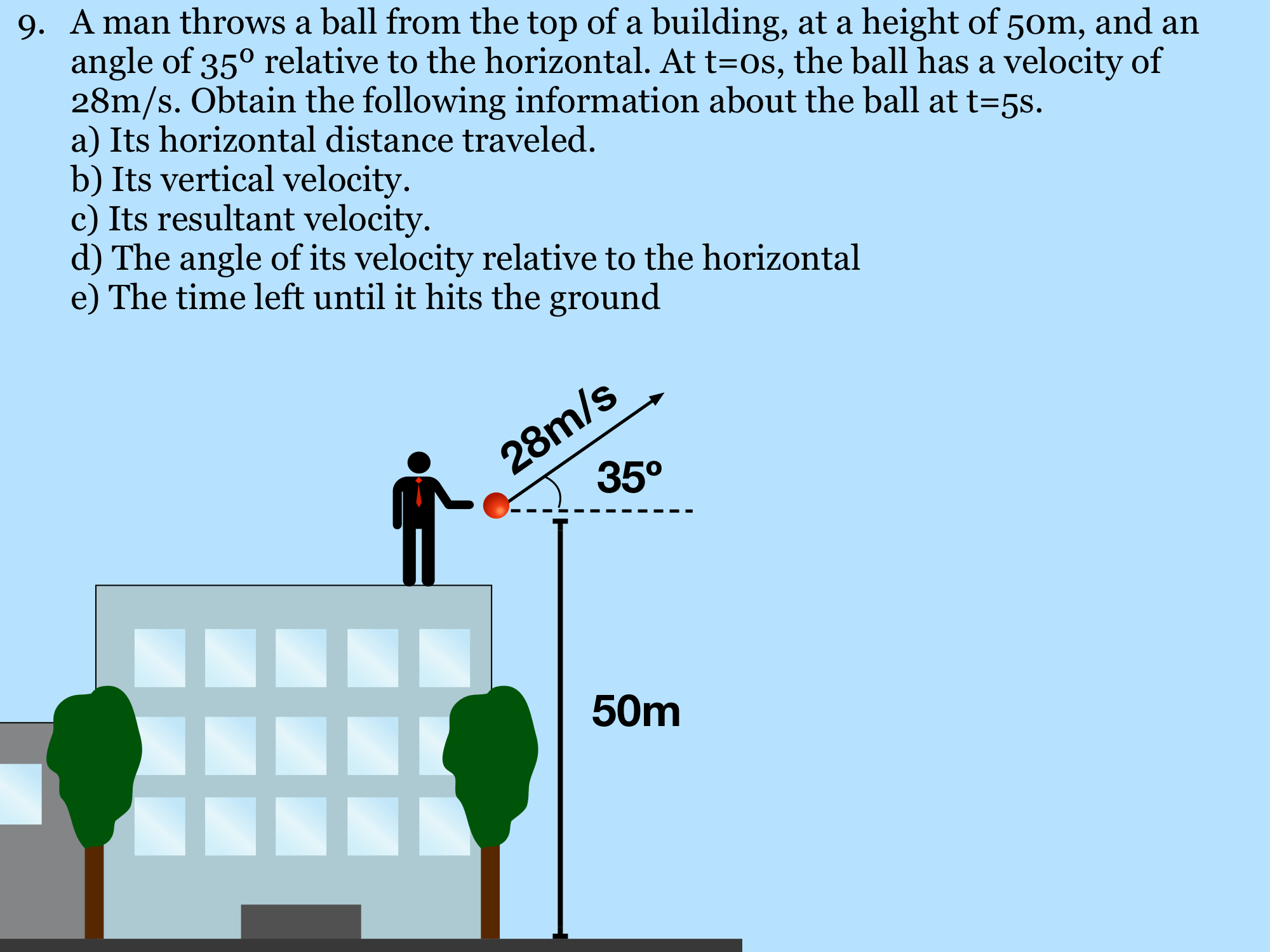
The original PNG clearly labels 28 m/s in both text and diagram. The OCR reading “20 m/s” is incorrect.
Problem text
A ball is thrown from height 50 m at 28 m/s and 35° above horizontal. At t = 5.0 s find (a) horizontal distance, (b) vertical velocity, (c) resultant velocity vector and speed, (d) velocity angle relative to horizontal and (e) time remaining before ground impact. Neglect air resistance; use g = 9.8 m/s².
Drawing is temporarily unavailable. Work on paper if needed, then record your reasoning here.
Saving written working requires JavaScript. The problem remains available above; keep your work on paper or in your own notes.
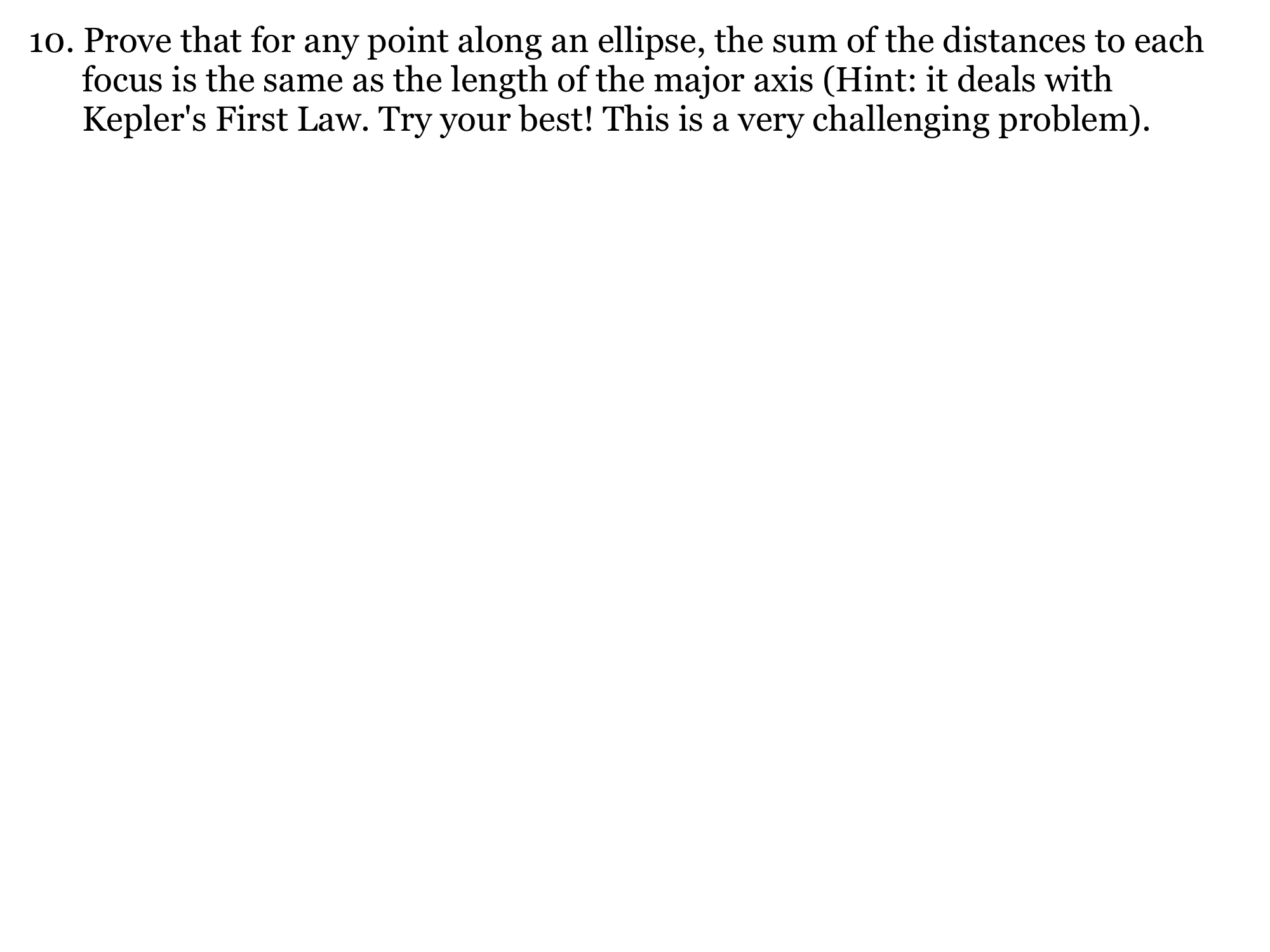
Original problem 10
Problem text
Prove that the sum of the distances from any point on an ellipse to its two foci equals the major-axis length. Use an ellipse x²/a² + y²/b² = 1 with a ≥ b > 0 and foci (±c, 0), where c² = a² − b².
Drawing is temporarily unavailable. Work on paper if needed, then record your reasoning here.
Saving written working requires JavaScript. The problem remains available above; keep your work on paper or in your own notes.
Reviewed physics notes (16)
These corrections keep the original lesson’s purpose while fixing errors in the source edition.
- The source uses instantaneous Sun–planet distance and asserts the same constant universally. — Reference 1
- The gravitational parameter sets the Kepler constant. — Reference 1
- Update the defined au and clarify semimajor-axis normalization. — Reference 1, Reference 2
- A larger instantaneous force alone is not a sufficient explanation of the speed at a location. — Reference 1
- Kepler’s law concerns swept sectors, not exact finite chord triangles. — Reference 1
- Explain via equal areas rather than force magnitude alone. — Reference 1
- Explain via equal areas. — Reference 1
- Dividing x²/4 + y²/16 = 25 by 25 gives x semiaxis 10; the full x-width is 20. — Reference 1
- The x endpoints are −10 and +10, so full width is 20. — Reference 1
- Focus distance is √(64 − 16) = √48 = 6.928203, not 6.923. — Reference 1
- Use the same corrected numeric distractor value. — Reference 1
- Kepler’s law determines semimajor axis, not instantaneous distance. — Reference 1
- Use semimajor axis for an elliptical orbit. — Reference 1
- The summary must distinguish average from instantaneous quantities and must not square velocity vectors. — Reference 1, Reference 2, Reference 3
- The summary uses n for the minor semiaxis while the source defines it as i; retain a consistent definition. — Reference 1
- Venus semimajor axis is about 0.72 AU; source 0.12 AU contradicts its own Kepler ratio. — Reference 1
Glossary and deeper reading · 6 refreshers
These editorial refreshers supplement the reading. Definitions and examples are added guidance; original source wording and recorded answers remain in their original context.
-
Velocity
Velocity describes how position changes with time and includes direction. Instantaneous velocity describes one moment, while average velocity is displacement divided by elapsed time. For example, a car turning a corner can change velocity while maintaining the same speed.
-
Conservation of angular momentum
Angular momentum is conserved about a chosen axis when the net external angular impulse about that axis is zero. Internal interactions can change the distribution of mass and the rotation rates of parts without changing the total. For example, a rotating skater who pulls their arms inward can spin faster as their rotational inertia decreases.
-
Orbital period
An orbital period is the time needed for one complete orbit. In a two-body model it depends on the attracting mass and the orbit’s size rather than just the orbiting object’s mass. For example, a larger circular orbit around the same planet has a longer orbital period.
-
Oscillation period
An oscillation period is the time required for one complete repeating cycle. It is the reciprocal of frequency and is measured in seconds. For example, measuring the time for several pendulum swings and dividing by the number of cycles estimates the period.
-
Acceleration
Acceleration is the vector rate of change of velocity with time. It can change an object’s speed, direction, or both, and it is measured in meters per second squared. For example, a satellite moving at constant speed in a circular orbit accelerates toward the center.
-
Scalar
A scalar is a quantity described by a value and unit without a spatial direction. A scalar can have a sign when its definition or reference permits one; scalar does not mean always positive. For example, mass is a scalar, whereas the velocity of that mass also needs a direction.