Period and Frequency: What Sets the Pace?
Compare periods and frequencies and plan measurements for spring and small-angle pendulum models.
What sets the pace?
Two spring carts can look almost identical while one goes back and forth much faster. So what should we change to speed up the motion: the mass, the spring, or how far we pull? Let’s sort out those choices rather than just memorize a formula.
A period T is the time for one complete cycle, measured in seconds. A frequency f is the number of cycles per second, measured in hertz: 1 Hz = 1 s⁻¹. They describe the same pace from opposite directions, so T = 1/f. If a cart completes 12 full cycles in 9.6 s, T = 9.6/12 = 0.80 s and f = 1.25 Hz. Moving from the right turning point to the left turning point is half a cycle, not a whole cycle. Passing through the center twice isn’t necessarily a full cycle unless you track direction too.
An ideal spring oscillator
For an ideal, light spring with a mass m and negligible friction, T = 2π√(m/k). Equivalently, f = (1/2π)√(k/m). The spring constant k is the stiffness: a larger k gives a larger restoring force for the same displacement. A bigger mass is harder to accelerate, so it takes longer to complete a cycle. The units check works nicely: kg/(N/m) = s², so the square root is a time. The factor 2π comes from one full cycle of sinusoidal motion. You don’t need calculus to use or rearrange this relationship.
A 0.25 kg cart on a 100 N/m spring has T = 2π√(0.25/100) = 0.314 s, giving f = 3.18 Hz. Now replace the cart with 1.00 kg while keeping the spring. The mass is four times bigger, so the period is √4 = 2 times bigger: 0.628 s. If we quadruple k instead, the period is halved. Write the ratio first:
T₂/T₁ = √[(m₂/m₁)(k₁/k₂)].
This is much cleaner than calculating both periods and hoping the arithmetic tells the story. If mass and spring stiffness both double, their ratio stays unchanged and so does the period.
A small-angle pendulum
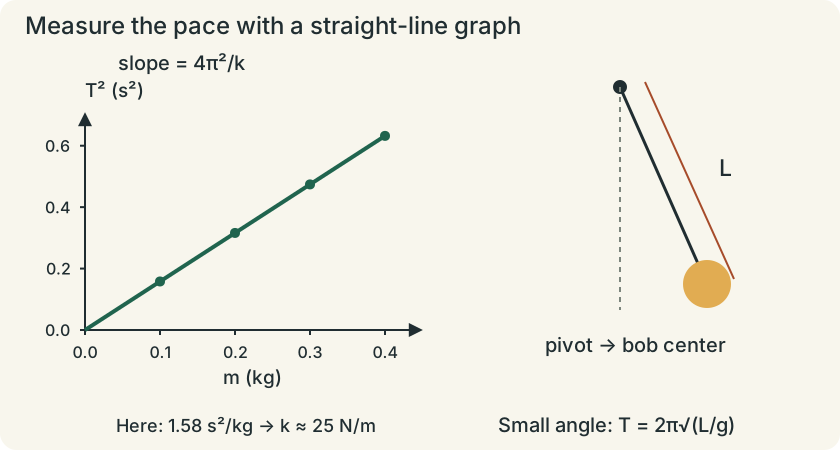
For a light string, pointlike bob, negligible resistance, and small angular displacement, T = 2π√(L/g). L is measured from the pivot to the bob’s center of mass, not just to the top of the bob. The period doesn’t depend on bob mass in this model. A heavier bob has more gravitational restoring torque, but it also has proportionally more rotational inertia; those mass factors cancel. OpenStax explains this model and its assumptions.
A 0.64 m pendulum where g = 9.8 m/s² has period 2π√(0.64/9.8) = 1.61 s. Shortening its length by a factor of four halves its period. Moving the same pendulum to a location with smaller g makes its period longer. From T² = 4π²L/g, a T²-versus-L graph has slope 4π²/g, with units s²/m. A best-fit slope of 4.03 s²/m gives g = 4π²/4.03 = 9.80 m/s².
Does a bigger pull make it slower?
For ideal SHM, amplitude doesn’t change the period. A larger displacement creates a larger restoring acceleration, letting the mass cover a larger path in the same cycle time. Its maximum speed does increase. This statement depends on the model: a real spring outside its linear range, or a pendulum swinging through a large angle, need not have an amplitude-independent period. Testing a model means checking its assumptions too. The original Dampened Harmonics section discusses resistance as enrichment; strong damping isn’t part of the ideal formula above.
A useful experiment, step by step
Hang a spring securely and choose five known total masses, including the hanger. For each mass, let the system settle, pull down by a small measured displacement, and release without a push. Time 10 complete cycles, using the same turning point as both the start and finish. Repeat the timing three times for each mass. Divide the mean elapsed time by 10 to find T. Keep the spring, release method, and amplitude range fixed while varying mass. Never exceed the spring’s elastic range.
Make a table with m in kg, T in s, and T² in s². Plot T² vertically against m horizontally, label both axes and scales, and draw a best-fit line through the trend rather than connecting every point. Rearranging the model gives T² = (4π²/k)m, so k = 4π²/slope. If the slope is 1.58 s²/kg, k ≈ 25.0 N/m. Timing many cycles reduces the fractional effect of reaction time; repeats show the measurement spread. A consistent positive intercept can suggest an unaccounted moving mass, such as the spring itself. Don’t force the fit through zero merely because the ideal formula does.
Set the pace
Pause & try it
Let's see what stuck.
Choose an answer, then check the reasoning. Try the written problems below before opening their solutions.
0 of 3 checked · 0 correct
Written practice: an experiment with the wrong cycle count
A student times 20 successive turning-point-to-turning-point trips of a spring oscillator, counting both directions: right to left, then left to right, and so on. The total time is 8.0 s. The student treats each trip as a full cycle and reports T = 0.40 s. Correct the cycle count, find f, and explain the effect on a spring constant found from this T.
Open the separate worked solution.
The original book also keeps the spring-period glossary and the simple-pendulum period for a quick reference.
Teaching reference: CED topic 7.2, printed page 125 asks us to describe period and frequency for ideal spring oscillators and small-angle pendulums.
Related source reading
These alternative explanations and examples retain their source context. Draft placement does not add accepted exam coverage.
- Physical-pendulum period · source context; placement review pending
Glossary and deeper reading · 10 refreshers
These editorial refreshers supplement the reading. Definitions and examples are added guidance; original source wording and recorded answers remain in their original context.
-
Oscillation period
An oscillation period is the time required for one complete repeating cycle. It is the reciprocal of frequency and is measured in seconds. For example, measuring the time for several pendulum swings and dividing by the number of cycles estimates the period.
-
Frequency
Frequency is the number of complete repeating cycles per unit time. It is measured in hertz, meaning cycles per second, and is the reciprocal of the period. For example, a vibrating string with a higher frequency produces more cycles each second.
-
Spring constant
A spring constant measures the stiffness of a spring within its approximately linear range. Its units are newtons per meter, and a larger value means more force is needed for the same deformation. For example, two springs stretched by the same distance exert different forces if one is stiffer.
-
Restoring force
A restoring force points toward an equilibrium position when an object is displaced from it. Simple harmonic motion requires the net restoring force to be proportional to displacement and opposite in direction. For example, a compressed ideal spring pushes its attached object back toward the spring’s relaxed length.
-
Angular displacement
Angular displacement is the change in an object’s rotation angle about a specified axis. Its sign follows the chosen rotation convention, and it is commonly measured in radians. For example, a wheel can return to the same orientation after one turn while having an angular displacement of two pi radians.
-
Center of mass
The center of mass is the position obtained by weighting each part’s position by its mass. Its motion represents the translational motion of the whole system under the net external force. For example, adding a heavy object to one end of a light bar shifts the center of mass toward that end.
-
Pendulum
A pendulum is a system that swings about a support under a restoring torque. A simple pendulum approximates a small mass on a light string and follows simple harmonic motion only for sufficiently small angles. For example, a short string pendulum completes small swings more quickly than a longer one under the same gravitational field.
-
Simple harmonic motion
Simple harmonic motion occurs when the net restoring force is proportional to displacement from equilibrium and points in the opposite direction. The resulting position varies sinusoidally with time in the ideal model. For example, a mass attached to an ideal spring can execute simple harmonic motion when damping is negligible.
-
Amplitude
Amplitude is the maximum magnitude of a repeating disturbance measured from its equilibrium value. It describes the size of the oscillation rather than its frequency or propagation speed. For example, pulling a spring-mounted mass farther from equilibrium increases its oscillation amplitude when it is released from rest.
-
Displacement
Displacement is the vector change in position from the start of an interval to its end. It depends on those endpoints rather than the length or shape of the path traveled. For example, walking around a closed track and returning to the start gives zero displacement but a nonzero distance traveled.