Force Analysis
Original textbook reading.
Free-body diagrams, friction and Newton's second law fit the AP course. Quantitative drag and terminal-speed coefficient calculations are extra exploration.
Free body diagrams help identify and resolve all forces on a chosen object. Kinetic friction applies when contacting surfaces slide relative to each other; static friction applies when they do not slide relative to each other. An object may move relative to the ground while experiencing static friction.
This section will pretty much be composed of example problems for greater practice with Free Body Diagrams and solving some basic vector-force problems. Read for the first one? Go!
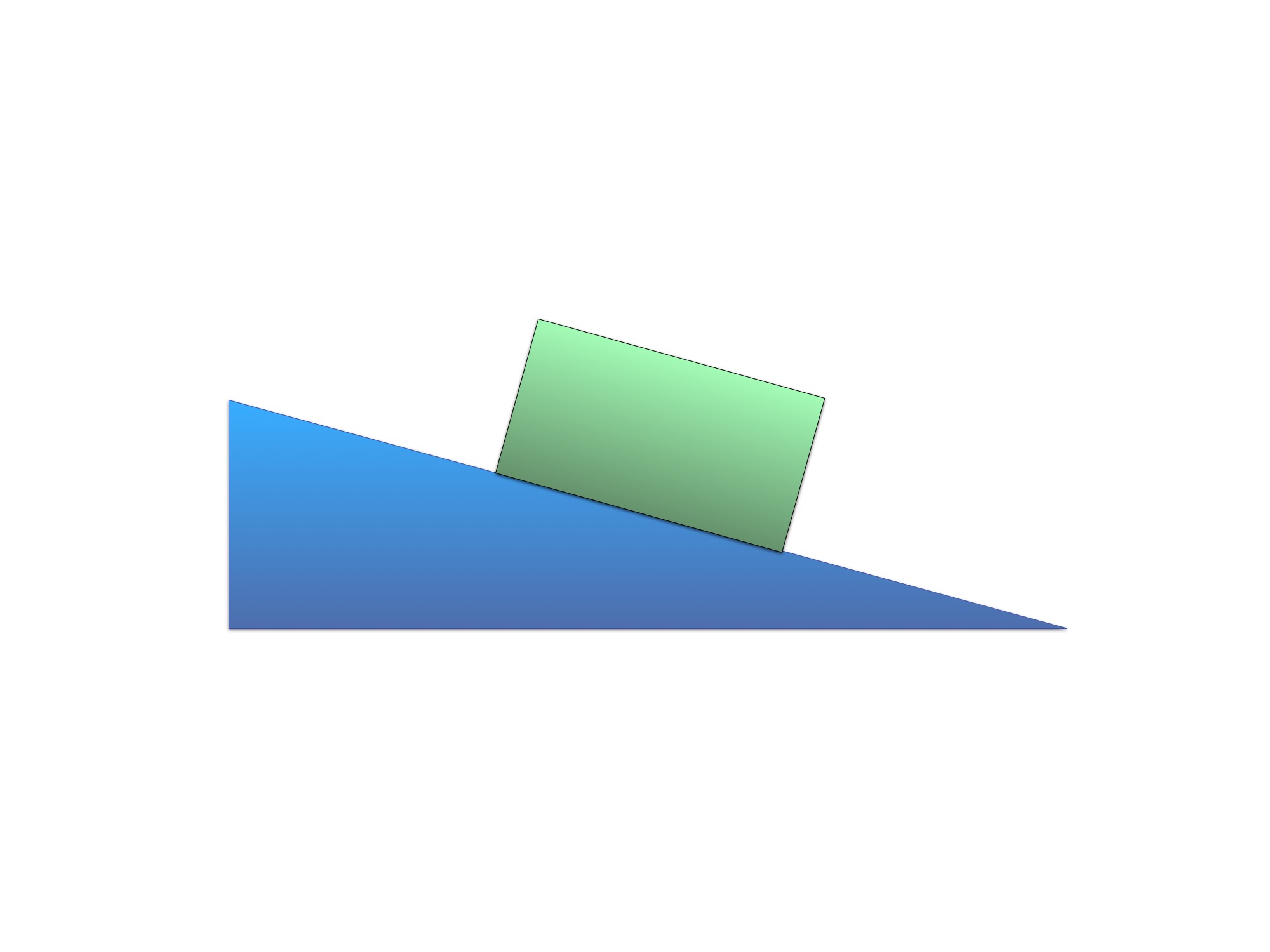
Example Problem 2.1.1
Read every step and figure
Step 1
Step 2
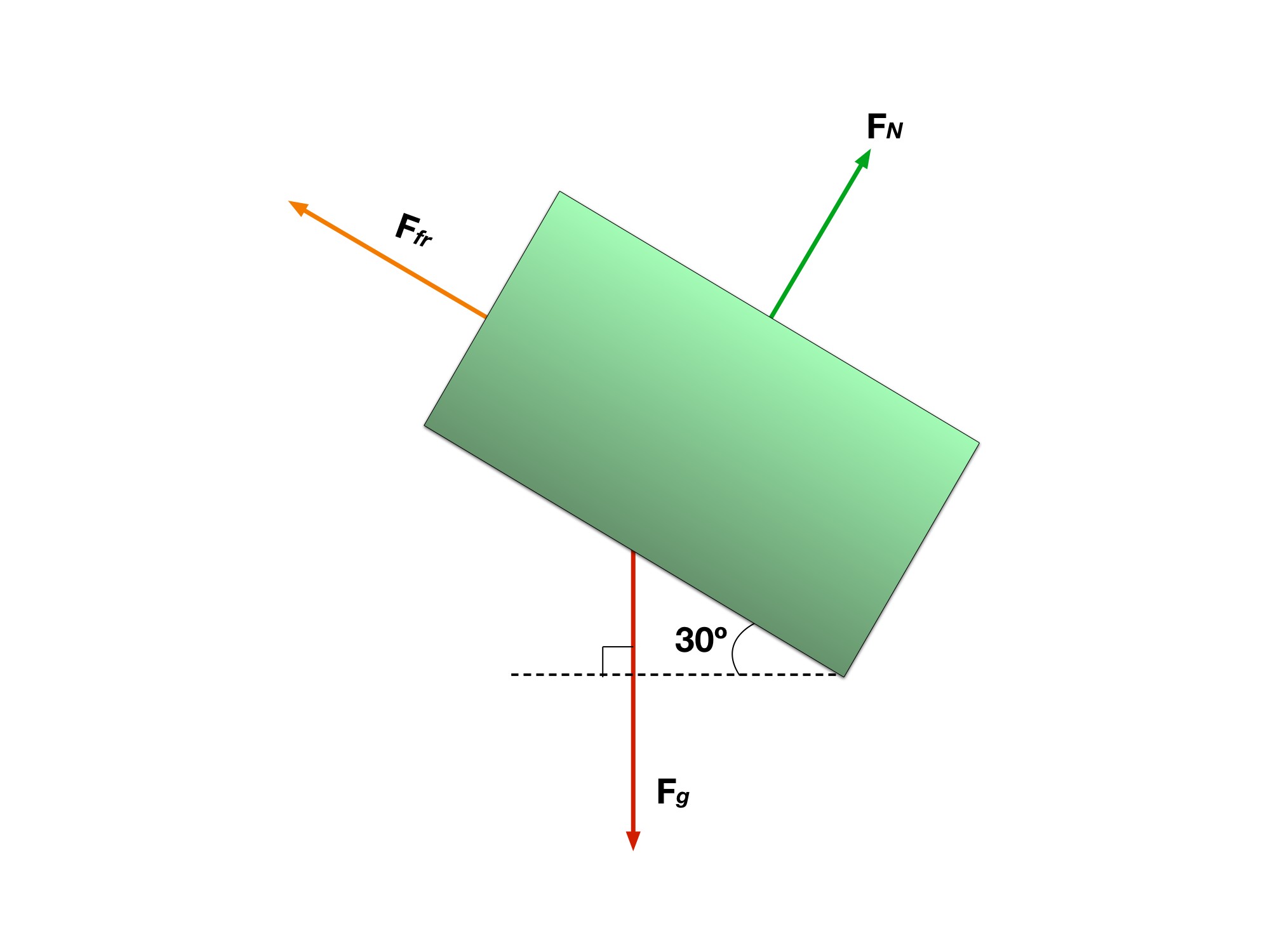
The resting block has a mass of and is at an angle of . The coefficient of static friction between the block and the plane is , and the coefficient of kinetic friction is . Draw a complete FBD, and determine if the block begins to move, and if so, what its acceleration is.
Step 1: Draw the Free Body Diagram
In drawing free body diagrams, we first choose a system and isolate it. Here, we choose the block as it’s the block’s acceleration which is needed. Therefore, we draw the Free Body Diagram just showing the block.
The forces in this problem are the friction force, , the normal force, , and the force of gravity, .
Key Point: The force of gravity, , is most commonly referred to as the weight of an object. This is different from mass, which is measured in kg. Weight is measured in N.
Step 2: Input all known values
The block initially rests. Static friction can have any needed magnitude up to fₛ,max = μₛN; only after sliding begins do we use fₖ = μₖN.
The easiest way to do so is to do it via x and y components. We will use equations 2.1.2 and 2.1.3 for the y and x totals.
The , and the .
Therefore, the only acceleration will be in the positive x direction, or downwards along the plane.
To determine the magnitude of , we must use Newton’s Second Law. Using as our and our given value of for , we find our final answer:
The block’s weight magnitude is mg = (5 kg)(9.81 m/s²) = 49.05 N. Keep friction unknown until the normal force and static limit are found.
Step 3: Solve for the unknown
To solve for , we first set up a coordinate system. We choose the x axis to be inline with the bottom of the block, which makes the collinear with the y axis.
As the normal force is in the y direction, we can solve for the normal force by analyzing the sum of the forces in the y direction, . This is given below:
The block has zero acceleration perpendicular to the stationary ramp while contact is maintained. Therefore ΣFᵧ = 0 and N = mg cos 30°; this follows from the motion constraint, not from the definition of normal force.
The block therefore begins to slide downhill. Friction is not negated; once sliding begins it opposes sliding with kinetic magnitude μₖN.
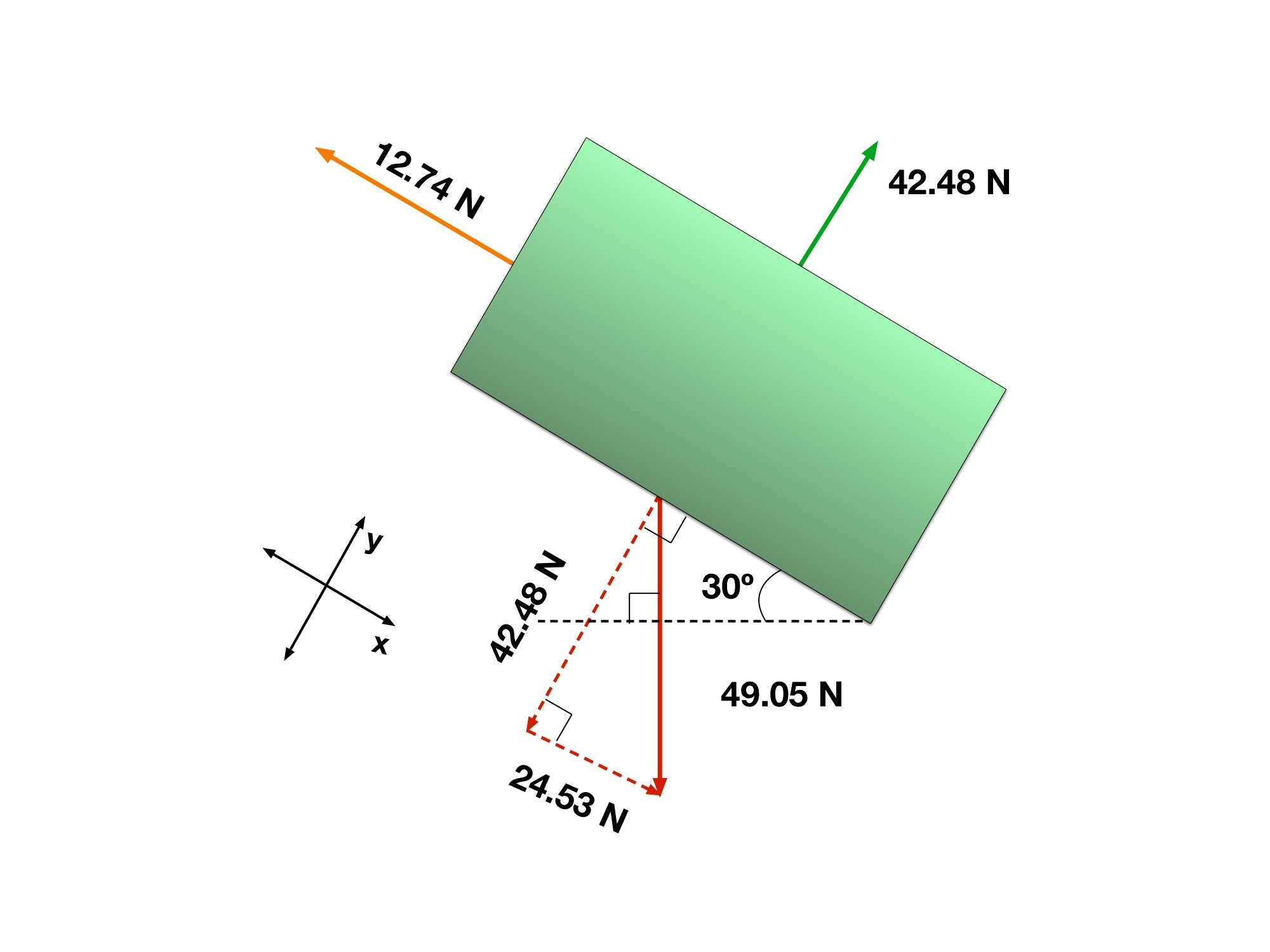
Because the block will move, we need to change the frictional force to kinetic friction. We make the appropriate changes to the Free Body Diagram.
Step 5: Solve for the final system
We must now solve for the value of the new frictional force, through the friction equation:
This gets us a force of .
Step 6: Determine the block’s acceleration
To determine the block’s acceleration we need to know the total sum of all the forces acting on the block.
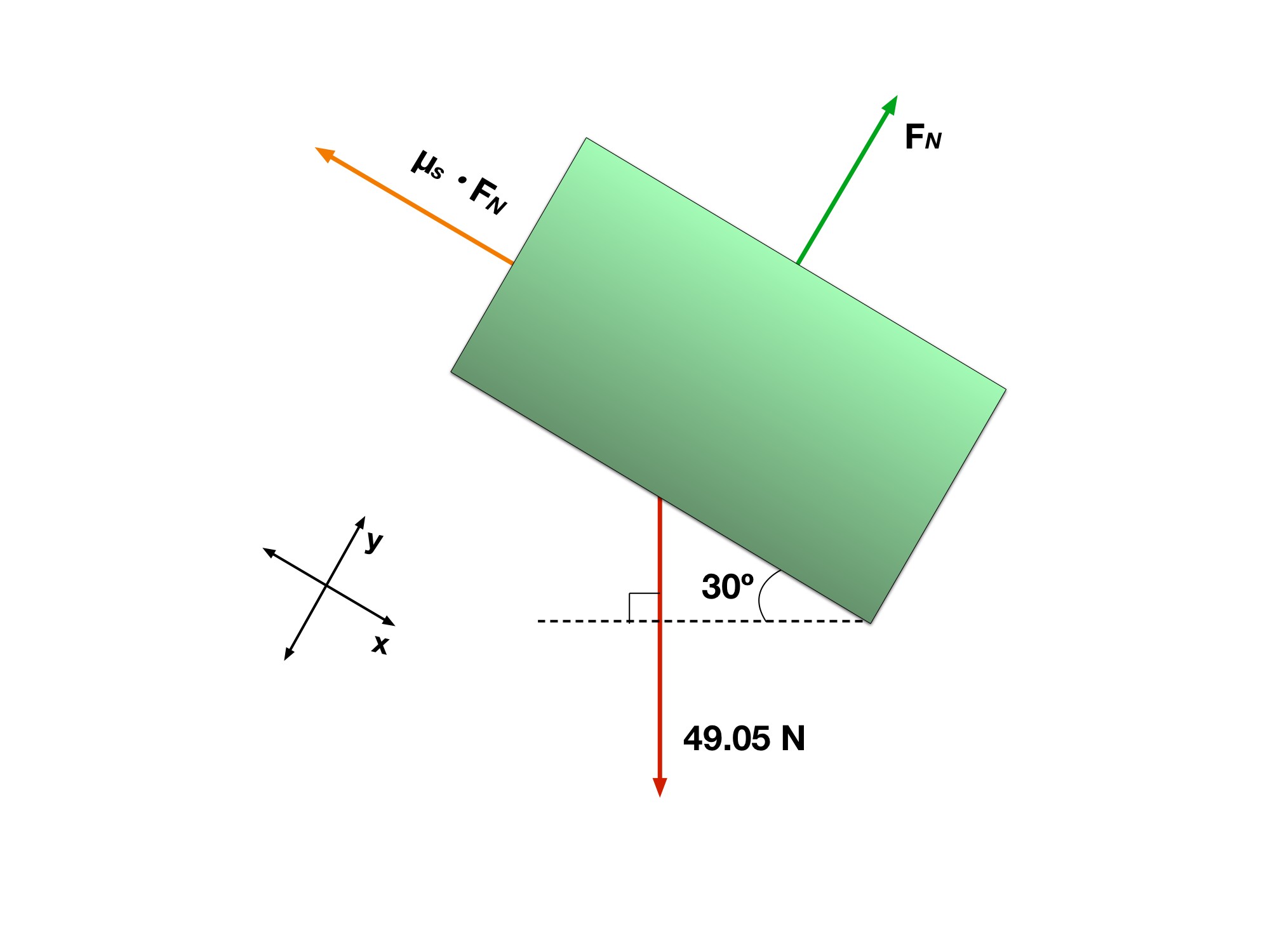
Step 2- we have substituted known values for the force of gravity and friction. Now our only unknown is the normal force.
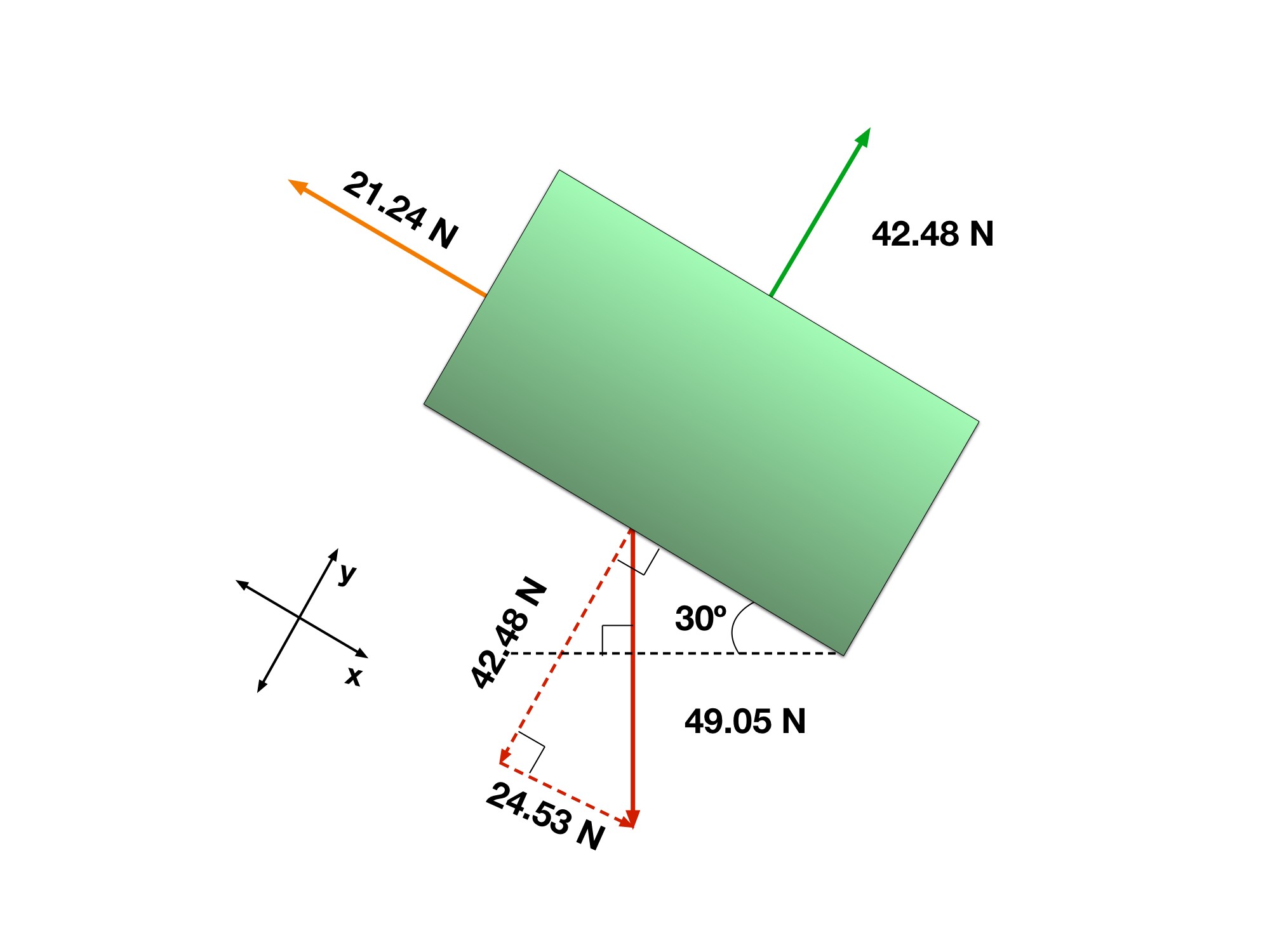
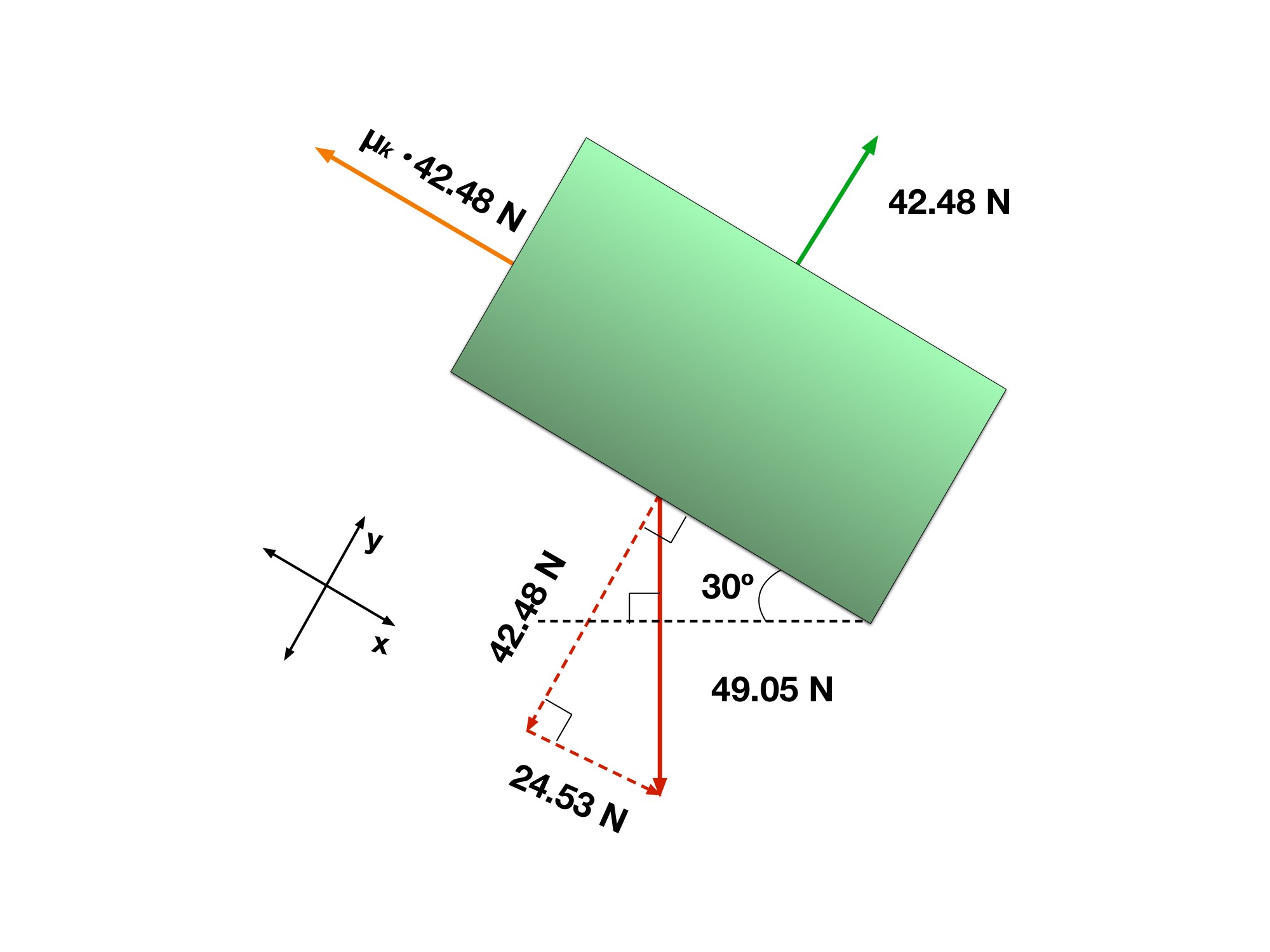
Step 4 - Here we notice that the x component of the force of gravity exceeds the static frictional force, which means that the block will move. As it will move, we must calculate friction using the kinetic coefficient.
Example Problem 2.1.2
This next example problem deals with multiple applied forces on an object, instead of simply gravity and friction.
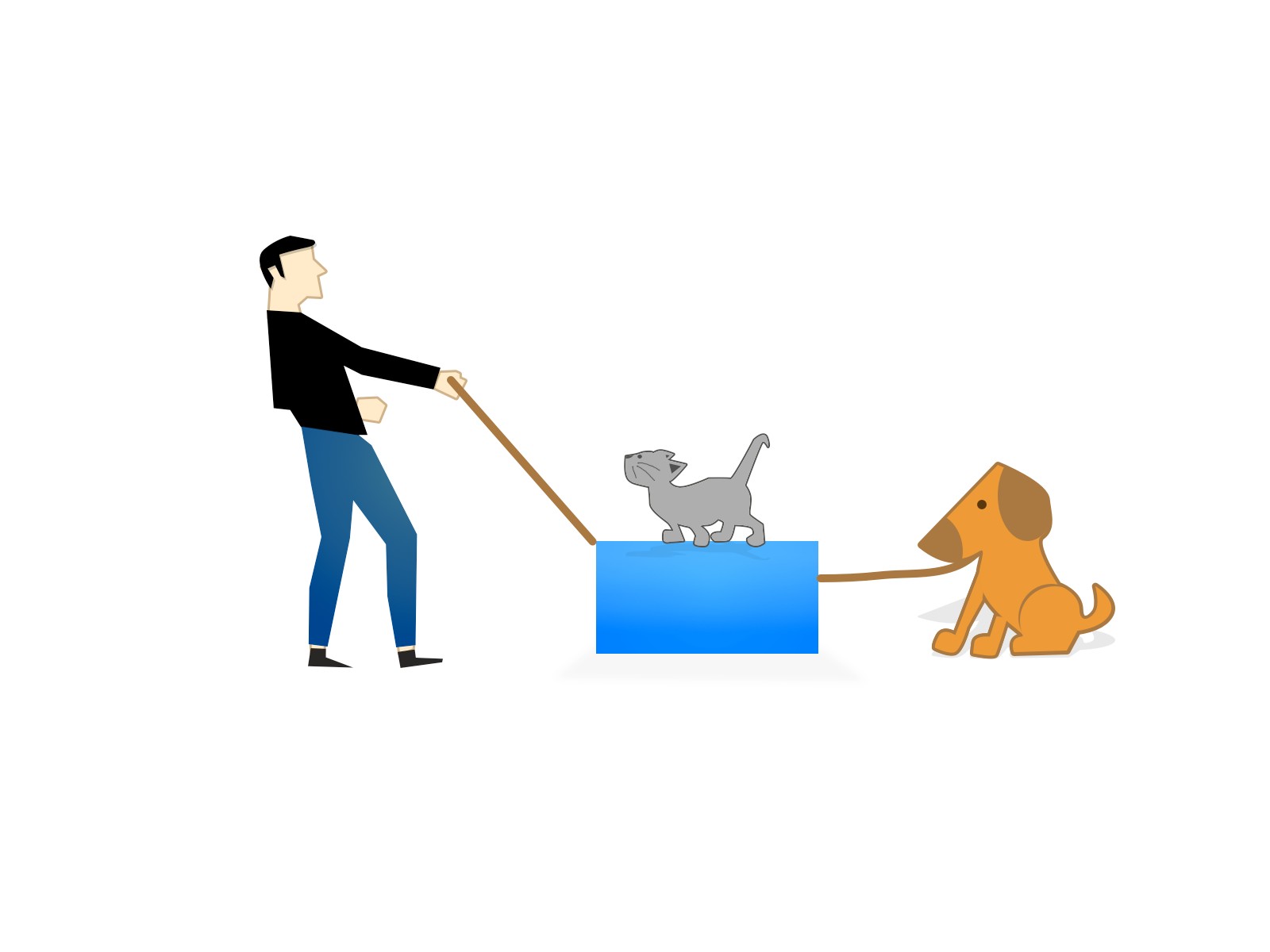
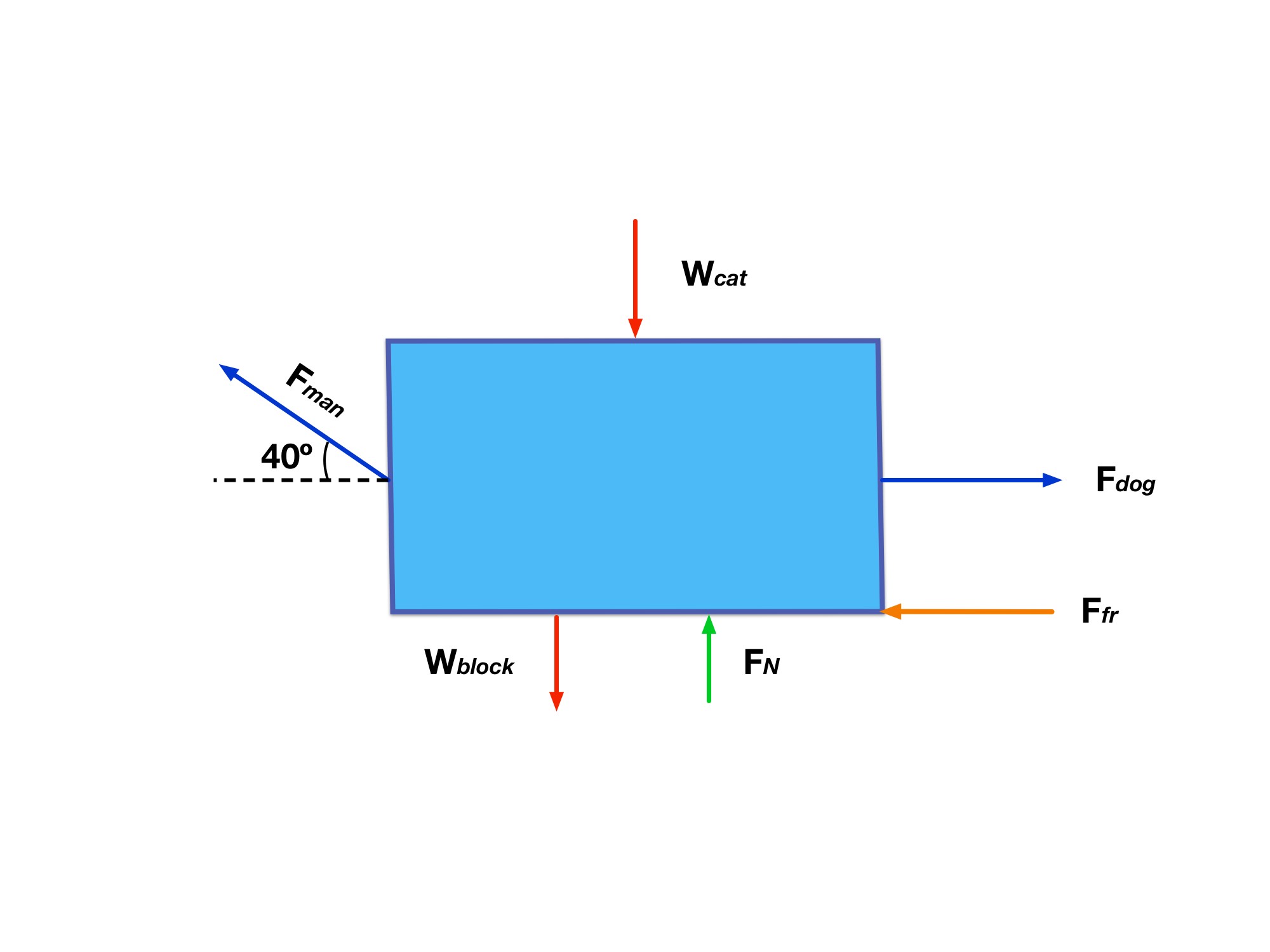
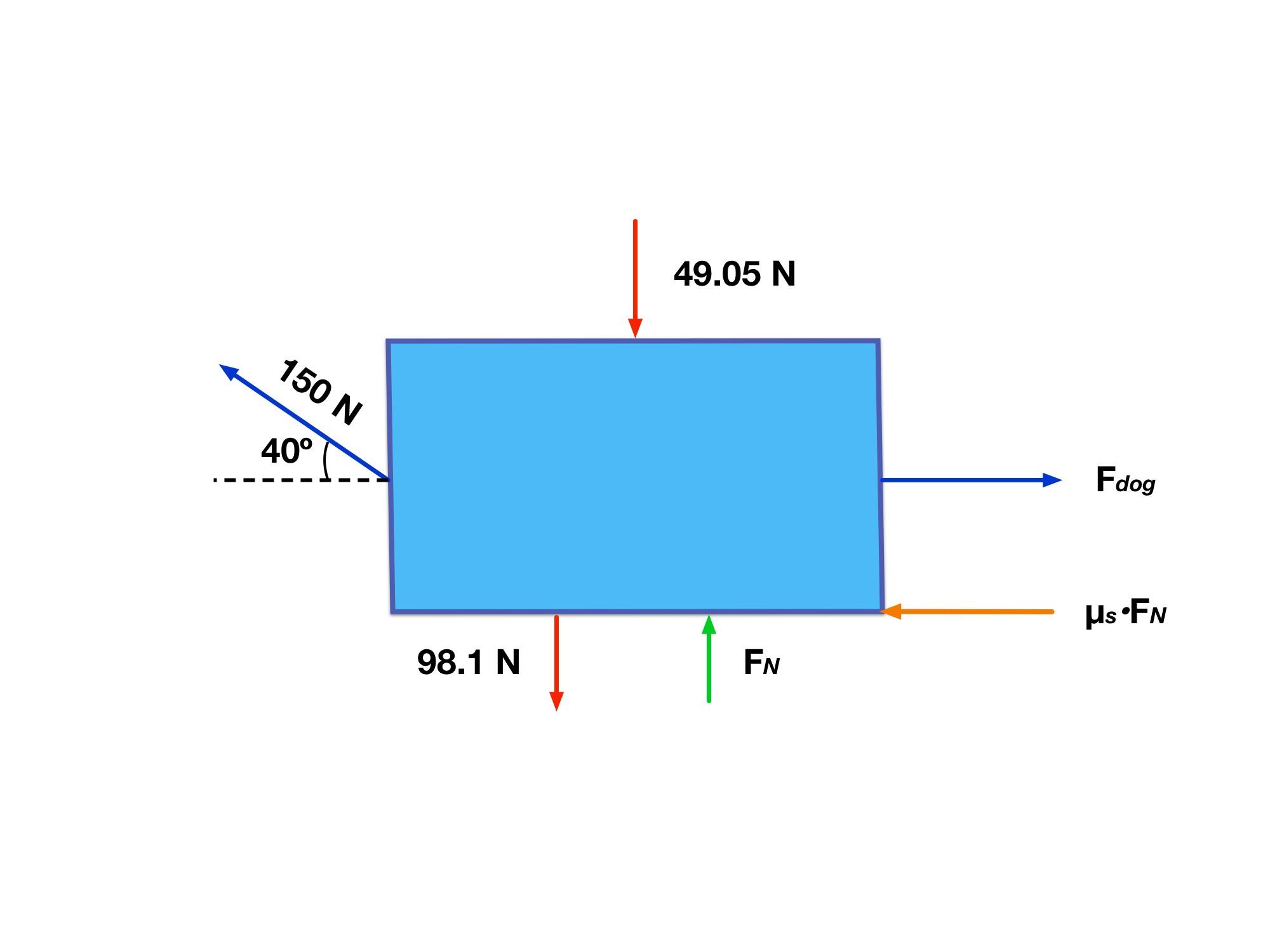
A man is playing tug-of-war with his dog. They are both pulling on ropes connected to the same block. The man’s rope is at an angle of from the horizontal, and the dog’s rope is horizontal. The man’s cat decides to sit on the block during their game. If the man pulls with a force of , the block has a mass of , the cat has a mass of , at what force must the dog pull to win the tug-of-war? The static coefficient of friction for the block is .
Step 1: Draw a Free Body Diagram for the block
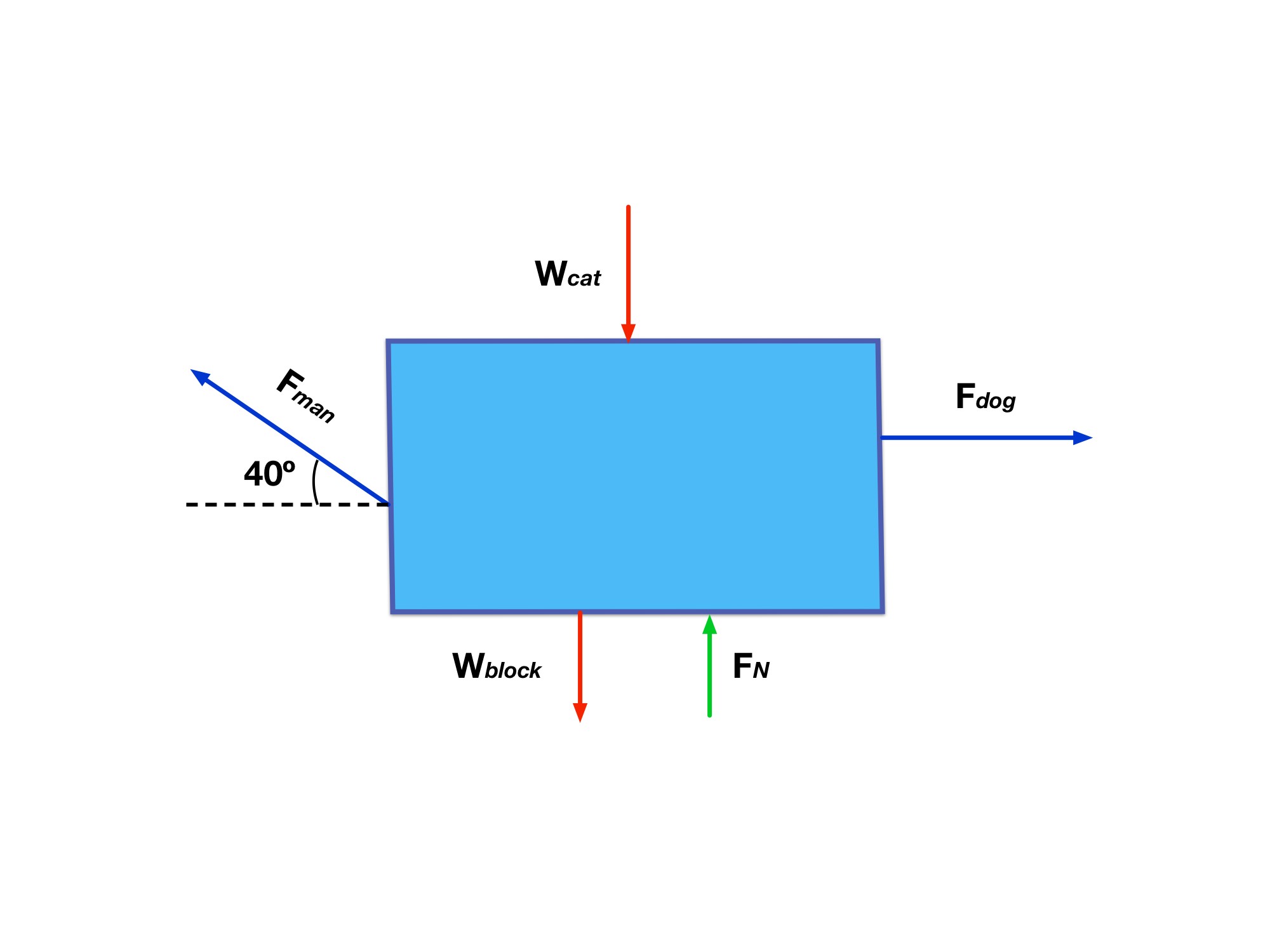
To begin this problem, we first must isolate the system. In this case, our system is the block. Our gallery here shows all the forces acting on the block. The frictional force was set as being that direction due to the condition that if the dog wins the tug-of-war, then the block will be resisting motion to the right.
Also notice that instead of , we have used . refers to weight, which is the equivalent to the force of gravity on an object’s mass. This was described in the previous key point.
Step 2: Input all known data
The question provides us with a bit of info.
We use the static friction as the block is not moving until the dog starts to win. Even if the block were already moving left (if the man was initially winning) the dog would temporarily stop the block as it begins to move toward the dog.
Step 3: Solve for Normal Force
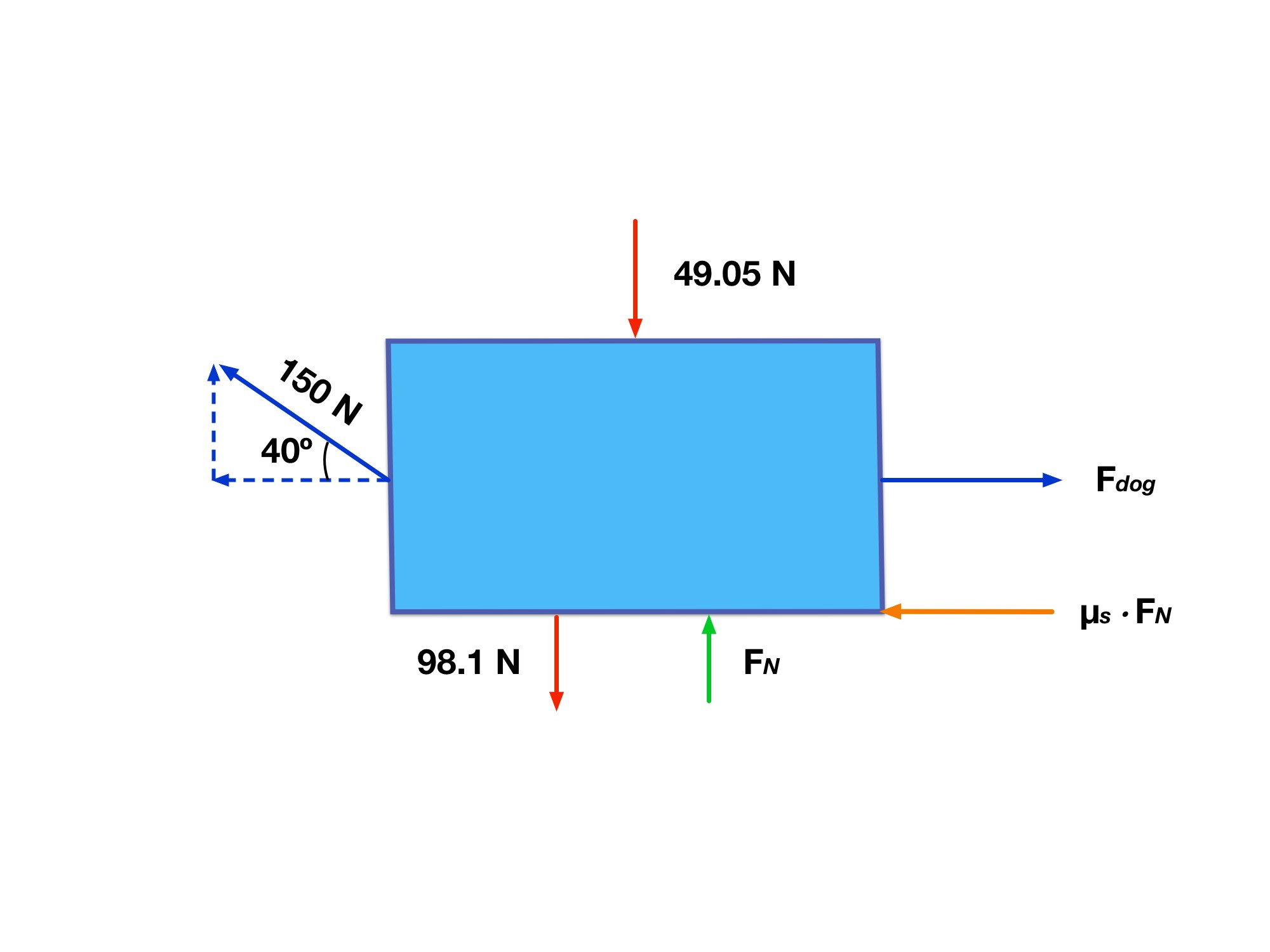
Step 3a: Split the angled force into components
To solve for normal force, we must first split the angled force from the man into components.
That means we must decide on a coordinate system. In this case, it is easiest to pick the x axis to be horizontal, which makes the y axis vertical. Doing so gives us and .
is therefore .
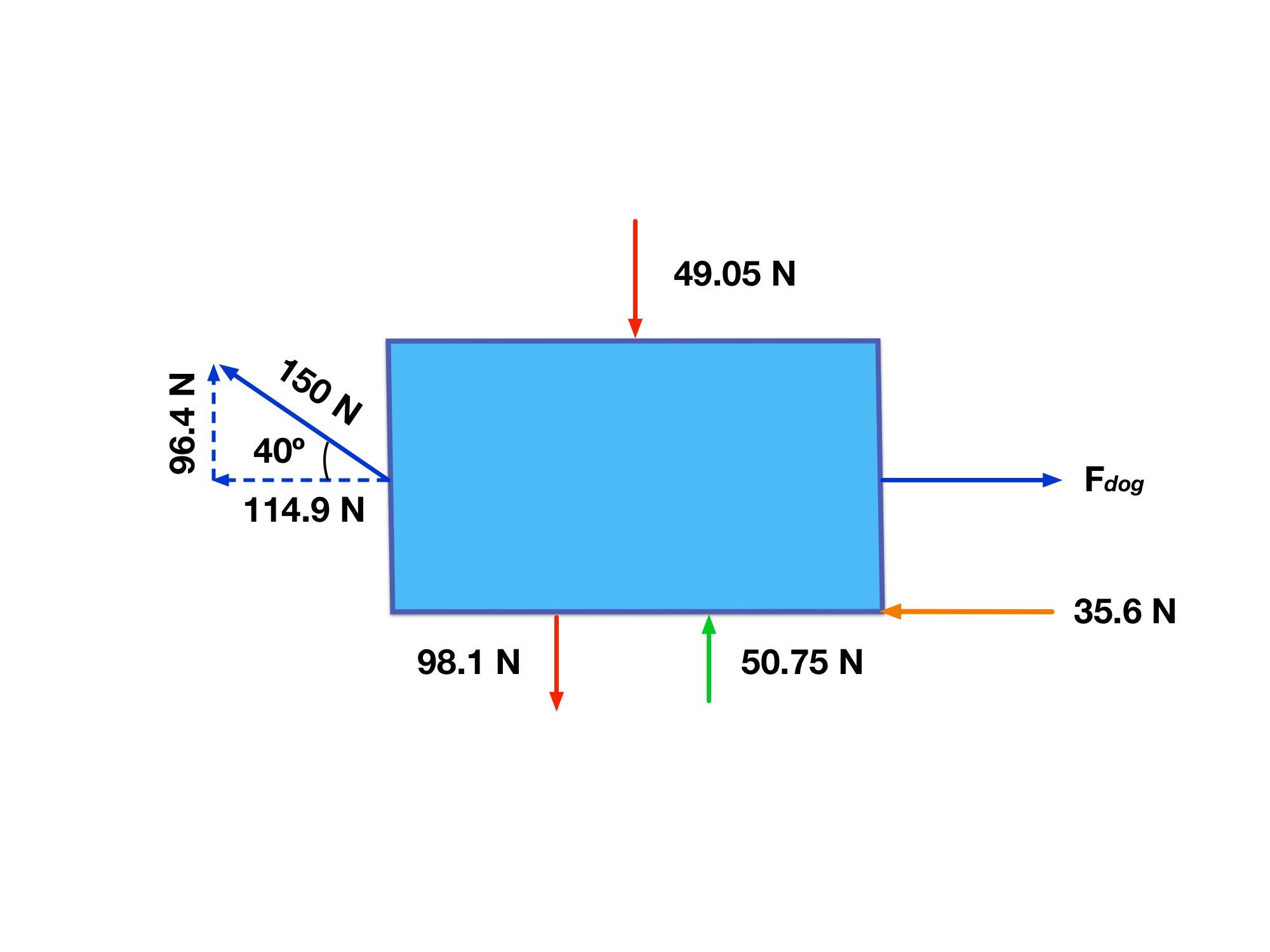
Step 4: Solve for
At the threshold of motion toward the dog, static friction reaches its maximum μₛN ≈ 35.55 N. Below that threshold it adjusts to the force needed for equilibrium.
Now that we only have one unknown, we can solve for the force the dog needs to pull on the block to win the game.
To find the force the dog must pull, we do a force balance in the x direction. By setting the total forces equal to , we find the minimum force the dog has to pull.
This gives us:
The threshold dog force is approximately 150.42 N. To initiate motion toward the dog, the pull must exceed this threshold.
Step 1a
Step 2
Step 4
In most introductory physics problems, air resistance is typically neglected. Air resistance is very tricky subject as it changes with velocity, so it is hard to determine the force exerted by air resistance on a system, because it can change over time.
For steady vertical falling, terminal velocity is reached when upward drag balances weight and the net force is zero.
The quadratic drag-force magnitude is D = ½ρC_DAv² (Equation 2.1.1), where v is speed relative to the fluid. Drag points opposite that relative velocity.
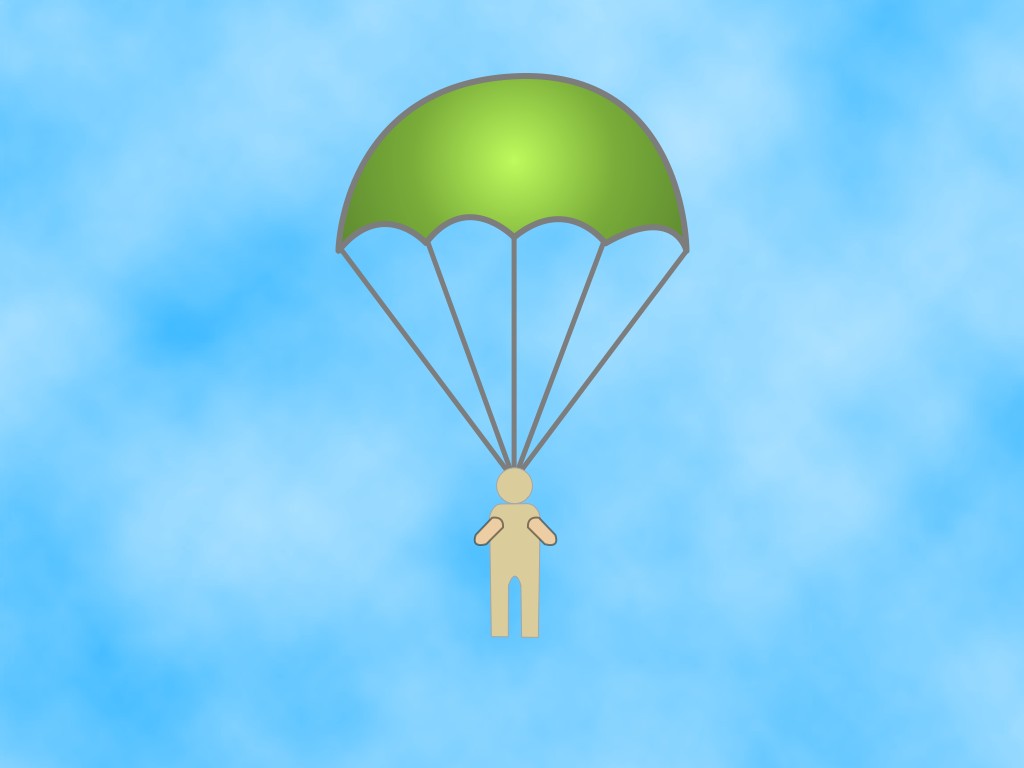
Example Problem 2.1.3
A parachutist has mass 80 kg and carries a pack of mass 15 kg. The parachute has diameter 3 m and drag coefficient C_D = 2.068. Air density is 1.25 kg/m³. Use g = 9.81 m/s².
a) What is the man’s terminal velocity?
b) Suppose the man dropped his backpack. What would his new terminal velocity be?
Step 1: Draw a Free Body Diagram
In this problem, there are only 2 forces, the drag force and the force due to gravity. Therefore, the Free Body Diagram is fairly simple.
Step 2: Determine the value of the force due to gravity
Again, a straightforward step, this is simply . With a combined mass of , the gravitational force is .
Step 3: Set up a force balance in the vertical direction
Defining the vertical direction as being y, we have:
We know terminal velocity occurs when drag force and force of gravity are equal.
Step 4: Solve for velocity
By substituting in Equation 2.1.1, we get:
We are given the drag coefficient and density, and area is simply .
If we plug in those values, we get:
With the stated density, A = π(1.5 m)² = 7.06858 m² and ½ρAC_D = 9.13614 kg/m. Thus 931.95 N = (9.13614 kg/m)v².
v² = 102.00693 m²/s².
v = 10.100 m/s downward.
We know that the direction is downwards, as he is falling due to gravity. This is our answer for part a.
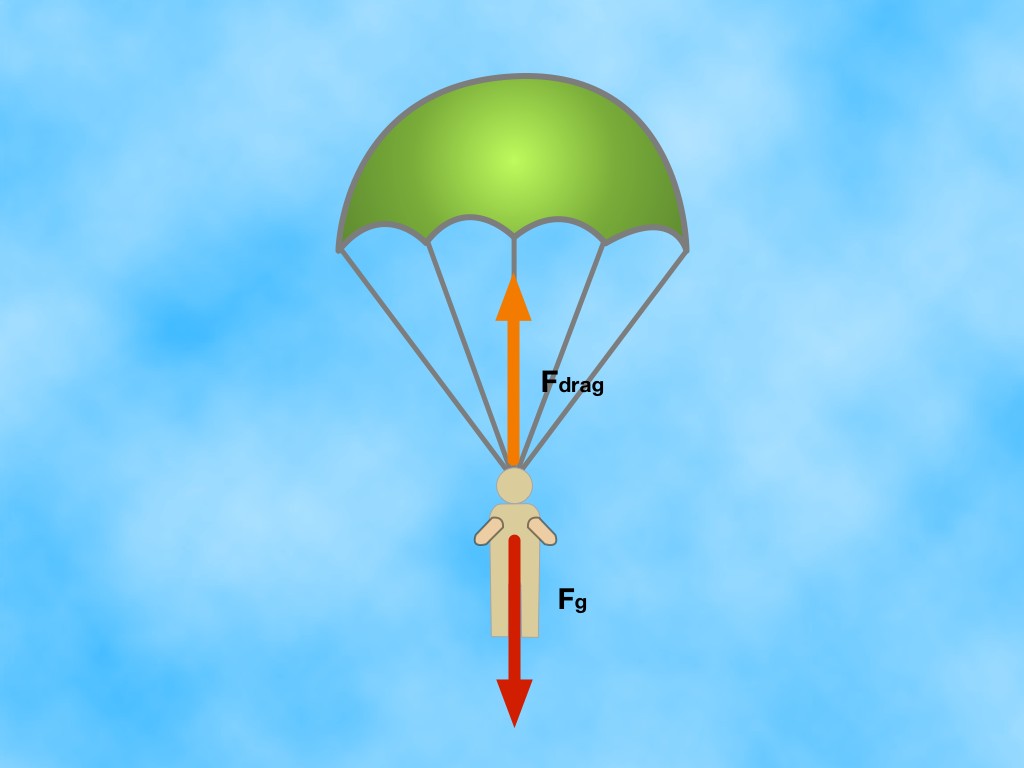
Free Body Diagram
Pop Quiz 2.1.1 Free Body Diagrams
Question 1 of 5 · 0 correct
AP Topic 2.2 · Read the worked solution
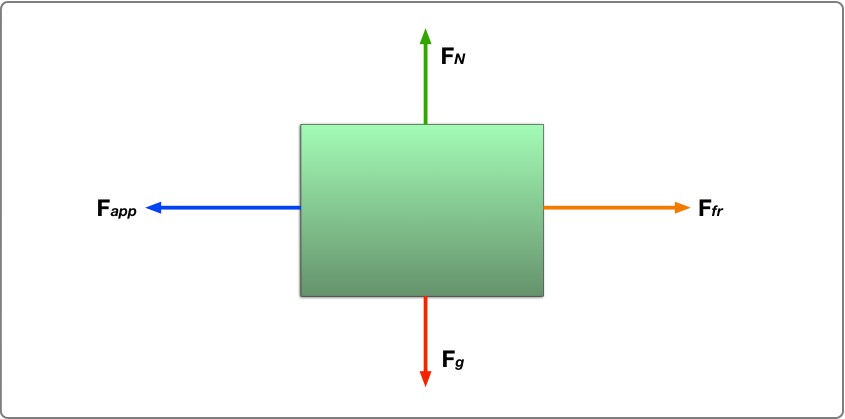
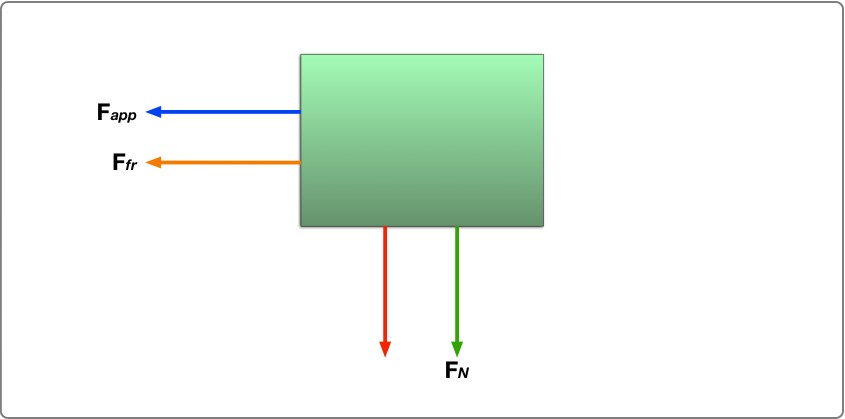
Which free body diagrams correctly label all the forces on a block that is sliding to the left on a level floor while being pulled left?
Read every full question without answers
Question 1
Which free body diagrams correctly label all the forces on a block that is sliding to the left on a level floor while being pulled left?
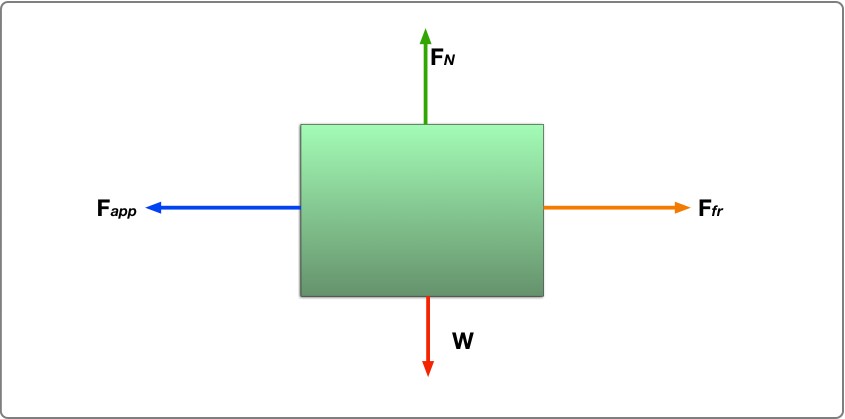
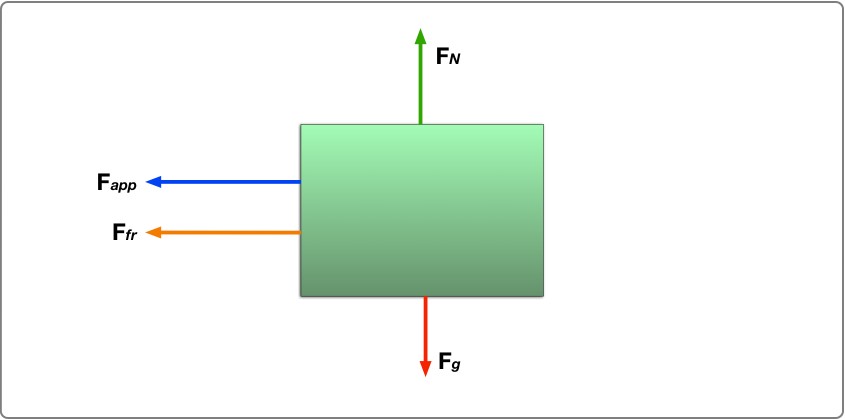
Question 2
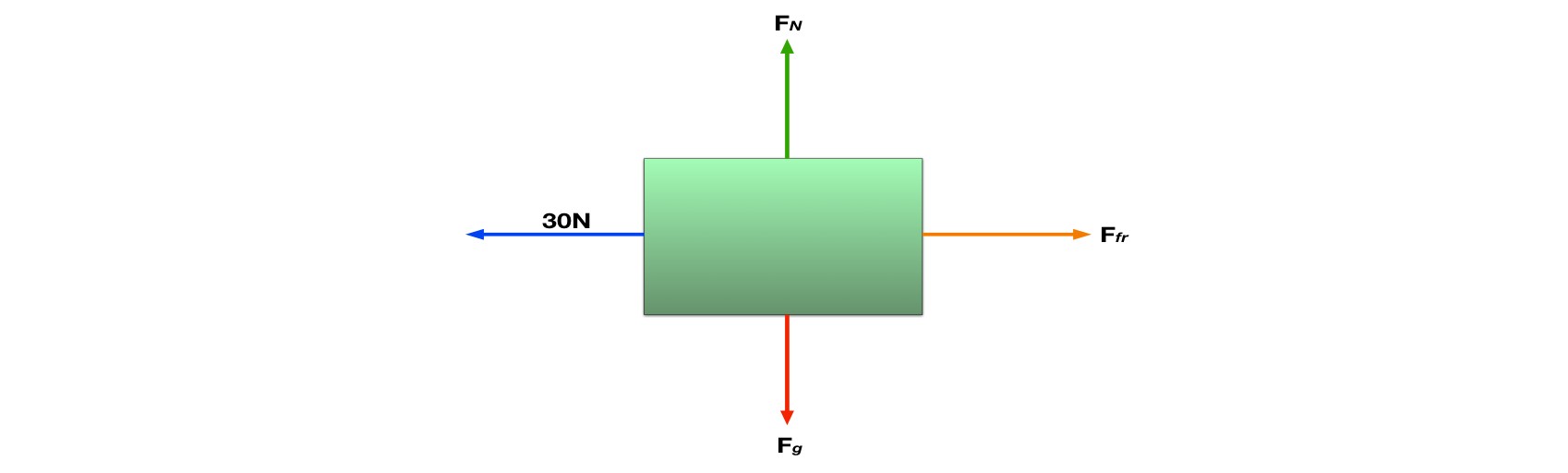
Question 3
Question 4
Question 5
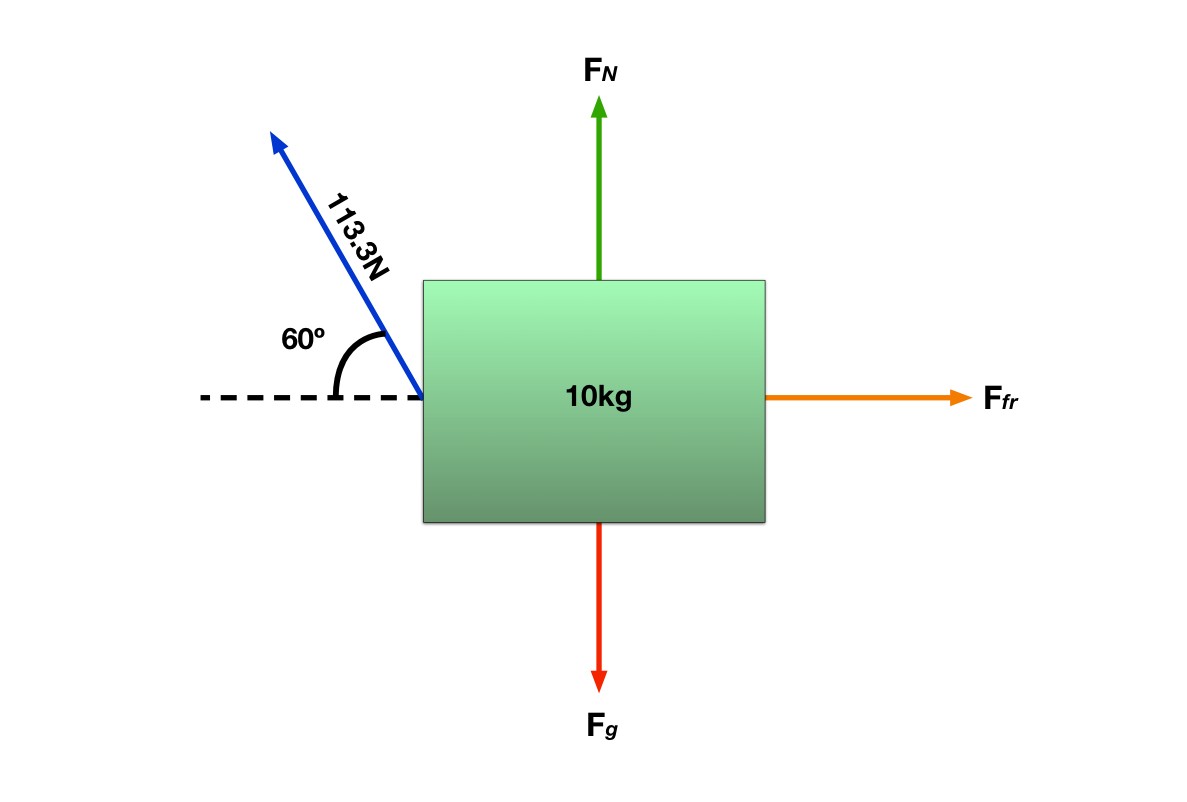
A 10 kg block slides left on a level floor. A pull acts at 60° above the leftward horizontal with magnitude F = mg/sin 60° ≈ 113.28 N. Find its horizontal acceleration magnitude for μₖ = 0.4 and μₖ = 0.3, at the threshold where the normal force is zero. Use g = 9.81 m/s².


Reviewed physics notes (22)
These corrections keep the original lesson’s purpose while fixing errors in the source edition.
- Friction depends on relative sliding at contact, not absolute motion. — Reference 1
- Terminal equilibrium is directional and requires zero net force. — Reference 1
- A squared vector is not the scalar drag magnitude. — Reference 1
- Kilograms measure mass, and the given density must be carried consistently into the solution. — Reference 1
- The source uses kinetic friction before checking whether a resting block can move. — Reference 1
- Correct the pre-sliding force model. — Reference 1
- A normal force does not automatically enforce zero net force. — Reference 1
- Compare demand with the maximum static-friction capacity. — Reference 1
- A static-friction inequality determines the onset of sliding. — Reference 1
- Friction remains active after motion begins. — Reference 1
- Correct a general false statement about equilibrium. — Reference 1
- Static friction is not always μₛN. — Reference 1
- Equality describes limiting equilibrium. — Reference 1
- The source substitutes a different density and gives an inconsistent coefficient. — Reference 1
- Recalculate from the stated data. — Reference 1
- The source says 748.8 N before displaying 784.8 N. — Reference 1
- Use the same stated density for part b. — Reference 1
- Specify relative sliding so friction direction is defined. — Reference 1
- N = 98.1 N and kinetic friction = 29.43 N right, leaving 0.57 N left. — Reference 1
- Repair the source’s “max” to mass and state g. — Reference 1
- The rounded 113.3 N gives an upward component slightly greater than weight. The exact threshold removes this rounding ambiguity. — Reference 1, Reference 2
- At the stated threshold N = 0, so friction vanishes for both coefficients. — Reference 1, Reference 2
Glossary and deeper reading · 7 refreshers
These editorial refreshers supplement the reading. Definitions and examples are added guidance; original source wording and recorded answers remain in their original context.
-
Free-body diagram
A free-body diagram shows the external forces acting on one selected object or system. Each arrow names a real interaction, and its direction is the direction of that force. For example, a book resting on a desk has a downward gravitational force and an upward normal force; velocity is not an extra force arrow.
-
Force
A force describes an interaction that can change an object’s momentum. It is a vector measured in newtons, so both size and direction matter when forces are added. For example, a rope can pull a cart while the floor exerts friction in another direction.
-
Vector
A vector is a quantity with a magnitude and a direction, represented by an arrow or by components along chosen axes. Vectors add by adding corresponding components rather than simply adding their magnitudes. For example, an eastward displacement followed by a northward displacement produces a resultant pointing northeast. The zero vector has zero magnitude and no unique direction.
-
Terminal speed
Terminal speed is a constant speed reached when the forces along the direction of motion balance. For a falling object in fluid, increasing drag can eventually balance weight after buoyancy is also accounted for. For example, a falling raindrop can reach approximately constant downward velocity instead of accelerating indefinitely.
-
Drag
Drag is a force from a fluid that opposes an object’s motion relative to that fluid. Its dependence on speed, shape, and fluid properties varies with the physical regime. For example, a parachute increases air drag by presenting a large area to the moving air.
-
Magnitude
Magnitude is the nonnegative size of a vector quantity. It does not specify direction, and it differs from a signed component. For example, a westward velocity can have a negative x component while its speed, the velocity magnitude, stays positive.
-
Fluid
A fluid is a material that flows and continuously deforms under a sustained shear stress. Liquids and gases are both fluids, although their compressibility and other properties can differ greatly. For example, both water in a pipe and air flowing through a duct are fluids.