Fluids and Density: What Is Inside Matters
Describe fluid particle models and infer density from a meaningful mass-volume graph.
What is inside matters
Pour water from a cup into a bowl, and it changes shape. Move a wooden block from the cup to the bowl, and the block keeps its shape. That difference starts with what the particles inside can do. Let’s connect that tiny picture to quantities we can actually measure.
In a solid, interactions keep neighboring atoms or molecules near particular relative positions. The particles still move, often vibrating about those positions; “solid” doesn’t mean motionless particles. In a liquid, particles remain close together but can change neighbors, so the material can flow while keeping a nearly fixed volume. In a gas, particles are much farther apart under ordinary conditions and move throughout the available container. These differences reflect the interactions and arrangement of the particles, not a universal rule that one state always has a particular particle speed.
A fluid has no fixed shape. Liquids and gases are both fluids. A liquid takes the shape of its container’s lower portion, while a gas expands to fill its available space. A material’s visible shape doesn’t define its state by itself: a liquid may temporarily have a shape while flowing, and a solid may deform. What matters is how it responds to forces and whether it maintains a fixed shape. OpenStax’s fluid introduction supports this distinction.
How much mass fits in a volume?
Density ρ = m/V, with SI units kg/m³. The Greek letter ρ is pronounced “rho.” Density tells us how much mass is packed into each unit of volume. It isn’t total mass and it isn’t weight. A small steel screw has greater density than a large foam block even if the foam block has more total mass. Gravity changes weight through mg; it doesn’t directly appear in the definition of density.
Suppose 250 mL of an unknown liquid has mass 0.200 kg. Since 1 mL = 10⁻⁶ m³, the volume is 2.50 × 10⁻⁴ m³. Its density is 0.200/(2.50 × 10⁻⁴) = 800 kg/m³. In laboratory units this is 0.800 g/mL. Both values describe the same liquid. Be careful: converting length by a factor of 1000 changes volume by 1000³. Writing down the volume conversion explicitly prevents a surprisingly large mistake.
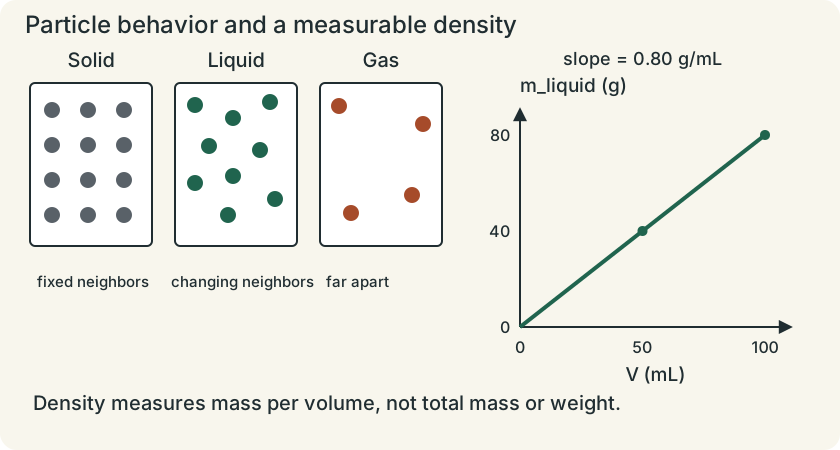
For a uniform material at fixed conditions, m = ρV. Double the volume and the mass doubles, while density stays the same. On a graph of mass vertically versus volume horizontally, density is the slope. On a volume-versus-mass graph, the slope is 1/ρ instead. Always read the axis labels before interpreting a slope. For a mixture or an object containing air pockets, m/V using its total external volume gives its average density. That average is what we’ll need for many floating problems.
The ideal-fluid shortcut
In AP’s ideal-fluid model, a fluid is incompressible and has no viscosity. Incompressible means a given amount of fluid keeps the same volume and density when its pressure changes. It doesn’t mean the fluid can’t move, change shape, or speed up. No viscosity means we neglect internal friction that would dissipate mechanical energy. Ideal fluid is a model, not a claim that every real fluid behaves perfectly that way. These assumptions let us use the conservation equations in topic 8.4.
Water is often a reasonable approximation to an incompressible fluid in ordinary classroom flow problems. A gas often isn’t, because its volume and density can change substantially with pressure. Nevertheless, follow an explicitly stated ideal-fluid assumption for an AP problem. If the problem changes the model, say which assumption changed. The original book’s Ideal Gas Law and More on Fluids are preserved as enrichment. Gas laws, intermolecular corrections, and quantitative head-loss formulas aren’t required by this AP density topic.
Measure density without hiding the container
Place a dry graduated cylinder on a balance and record its empty mass. Add successive measured volumes of the same liquid, recording total mass each time. Read the meniscus at eye level to reduce parallax, and use several volumes spread across the cylinder’s range. Subtract the empty mass to plot liquid mass against volume. Use the best-fit slope to estimate density. Repeat measurements to see how much they vary, and note the cylinder’s resolution and the balance’s resolution.
Try these original data: volumes 20, 40, 60, and 80 mL have liquid masses 16.1, 31.9, 48.2, and 63.8 g. A reasonable fitted density is about 0.80 g/mL, or 800 kg/m³. If you accidentally plot total mass, a straight-line fit can still give the same slope, but the intercept is the empty container mass. Taking total mass divided by a single liquid volume would overestimate density, especially for a small sample. OpenStax’s density treatment supports the mass–volume relationship; this data task is original.
For an irregular solid, measure its mass and use a graduated cylinder to find how much the water volume rises when the object is completely submerged. The rise equals displaced volume. Make sure no trapped air is included, and use an object that doesn’t dissolve or absorb appreciable water. This connects density measurement to displaced volume, but displacement alone doesn’t tell us the object’s weight.
Same particles, different ways to rearrange
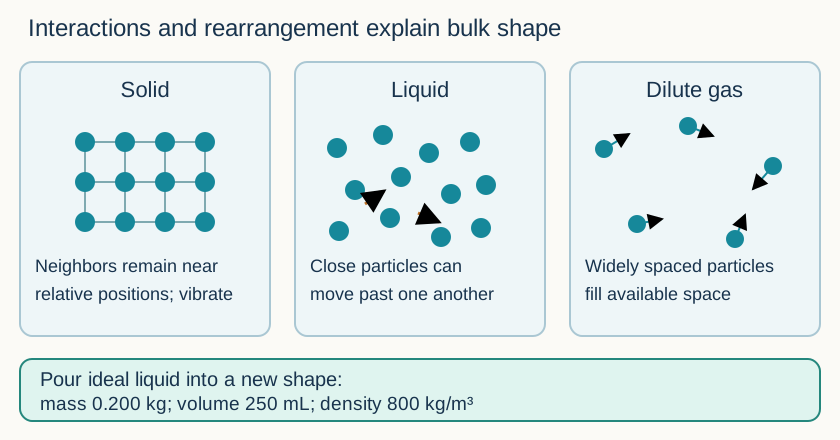
Picture the same substance as a solid, a liquid, and a gas under conditions where each phase can exist. The particles themselves do not become larger when the gas fills a bigger container. In a solid, neighboring particles interact strongly enough to remain near particular relative positions, so the sample resists a lasting change of shape. They can still vibrate. In a liquid, particles interact and stay close but can move past one another and change neighbors. That rearrangement lets a liquid take the container’s shape while keeping a nearly fixed volume. In a dilute gas, particles are far apart and interactions between encounters are much less influential; their motion spreads them throughout the available container. Different interactions and arrangements explain the different bulk responses.
A 250 mL liquid sample of mass 0.200 kg can be poured from a tall cup into a wide bowl. In the incompressible model its volume remains 2.50 × 10⁻⁴ m³ and its density remains 800 kg/m³ even though its shape changes. A gas transferred into a larger closed container can occupy a larger volume and have a smaller density at the same mass. Both are fluids because neither maintains a fixed shape. A solid sample normally keeps its own shape; a pile of solid grains can pour because separate grains rearrange, not because each grain is a liquid.
Inspect diagram labels
The diagram keeps its full size here. Focus the view and use the arrow keys, or scroll across it, to inspect every label.
The model compares particle interactions and freedom to rearrange; it does not assume one phase always has the fastest particles or that intermolecular forces vanish completely in a gas. Those shortcuts would miss the cause of the macroscopic behavior.
Check what density means
Pause & try it
Let's see what stuck.
Choose an answer, then check the reasoning. Try the written problems below before opening their solutions.
0 of 3 checked · 0 correct
Written practice: the container intercept
A best-fit total-mass graph obeys m_total = (0.90 g/mL)V + 45 g. Find the liquid density in SI units and explain what the intercept means. What total mass should the balance show for 60 mL?
Open the separate worked solution.
Teaching reference: CED topic 8.1, printed page 134 asks us to describe fluids, density, and the ideal-fluid model.
Explain and apply the model
Try these problems before opening the solutions. State your assumptions, show the diagram or calculation, and explain what makes your answer follow.
Explain shape using particle interactions
A solid sample, a liquid sample, and a dilute gas sample of the same substance are considered under suitable conditions for each phase. Each is moved to a differently shaped container. Separately, a 0.180 kg sample of ideal incompressible liquid has volume 200 mL before it is poured from a narrow cylinder into a wide bowl. Ignore evaporation and spilling.
(a) Describe how interactions and arrangements of atoms or molecules explain the distinguishing shape and volume responses of the solid, liquid, and gas. Classify which phases are fluids and justify that classification using the lack of fixed shape. Avoid explaining the change by making the individual particles larger.
(b) Calculate the liquid density in kg/m³ before and after pouring. State the mass and volume after pouring, and explain why changing shape does not require a density change.
Your written working
Drawing is temporarily unavailable. Work on paper if needed, then record your reasoning here.
Saving written working requires JavaScript. The problem remains available above; keep your work on paper or in your own notes.
Glossary and deeper reading · 6 refreshers
These editorial refreshers supplement the reading. Definitions and examples are added guidance; original source wording and recorded answers remain in their original context.
-
Fluid
A fluid is a material that flows and continuously deforms under a sustained shear stress. Liquids and gases are both fluids, although their compressibility and other properties can differ greatly. For example, both water in a pipe and air flowing through a duct are fluids.
-
Mass density
Mass density is mass per unit volume of a material or sample. It is commonly measured in kilograms per cubic meter and can vary with temperature or pressure. For example, equal-volume samples of water and oil generally have different masses because their densities differ.
-
Weight
Weight is the gravitational force exerted on an object by a specified attracting body. Near Earth’s surface its magnitude is approximately mass times the local gravitational field strength, and it is measured in newtons. For example, an astronaut has less weight on the Moon while retaining the same mass.
-
Incompressible fluid
An incompressible-fluid model treats density as constant despite pressure changes in the modeled situation. This approximation often works for liquids over modest pressure ranges but is not a universal property of all fluids. For example, water flowing through a narrowing pipe can often be treated as incompressible.
-
Viscosity
Viscosity measures a fluid’s resistance to relative motion between neighboring layers. Viscous effects can dissipate mechanical energy and alter the velocity profile of flowing fluid. For example, honey flows more reluctantly than water under comparable conditions because it is more viscous.
-
Pressure
Pressure is the normal force per unit area exerted on a surface. It is a scalar measured in pascals, with one pascal equal to one newton per square meter. For example, a gas exerts pressure throughout its volume through many microscopic collisions, even when its bulk motion is zero.