A reflected-ultrasound model
Enrichment article
Read the related lesson → · Full original reading →
Doppler Effect
This may be something that you hear on a daily basis, but maybe won’t notice how it works. Ever been in a situation where you were in your car and you heard either an ambulance or a fire truck coming? It’s because they’re blasting their sirens trying to get you to move out of the way!
As a siren approaches, received intensity often rises because its distance decreases. Separately, relative motion changes the detected pitch: approach gives a higher frequency and recession a lower one under the usual subsonic conditions.
These changes in frequencies with respect to motion of a relative object is what is known as the doppler effect↗. When dealing with this, we will denote two other definitions: the source, which is the source of where the sound is coming from, and the detector, which is the object that detects the sound.
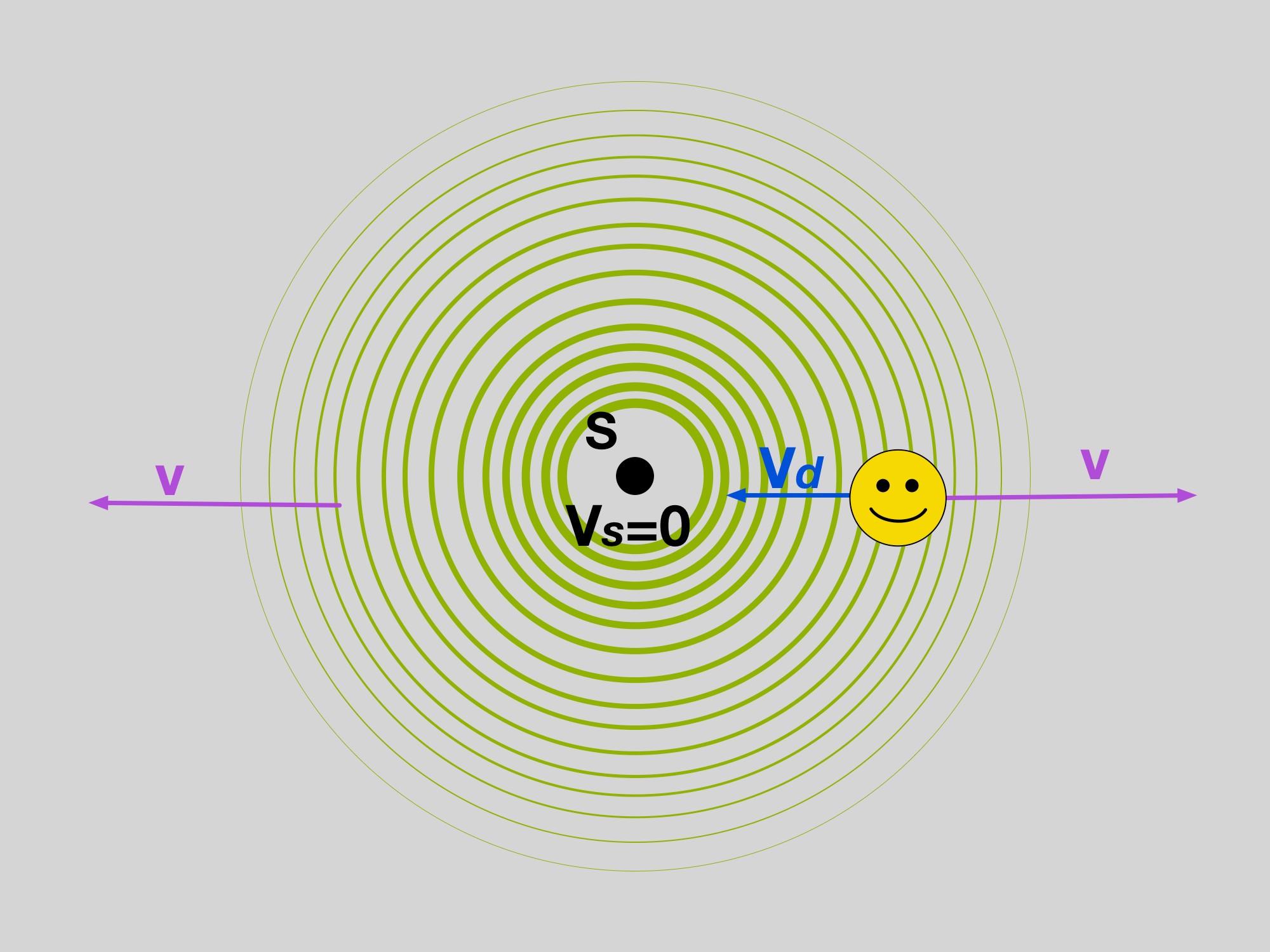
A detector moving toward a stationary sound source encounters wavefronts more frequently and hears a higher pitch. Intensity may also rise as it gets closer, but that is a separate distance effect.
The general equation for this is:
(Equation 9.4.1)
Where is the detected frequency, is the emitted frequency, is the speed of sound through the medium (in this case its air), and and are the speeds of the detector and source relative to the air, respectively. The reason for the “” is because you can have multiple scenarios that affect the detected frequency:
- Use +u_D in the numerator when the detector’s velocity component relative to the medium points toward the source.
- Use −u_S in the denominator when the source’s velocity component relative to the medium points toward the detector.
- Use +u_S in the denominator when the source’s velocity component relative to the medium points away from the detector.
- An object stationary relative to the medium has zero velocity in the Doppler formula. The usual expressions here assume collinear subsonic motion.
Example Problem 9.4.1
Ultrasound imaging detects reflected acoustic waves. A Doppler frequency shift can measure a moving reflector’s velocity component along the beam. The following example uses this reflected-wave effect.
The way it works is that it emits waves and produces an image by detecting waves that bounce off the objects. In that case, it forms the image on a screen from the reflected waves it catches back from within the woman’s womb.
In a hypothetical reflected-ultrasound model, a stationary transducer emits 2.30 × 10⁶ Hz and receives 3.0 × 10⁶ Hz from a reflector moving toward it. Sound speed is 1.54 × 10³ m/s. Find the reflector’s speed along the beam. These frequencies are not realistic fetal-heart data.
Step 1: Realize that this is a double doppler question
The tricky part about this question is realizing that you have different scenarios going on. First thing is that the initial source is the ultrasound machine that sends the waves to the detector which is the heart.
Then the heart emits back a wave for the ultrasound machine to receive and make into an image. This means that at that point the heart acts as the source and the ultrasound machine as the detector.
Step 2: Solve for the detected frequency of the Heart
We will be using our relative frequency equation:
But for this case since we’re dealing with multiple doppler effects, let’s change the subscripts to prevent confusion.
The first part to solving this requires us to set up the first part of the doppler system, where the heart acts as the detector (we’ll refer to it as ) and then the ultrasound, which we’ll refer to as , so the equation will look like:
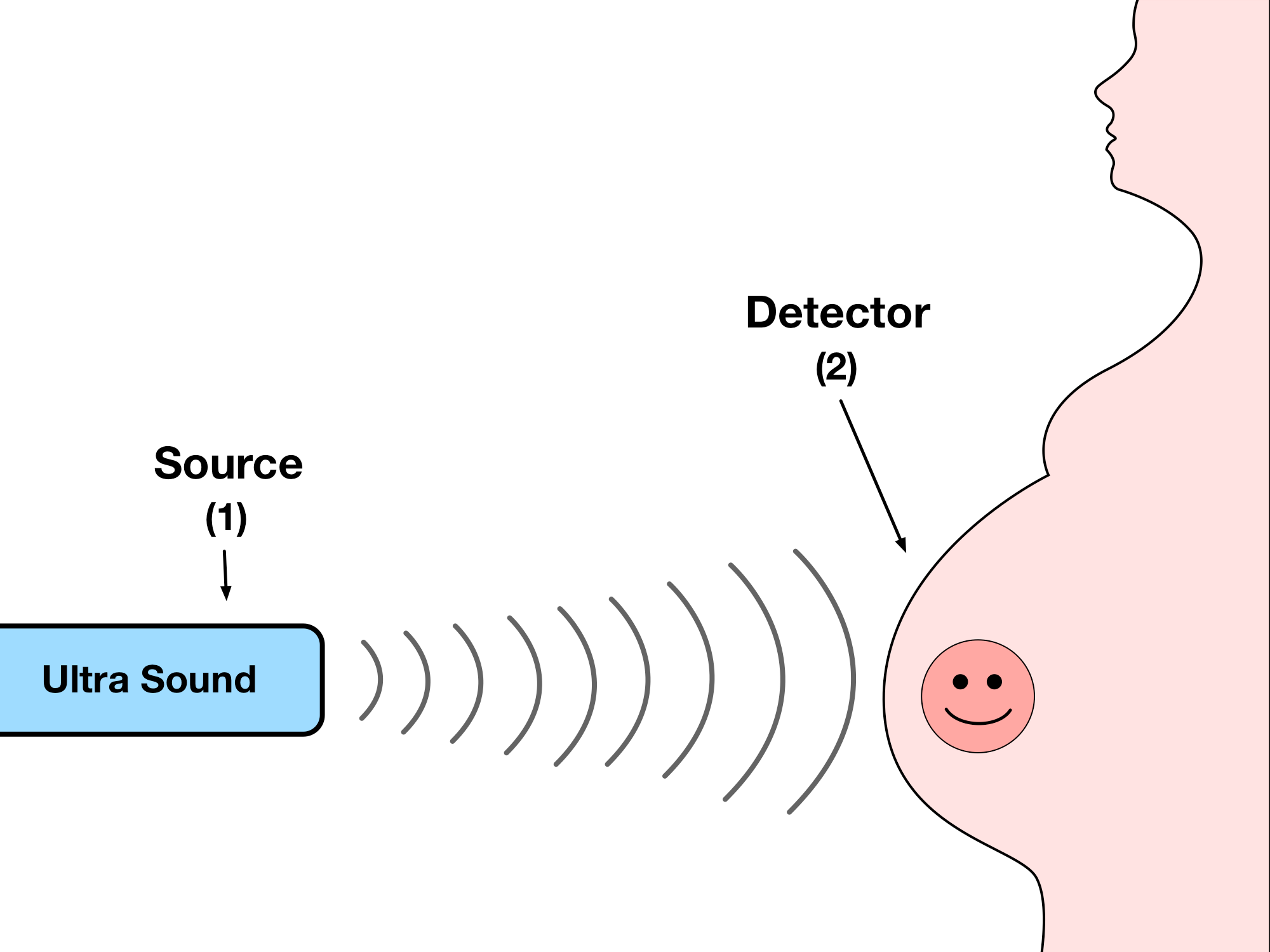
Initially, the ultrasound is the source while the fetus is the detector.
Read every step and figure
Step 1
Step 2
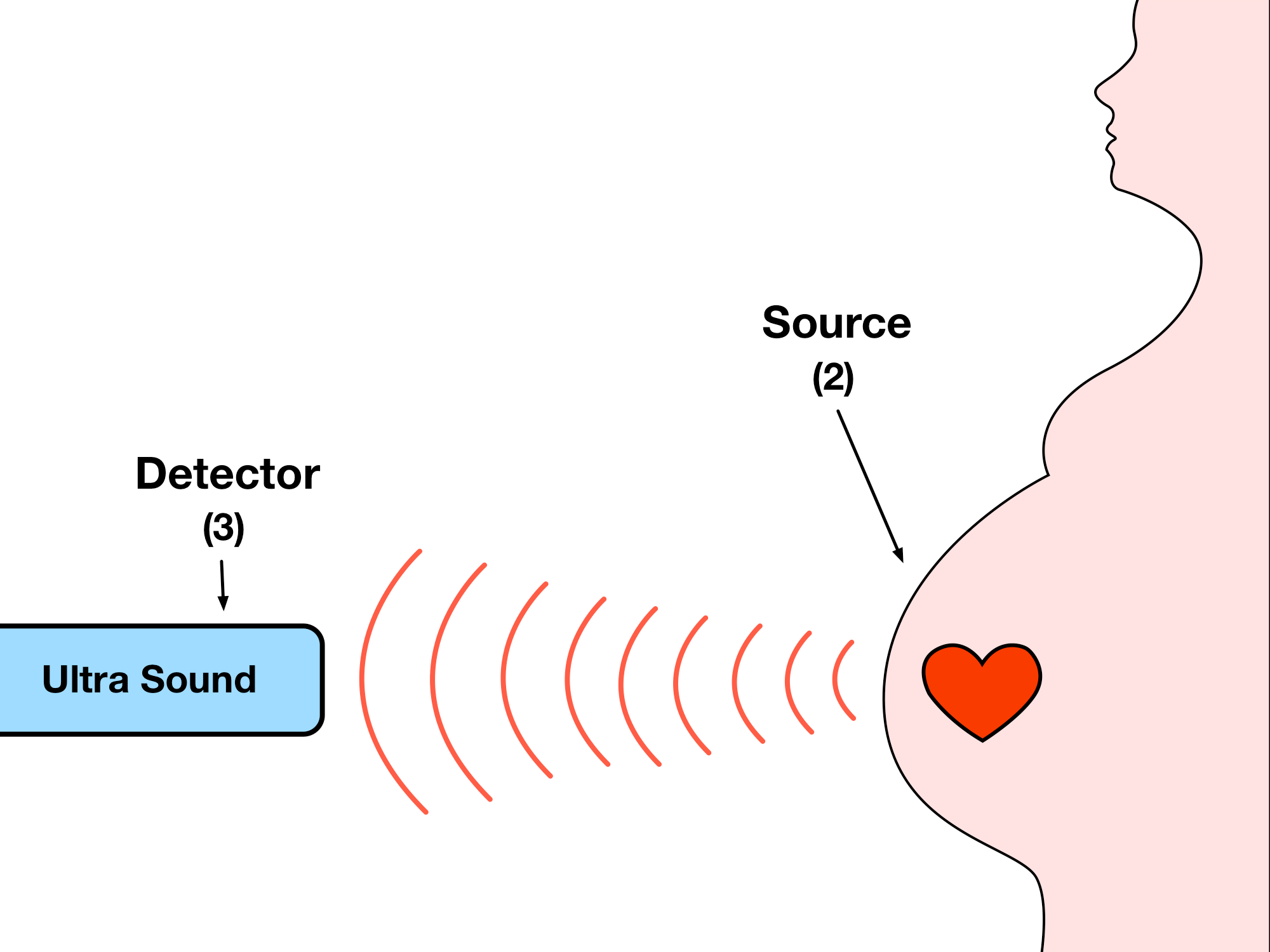
The reflector is moving toward the stationary transducer, so it encounters the incoming wavefronts more frequently. For this first shift, f₂ = f₁(v + u)/v.
which simplifies to
Step 3: Set up our second doppler equation
This time we are looking at the heart as the source since it will be reflecting waves back for the ultrasound to detect. We will designate the ultrasound as () since it is a new frequency that the ultrasound will detect. The heart is still partially moving, so it still has it’s velocity but this time the waves are moving away from the heart, so the source is essentially moving
On return, the reflector acts as a source moving toward the stationary transducer, so the source denominator is v − u.
Step 4: Find the equation for the velocity of the heart
We have equations with unknowns so we’ll have to use substitution to eliminate . Rearranging to solve for gives us:
and we already know that also equals therefore we can set these equal to each other to give us the following equation:
Source and curriculum context
Adapted from Physics I by Jake Yap and Laurence Vincent.
physics2 · 14.5 · printed pages 118.
Glossary and deeper reading · 3 refreshers
These editorial refreshers supplement the reading. Definitions and examples are added guidance; original source wording and recorded answers remain in their original context.
-
Frequency
Frequency is the number of complete repeating cycles per unit time. It is measured in hertz, meaning cycles per second, and is the reciprocal of the period. For example, a vibrating string with a higher frequency produces more cycles each second.
-
Doppler effect
The Doppler effect is a difference between emitted and observed frequency caused by relative motion of source and observer. For sound, both motions must be considered relative to the medium; motion changes the rate at which wavefronts are encountered. For example, a sound source approaching a stationary listener usually produces a higher observed frequency than the source’s rest frequency.
-
Velocity
Velocity describes how position changes with time and includes direction. Instantaneous velocity describes one moment, while average velocity is displacement divided by elapsed time. For example, a car turning a corner can change velocity while maintaining the same speed.