Carbon-surface photoemission
Enrichment article · AP Physics 2
Read the related lesson → · Full original reading →
The prompt specifies emission from a model carbon surface; the historical solution still says “ionize carbon”. Keep this terminology inconsistency in view; it has not been accepted as atomic-ionization instruction.
Another aspect of light is color. The term light refers to a specific type of electromagnetic radiation. This electromagnetic radiation refers to any wave-particle instance of a photon. The only reason that we see this radiation as light is due to the wavelength of that photon. A diagram of the electromagnetic spectrum is shown in the figure.
Figure 9.3.2 Electromagnetic Spectrum
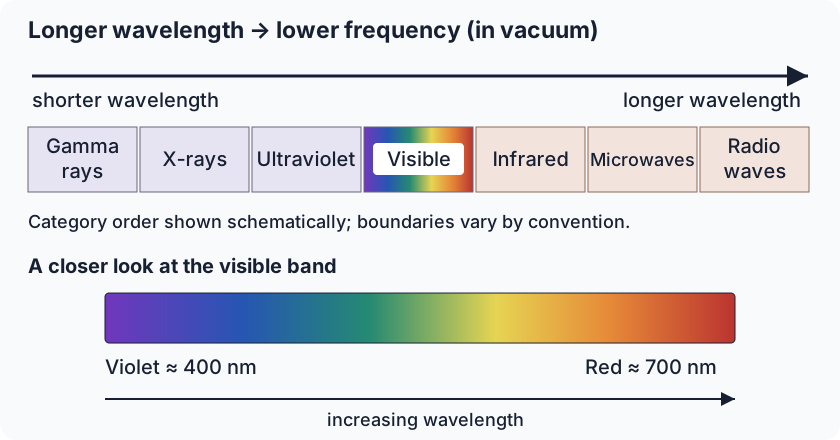
Wavelength increases from left to right. In the visible band, violet has shorter wavelength than red. The category overview is schematic; the visible strip is a separate enlargement. Electromagnetic spectrum.
The small range of around is the only part that we can see of this visible light spectrum. There are cameras that will take other wavelengths and convert them into visible light, allowing us to ‘see’ the other parts of the spectrum. That is actually what a thermal camera does. Heat generates infrared light, and the thermal cameras detect that light and convert it into video we can see.
A photon of frequency f carries energy E = hf. For N photons of that frequency, total energy is Nhf. Total beam energy therefore depends on both photon frequency and photon number.
This lead to the Planck-Einstein equation:
In this equation, is the wave’s frequency, and is the Planck Constantⓘ, . This can be re-written by using the definition of frequency:
In the photoelectric effect, incident light can eject electrons from a material. The work function is the minimum photon energy needed for ordinary single-photon emission from that surface; K_max = hf − φ when hf ≥ φ.
A model carbon surface is assigned a work function 7.686 × 10⁻¹⁹ J. Find the threshold photon frequency and corresponding maximum wavelength for photoelectric emission. Classify this radiation.
Source and curriculum context
Adapted from Physics I by Jake Yap and Laurence Vincent.
physics2 · 15.5.A · printed pages 144, 145.
Glossary and deeper reading · 7 refreshers
These editorial refreshers supplement the reading. Definitions and examples are added guidance; original source wording and recorded answers remain in their original context.
-
Electromagnetic wave
An electromagnetic wave contains oscillating electric and magnetic fields that transport energy. In the plane-wave vacuum model, both fields are perpendicular to each other and to the propagation direction. For example, visible light and radio waves can both travel through empty space.
-
Wave
A wave is a propagating disturbance that can transfer energy without transporting the medium as a whole. Mechanical waves require a material medium, while electromagnetic waves can propagate through vacuum. For example, a pulse travels along a rope while individual rope segments move locally around their equilibrium positions.
-
Wavelength
Wavelength is the spatial distance between neighboring points at the same phase of a periodic wave. It connects propagation speed and frequency through speed equal to frequency times wavelength. For example, neighboring crests of a sinusoidal water wave are separated by one wavelength.
-
Heat
Heat is energy transferred between systems because of a temperature difference. It describes a transfer rather than a substance or energy store contained in an object. For example, when a warmer mug transfers energy to a cooler hand, the mug loses internal energy and the hand gains it.
-
Photon
A photon is a quantum of electromagnetic radiation with energy proportional to its frequency. It has zero rest mass and no electric charge but carries energy and momentum. For example, increasing light’s frequency increases the energy of each photon, while increasing the number of same-frequency photons increases the total energy.
-
Frequency
Frequency is the number of complete repeating cycles per unit time. It is measured in hertz, meaning cycles per second, and is the reciprocal of the period. For example, a vibrating string with a higher frequency produces more cycles each second.
-
Planck’s constant
Planck’s constant relates the energy of a photon to its frequency. It also sets the scale connecting particle momentum to de Broglie wavelength. For example, two photons of different frequencies have energies in the same ratio as their frequencies because the constant is the same for both.