Kinetic Energy
Original textbook reading.
Like we mentioned in the introductory section of this chapter, kinetic energy is the energy associated with an object that is in motion. The equation that we will be concerned with will be:
(Equation 4.4.2)
As you can see, the kinetic energy of an object is directly proportional to the mass of an object and the square of the velocity of that object. In the example in Figure 5.1.1 of our lovely Omninox Express train, a large mass with a high velocity has a much larger kinetic energy than when compared to say a tennis ball.
The units of kinetic energy can be written as Joules:
A car with mass m= 300 kg is traveling with an acceleration, a= 3 m/s2 and initial velocity, v= 20 m/s. The car starts travels a distance d of 8 m. What is the final kinetic energy of the car?
Step 1: Notice that it is a kinematics problem
It may be hard to see it, but to solve this problem, you’re going to have to realize that we need the kinematic equations of Chapter 3. So which one are we going to use?
To figure out the right equation to use, we’ll look at our givens.
Example Problem 5.2.2
Now this is a little too easy. Let’s delve into something more complicated.
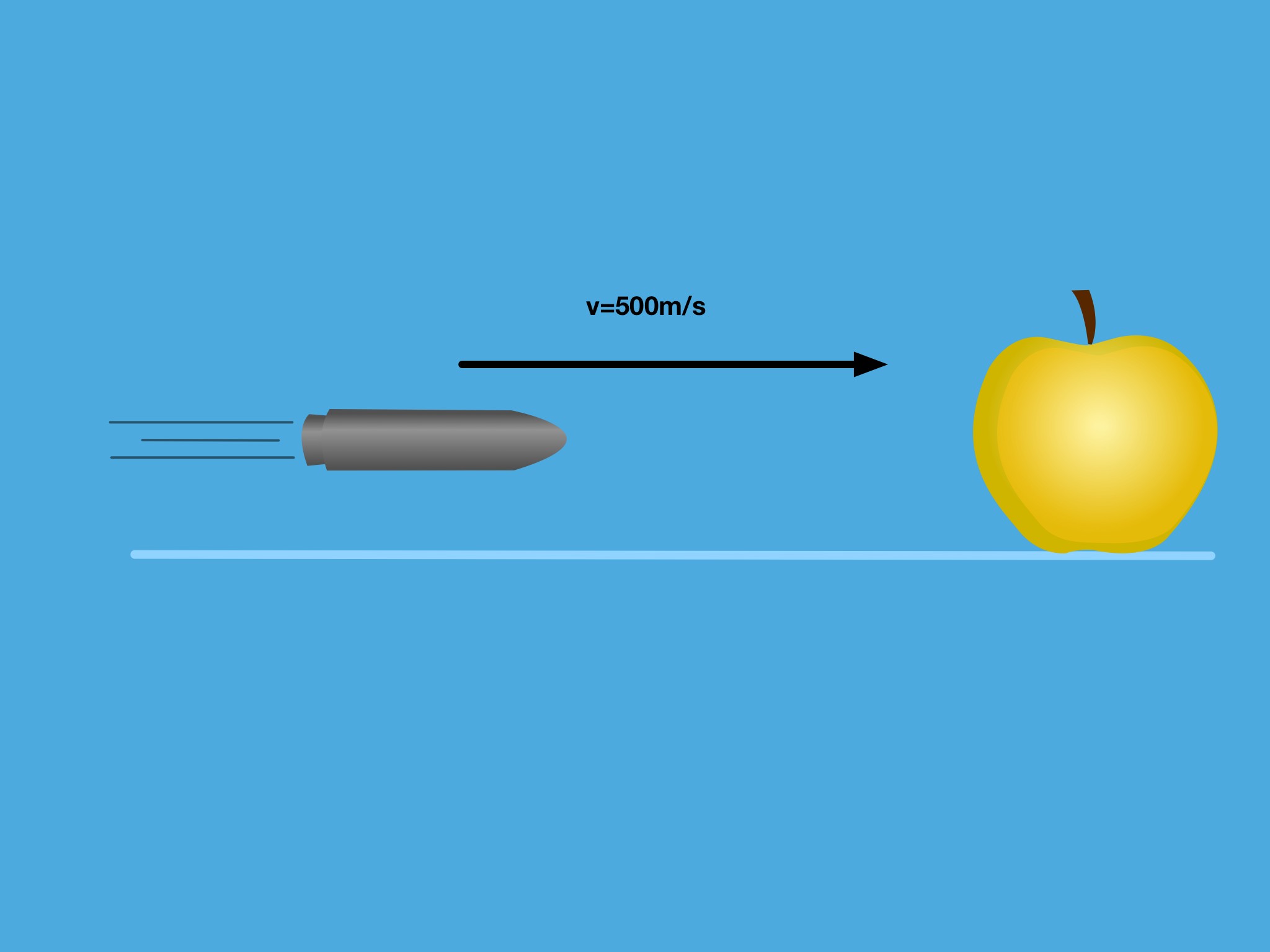
A stationary 50 g apple on a level frictionless surface is struck by a 10 g bullet moving at 500 m/s; the bullet embeds. After collision an external braking force gives the combined object a constant acceleration of −8 m/s². Find its kinetic energy immediately after collision and its displacement over the next 5 s.
Step 1: Realize that this is an inelastic collision
If you don’t recognize this, then we cannot solve this problem. This is a conservation of linear momentum problem since it’s only traveling in one dimension.
The key phrase to look for in the problem is that the apple and bullet accelerate together after collision, meaning that they travel as one. This means that a completely inelastic collision has occurred.
Step 2: Solve for the velocity of the golden apple + bullet
Now that we know that this is a completely inelastic collision, we can solve for the velocity of the whole apple + bullet.
Step 4: Solve for the distance the golden apple + bullet Travel
In order to solve for the distance, we must realize that this is a kinematics approach. At this point, let’s use our kinematic equation:
Since this is all in one direction, we don’t need to worry about y-direction movement, so we can assume this is all in the x-direction.
Let’s see what our givens are:
And we also have to use the velocity that we solved for in step 2 because we’re concerned with how far the apple moves after the bullet has collided with it. In that case:
Therefore, we can plug in our values in:
Δx=(83.333 m/s)(5 s)+½(−8 m/s²)(5 s)².
Δx=316.667 m. The speed after 5 s is 43.333 m/s, so the object has not yet reversed.
We would expect it to travel far since the bullet is traveling so fast. Can you imagine if the object hit wasn’t an apple? What if it was something much heavier?
Pop Quiz 5.2.1 Kinetic Energy
Question 1 of 5 · 0 correct
AP Topic 3.1 · Read the worked solution
A baseball and a bowling ball are thrown at the same velocity. Which one has a larger kinetic energy?
Read every full question without answers
Question 1
Question 2
Question 3
Question 4
Question 5
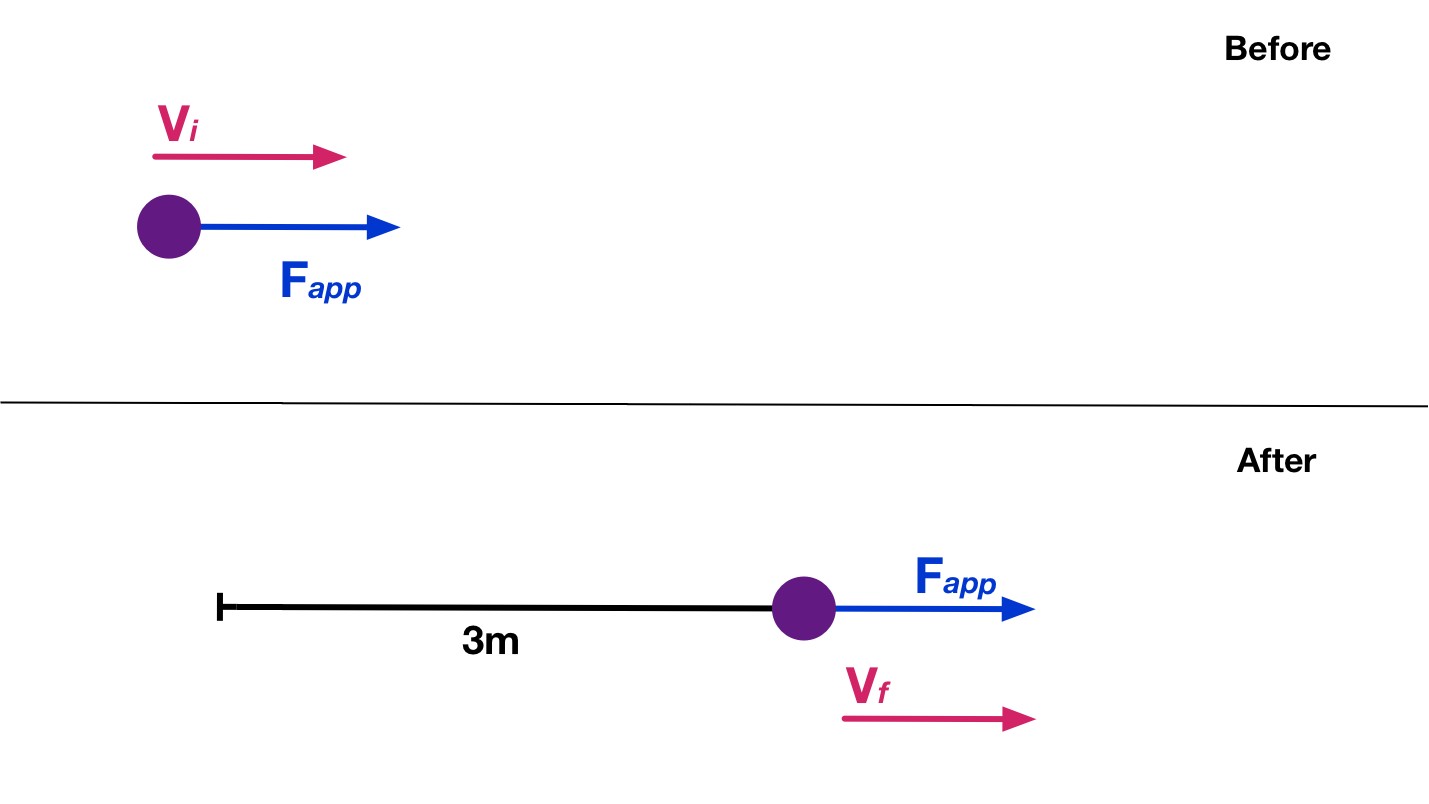
A 1 kg particle initially moves at 2 m/s along +x. A constant net force of 4 N acts along +x through a displacement of 3 m. Find v_f/v_i.


Reviewed physics notes (5)
These corrections keep the original lesson’s purpose while fixing errors in the source edition.
- The source printsv_f=448m²/s² instead ofv_f². — Reference 1
- Explicit sticking and external braking make the subsequent negative acceleration consistent with a frictionless surface. — Reference 1, Reference 2, Reference 3
- Source loses the negative acceleration sign. — Reference 1
- Correct source 516.7 m arithmetic. — Reference 1
- Existing√7 key requires force parallel to displacement and positive work. — Reference 1
Glossary and deeper reading · 1 refreshers
These editorial refreshers supplement the reading. Definitions and examples are added guidance; original source wording and recorded answers remain in their original context.
-
Velocity
Velocity describes how position changes with time and includes direction. Instantaneous velocity describes one moment, while average velocity is displacement divided by elapsed time. For example, a car turning a corner can change velocity while maintaining the same speed.