Potential Energy
Original textbook reading.
Now that you know about the energy that an object has due to its motion, you will now learn about the energy that a body has from its position.
It may seem like a strange concept, that two objects can have different energies from being in different locations, but it actually is pretty simple.
The concept involved here is called potential energy. This energy stems not from anything about an object itself, but rather from the forces that are acting on the object. You already know that energy can’t be created or destroyed, so let’s take a quick example.
Say you have a tennis ball, and you place it on the ground. It isn’t moving so it doesn’t have any kinetic energy. Now, if you leave that tennis ball where it is, and then run up to the second story of a nearby building, and hold another tennis ball out of the window, the two tennis balls are each not moving, so they don’t have any kinetic energy. However, when you release the tennis ball, it falls. In order to fall, it needs to acquire kinetic energy, because it now has a velocity.
If energy can’t be created or destroyed, where did that kinetic energy come from? The answer lies in potential energy. Simply by being above the other ball gave it more energy. This form of energy is called gravitational potential energy, and its formula is given as:
U_g=mgh (Equation 5.3.1), where g=9.81 m/s² is a positive scalar and h is signed vertical height relative to a fixed datum. Only changes in U_g affect the motion.
As you have learned already, energy is conserved during any interaction. For this section, we will be combining both Kinetic Energy and Potential Energy. We will use the following equation to relate the two:
(Equation 5.3.2)
In this case, we assume that there are no energy changes except from kinetic to potential. Now, that is not true, as you can tell simply by dropping a basketball. The basketball doesn’t return to its full height, which means that some energy was lost along that way. That problem will be covered in the following section.
For now, let us assume that the only two forms of energy are kinetic and potential. As these problems rely on successfully utilizing a reference height (which we will label a ‘datum’), the next couple example problems will help you to analyze a problem.
Example Problem 5.3.1
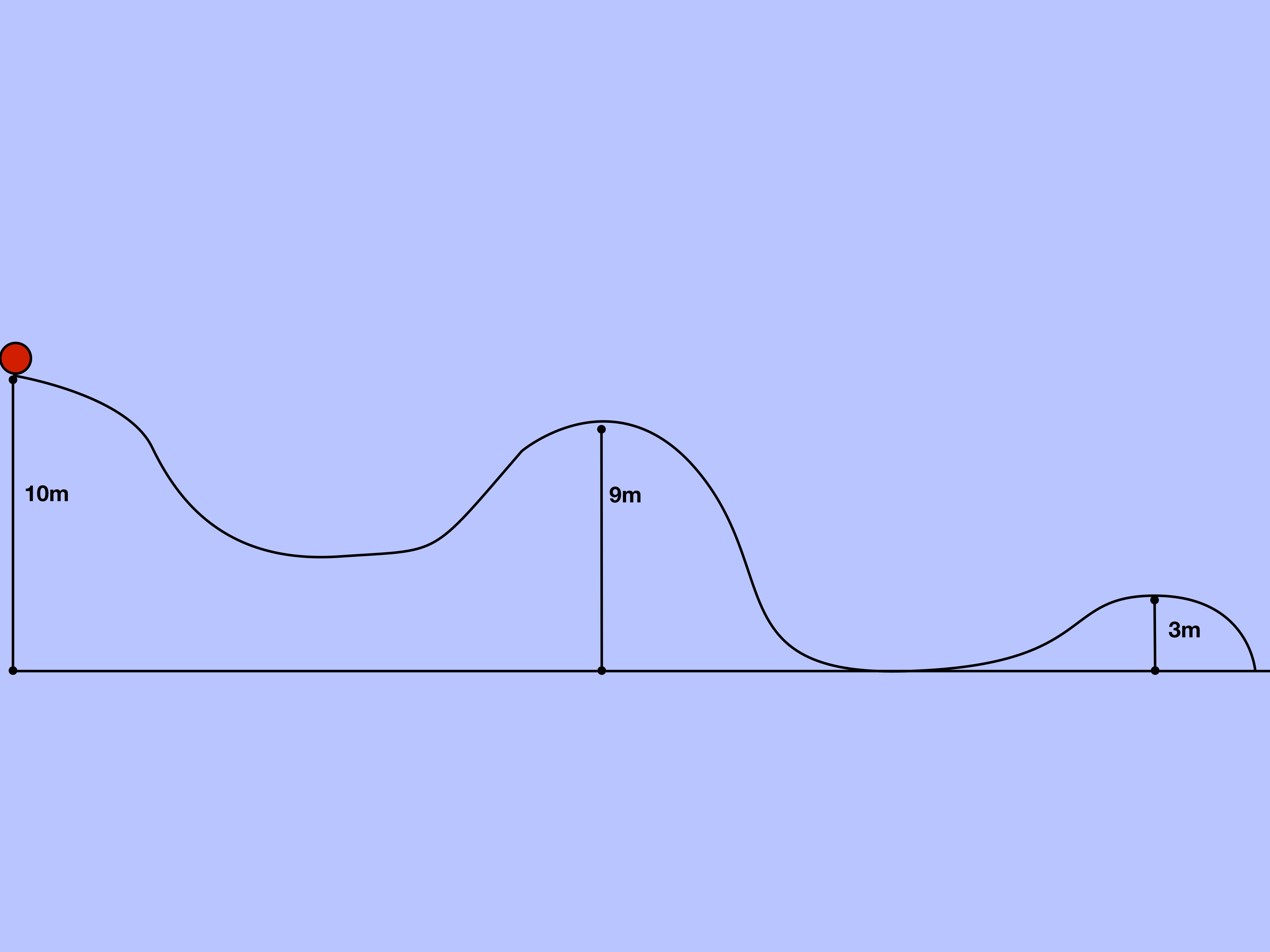
Treat the 1 kg ball as a sliding point mass, neglecting spin, friction, and air resistance. It starts from rest on the shown path. Find its speed at each hilltop.
Step 1: Determine the datum
For this problem, we have a few options for our datum. We can use the datum that is presented in the picture, at the base of the second hill, but we can actually have an easier time if we choose the datum to be at one of the hill tops. That way, the potential energy at that hill will be , so it simplifies the calculation.
If we pick the top of the first hill to be our datum, that would make the second hill have a negative height. While that is fine, we don’t need that. Instead, we can choose our datum to be the top of the second hill.
This gives us a value of all the heights involved (starting height, top of the first hill, top of the second hill). Respectively, these heights are , , and .
Step 2: Determine the total energy of the ball.
As we know that there are no energy losses during this problem, we can come up with a total energy that the ball has. Due to everything being known at the initial point, we can use that:
As the ball is initially stationary, there is no kinetic energy. This makes the potential energy the only factor present.
Step 3: Determine the ball’s velocity at the peak of the first hill.
Now we can use the same energy definition we used previously:
That wasn’t so hard. Let’s try another problem, but this time we’ll intentionally pick a datum that gives us a negative datum.
Example Problem 5.3.2
Example Problem 5.3.2
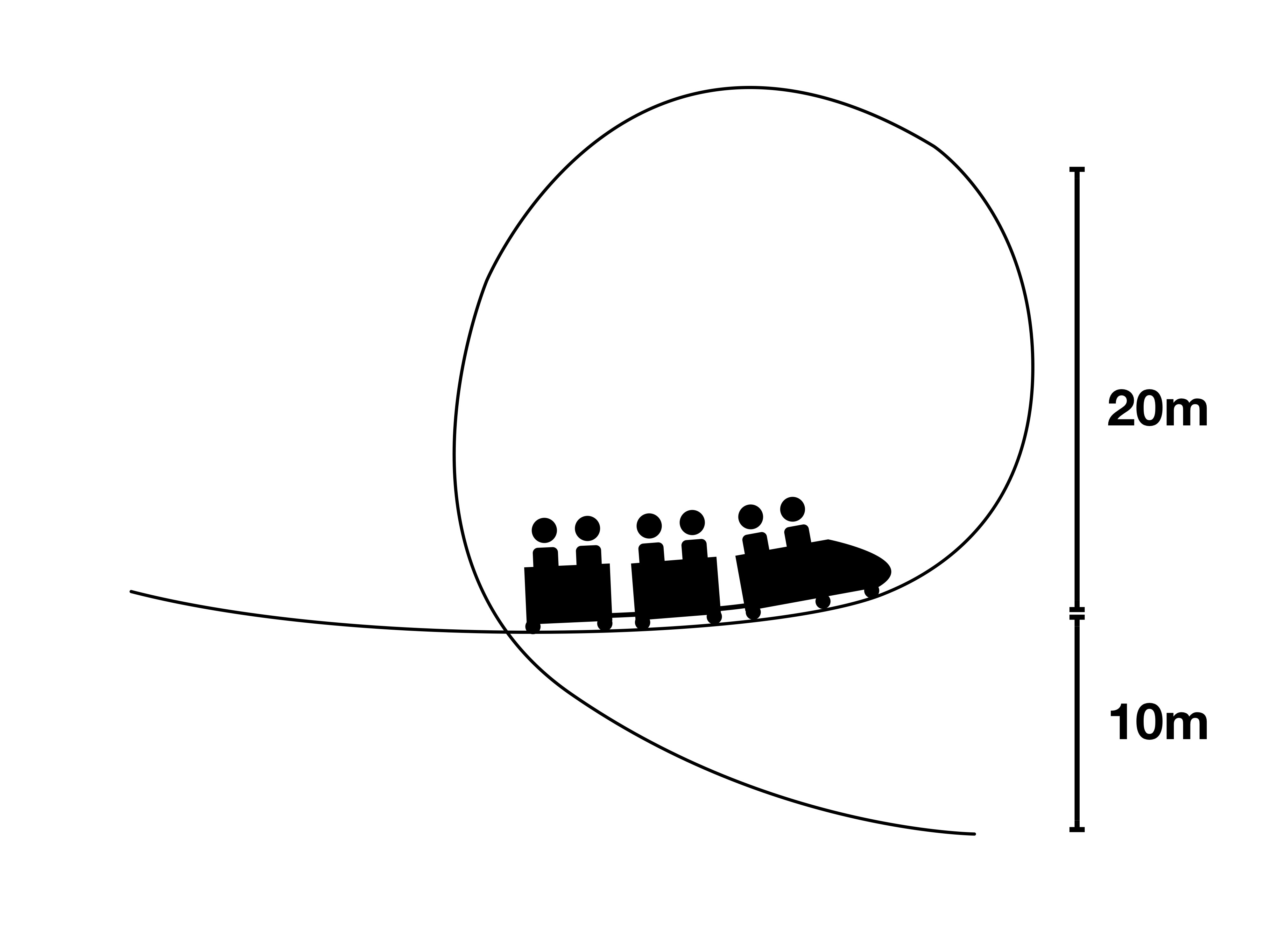
A roller coaster with total mass 500 kg launches at 20 m/s. The illustrated loop rises 20 m above the launch level and its bottom is 10 m below that level. Assume friction is negligible and retaining wheels constrain the train to the track throughout the loop. Find its speed at the top and bottom.
Step 1: Choose a datum
As we want to demonstrate negative heights, we will choose the starting position to be our datum. This makes the heights at the start, the top of the loop, and the bottom of the loop , , and , respectively.
Step 2: Determine the velocity at the top of the loop
As we want to show different ways of solve these types of problems, here we skip straight to the energy balance. We use the energy balance equation.
Our initial and final states will be at the launch and at the top of the loop.
One little trick to this approach that makes it a bit easier can be seen if we expand that equation:
The mass value will cancel out, leaving us with:
This makes the equation a bit simpler.
Now, plugging in what we know, we get:
Step 3: Determine the velocity at the bottom of the loop.
We can use the same approach for the bottom.
Now that you know how to use kinetic and potential energy to solve problems, here’s a review widget.
Gravity isn’t the only force that causes a potential energy on an object. Another common force is the spring force. You’ve already learned about this force earlier, but it creates a potential energy in whatever object it is attached to.
The equation for the spring potential energyⓘ is:
U_s=½kx² (Equation 5.3.3), where x is the signed extension or compression measured from the spring’s unloaded length. Energy depends on x² and is scalar.
For an ideal Hooke-law spring, measure the deformationx from its unloaded length. A convenient convention isU_s=0 there. You may add a constant to potential energy; the forces and energy differences remain the same. The equilibrium position of a loaded spring can differ from its unloaded position.
One disappointing factor you might notice in the spring potential energy is that mass is not included. This means that in problems containing springs, you cannot just toss mass out, as it will not cancel.
To use the spring potential energy, we simply start with the previous energy balance equation:
(Equation 5.3.2)
Here, potential energy is present, we just need to explicitly define it to be both gravitational potential and spring potential. This means our more robust energy balance is given by:
(Equation 5.3.4)
This ensures we can deal with problems that cover both spring potential and gravitational potential energies.
Example Problem 5.3.3
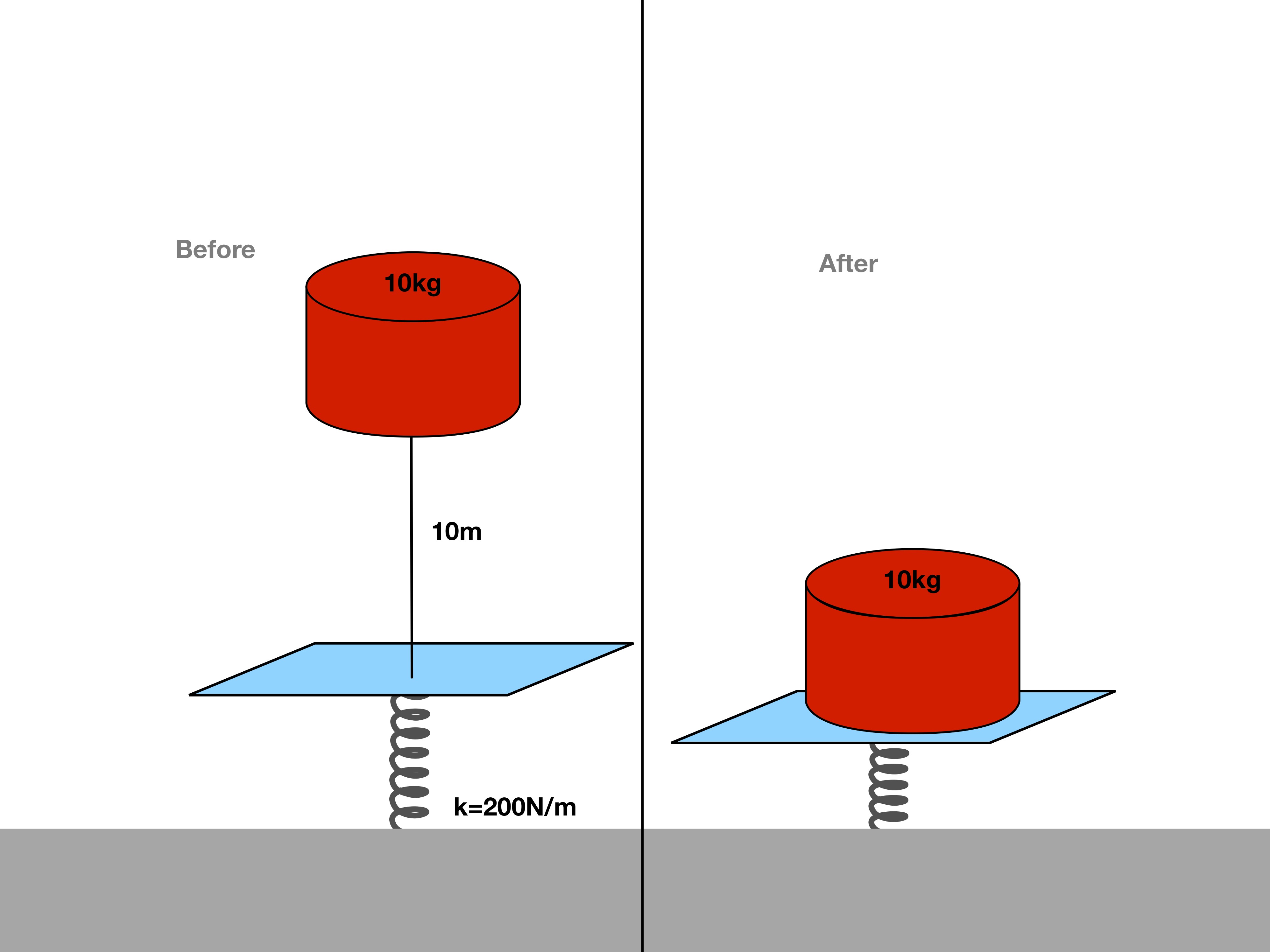
A 10 kg mass is released from rest 10 m above a massless platform on an initially unloaded vertical spring. Ignore losses and platform mass. Find the maximum spring compression when the falling mass comes instantaneously to rest. The spring constant is 200 N/m.
Step 1: Pick a datum
While this may seem like a simple choice, the top of the board, it’s actually a bit more complicated than that. Our initial and final states are actually the state before the block is dropped and the state after the board is depressed. Therefore, we should choose our datum to be the height of the board after it gets depressed by . This makes the initial height , and the final height .
Step 2: Simplify the energy balance
We have both gravitational and spring potential energies, meaning we need to use the full energy balance equations:
We begin by eliminating the energies that will be simply .
So what can we eliminate? Well, initially, the block is getting ready to fall. This means that the block isn’t moving, so we can eliminate . We can also say that without the weight on it, the spring is neutral. This means . As for the state after the mass is caught, we have already picked that state as our datum for , so that would be zero then.
Now we have a quadratic equation. We can solve this using the quadratic formula:
Example Problem 5.3.3 Given Image
Let x≥0 be compression distance. From 100x²−98.1x−981=0, the roots are x=(98.1±√(98.1²+392400))/200=3.66077 m or −2.67977 m.
Becausex was defined as a nonnegative compression magnitude, only the positive root represents the specified turning point. The rejected root is outside this model’s domain; it is not a valid alternative stretch of the spring catching this mass.
Use g=9.81 m/s² as the magnitude of gravity. The compression convention was set separately as x≥0.
Maximum compression x=3.661 m.
Pop Quiz 5.3.2 Spring Energy
Question 1 of 5 · 0 correct
AP Topic 3.4 · Read the worked solution
A 1 kg ball is launched horizontally on a frictionless surface by an ideal spring with k=100 N/m initially compressed 0.5 m. Find the ball’s speed when the spring returns to its unloaded length. Ignore spin.
Read every full question without answers
Question 1
Question 2
Question 3
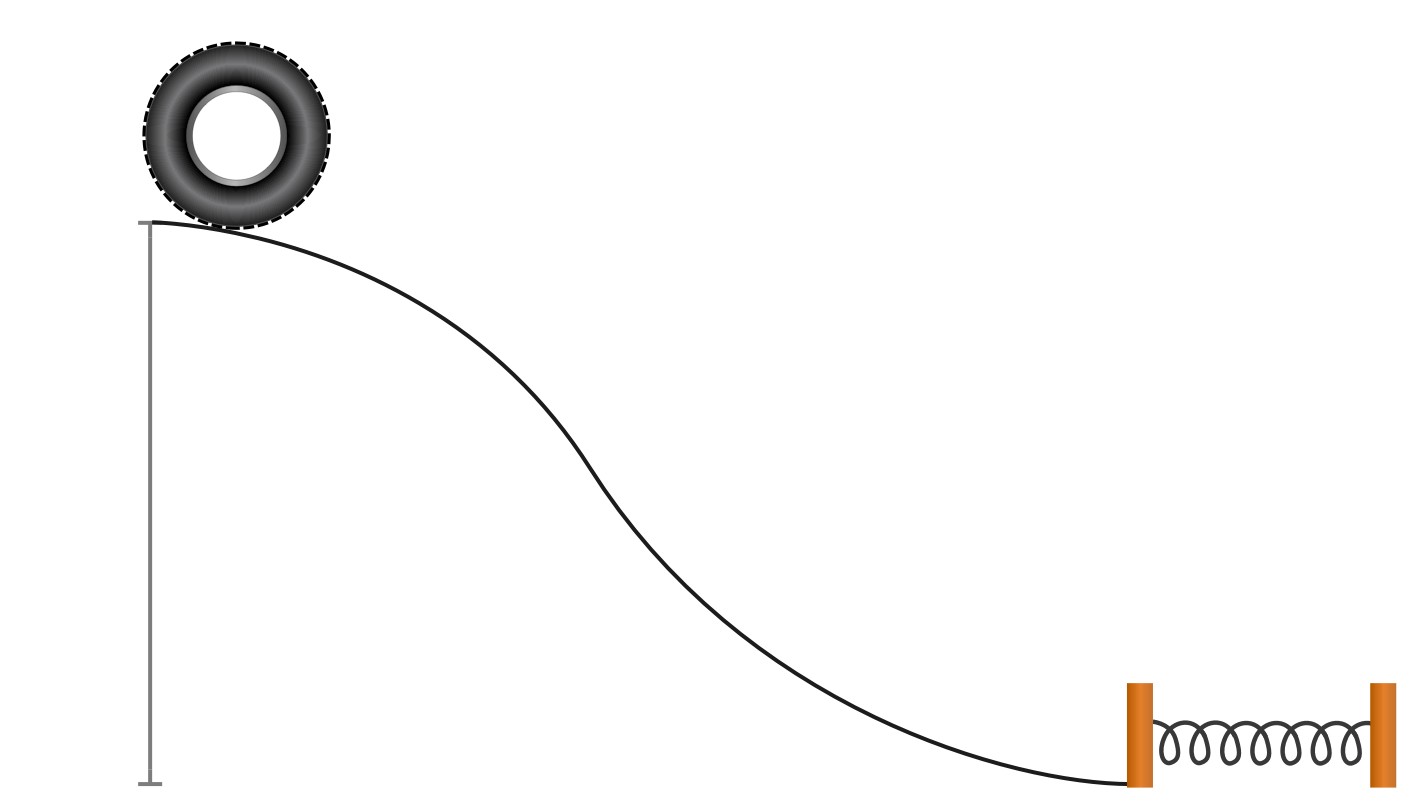
Treat the shown 5 kg wheel as a sliding point mass and neglect rotation. It starts from rest 10 m above a horizontal spring with k=200 N/m on a frictionless path. How far does it compress the spring?
Question 4
A 60 kg diver stands on an ideal massless board modeled as a vertical spring with k=15 kN/m. Its unloaded surface is 5 m above the water and is initially depressed 0.2 m, so the diver starts 4.8 m above the water at rest. With no extra muscular work or losses, how high above the water does the diver rise?
Question 5
If a penny was dropped from the top of the Empire State Building, will it pierce the awning at the base of the building? Assume the awning acts as a spring with a spring constant of , and it will tear if it is moved more than from equilibrium. The Empire State Building is high, and a penny has a mass of .


Reviewed physics notes (17)
These corrections keep the original lesson’s purpose while fixing errors in the source edition.
- Potential energy is scalar, notmg-vector timesheight. — Reference 1
- Actual rolling stores rotational kinetic energy and would change the answers. — Reference 1, Reference 2
- Energy gives only 2.76 m/s at top, insufficient for ordinary unrestrained inside-loop contact withradius 15 m. — Reference 1, Reference 2
- Correct displacement-square/vector language. — Reference 1
- Potential-energy datum remains arbitrary; loaded equilibrium is not automatically zero deformation. — Reference 1
- State unloaded spring and first turning point, rather than static final equilibrium. — Reference 1, Reference 2
- The source’s1.6 m and −0.6 m roots are numerically wrong. — Reference 1, Reference 2
- Reject root by variable definition, not arbitrary sign ofg. — Reference 1
- Using positiveg does not itself declare a positive coordinate direction. — Reference 1
- Correct final compression. — Reference 1, Reference 2
- Existing 5.0 m/s key excludes gravitational work during launch. — Reference 1, Reference 2
- The ball falls an additional 1 m during compression. — Reference 1, Reference 2
- 25 J spring energy balancesmg(5+1);m=25/(9.81·6)=0.4247 kg. — Reference 1, Reference 2
- Source refers to unspecified initial velocity and rolling; the diagram shows no velocity value. Correct classroom point-mass model retains 2.2 m key. — Reference 1, Reference 2
- The source omits initial height loss during compression and confuses unloaded and equilibrium reference. — Reference 1, Reference 2
- H=4.8+½(15000)(.2²)/(60·9.81)=5.3097 m. — Reference 1, Reference 2
- 5.51 m incorrectly adds the spring rise to the unloaded 5 m instead of the compressed 4.8 m initial height. — Reference 1, Reference 2
Glossary and deeper reading · 7 refreshers
These editorial refreshers supplement the reading. Definitions and examples are added guidance; original source wording and recorded answers remain in their original context.
-
Force
A force describes an interaction that can change an object’s momentum. It is a vector measured in newtons, so both size and direction matter when forces are added. For example, a rope can pull a cart while the floor exerts friction in another direction.
-
Kinetic energy
Kinetic energy is energy associated with motion relative to a chosen reference frame. For a nonrelativistic translating object it is one half of its mass times speed squared. For example, doubling a cart’s speed quadruples its translational kinetic energy when its mass stays fixed.
-
Velocity
Velocity describes how position changes with time and includes direction. Instantaneous velocity describes one moment, while average velocity is displacement divided by elapsed time. For example, a car turning a corner can change velocity while maintaining the same speed.
-
Gravitational potential energy
Gravitational potential energy is energy associated with the relative positions of attracting masses. Near Earth, changes can be approximated by mass times gravitational field strength times height change when that field is nearly constant. For example, lifting a book increases the gravitational potential energy of the book–Earth system.
-
Scalar
A scalar is a quantity described by a value and unit without a spatial direction. A scalar can have a sign when its definition or reference permits one; scalar does not mean always positive. For example, mass is a scalar, whereas the velocity of that mass also needs a direction.
-
Spring potential energy
Spring potential energy is energy stored in an ideal spring’s deformation from its relaxed length. It is proportional to the square of deformation, so equal extension and compression magnitudes store equal energy. For example, compressing a spring before releasing a toy transfers energy that can later become kinetic energy.
-
Equilibrium position
An equilibrium position is a position at which the net force in the modeled coordinate is zero. In a stable oscillator, displacement to either side produces a restoring force back toward that position. For example, a mass on a vertical spring oscillates about a position below the spring’s relaxed-length position because gravity shifts the balance.