Rotational Inertia
Compare mass distributions and calculate rotational inertia about specified axes.
Mass matters, and so does where it sits
A wheel is harder to speed up when more of its mass sits near the rim. Rotational inertia I measures resistance to a change in rotation about a particular axis. It depends on the mass distribution relative to that axis, not just total mass. Move mass farther from the axis and the same net torque produces a smaller angular acceleration.
For an object modeled as a point mass m at perpendicular distance r, I = mr². For several point objects, add the contributions: I_total = m₁r₁² + m₂r₂² + …. Units are kg·m². Distances are perpendicular distances to the rotational axis, not automatically x coordinates or distances from the center of mass.
Doubling a point mass doubles its contribution; doubling its distance multiplies its contribution by four. This squared-radius effect explains why a hoop has more inertia than a solid disk of the same mass and outer radius. All the hoop’s mass is at the outside, while much of the disk’s mass sits closer in.
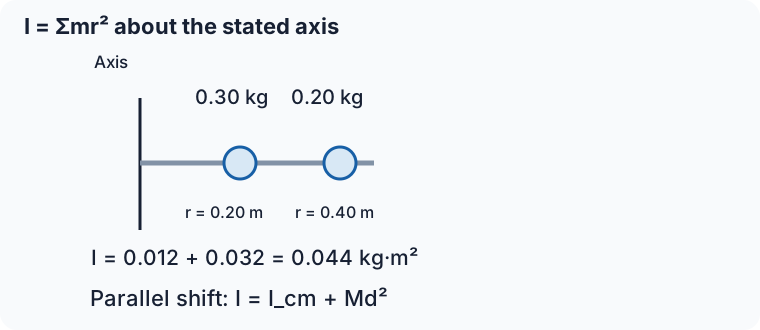
Worked example: an off-center arrangement
A light rigid support holds a 0.20 kg object 0.40 m from an axis and a 0.30 kg object 0.20 m from that same axis. Treat the support’s mass as negligible. Then I = 0.20(0.40²) + 0.30(0.20²) = 0.032 + 0.012 = 0.044 kg·m².
If the first object moves to 0.80 m while the second stays put, I becomes 0.20(0.80²) + 0.012 = 0.140 kg·m². The first contribution quadruples; the whole inertia does not quadruple because the second contribution was unchanged. This is a good reason to keep the sum visible instead of applying a blanket scaling factor.
For a point at coordinates (x, y) with an axis perpendicular to the plane through the origin, r² = x² + y². A 0.50 kg object at (0.30 m, 0.40 m) contributes 0.50(0.30² + 0.40²) = 0.125 kg·m². There is no need to calculate the square root first.
Moving the axis: the parallel-axis theorem
For a rigid system, an axis through its center of mass gives the minimum inertia among parallel axes. If a parallel axis is displaced a perpendicular distance d from the center-of-mass axis, I = I_cm + Md², where M is the total mass. This theorem is part of the updated AP Physics 1 course.
Suppose a uniform 2.0 kg rod of length 0.60 m has a provided center-of-mass inertia I_cm = ML²/12 = 0.060 kg·m² for an axis perpendicular to the rod. An end axis is parallel and lies d = L/2 = 0.30 m away. Thus I_end = 0.060 + 2.0(0.30²) = 0.240 kg·m². The increase is positive, as expected. The theorem uses distance between axes, not distance from the axis to every piece of the rod.
Do not write I_new = I_old + Md² for any two arbitrary axes. The known axis must pass through the center of mass, and the other axis must be parallel. To compare two off-center parallel axes, first express each relative to I_cm. Comparing perpendicular axes is a different problem.
What you need to calculate, and what is supplied
AP calculations of point-object arrangements are limited to five or fewer objects in a two-dimensional configuration. You should reason qualitatively about extended objects, but the exam supplies their inertia expressions. Memorizing a long table of rod, sphere, cone, and disk formulas is unnecessary. Calculus-based derivations of those formulas remain enrichment in the original book.
Instructional example (guided activity):
A useful experiment places equal masses at several measured radii on a light rotating frame. Apply the same measured net torque and infer α from an ω–t graph. Increasing radius should decrease α. A plot of I versus r² is linear for identical point masses moved together; its slope depends on their combined mass, and its intercept represents the frame’s own inertia.
Worked example — Prove a minimum over every parallel axis
A rigid assembly has M = 2.0 kg and I_cm = 0.080 kg·m² for axes perpendicular to its plane. For any parallel axis at perpendicular separation d, I(d) = 0.080 + 2.0d² kg·m² when d is in meters. Since M > 0 and d² ≥ 0, I(d) ≥ I_cm for every such axis, with equality only at d = 0. This proves the center-of-mass minimum across the whole family of parallel axes; one off-center example alone would not prove it.
At d = 0.10 m, I = 0.100 kg·m²; at d = −0.10 m on the other side, I is the same. At |d| = 0.20 m, I = 0.160 kg·m². An I-versus-signed-axis-offset graph is an upward parabola with vertex (0, 0.080). Do not compare differently oriented axes with this equation; “minimum” here keeps the axis direction and rotation plane fixed.
Compare distributions, not appearances
Pause & try it
Let's see what stuck.
Choose an answer, then check the reasoning. Try the written problems below before opening their solutions.
0 of 3 checked · 0 correct
Assigned practice: two equal masses on a rod
Two 0.50 kg point masses are attached at the two endpoints of a massless 0.80 m rod. Find I about a perpendicular axis through its center and about a parallel axis through one end.
Open the separate worked solution.
Assigned practice: choose a graph that can test the inertia model
A light rotating frame has inertia 0.010 kg·m². Two 0.20 kg point masses are attached at equal adjustable radii r, and a known constant net torque 0.040 N·m drives each fixed configuration. You can determine angular acceleration α for several radii. Choose between plotting α against r² or plotting 1/α against r² if your goal is a straight-line test of the point-mass inertia model. Derive the predicted slope and intercept for your choice, and explain what mistake results from ignoring the frame’s inertia.
Open the separate worked solution.
Review the original Moment of Inertia for its diagrams and quizzes. Keep its integrals as optional extensions, and use the point-mass sum and parallel-axis theorem for the AP calculations above.
Sources and scope: College Board CED, with edition-specific coverage verified against the supplied file. Supplied College Board CED, printed pp. 97–98, 5.4.A–B, specifically requires the parallel-axis theorem and gives the point-object and supplied-formula boundaries. OpenStax: Dynamics of Rotational Motion verifies inertia’s dependence on mass distribution. Examples and graphic are original.
Explain and apply the model
Try these problems before opening the solutions. State your assumptions, show the diagram or calculation, and explain what makes your answer follow.
Prove the center-axis minimum
A rigid planar assembly has total mass 3.0 kg and provided inertia I_cm = 0.12 kg·m² about a center-of-mass axis perpendicular to its plane. Every axis in this task is parallel to that axis. Let signed offset d measure axis position relative to the center-of-mass axis.
(a) Use I(d) = I_cm + Md² to prove that the center-of-mass axis has the minimum inertia among every axis in this parallel family. State the equality condition and explain why this proof does not compare differently oriented axes.
(b) Calculate I at d = +0.20 m, −0.20 m and +0.40 m. Sketch I versus d with labeled axes, units, those points and the minimum; explain the left/right symmetry.
Your written working
Drawing is temporarily unavailable. Work on paper if needed, then record your reasoning here.
Saving written working requires JavaScript. The problem remains available above; keep your work on paper or in your own notes.
Related source reading
These alternative explanations and examples retain their source context. Draft placement does not add accepted exam coverage.
- Thin-shell inertia derivation · source context; placement review pending
Glossary and deeper reading · 5 refreshers
These editorial refreshers supplement the reading. Definitions and examples are added guidance; original source wording and recorded answers remain in their original context.
-
Torque
Torque describes a force’s turning effect about a chosen axis or point. Its magnitude is force times the perpendicular lever arm, and its direction or sign describes the rotation tendency. For example, pushing near the handle of a door produces more torque than the same perpendicular push near the hinge.
-
Angular acceleration
Angular acceleration is the rate of change of angular velocity. For a fixed axis its sign follows the chosen positive rotation direction, and its units are radians per second squared. For example, a fan speeding up has angular acceleration, whereas one turning steadily does not.
-
Center of mass
The center of mass is the position obtained by weighting each part’s position by its mass. Its motion represents the translational motion of the whole system under the net external force. For example, adding a heavy object to one end of a light bar shifts the center of mass toward that end.
-
Inertia
Inertia is an object’s resistance to a change in its velocity. Mass measures translational inertia, whereas rotational inertia also depends on how mass is distributed relative to an axis. For example, a loaded cart accelerates less than an empty cart under the same net force.
-
Parallel-axis theorem
The parallel-axis theorem relates rotational inertia about a center-of-mass axis to inertia about a parallel displaced axis. The displaced-axis value is the center-of-mass value plus total mass times the squared separation of the axes. For example, a uniform rod has greater rotational inertia about one end than about a parallel axis through its middle.