Periodic Waves
Relate period, frequency, wavelength, speed, and intensity with correctly labeled representations.
AP Physics 2 Topic 14.2 · College Board CED printed p. 112, 113 / PDF p. 119, 120 · See this topic in the course outline
A snapshot answers “How far apart?” A time trace answers “How long between repeats?” Keep those questions separate.
Period, frequency, wavelength, and energy
Phase means where an oscillation is in its cycle: at a crest, crossing equilibrium upward, at a trough, or crossing equilibrium downward. Two points are in phase when they have the same cycle position and direction of motion; one full cycle is 360° or 2π radians. A half-cycle difference is 180° or π radians.
The period T is the time for one complete oscillation at a fixed location. Frequency f counts cycles per second: , in hertz (Hz = s⁻¹). Wavelength λ is a spatial repeat: crest-to-next-crest, trough-to-next-trough, or any two successive points at the same phase. Amplitude can be changed without changing the source's frequency or period.
Sound frequency sets pitch: a higher frequency normally sounds higher, while amplitude chiefly affects loudness. For equal displacement amplitude in the same linear mechanical medium, faster oscillations carry more energy per fixed length and transfer more average power; a sinusoidal string's power scales as A²f². State what is fixed. This is not a rule that every electromagnetic wave at fixed field amplitude has intensity proportional to frequency: that intensity depends on field amplitude. Unit 15 will introduce photons and energy per photon; that separate quantum comparison is not needed for this mechanical-wave comparison.
Translate between spatial and temporal graphs
At one location a sinusoidal disturbance can be written . A snapshot at one instant can be written . The phase constants set where the graph starts; they do not change A, f, or λ. A full right-moving form is . No calculus is needed: track a crest by keeping the bracket constant.
| Fraction of a cycle | Time at fixed x (s) | Position at fixed t (m) | Displacement (cm) |
|---|---|---|---|
| 0 | 0 | 0 | +2.0 |
| 1/4 | 0.050 | 0.20 | 0 |
| 1/2 | 0.100 | 0.40 | −2.0 |
| 3/4 | 0.150 | 0.60 | 0 |
| 1 | 0.200 | 0.80 | +2.0 |
Plot each column pair to make the two sinusoidal representations; their shapes match, but their horizontal units do not.
One wavelength passes per period
During one period, a crest advances one wavelength. Thus , or . At fixed wave speed, doubling f halves λ. Crossing into a slower medium at the same f shortens λ.
Use v = fλ with the speed appropriate to that wave and medium; it is a relationship among quantities, not a claim that changing f necessarily changes the medium's speed. For a dispersive medium v may itself depend on f. In vacuum electromagnetic v is always c; the wavelength changes when the frequency changes.
Read two horizontal axes
A time trace has crests at 0.10 s and 0.35 s, with equilibrium at zero and extremes ±3.0 mm. A snapshot has adjacent crests 0.60 m apart. Find A, T, f, and v.
A = 3.0 mm and T = 0.35 − 0.10 = 0.25 s.
Why this step? Amplitude is distance from equilibrium; period is time between equal phases.
and λ = 0.60 m.
Why this step? The spatial graph provides wavelength; the time graph provides period.
.
Why this step? One wavelength moves past during one period; Hz times meters has units m/s.
Answer and check
A = 3.0 mm, T = 0.25 s, f = 4.0 Hz, v = 2.4 m/s.
Freeze one coordinate at a time
A time graph follows one marked segment. Freeze x and watch y repeat after T; its equation needs a coefficient 2π/T multiplying time. A spatial snapshot freezes t instead and compares many segments; its equation needs 2π/λ multiplying position. Their vertical amplitude may be the same, but their horizontal quantities have different units and meanings.
For a right-moving sinusoid that has a crest at x = 0 when t = 0, y(x,t) = A cos[2π(x/λ − t/T)]. At x = 0 the time trace is y(t) = A cos(2πt/T), since cosine is even. At t = 0 the snapshot is y(x) = A cos(2πx/λ). Later snapshots require a changed phase. Keeping x/λ − t/T constant shows that a crest moves toward increasing x at λ/T. Changing amplitude alone rescales the vertical axis and leaves T, f, and λ unchanged.
Inspect diagram labels
The diagram keeps its full size here. Focus the view and use the arrow keys, or scroll across it, to inspect every label.
Read and write both views of a sinusoid
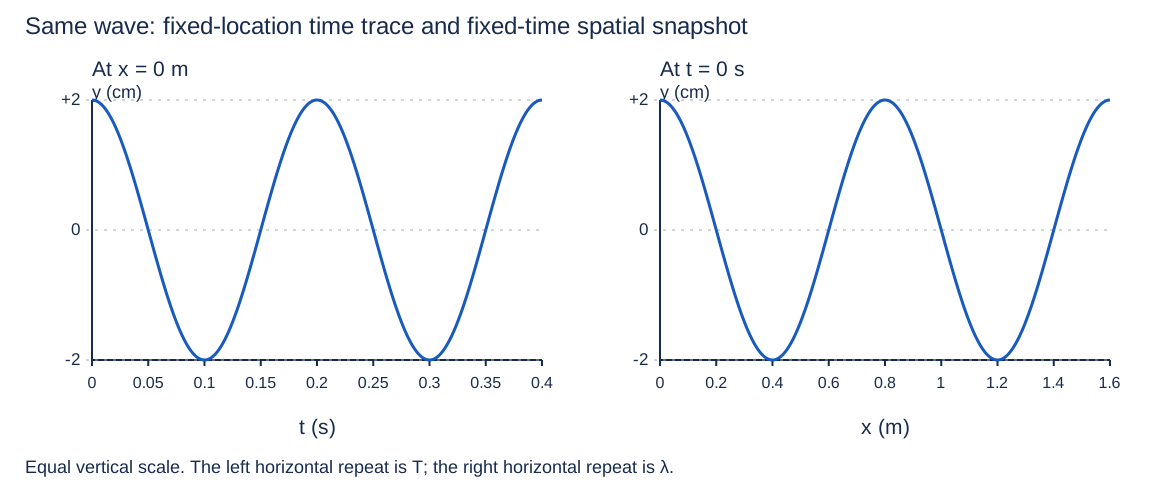
A right-moving sinusoidal string wave has A = 2.00 cm, λ = 0.800 m and f = 5.00 Hz. It has a crest at x = 0 and t = 0. Use centimetres for displacement, metres for x and seconds for t.
Inspect diagram labels
The diagram keeps its full size here. Focus the view and use the arrow keys, or scroll across it, to inspect every label.
- T = 1/f = 0.200 s and v = λ/T = 4.00 m/s.
- At x = 0: y(t) = (2.00 cm) cos(10πt), with 10π in rad/s. Its plotted extrema are +2.00 cm at t = 0, 0.200, 0.400 s and −2.00 cm at 0.100 and 0.300 s.
- At t = 0: y(x) = (2.00 cm) cos(2πx/0.800 m). Its maxima are at x = 0, 0.800, 1.600 m; minima are at 0.400 and 1.200 m.
- At t = 0.0500 s, the snapshot becomes y(x) = (2.00 cm) cos[2πx/(0.800 m) − π/2]. Its first crest has moved from x = 0 to x = 0.200 m, consistent with vΔt.
Answer and check
The two plotted cosine curves share 2.00 cm amplitude. One repeats every 0.200 s; the other every 0.800 m. The shifted later snapshot is a spatial equation, not a second time trace.
Try it from memory
Write your answer and reason before opening the worked answer. Your self-assessment is a study decision; it is not an automatically graded score.
Question 1
At a fixed point, y = (0.020 m) cos(10πt), with t in seconds. What are f and T?
Worked answer and reason
2πf = 10π s⁻¹, so f = 5.0 Hz and T = 0.20 s.
The coefficient is angular frequency, so divide by 2π rather than reading 10π as Hz.
Question 2
A source doubles f on an unchanged ideal string and leaves displacement amplitude fixed. What happens to λ, pitch if audible, and energy per fixed length?
Worked answer and reason
λ halves because v stays fixed. Pitch rises. The higher-frequency mechanical oscillation has greater energy per fixed length at the same amplitude.
Separate medium speed, source timing, and amplitude; do not assume more frequency means more amplitude.
JavaScript enables saved drafts and self-assessment. You can always work on paper.
Catch the tempting mistake
- The distance between two crests on any graph is wavelength.
- Check the horizontal units: crest separation in seconds is period; separation in meters is wavelength.
Put it to work
Give the physical reason as well as the calculation. The worked solutions are on a separate page.
- Problem 3 · graphical
- Problem 4 · mixed
- Problem 19 · experimental
- Problem 20 · experimental
- Problem 21 · mixed
Explain and apply the model
Try these problems before opening the solutions. Show the physical model, your calculation or sketch, and the reason your conclusion follows.
Write and draw two views of the same traveling wave
A sinusoidal wave travels right on a uniform ideal string. Displacement extremes are ±3.00 mm. Adjacent crests are 1.20 m apart; a marked segment repeats every 0.400 s. At t = 0 a crest is at x = 0.300 m. Use x in metres, t in seconds and y in millimetres.
(a) Determine A, λ, T, f and v. Write a fixed-location displacement-time equation at x = 0.300 m starting at a crest, and a fixed-time displacement-position equation at t = 0.100 s. Keep the given phase origin and rightward direction consistent.
(b) Create the actual y-versus-t graph at x = 0.300 m from 0 to 0.800 s and the actual y-versus-x snapshot at t = 0.100 s from 0 to 2.40 m. Label axes, numerical scales, units, extrema and zero crossings. Locate the first nonnegative spatial crest on the snapshot and use its shift from t = 0 to check v.
(c) The source doubles displacement amplitude on the unchanged ideal string but keeps its frequency fixed. Predict changes in both graphs, their horizontal repeats, and wave speed. Then explain why an antinode of a later standing wave would not mean a point stays at maximum displacement.
Written working workspace
Drawing is temporarily unavailable. Work on paper if needed, then record your reasoning here.
Saving written working requires JavaScript. Keep your work on paper or in your own notes; the source problem above remains available.
Worked solution and rubric →Revisit the explanation →Revisit the explanation →
Diagnose a time axis mistaken for a spatial axis
At x = 0, a string wave is y(t) = (2.00 mm) cos(20πt), with t in seconds. A t = 0 snapshot is y(x) = (2.00 mm) cos(4πx), with x in metres.
(a) Which interpretation is consistent with both equations?
Worked solution and rubric →Revisit the explanation →Revisit the explanation →
Scientific calculator workspace
Keep intermediate precision and report units. This calculator supports arithmetic and elementary functions.
Scientific calculator
This calculator requires JavaScript. Use the physics formula sheets and show your working manually.
+ − * / ^ ! · pi · e · sqrt · sin, cos, tan · asin, acos, atan · atan2(y,x) · ln, log · abs · exp · hypot(x,y). Use * between factors. Keep units in your written working.
For the teacher
- Show identical-looking curves with x and t axes and ask which gives wavelength. Ask what is being held fixed before an energy comparison.
Source objectives and scope
- 14.2.A — Describe the physical properties of a periodic wave.
Suggested skills are teaching guidance. The course applies all science practices across its objectives.
Science references for this teaching
- AP Physics 2 Course and Exam Description, official Unit 14 — Official topic/LO/EK scope and boundaries; local pinned source pages 117–134, equations visually checked on 118,120,130,132,134.
- OpenStax University Physics 1, Energy and Power of a Wave — Verification of fixed-amplitude mechanical-wave frequency scaling and distinction from electromagnetic intensity.
- OpenStax University Physics 1, Interference of Waves — Linear superposition and pointwise addition model.
- OpenStax University Physics 3, Single-Slit Diffraction — Verification of aperture minima and small-angle conditions.
- OpenStax University Physics 3, Interference in Thin Films — Verification of reflection phase and normal-incidence thin-film paths.
Related source reading
These alternative explanations and examples retain their source context. Draft placement does not add accepted exam coverage.
- A traveling-wave equation and displacement · alternative source explanation
Glossary and deeper reading · 11 refreshers
These editorial refreshers supplement the reading. Definitions and examples are added guidance; original source wording and recorded answers remain in their original context.
-
Frequency
Frequency is the number of complete repeating cycles per unit time. It is measured in hertz, meaning cycles per second, and is the reciprocal of the period. For example, a vibrating string with a higher frequency produces more cycles each second.
-
Oscillation period
An oscillation period is the time required for one complete repeating cycle. It is the reciprocal of frequency and is measured in seconds. For example, measuring the time for several pendulum swings and dividing by the number of cycles estimates the period.
-
Oscillation phase
Phase specifies the position within a repeating oscillation cycle. A phase difference tells how much one oscillation leads or lags another at a chosen place and time. For example, two sinusoidal waves half a cycle out of phase can cancel when their amplitudes are equal.
-
Radian
A radian is an angle measure defined by arc length divided by radius. One complete turn is two pi radians, and angle formulas connecting linear and rotational motion use this measure. For example, an arc whose length equals the circle’s radius subtends one radian at the center.
-
Wavelength
Wavelength is the spatial distance between neighboring points at the same phase of a periodic wave. It connects propagation speed and frequency through speed equal to frequency times wavelength. For example, neighboring crests of a sinusoidal water wave are separated by one wavelength.
-
Amplitude
Amplitude is the maximum magnitude of a repeating disturbance measured from its equilibrium value. It describes the size of the oscillation rather than its frequency or propagation speed. For example, pulling a spring-mounted mass farther from equilibrium increases its oscillation amplitude when it is released from rest.
-
Displacement
Displacement is the vector change in position from the start of an interval to its end. It depends on those endpoints rather than the length or shape of the path traveled. For example, walking around a closed track and returning to the start gives zero displacement but a nonzero distance traveled.
-
Power
Power is the rate at which energy is transferred or converted. It is measured in watts, with one watt equal to one joule per second. For example, two motors can lift the same load through the same height but have different average powers if they take different times.
-
Wave
A wave is a propagating disturbance that can transfer energy without transporting the medium as a whole. Mechanical waves require a material medium, while electromagnetic waves can propagate through vacuum. For example, a pulse travels along a rope while individual rope segments move locally around their equilibrium positions.
-
Antinode
A wave antinode is a location where the specified oscillating quantity has its largest oscillation amplitude in a standing-wave pattern. Displacement antinodes and pressure antinodes describe different quantities, and their instantaneous values can still pass through equilibrium. For example, the center of a string in its fundamental two-fixed-end mode is a displacement antinode.
-
Standing wave
A standing wave is a spatially fixed interference pattern formed by suitable waves traveling in opposite directions. Its nodes remain at zero displacement while antinodes mark positions of maximum oscillation amplitude. For example, a string fixed at both ends can support standing waves whose wavelengths fit the boundary conditions.