Newton’s Second Law
Reference from the original Physics I textbook.
- Newton’s Second Law
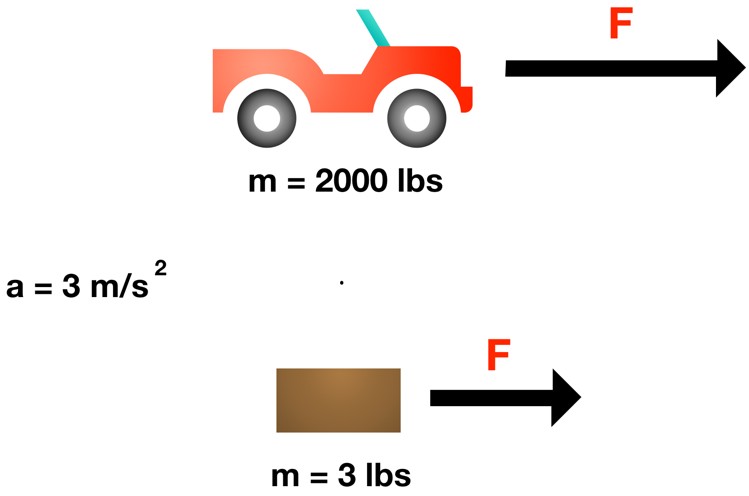
In an inertial frame, the net external force equals the rate of change of momentum. For constant mass, ΣF⃗ = ma⃗. The acceleration need not be constant.
- Related Glossary Terms
- Index
Chapter 1 - Newton’s Laws and FBDs
Reviewed physics notes (1)
These corrections keep the original lesson’s purpose while fixing errors in the source edition.
- Newton’s second law is not limited to constant acceleration or a single force. — Reference 1
Glossary and deeper reading · 1 refreshers
These editorial refreshers supplement the reading. Definitions and examples are added guidance; original source wording and recorded answers remain in their original context.
-
Force
A force describes an interaction that can change an object’s momentum. It is a vector measured in newtons, so both size and direction matter when forces are added. For example, a rope can pull a cart while the floor exerts friction in another direction.