Introduction to Momentum
Original textbook reading.
Momentum is the vector quantity p = mv. Inertia is resistance to a change in velocity and is measured by mass. Newton’s first law says a body keeps constant velocity when the net external force is zero; momentum is not a force that keeps a body moving.
Momentum is calculated by the following equation:
(Equation 4.1.1)
Unlike work as we discussed previously, momentum is a vector. The direction of an objects momentum is always in-line with the object’s velocity.
A system’s total momentum is conserved when its net external impulse is zero. For two bodies interacting under that condition:
(Equation 4.1.2)
In this equation, the numbers 1 and 2 refer to two separate bodies that interact with one another. For example, if a skateboarder ran and jumped onto his skateboard, the skateboarder would be body 1, and the skateboard would be body 2. The i and f refer to the initial state and final state, in the same example, the initial state would be right before the skateboarder lands on his board, and the final state would be right after the skateboarder lands on his skateboard and they both begin moving.
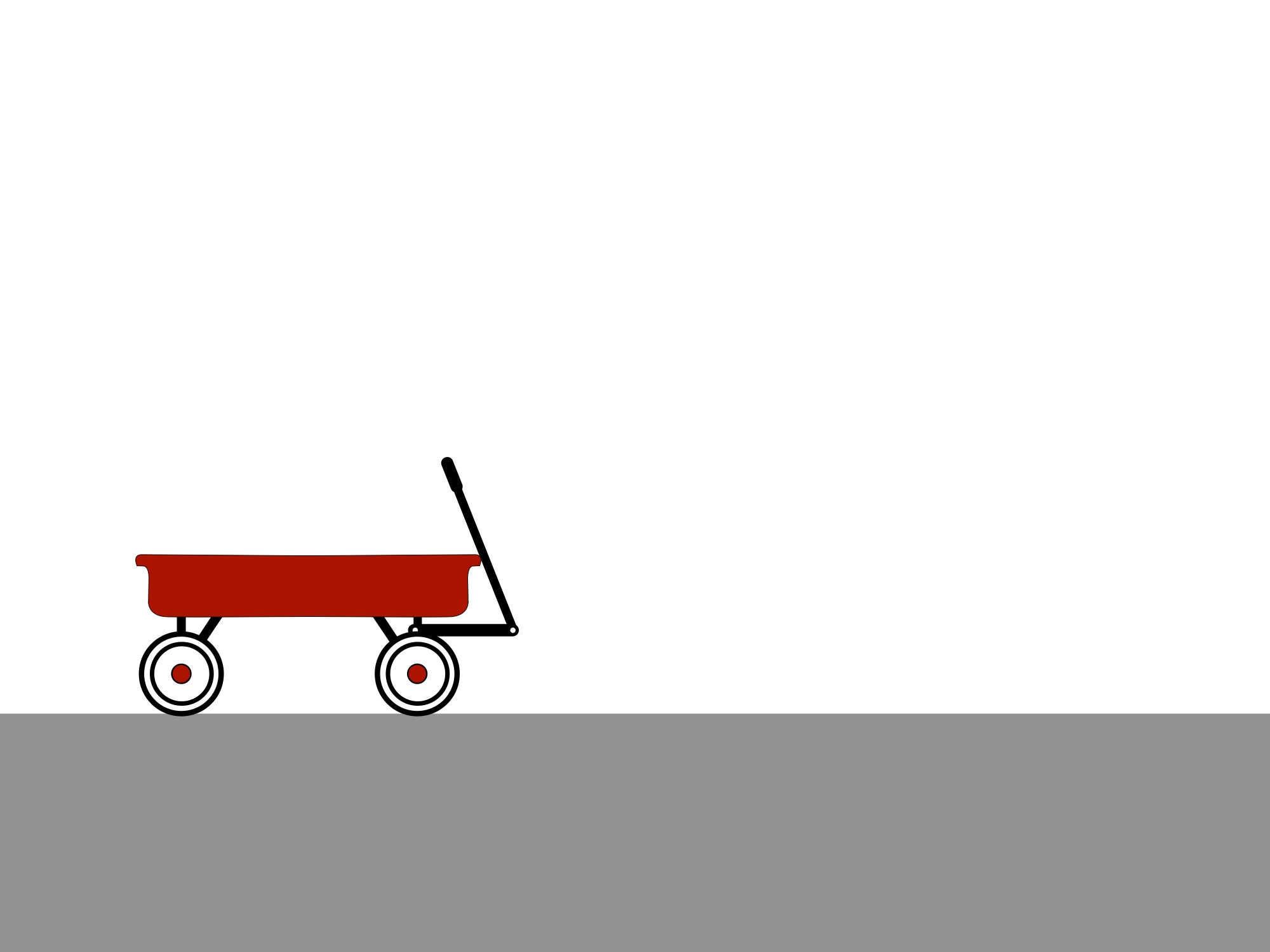
Here sits a wagon, sitting idly.
Read every step and figure
Step 1
Step 2
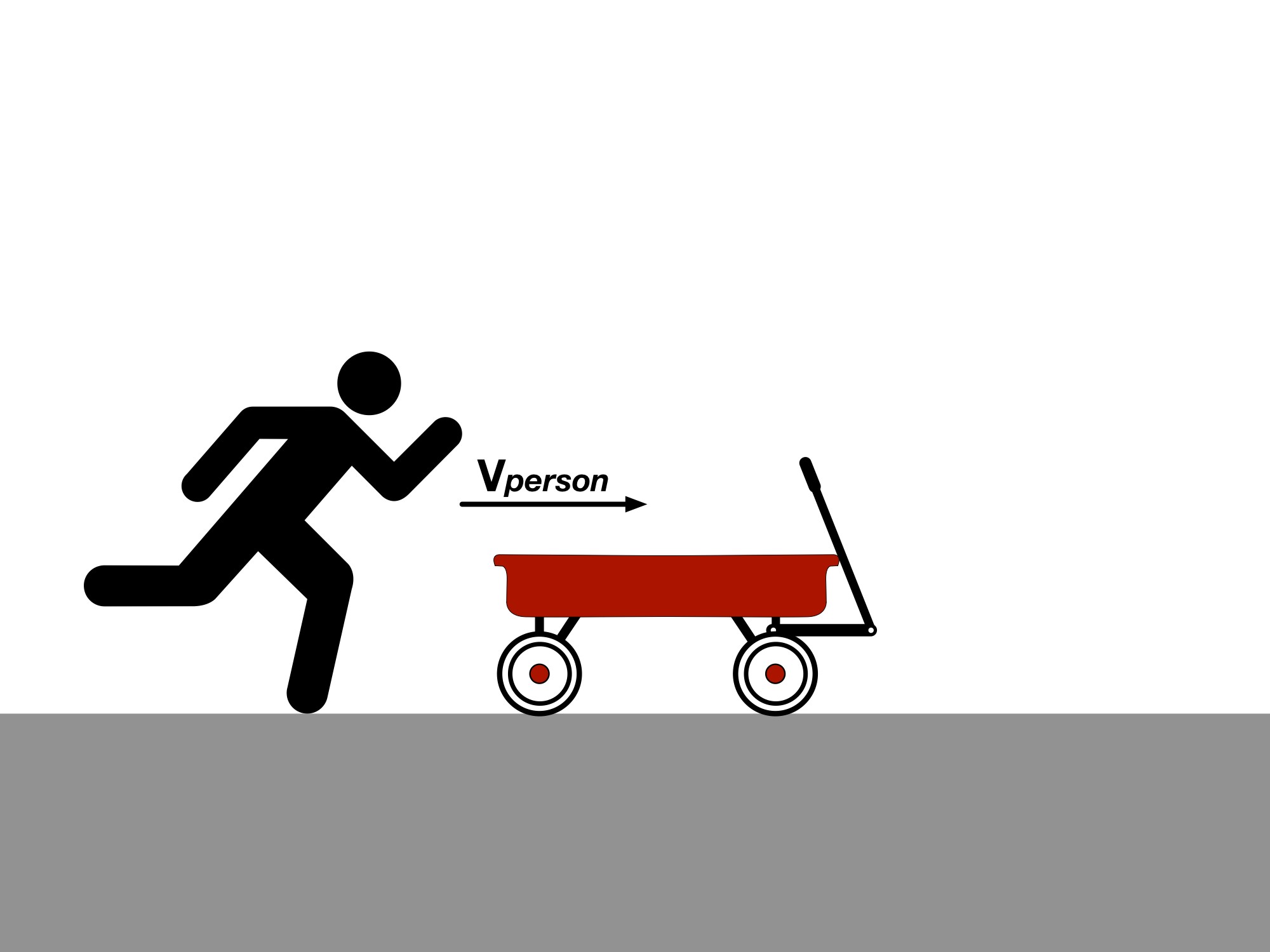
Step 3
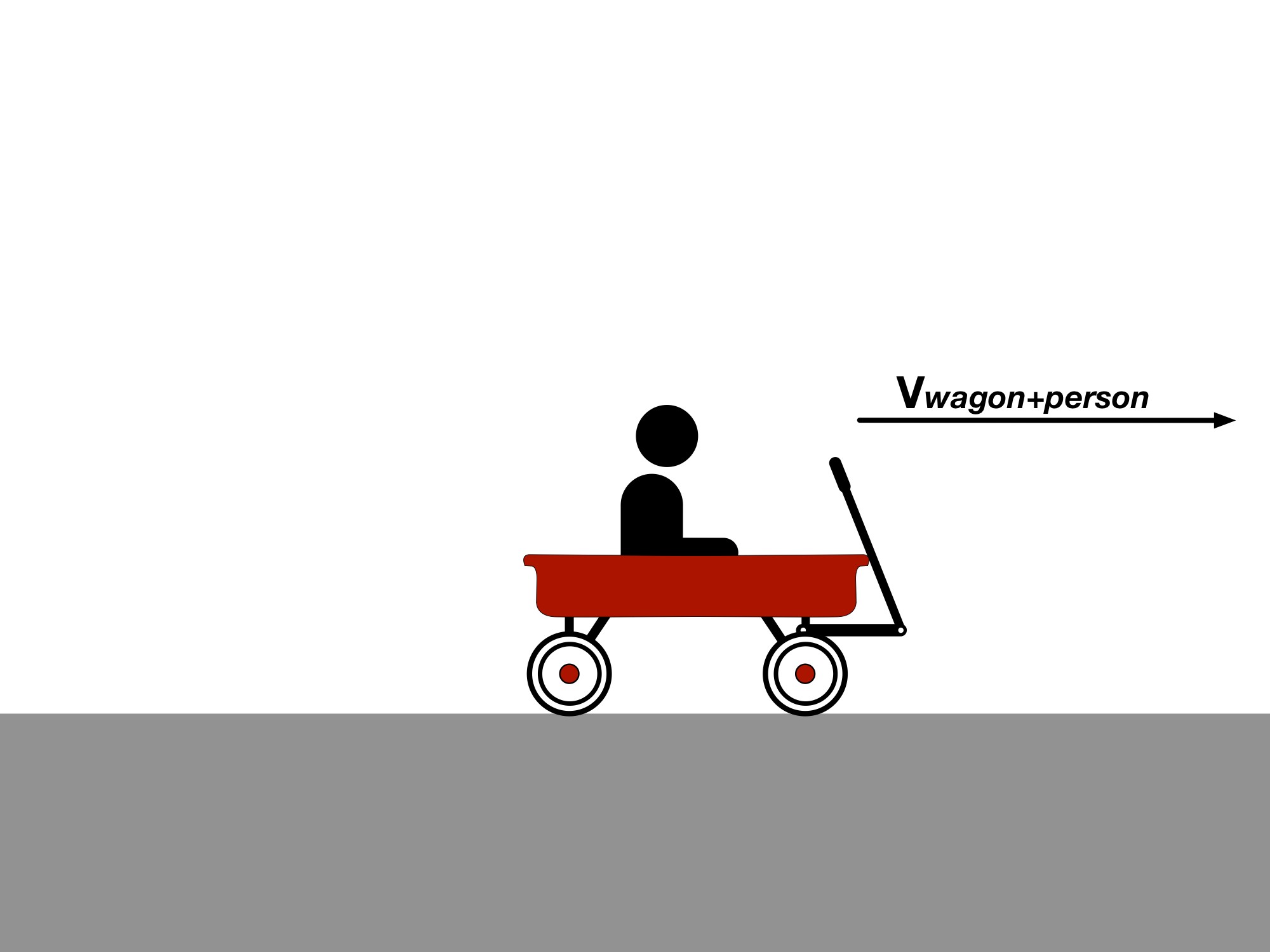
This idea stems from Newton’s third law. For example, when you fire a gun, you start at a momentum of for both the gun and the bullet. After the gun is fired, though, the bullet gains a high velocity, giving it momentum. The gun therefore gains the same amount of momentum, except in the negative direction. This causes the net momentum of the gun and bullet to remain as 0. This is felt by the shooter as recoil.
An astronaut is drifting away from the space station on a failed space-walk. He has with him a gun that can fire in space. If the gun fires bullets at , and the astronaut is drifting away at a speed of , how many bullets must he fire to start heading back to the station? What will the astronaut’s new velocity be after shooting that many times? Assume the fired bullets do not significantly affect change his mass.
Step 1: Set up the conservation of momentum equation
Take the positive direction toward the station. The astronaut’s initial velocity is −1.5 m/s. Each 0.020 kg bullet is fired away from the station at muzzle speed 500 m/s relative to the astronaut. With the source’s constant-mass approximation, each shot changes the 100 kg astronaut’s velocity by about +(0.020)(500)/100 = +0.10 m/s.
Use the station frame for astronaut velocities and the stated relative muzzle speed to calculate each recoil increment. The source allows us to neglect the small change in carried mass as bullets leave.
Under that approximation, after n shots the astronaut’s velocity is:
v_astronaut ≈ −1.5 + 0.10n m/s.
The in this case represents the number of bullets.
Step 2: Solve for the unknowns
As we want the astronaut to begin moving towards the space station, we simply need the astronaut’s final velocity to be positive. Therefore, if we solve for velocity, and set up an inequality, we get:
To head toward the station require −1.5 + 0.10n > 0, so n > 15. Exactly 15 shots stop the astronaut; the smallest integer giving motion back is 16.
n = 16 bullets.
That last question was a bit of a trick question, but it provides a good transition. The answer is false because another factor involved in determining how much force an object hits another is the time of collision.
The impulse of an object is how we relate momentum to forceⓘ. So, if you think that you feel a force when a tennis ball hits your racket, you are right. Specifically, impulse is the change in momentum (Denoted as either or ) :
The net impulse is J = p_f − p_i. It is the integral of the net external force over time: J = ∫F_net(t) dt. For a constant net force, or using its average value, this becomes:
Pop Quiz 4.1.1 Momentum
Question 1 of 5 · 0 correct
AP Topic 4.3 · Read the worked solution
Two ice skaters are holding hands, traveling together at . If one ice skater has a mass of , and the other has a mass of , and they push off from each other, resulting in the skater going , what is the new velocity of the ice skater?
Read every full question without answers
Question 1
Question 2
Question 3
Question 4
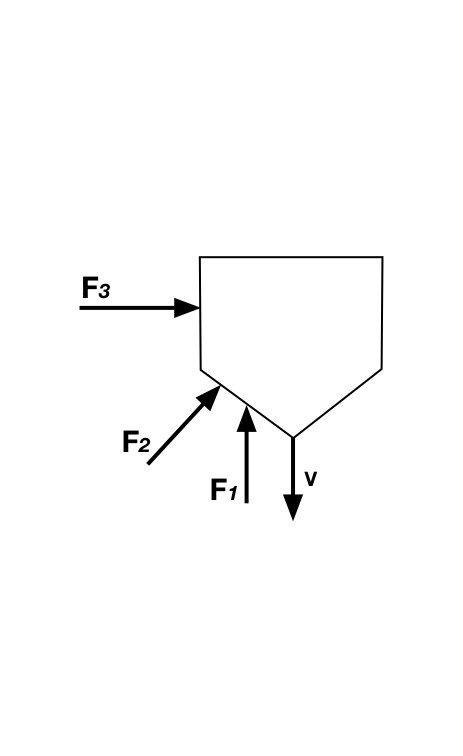
Three forces shown have equal magnitude and act separately on the same object for 5 s. Neglect other impulses. Which produces the largest magnitude of velocity change?
Question 5
This equation gives the average net force during the stated interval. To find a particular contact force, also account for any other forces, such as gravity. During very short collisions a small gravitational impulse may sometimes be neglected, but the assumption must be stated.
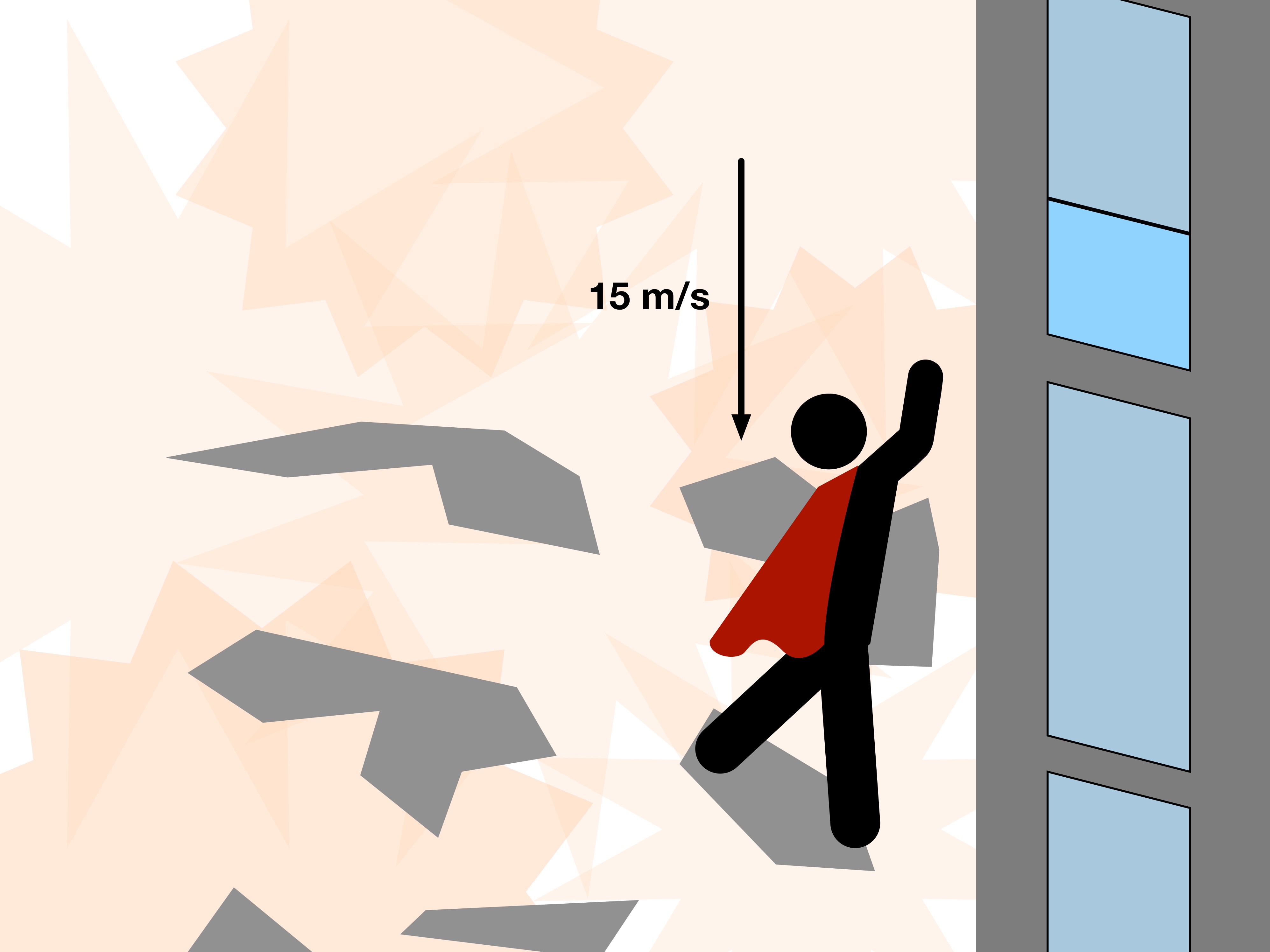
A superhero, Physics Lad, is falling amongst the rubble of a recently collapsed balcony.
- If he wants to leap to a window of a nearby building, with what force does he need to push off of a piece of rubble? Assume his feet push down on the rubble for , and that he weighs . Also, he is falling at , and needs an initial velocity of upwards to make it to the window.
- If the block of rubble weighs , find its new velocity. Assume it is initially falling the same speed as Physics Lad.
Example Problem 4.1.2
Step 1: Identify the impulse due to the change in momentum
As the mass doesn’t change, we can simplify it to:
Plugging in known values, we get:
Choose upward as positive. J_net = (90 kg)[3 − (−15)] m/s = 1620 N·s.
Step 2: Find the force needed
For this part, we use:
F_net,avg = 1620/1.2 = 1350 N upward. The rubble’s upward contact force also balances gravity: F_contact,avg = F_net,avg + mg = 1350 + 90(9.81).
Average contact force magnitude = 2232.9 N. Physics Lad pushes down on the rubble with the same magnitude.
Step 3: Calculate the new speed of the rubble
For the combined hero–rubble system, the mutual contact impulses cancel, but gravity gives an external impulse. Total momentum is therefore not conserved over the 1.2 s push.
p_f = p_i + J_gravity; J_gravity = −(90+50)(9.81)(1.2) = −1648.08 N·s.
90(3) + 50v_rubble = (90+50)(−15) − 1648.08 = −3748.08 kg·m/s.
Solving for , we find that the new velocity is:
v_rubble = −80.3616 m/s, or 80.4 m/s downward.


Reviewed physics notes (25)
These corrections keep the original lesson’s purpose while fixing errors in the source edition.
- The source conflates momentum, inertia, and Newton’s first/second laws. — Reference 1, Reference 2
- The conservation condition was missing. — Reference 1
- Impulse is force multiplied by time, not “force over time”; momentum change requires net impulse. — Reference 1
- State average/net distinction for variable contact forces. — Reference 1
- Average net force does not automatically equal one contact force. — Reference 1
- The source interprets net force as contact force without justification. — Reference 1
- 100 kg prompt was solved as 80 kg and reference frames were mixed. — Reference 1
- Relative and laboratory velocities cannot be substituted interchangeably in one momentum equation. — Reference 1
- Consistent reference-frame explanation. — Reference 1
- Correct mass and algebra. — Reference 1
- Correct answer using the supplied 100 kg. — Reference 1
- Correct source answer. — Reference 1
- Correct mass-dependent shot count. — Reference 1
- Correct source final velocity. — Reference 1
- The 90 kg prompt was solved with 80 kg. — Reference 1
- Include gravity over the 1.2 s interval. — Reference 1
- Distinguish the requested push force from net force. — Reference 1
- Gravity is not negligible over this long interval. — Reference 1, Reference 2
- Use system impulse–momentum relation. — Reference 1, Reference 2
- Correct mass and external gravitational impulse. — Reference 1, Reference 2
- Correct source speed under the full stated-duration model. — Reference 1, Reference 2
- Exact inversion gives 78.95 kg, so 80 kg is an approximate multiple-choice answer; specify frame. — Reference 1
- Diagram has three forces; equal vector impulse magnitudes give equal velocity-change magnitudes. — Reference 1
- Replace incorrect Force 3-only answer while preserving its already-correct weight. — Reference 1
- 350 N is net force; contact force is 1036.7 N. Clarify what the existing choices measure. — Reference 1
Glossary and deeper reading · 7 refreshers
These editorial refreshers supplement the reading. Definitions and examples are added guidance; original source wording and recorded answers remain in their original context.
-
Vector
A vector is a quantity with a magnitude and a direction, represented by an arrow or by components along chosen axes. Vectors add by adding corresponding components rather than simply adding their magnitudes. For example, an eastward displacement followed by a northward displacement produces a resultant pointing northeast. The zero vector has zero magnitude and no unique direction.
-
Inertia
Inertia is an object’s resistance to a change in its velocity. Mass measures translational inertia, whereas rotational inertia also depends on how mass is distributed relative to an axis. For example, a loaded cart accelerates less than an empty cart under the same net force.
-
Velocity
Velocity describes how position changes with time and includes direction. Instantaneous velocity describes one moment, while average velocity is displacement divided by elapsed time. For example, a car turning a corner can change velocity while maintaining the same speed.
-
Force
A force describes an interaction that can change an object’s momentum. It is a vector measured in newtons, so both size and direction matter when forces are added. For example, a rope can pull a cart while the floor exerts friction in another direction.
-
External force
An external force is exerted on part of a chosen system by something outside that system. The sum of external forces determines the rate of change of the system’s total momentum. For example, Earth’s gravitational force is external to a system consisting only of a falling ball.
-
Net force
Net force is the vector sum of all forces acting on the object or system under consideration. For constant mass in an inertial frame, it equals mass times acceleration. For example, equal upward and downward forces give zero net force even though neither force is zero.
-
Gravity
Gravity is the attractive interaction between masses in the Newtonian model. For spherical bodies or point-mass approximations, its strength decreases with the square of the separation between their centers. For example, Earth’s gravity provides the inward force that keeps a satellite in orbit.