Spring Force
Reference from the original Physics I textbook.
- Spring Force
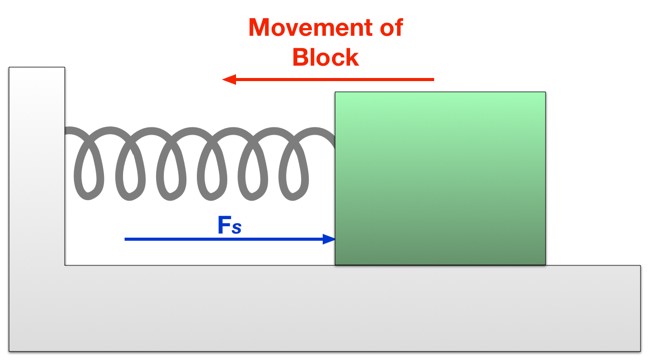
The force exerted by a spring. It is dependent on the spring’s spring constant and the spring’s displacement from rest.
- Related Glossary Terms
Force, Hooke’s Law↗, Relaxed State, Restoring Forceⓘ, Spring Force Equation, Spring Potential Energy
- Index
Glossary and deeper reading · 3 refreshers
These editorial refreshers supplement the reading. Definitions and examples are added guidance; original source wording and recorded answers remain in their original context.
-
Force
A force describes an interaction that can change an object’s momentum. It is a vector measured in newtons, so both size and direction matter when forces are added. For example, a rope can pull a cart while the floor exerts friction in another direction.
-
Hooke’s law
Hooke’s law models an ideal spring force as proportional to deformation and opposite in direction. The deformation is measured from the spring’s relaxed length, and the law applies only within the spring’s approximately elastic linear range. For example, doubling a small extension doubles the restoring-force magnitude of a spring that obeys this law.
-
Restoring force
A restoring force points toward an equilibrium position when an object is displaced from it. Simple harmonic motion requires the net restoring force to be proportional to displacement and opposite in direction. For example, a compressed ideal spring pushes its attached object back toward the spring’s relaxed length.