Spring Force
Original textbook reading.
Figure 2.3.1 Spring in Relaxed State
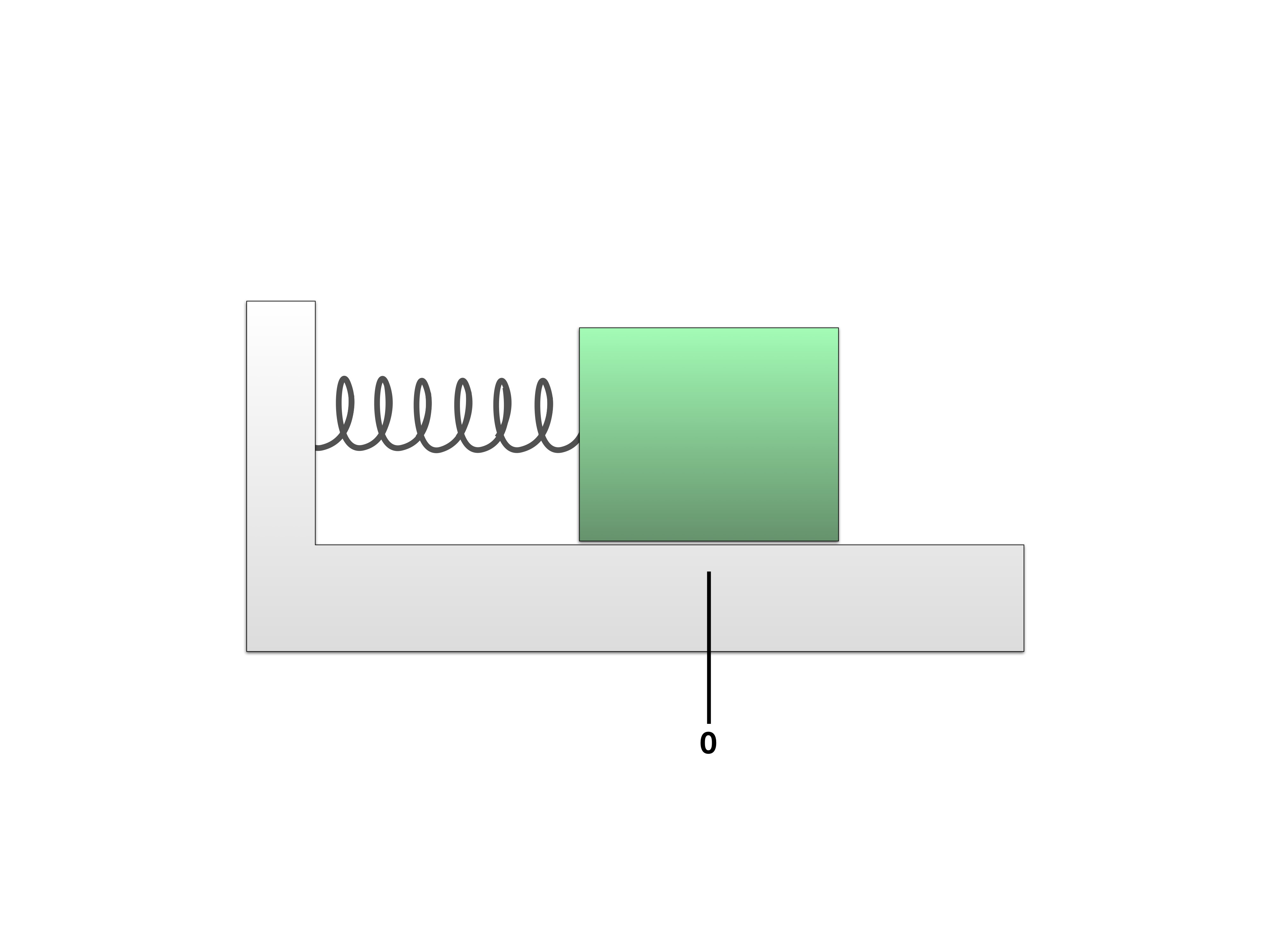
It’s exactly what is sounds like. A spring force is the force that a spring exerts on an object.
Spring forces occur in many natural environments. Thus, gaining an understanding of spring forces can help you in the understanding of many others.
Notice in Figure 2.3.1 that there is a resting object, in this case a block, attached to the end of the spring. It shows that the spring is neither extended nor compressed. When a spring is in this state of neither compression or extension, the spring is said to be in its relaxed state. In this relaxed state, there is no outside applied force being placed on the spring (i.e there is no one pushing or pulling it).
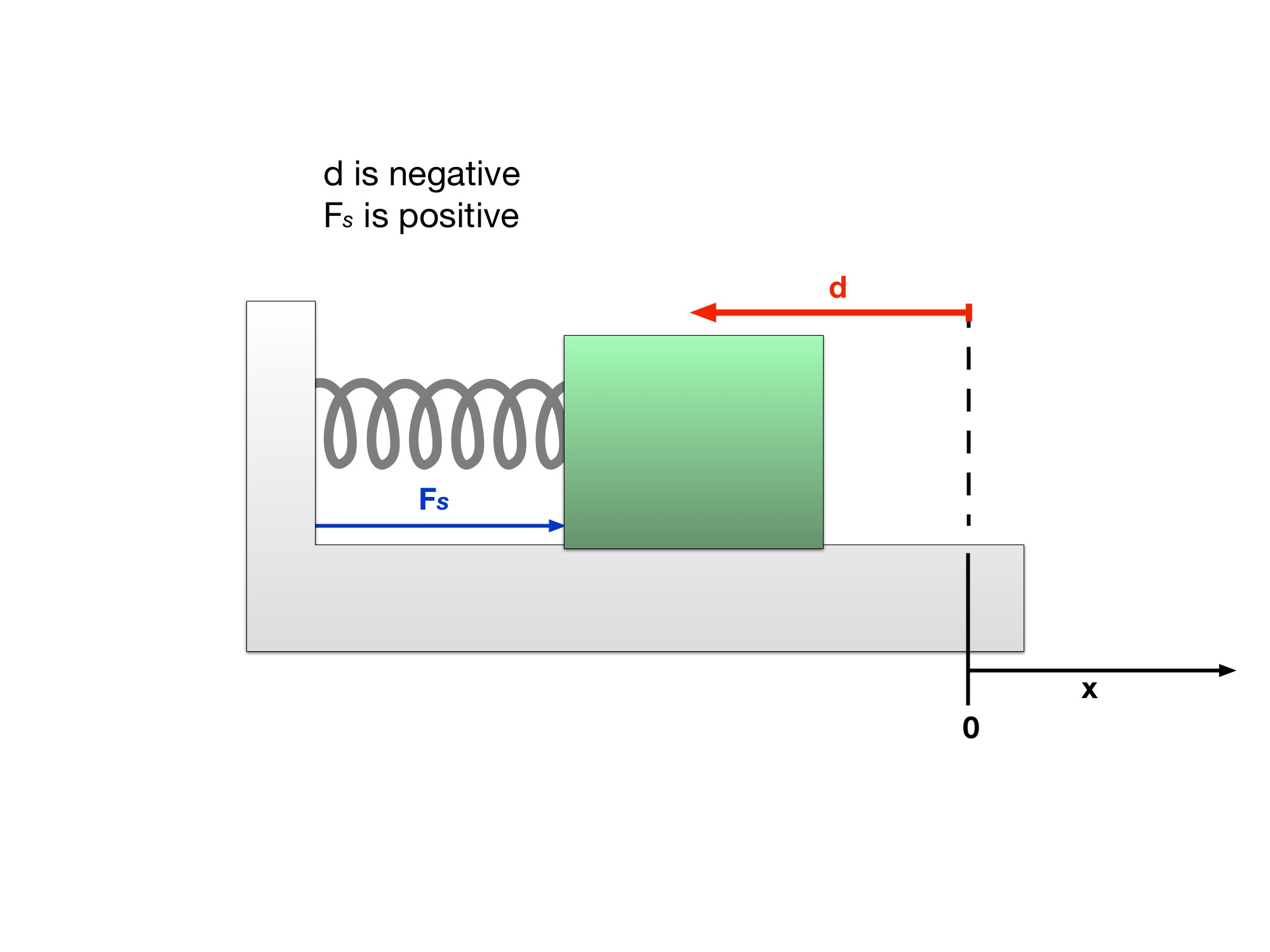
So what would the spring look like if it was not in it’s relaxed state? Take a look at Gallery 2.3.1. In the first image, you will notice that the spring is extended. And notice that it is extended a certain distance/displacement which we designate as . Remember that since this is a spring FORCE, it is a vector, so it has both magnitude and direction. If we stretch the spring by pulling the block towards the right as show, the natural thing to occur is for the spring to want to pull it back towards the left side. This is because the spring force is trying to restore itself to it’s relaxed state. This pull that is felt from the spring force is sometimes known as the restoring force.
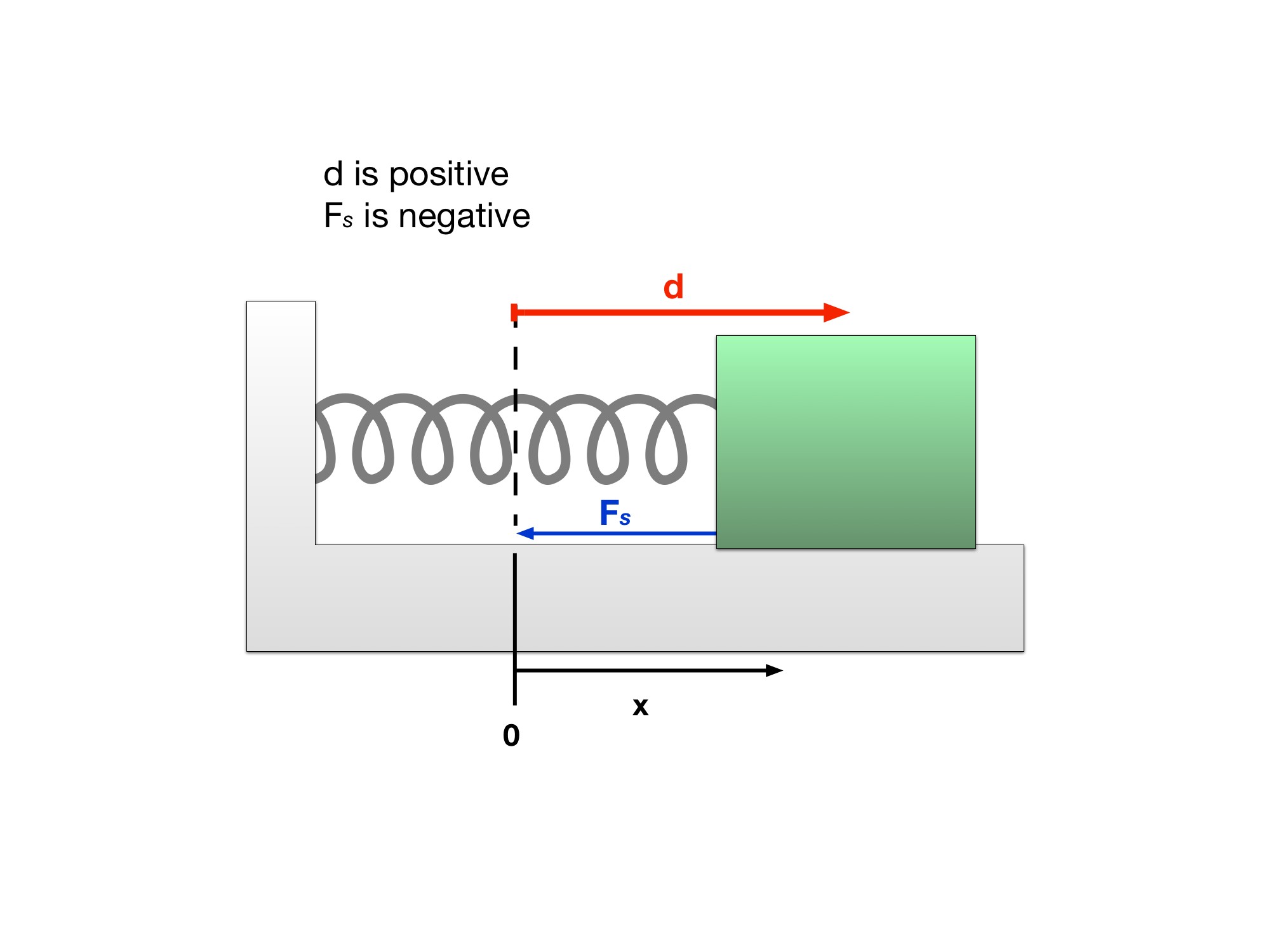
Extended spring at a distance d from the origin (x=0), so x is positive, but the spring force is pulling in the opposite direction so it is negative.
For an ideal spring within its linear elastic range, the restoring-force magnitude is proportional to extension or compression measured from its relaxed length.
Notice that the represents the displacement, not just the distance. This means you need to know whether the spring is being compressed or stretched.
This equation is known as Hooke’s Law named after Robert Hooke, a scientist from the late 1600s.
The variable is known as the spring constant, which has units of . The spring constant measures the “stiffness” of the spring, so you can imagine that a spring with a high means that the spring will have a greater pull or push at a given displacement. The negative sign in front of the equation is to account for how the spring force always acts in the opposite direction the displacement.
From Gallery 2.3.1, notice how we placed the x-axis parallel to the length of the spring. We can do this because the movement of the block and spring is all in the horizontal direction. Since this is true, we can rewrite the spring-force equation as:
Here, is the displacement of the spring in the x-direction. So if the block is stretched to the right, it is in the positive x-direction. Therefore, based on the equation above, the spring force will be negative, which is why it pulls the block in the negative x-direction. On the other hand, if the spring is compressed to the left (negative x-direction), the spring force will be positive, thus wanting to push the block towards the right.
If you had a spring that was oriented differently, you would generally try and choose axes such that either the x or y-axis was in-line with the spring axis.
Example Problem 2.3.1
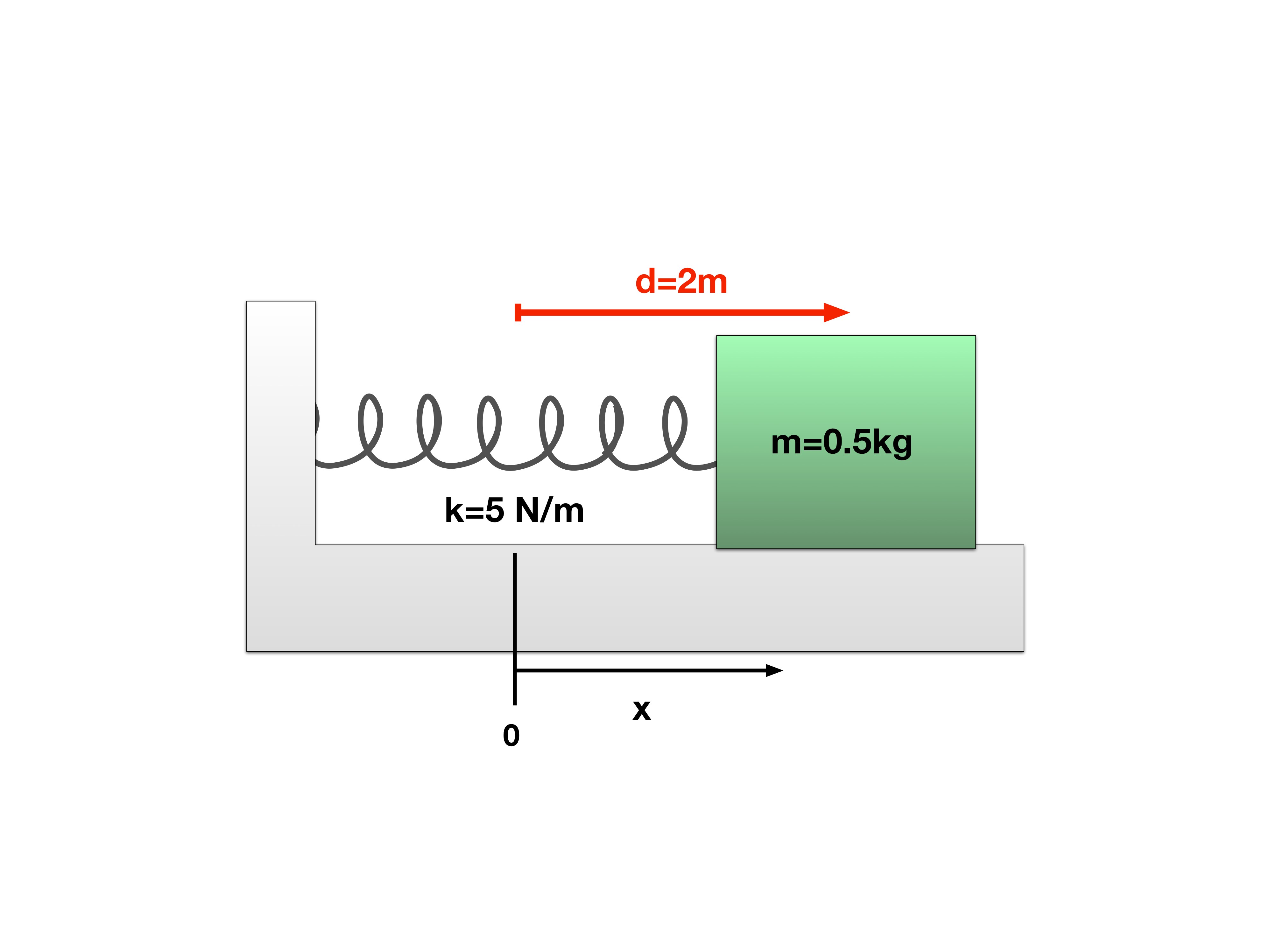
A 0.5 kg block on a level floor is attached to a spring with k = 5 N/m. The spring is extended by 2 m. Immediately after release, the block slides toward the wall and accelerates at 1 m/s². Find the kinetic friction coefficient. Use g = 9.81 m/s².
Step 1: Draw the Free Body Diagram
The spring force points opposite the displacement from the relaxed position. It need not point opposite velocity: when the block moves back toward equilibrium, force and velocity can point the same way.
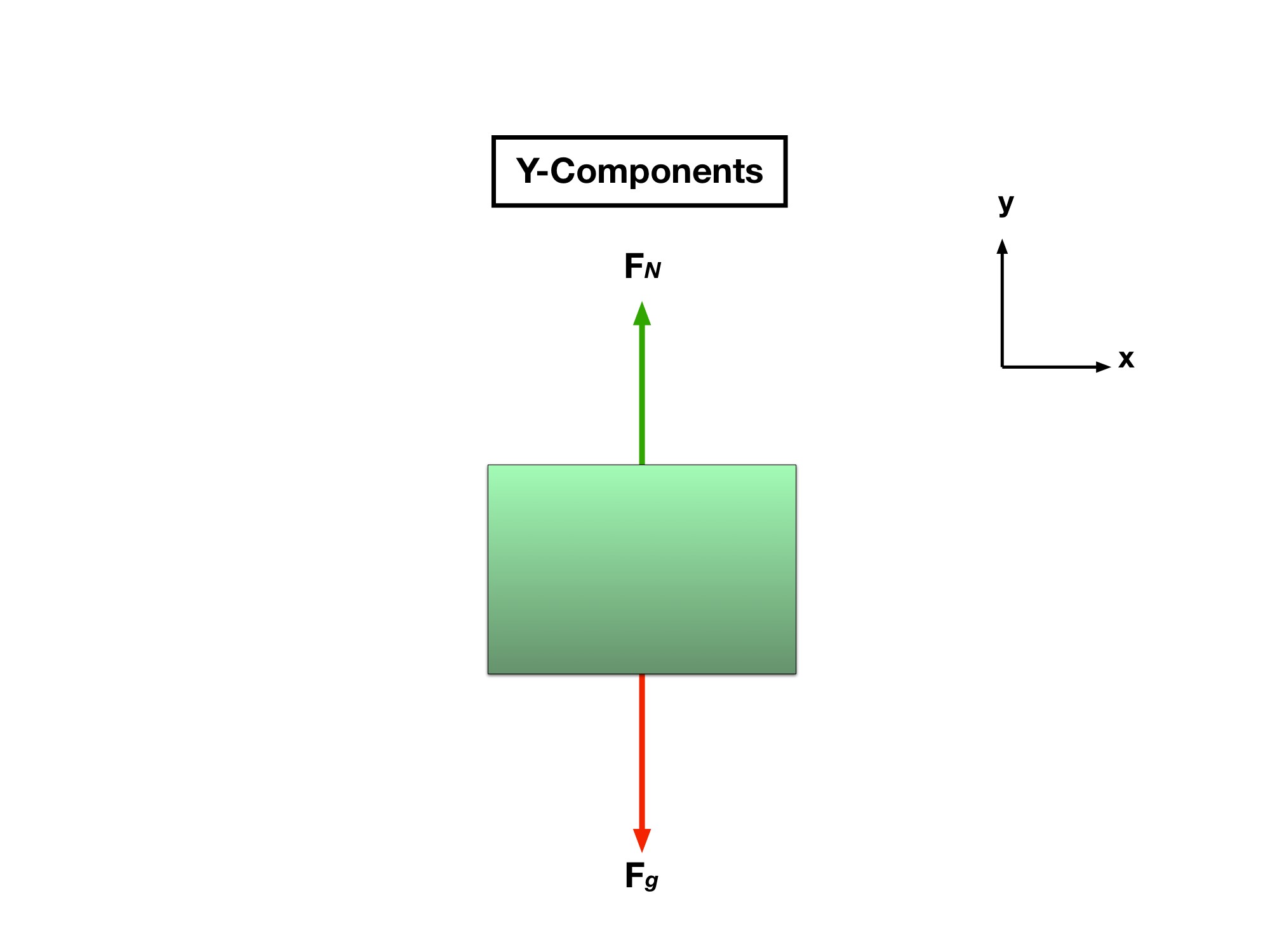
Step 2: Break into components
In the second image of Gallery 2.3.2, we broke it down into x and y components. This will make it easier for us when we set up our equations of motion. In the x-direction, there is only the spring force and friction force acting on the block. In the the y-direction, you have to normal force and weight
Step 3: Set up equations of motion
In the y-direction we have:
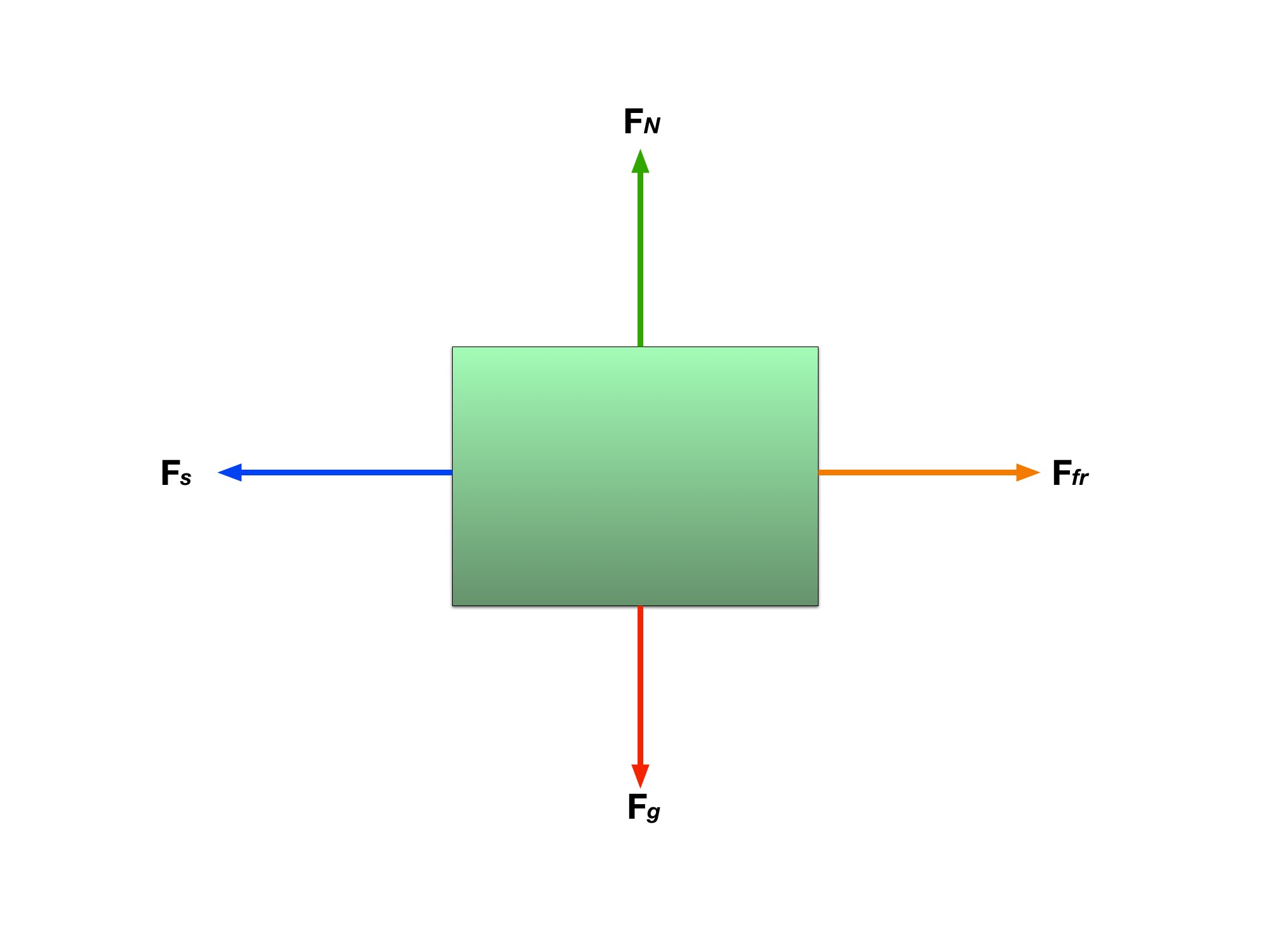
The spring adds a restoring force directed toward its relaxed position, opposite the extension in this diagram.
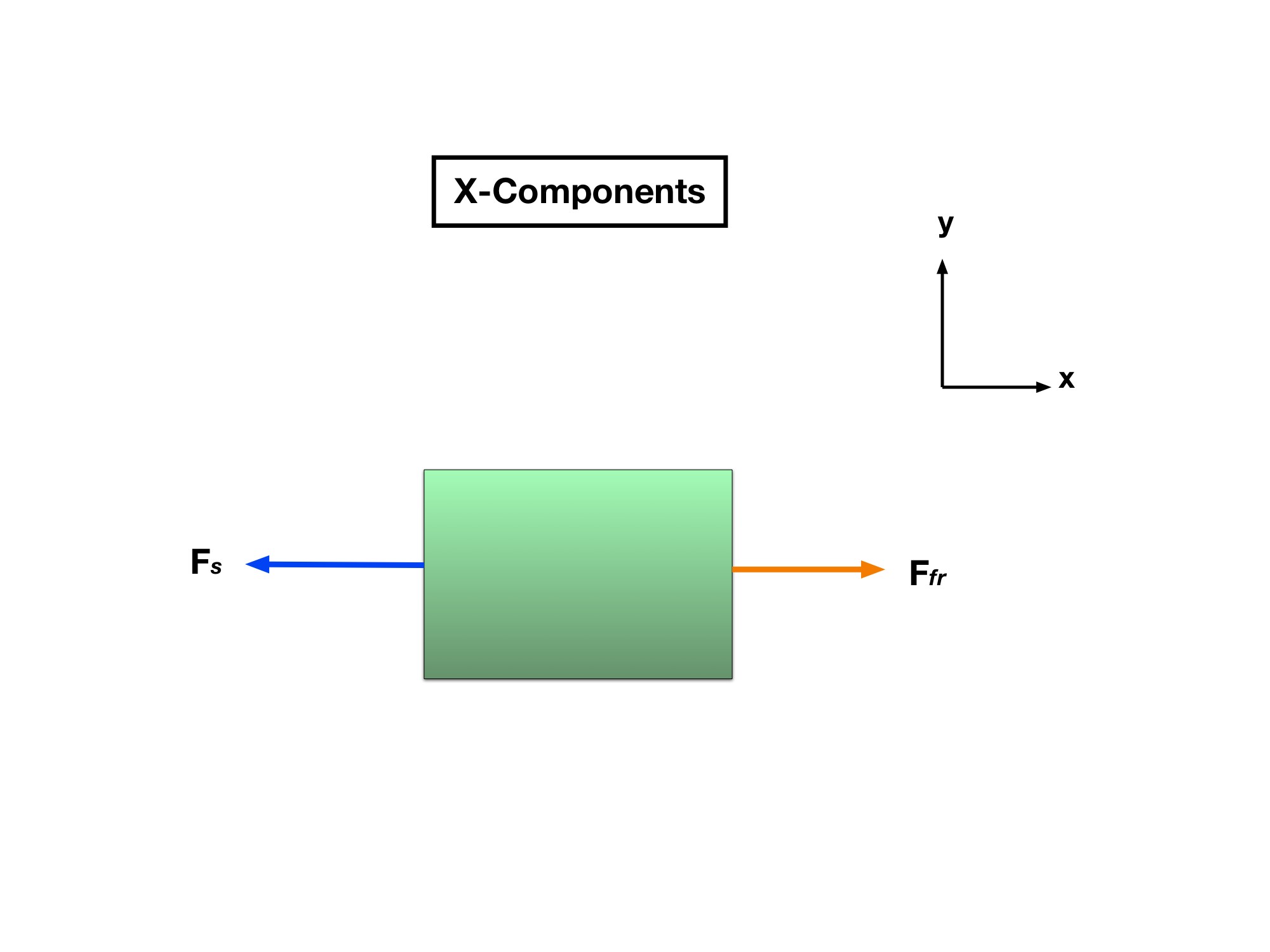
We know that , but we don’t have to worry about the negative sign since it is already taken into account in our equation of motion. This means our equation is now:
μₖN − kx = maₓ, so μₖ(4.905 N) − (5 N/m)(2 m) = (0.5 kg)(−1 m/s²).
μₖ(4.905 N) = 9.5 N.
μₖ = 9.5/4.905 = 1.937.
This is a large kinetic coefficient, but the equations allow it. The given data do not determine μₛ. Horizontal forces do not cause the block to bounce vertically.
Pop Quiz 2.3.1 Springs
Question 1 of 5 · 0 correct
AP Topic 2.8 · Read the worked solution
Read every full question without answers
Question 1
Question 2
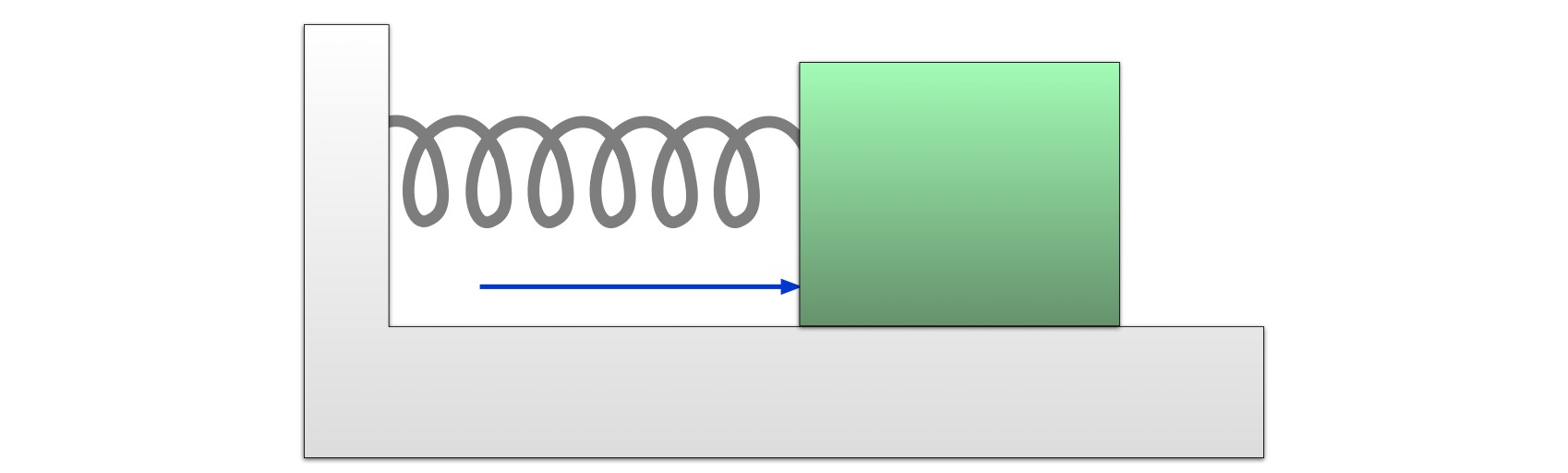
If each blue arrow represents an external horizontal applied force on the block, which diagram shows a force that can compress the spring?
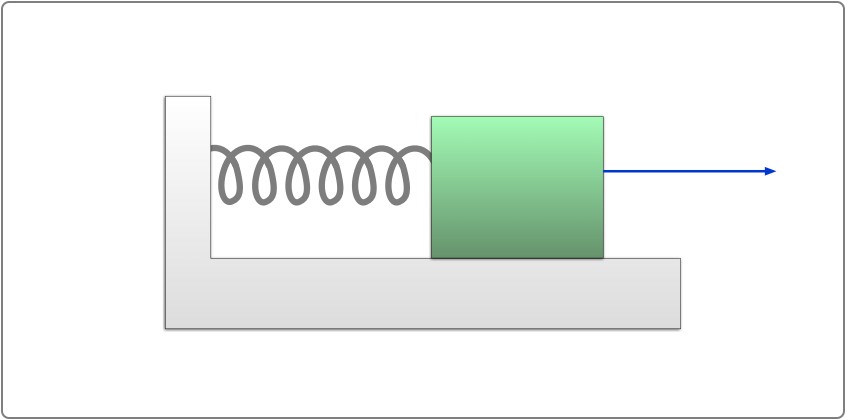
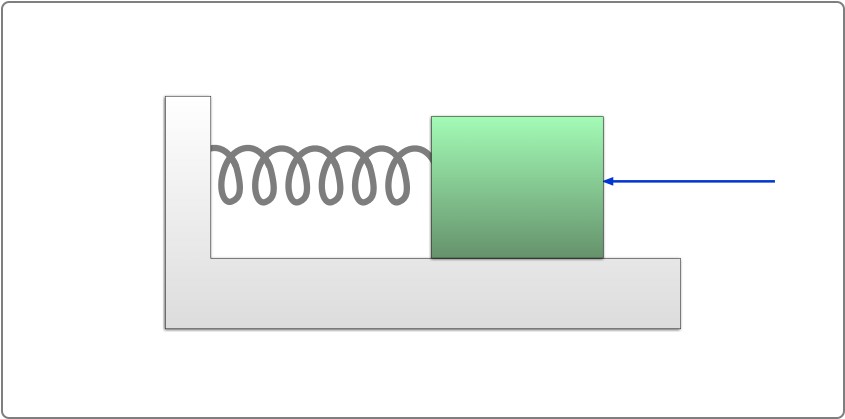
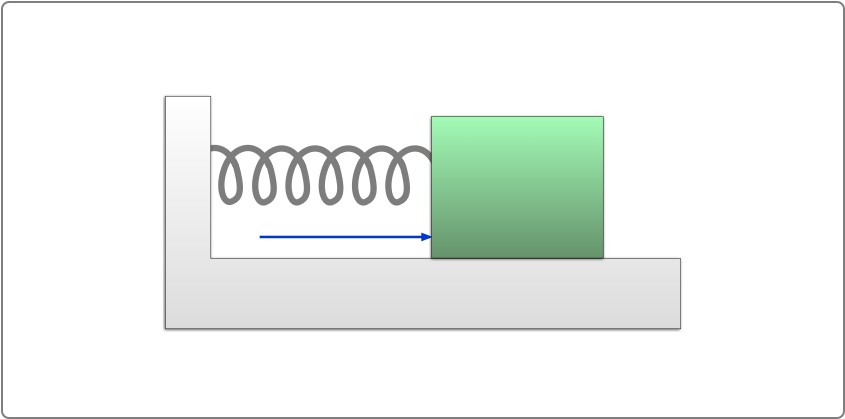
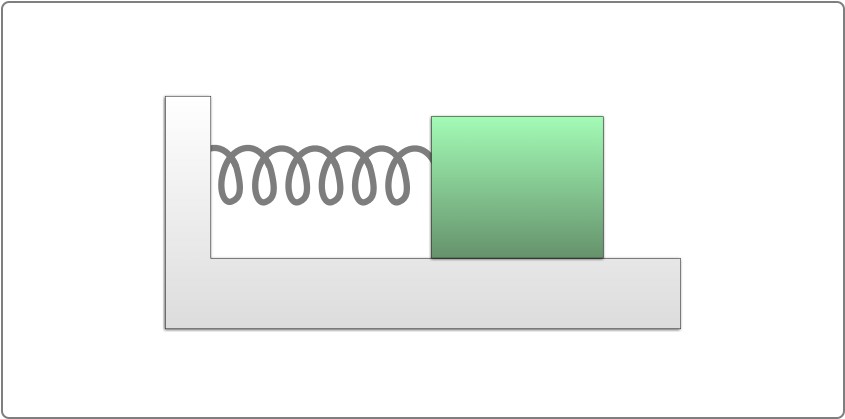
Question 3
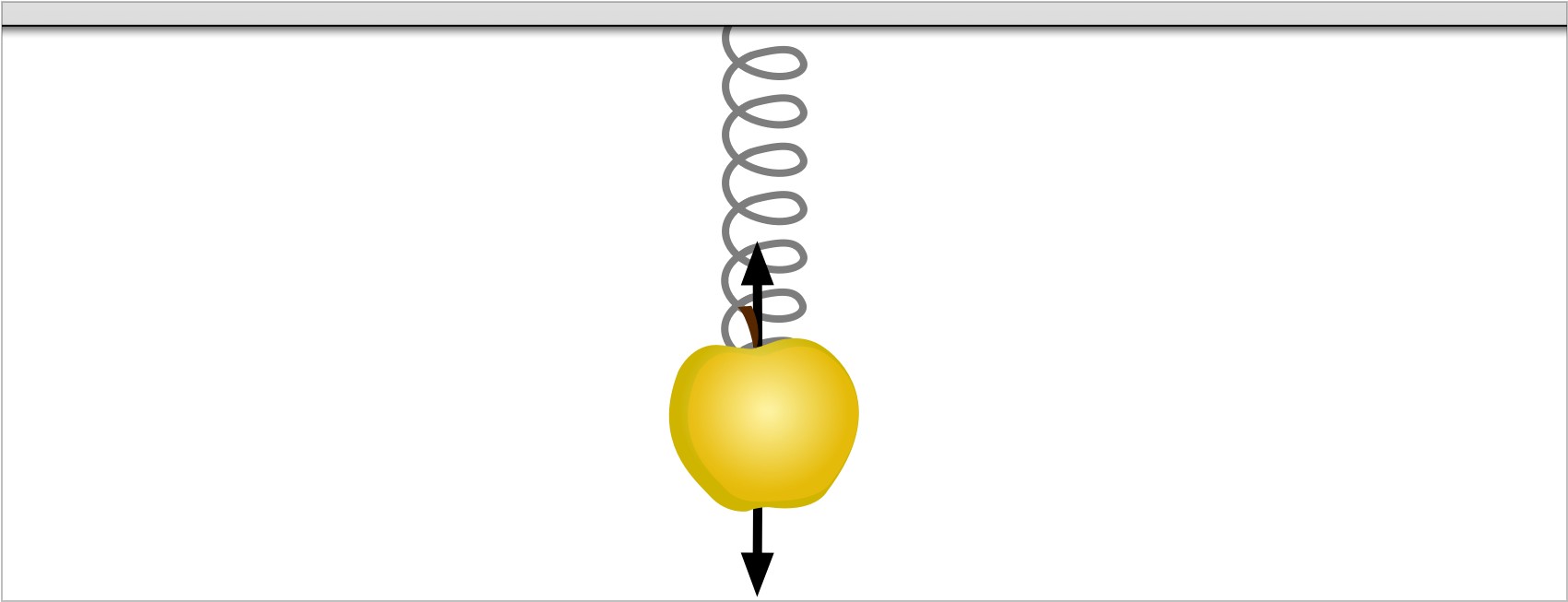 12
Match these labels to the numbered figure targets. Write your matches before opening the separate worked answer.
Question 4
Question 5
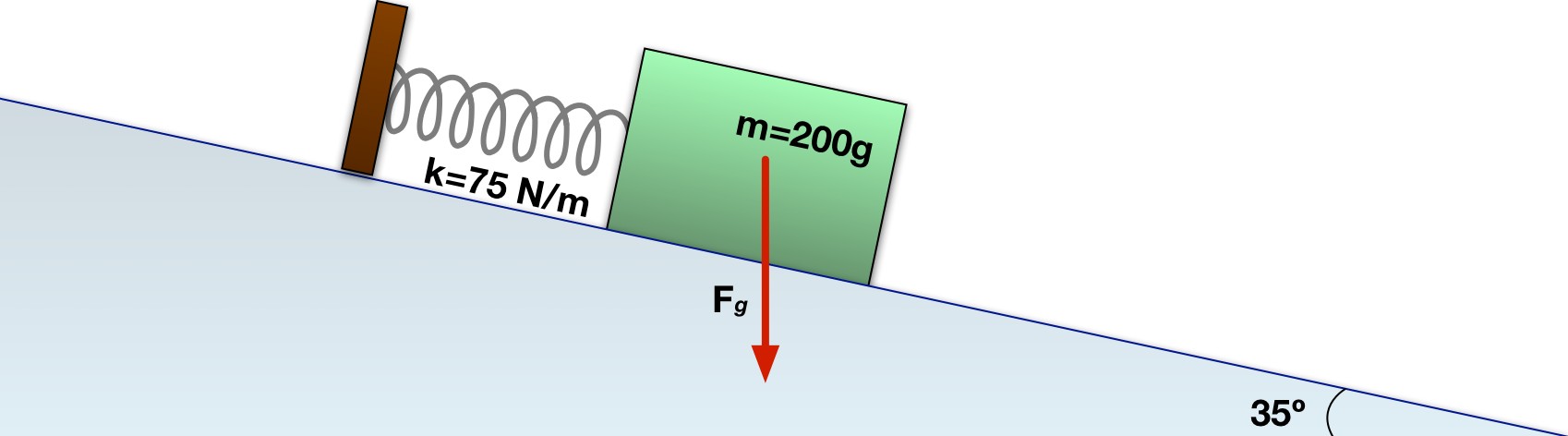
A block with mass is attached to a spring with stiffness of . The spring is stretched by . Determine the acceleration and direction of the spring block system. Ignore friction.


Reviewed physics notes (12)
These corrections keep the original lesson’s purpose while fixing errors in the source edition.
- Hooke’s law has a stated range of validity. — Reference 1
- A measured acceleration during sliding determines μₖ, not μₛ. — Reference 1, Reference 2
- Correct restoring force versus motion. — Reference 1
- Repair the coefficient used during sliding. — Reference 1
- Use unrounded N and kinetic friction. — Reference 1
- Use kinetic friction in the signed Newton equation. — Reference 1
- Keep the coefficient and intermediate precision consistent. — Reference 1
- Recalculate without intermediate rounding. — Reference 1
- The source’s claim that the friction coefficient causes bouncing is unsupported. — Reference 1
- Direction depends on displacement from equilibrium. — Reference 1
- The unlabeled blue arrows are ambiguous as applied force versus spring force; specify the applied-force interpretation used by the key. — Reference 1
- An impact force and compression alone do not establish a quasistatic Hooke relation; specify equilibrium. — Reference 1
Glossary and deeper reading · 5 refreshers
These editorial refreshers supplement the reading. Definitions and examples are added guidance; original source wording and recorded answers remain in their original context.
-
Force
A force describes an interaction that can change an object’s momentum. It is a vector measured in newtons, so both size and direction matter when forces are added. For example, a rope can pull a cart while the floor exerts friction in another direction.
-
Displacement
Displacement is the vector change in position from the start of an interval to its end. It depends on those endpoints rather than the length or shape of the path traveled. For example, walking around a closed track and returning to the start gives zero displacement but a nonzero distance traveled.
-
Vector
A vector is a quantity with a magnitude and a direction, represented by an arrow or by components along chosen axes. Vectors add by adding corresponding components rather than simply adding their magnitudes. For example, an eastward displacement followed by a northward displacement produces a resultant pointing northeast. The zero vector has zero magnitude and no unique direction.
-
Magnitude
Magnitude is the nonnegative size of a vector quantity. It does not specify direction, and it differs from a signed component. For example, a westward velocity can have a negative x component while its speed, the velocity magnitude, stays positive.
-
Spring constant
A spring constant measures the stiffness of a spring within its approximately linear range. Its units are newtons per meter, and a larger value means more force is needed for the same deformation. For example, two springs stretched by the same distance exert different forces if one is stiffer.