Chapter 10 Problems
Thirty chapter problems: 10 from the original book and 20 added for more practice.
Read the chapter problems → · Chapter solutions →
-
Original problem
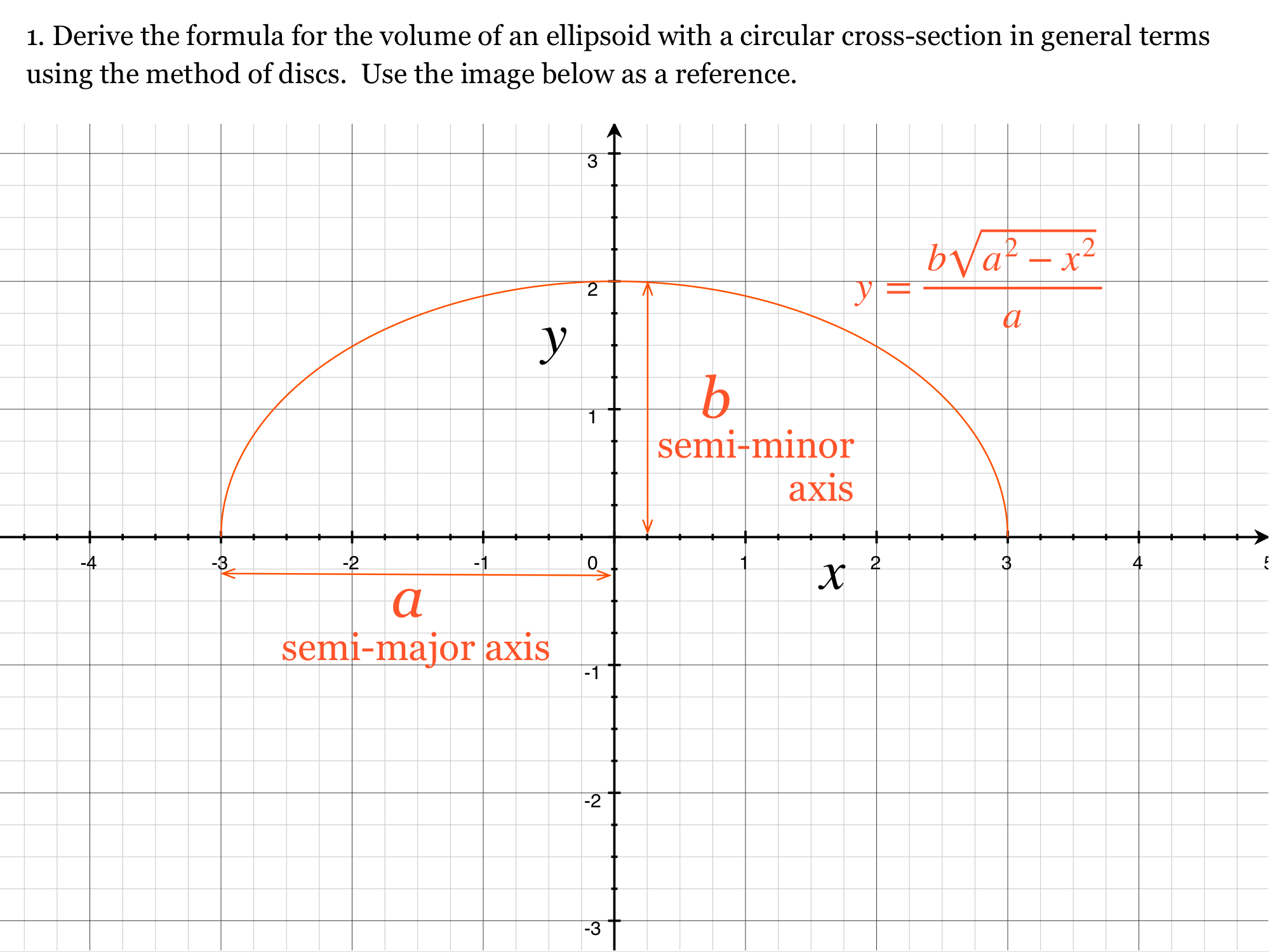
Derive the formula for the volume of an ellipsoid with a circular cross-section in general terms using the method of discs. Use the image below as a reference.Show your work for Problem 1
Source ellipsoid reference profile
An orange upper half-ellipse is drawn above the x-axis and is symmetric about the y-axis. In the illustrated grid it meets the x-axis at x=−3 and x=3 and reaches y=2 on the y-axis.
A horizontal double-headed arrow from the left endpoint to the origin is labeled a, semi-major axis. A vertical double-headed arrow from the x-axis to the top of the curve is labeled b, semi-minor axis. The source prints the following profile equation.
The 3 and 2 values belong to the pictured example. The existing task asks for a general derivation in the labeled axis lengths a and b; the overlay does not substitute those example numbers for the general parameters or give the volume formula.
Original source problem image and any figures. Read it together with the accessible problem text and any figure description or source note alongside it. Open the source image at full size. Drawing is temporarily unavailable. Work on paper if needed, then record your reasoning here.
Saving written working requires JavaScript. Keep your work on paper or in your own notes; the source problem above remains available.
-
Original problem
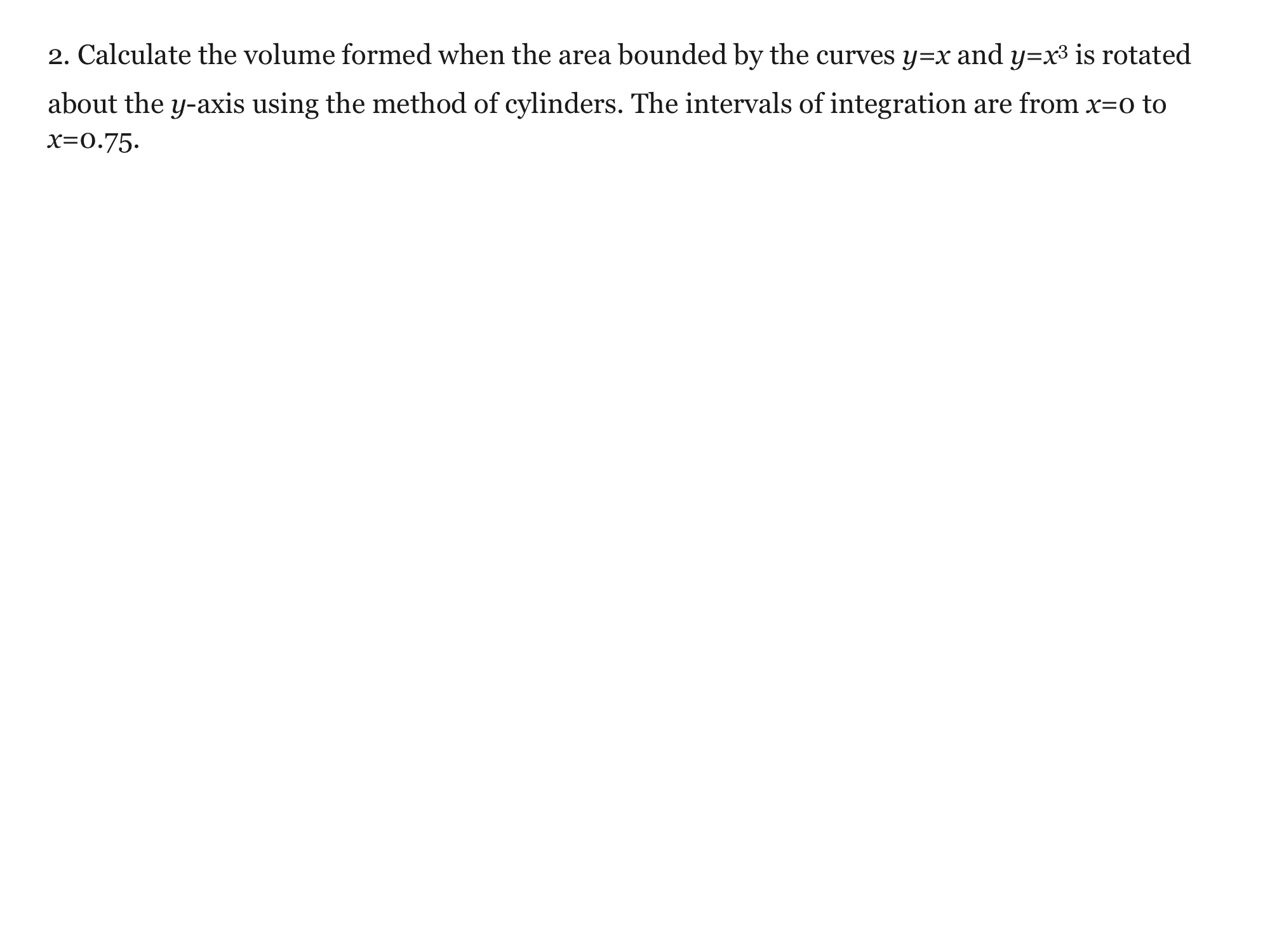
Calculate the volume formed when the area bounded by the curves y=x and y=x3 is rotated about the y-axis using the method of cylinders. The intervals of integration are from x=0 to x=0.75.Show your work for Problem 2
Original source problem image and any figures. Read it together with the accessible problem text and any figure description or source note alongside it. Open the source image at full size. Drawing is temporarily unavailable. Work on paper if needed, then record your reasoning here.
Saving written working requires JavaScript. Keep your work on paper or in your own notes; the source problem above remains available.
-
Original problem
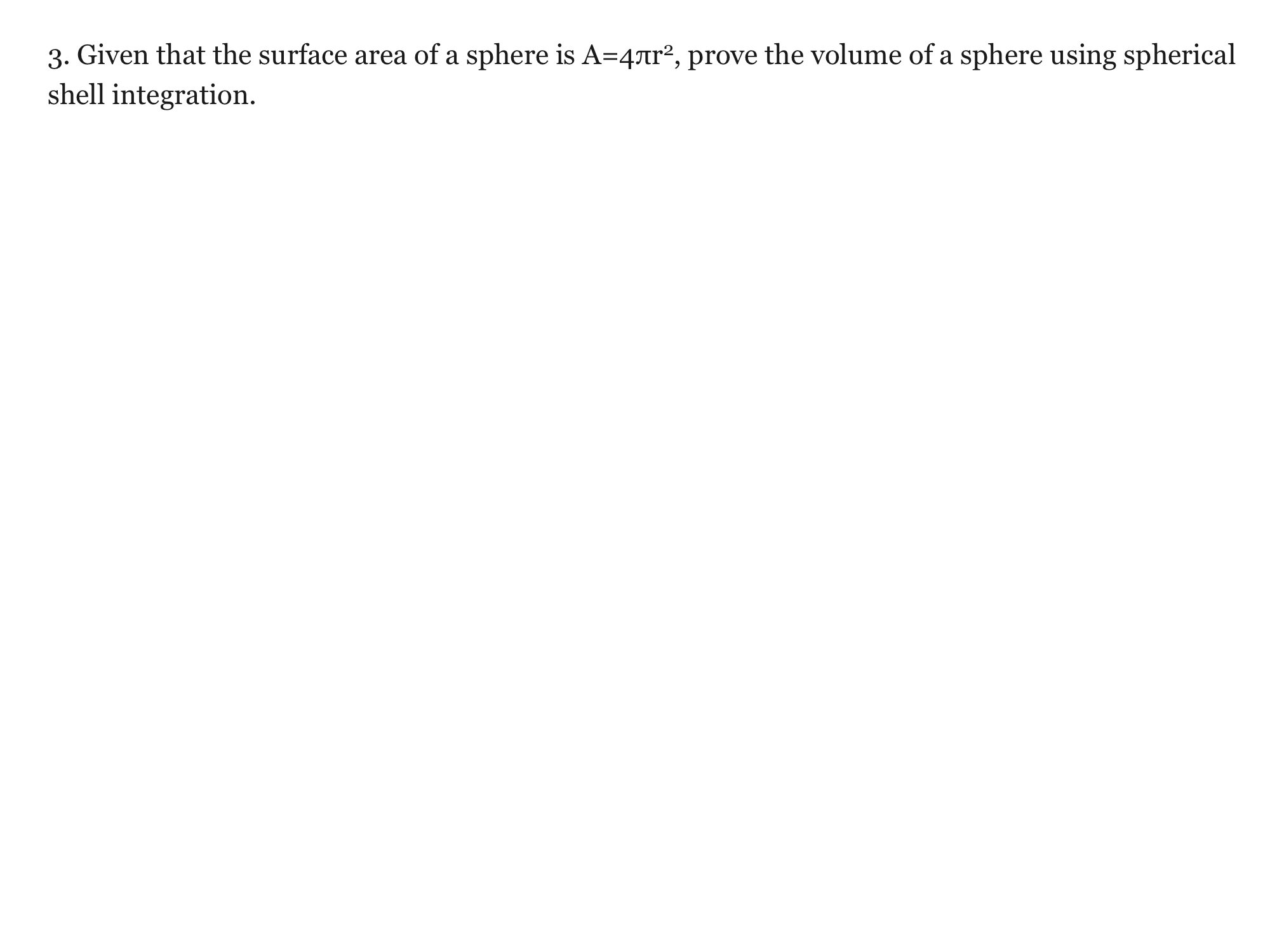
Given that the surface area of a sphere is A=4πr2, prove the volume of a sphere using spherical shell integration.Show your work for Problem 3
Original source problem image and any figures. Read it together with the accessible problem text and any figure description or source note alongside it. Open the source image at full size. Drawing is temporarily unavailable. Work on paper if needed, then record your reasoning here.
Saving written working requires JavaScript. Keep your work on paper or in your own notes; the source problem above remains available.
-
Original problem
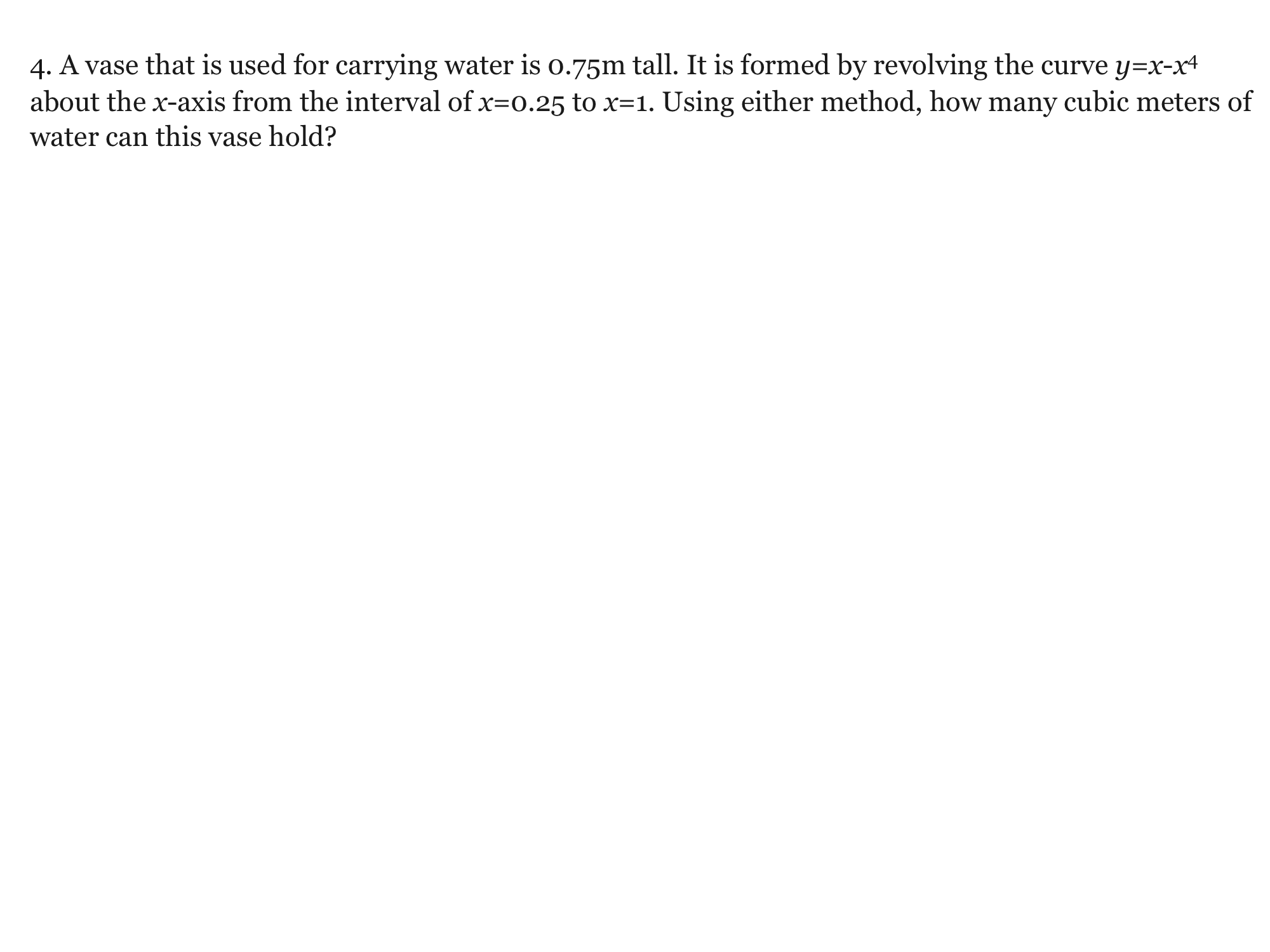
A vase that is used for carrying water is 0.75m tall. It is formed by revolving the curve y=x-x4 about the x-axis from the interval of x=0.25 to x=1. Using either method, how many cubic meters of water can this vase hold?Show your work for Problem 4
Original source problem image and any figures. Read it together with the accessible problem text and any figure description or source note alongside it. Open the source image at full size. Drawing is temporarily unavailable. Work on paper if needed, then record your reasoning here.
Saving written working requires JavaScript. Keep your work on paper or in your own notes; the source problem above remains available.
-
Original problem · clarified
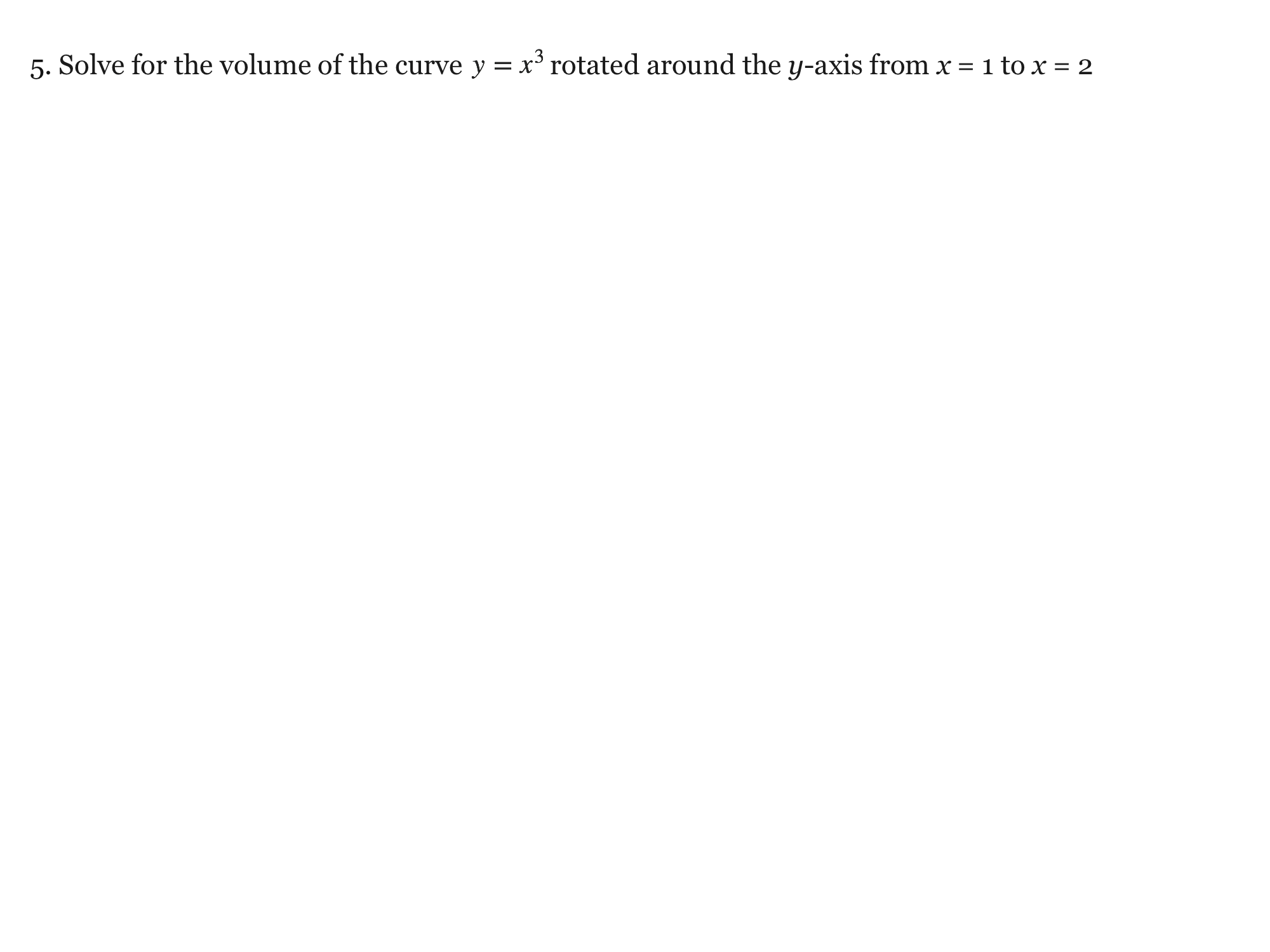
Solve for the volume of the curve rotated around the y-axis from x = 1 to x = 2Clarification: Use the region bounded by the y-axis, the curve x=y^(1/3), and the horizontal lines y=1 and y=8, then rotate it about the y-axis.
Show your work for Problem 5
Original source problem image and any figures. Read it together with the accessible problem text and any figure description or source note alongside it. Open the source image at full size. Drawing is temporarily unavailable. Work on paper if needed, then record your reasoning here.
Saving written working requires JavaScript. Keep your work on paper or in your own notes; the source problem above remains available.
-
Original problem · clarified
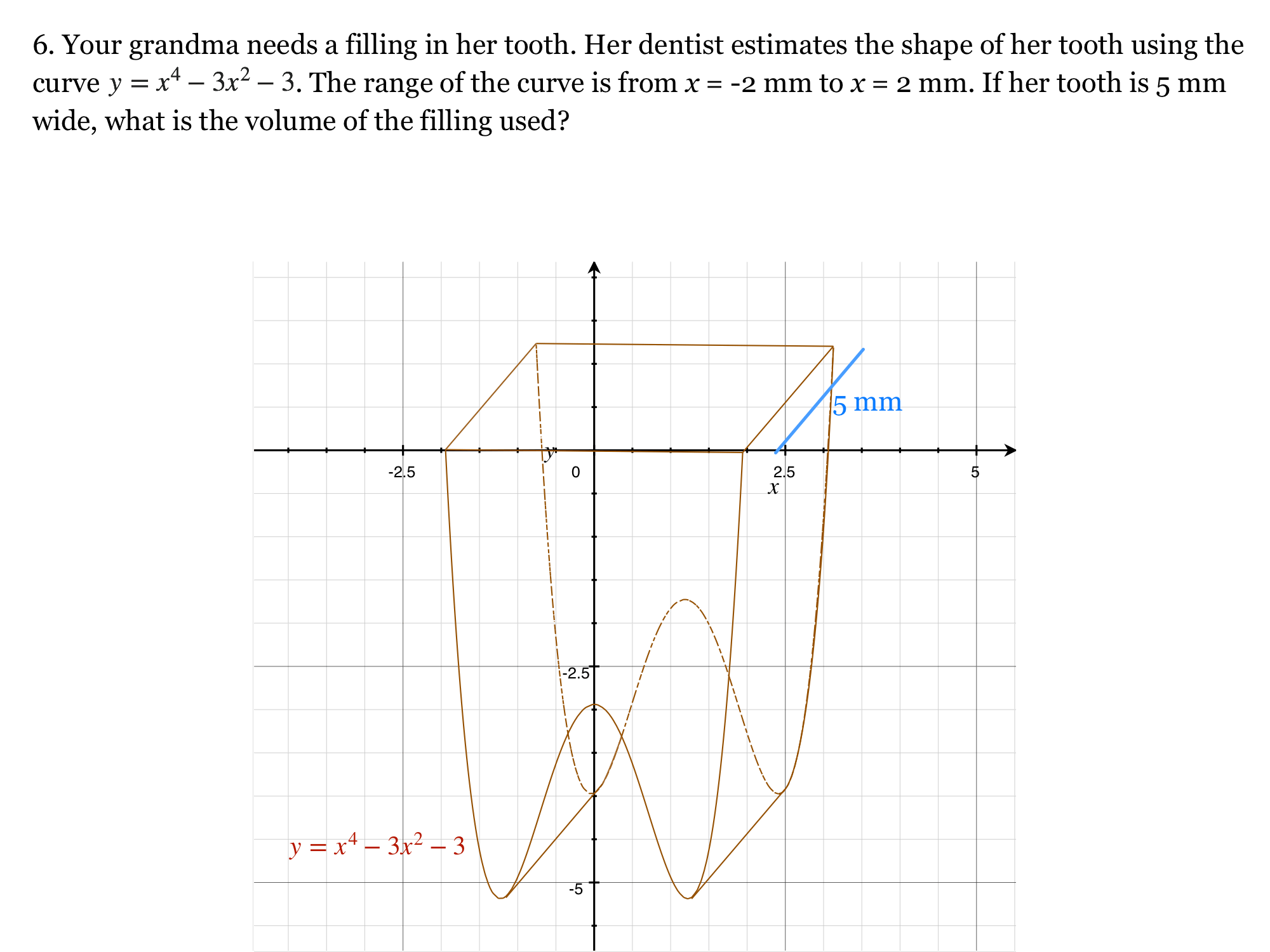
Your grandma needs a filling in her tooth. Her dentist estimates the shape of her tooth using the curve . The range of the curve is from x=-2mm to x=2mm. If her tooth is 5 mm wide, what is the volume of the filling used?Clarification: The filling is the cavity below the baseline y=0, extruded through a constant width of 5 mm. On −2≤x≤2, use depth max(0,−(x⁴−3x²−3)); exclude the end pieces above y=0.
Show your work for Problem 6
Original source problem image and any figures. Read it together with the accessible problem text and any figure description or source note alongside it. Open the source image at full size. Drawing is temporarily unavailable. Work on paper if needed, then record your reasoning here.
Saving written working requires JavaScript. Keep your work on paper or in your own notes; the source problem above remains available.
-
Original problem · clarified
Using the method of washers, find the volume when the region between and , for 0≤y≤1, is rotated about the y-axis.Clarification: The limits 0 and 1 are y-bounds. Use the y-axis rotation stated in the prose; the source widget’s x-axis label conflicts with it. This strip is not the full enclosed leaf.
-
Original problem
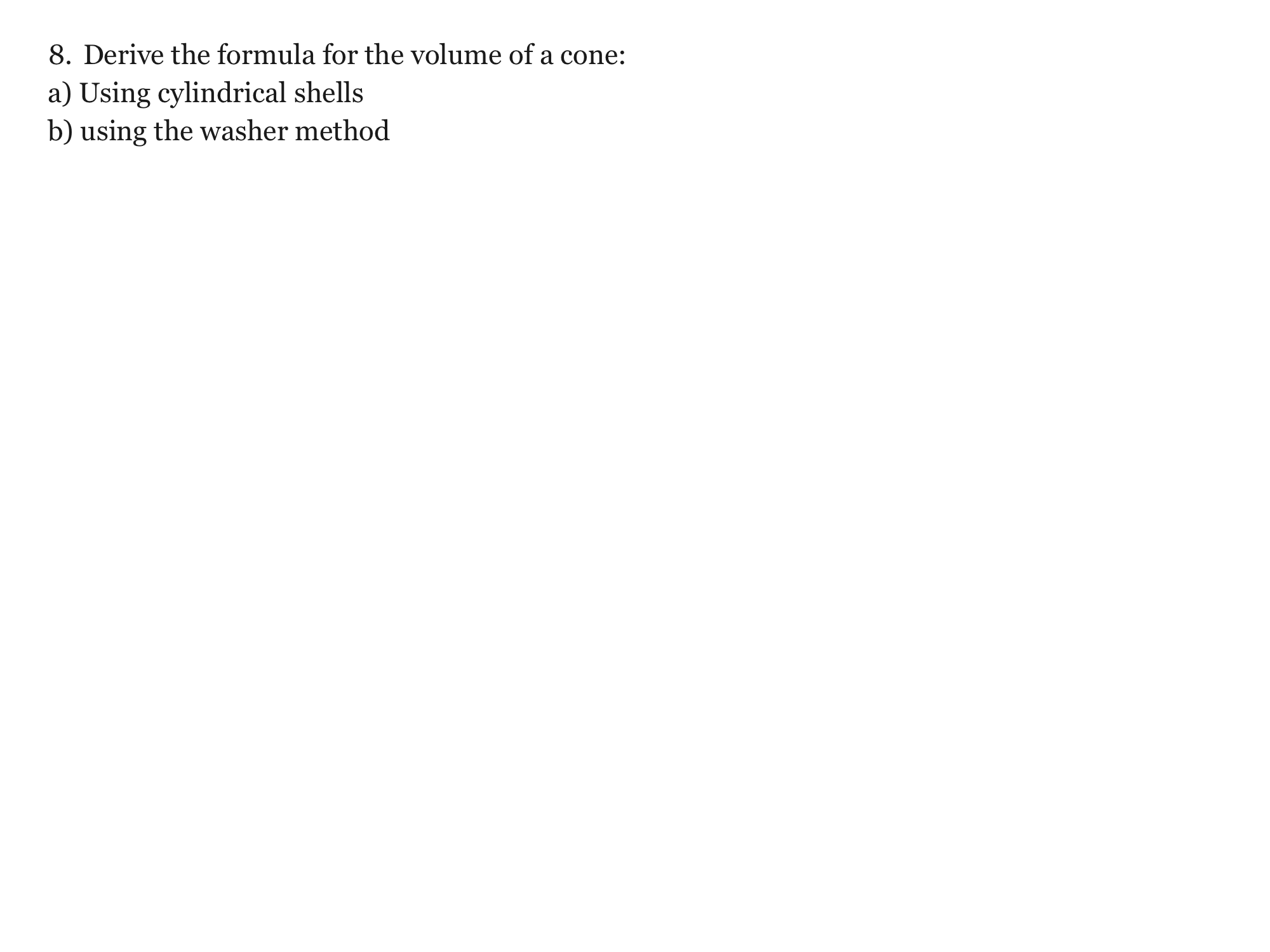
Derive the formula for the volume of a cone:
a) Using cylindrical shells
b) using the washer methodShow your work for Problem 8
Original source problem image and any figures. Read it together with the accessible problem text and any figure description or source note alongside it. Open the source image at full size. Drawing is temporarily unavailable. Work on paper if needed, then record your reasoning here.
Saving written working requires JavaScript. Keep your work on paper or in your own notes; the source problem above remains available.
-
Original problem
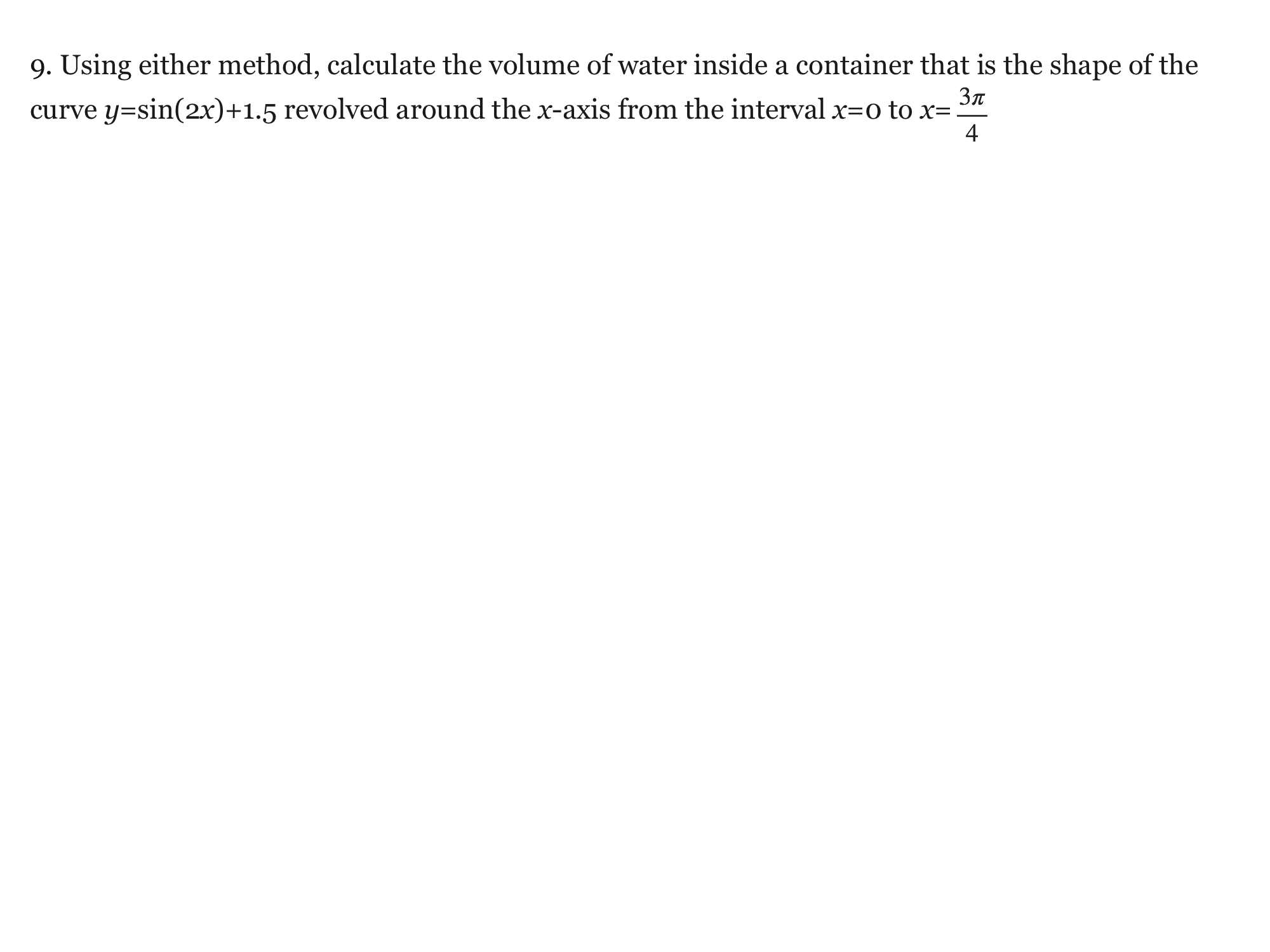
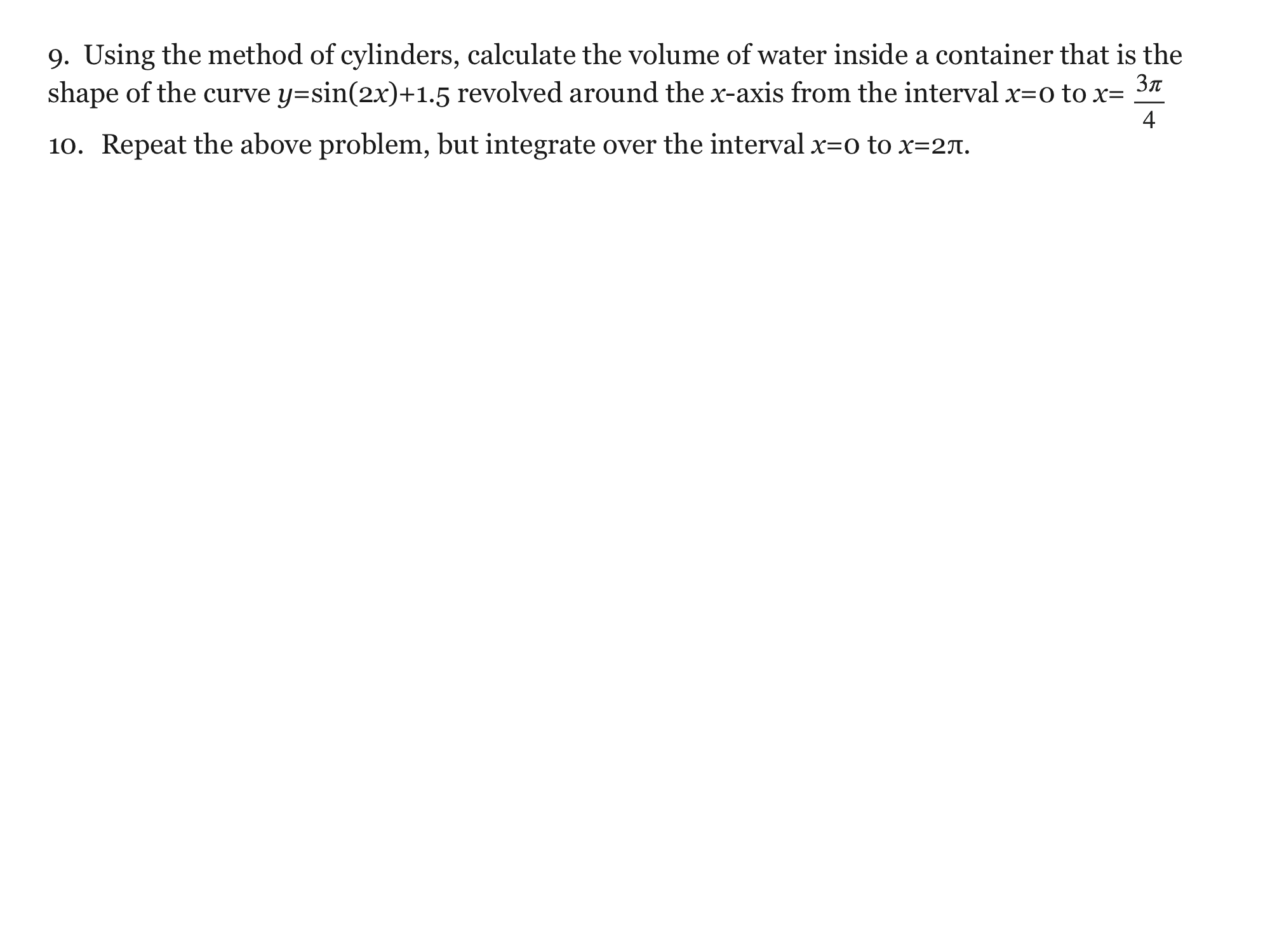
Using either method, calculate the volume of water inside a container that is the shape of the curve y=sin(2x)+1.5 revolved around the x-axis from the interval x=0 to x=Show your work for Problem 9
Original source problem image and any figures. Read it together with the accessible problem text and any figure description or source note alongside it. Open the source image at full size. Drawing is temporarily unavailable. Work on paper if needed, then record your reasoning here.
Saving written working requires JavaScript. Keep your work on paper or in your own notes; the source problem above remains available.
-
Original problem
Repeat the above problem, but integrate over the interval x=0 to x=2π.Show your work for Problem 10
Shared source instruction or preceding problem:
Using either method, calculate the volume of water inside a container that is the shape of the curve y=sin(2x)+1.5 revolved around the x-axis from the interval x=0 to x=Problem 10 says to repeat the previous problem with new bounds. Reuse the existing readable Problem 9 statement as context, then keep Problem 10’s own bounds.
Original source problem image and any figures. Read it together with the accessible problem text and any figure description or source note alongside it. Open the source image at full size. Drawing is temporarily unavailable. Work on paper if needed, then record your reasoning here.
Saving written working requires JavaScript. Keep your work on paper or in your own notes; the source problem above remains available.
-
Added problem
Use cylindrical shells to find the volume when the region , is revolved about the y-axis.
-
Added problem
Revolve the region , about the y-axis. Find its volume with shells.
-
Added problem
Use shells for the region , revolved about the vertical line .
-
Added problem
In the first quadrant, the region is bounded by , , and . Revolve it about the x-axis and find its volume using horizontal shells.
-
Added problem
Use shells to find the volume obtained by revolving the first-quadrant region bounded by , , and about .
-
Added problem
A student uses for the region , revolved about the y-axis. Explain the setup error and find the correct volume.
-
Added problem
Find the volume when the region , is revolved about the x-axis. Use washers.
-
Added problem
Revolve , about the y-axis. Use horizontal discs to find the volume.
-
Added problem
Find the volume generated by revolving , about . Use washers.
-
Added problem
Use washers to revolve the region , about . Find its volume.
-
Added problem
Find the volume obtained by revolving the region between and on about the x-axis.
-
Added problem
For , revolve the region about the x-axis. A student subtracts from each cross-sectional area. Explain why that is wrong and find the volume.
-
Added problem
A sphere of radius is centered at the origin. Use discs to find the volume of the portion between the planes and .
-
Added problem
A solid frustum has height and end radii . Its radius varies linearly along its axis. Derive its volume with discs.
-
Added problem
A solid has base region between and for , with coordinates in centimeters. Cross sections perpendicular to the x-axis are squares whose sides equal the vertical gap in the base. Find its volume.
-
Added problem
A solid has base disk . Cross sections perpendicular to the x-axis are semicircles whose diameters are the vertical chords of the base disk. Find the volume. You may use semicircle area for diameter d.
-
Added problem
A solid has base region , . Cross sections perpendicular to the x-axis are equilateral triangles with side length equal to the base’s vertical gap. Given triangle area , find the volume.
-
Added problem
A solid’s cross-sectional area is m² for and m² for , where x is measured in meters. Find its volume.
-
Added problem
A solid has measured cross-sectional areas of 4, 7, and 5 cm² at axial positions 0, 1, and 3 cm. Estimate its volume on this interval by a trapezoid between each pair of samples.
-
Added problem
Revolve the region bounded by and on about the x-axis. Compute its volume once with washers and once with horizontal shells, showing both sets of radii and bounds.