FFR - Future Calculusesuses...
This original textbook reading covers part of the AP topic. Follow the AP course outline for complete topic instruction and practice.
This reading includes verified answer corrections and explicitly stated clarifications.
Interactive 10.3.1 3-D Parabloid
Loading the original 3D model…
Original preview and model
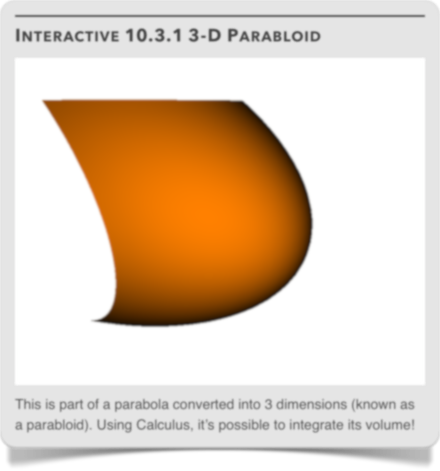
This viewer rotates the original source mesh. Lighting and controls are a web adaptation.
Download original COLLADA modelA recap for the future
So far we have found volumes of strange and unique solids by splitting them up into disc-like areas or shell-like areas, but with the help of double integrals, it is possible to find volumes of even more complex shapes, like a hyperbolic parabloid. These are usually covered in a Calculus III course.
Interactive 10.3.2 Hyperbolic Parabloid
Loading the original 3D model…
Original preview and model
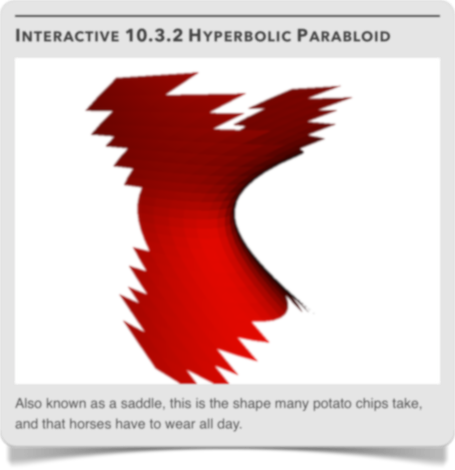
This viewer rotates the original source mesh. Lighting and controls are a web adaptation.
Download original COLLADA modelCalculus III courses have been described as “Calculus I in three dimensions.” Whereas before, the derivative of a two-dimensional curve was a tangent line, with three dimensions it is also possible to have a tangent plane. The inclusion of a z-axis allows us to graph even more complex curves and find their volumes using triple integrals, such as a hammock shape.
At many universities, Calculus III delves the deepest into integrals, coming up with such applications for it like arc length, and expanding the concept of an integral into line integrals in three dimensions.
Calculus II
Calculus II is partly Calculus I concepts extended, and partly entirely new concepts of sequences and series. Extension of Calculus I concepts includes integration by parts (the product rule equivalent of integration), and partial fraction integration. However, the bulk of the coursework comes from sequences and infinite series (infinite summations that end up having a finite answer, similar to integrals at ∞ that we covered earlier).
Calculus II also introduces the infamous Taylor Series and Maclaurin Series that relate a function’s second, third, fourth, infinite derivative and their sums. As a result, people often have strong feelings about Calculus II that might differ greatly from their feelings about Calculus I and III.
This concludes the lecture material on Calculus I. Please take some time to write a review to tell us how we can improve, and you can look forward to your suggestions being implemented in future versions. I hope this has been an enjoyable read for you.
Show your work for Problem 1
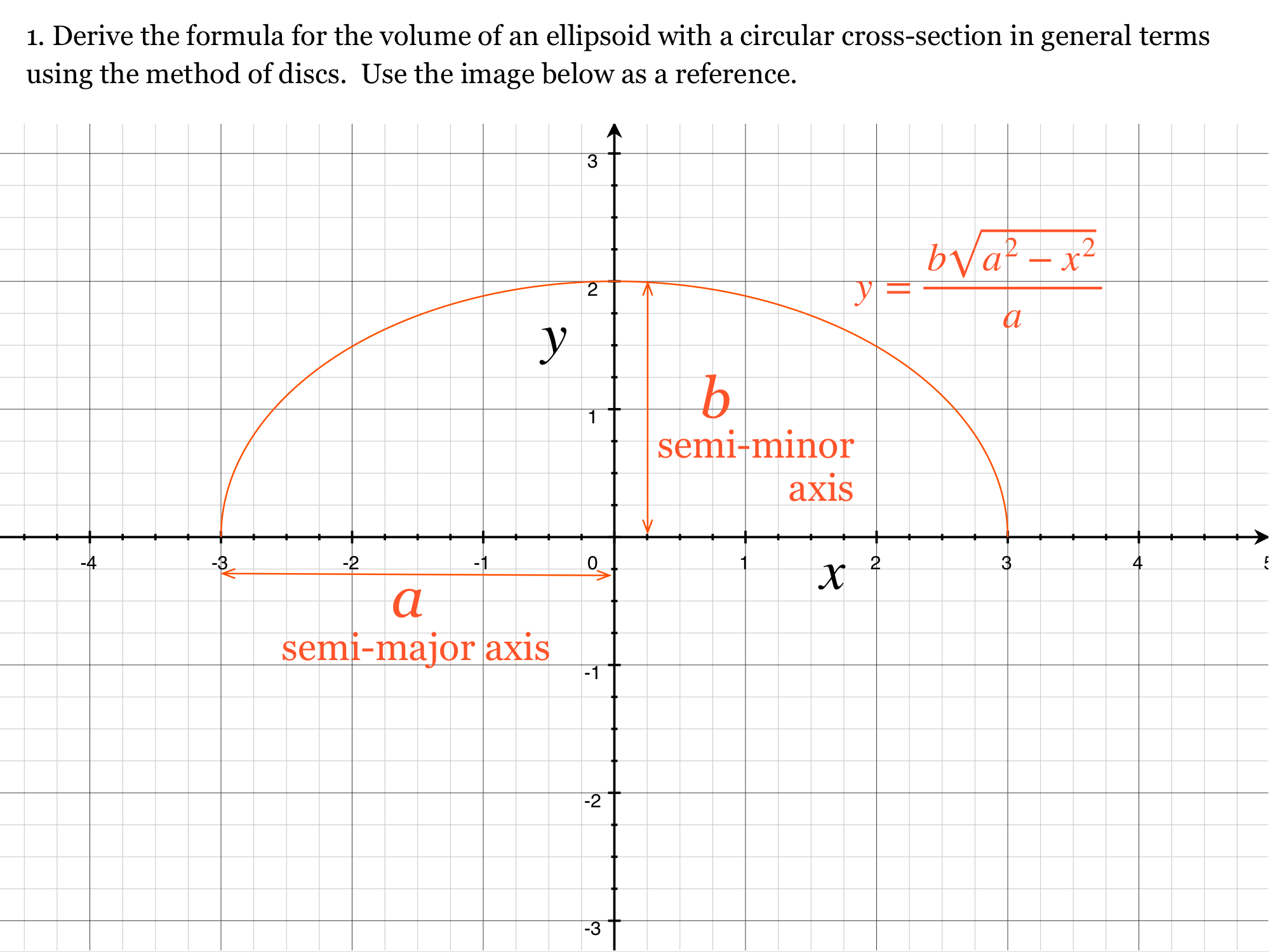
Source ellipsoid reference profile
An orange upper half-ellipse is drawn above the x-axis and is symmetric about the y-axis. In the illustrated grid it meets the x-axis at x=−3 and x=3 and reaches y=2 on the y-axis.
A horizontal double-headed arrow from the left endpoint to the origin is labeled a, semi-major axis. A vertical double-headed arrow from the x-axis to the top of the curve is labeled b, semi-minor axis. The source prints the following profile equation.
The 3 and 2 values belong to the pictured example. The existing task asks for a general derivation in the labeled axis lengths a and b; the overlay does not substitute those example numbers for the general parameters or give the volume formula.
Drawing is temporarily unavailable. Work on paper if needed, then record your reasoning here.
Saving written working requires JavaScript. Keep your work on paper or in your own notes; the source problem above remains available.
Show your work for Problem 2
Drawing is temporarily unavailable. Work on paper if needed, then record your reasoning here.
Saving written working requires JavaScript. Keep your work on paper or in your own notes; the source problem above remains available.
- Derive the formula for the volume of an ellipsoid with a circular cross-section in general terms using the method of discs. Use the image below as a reference.
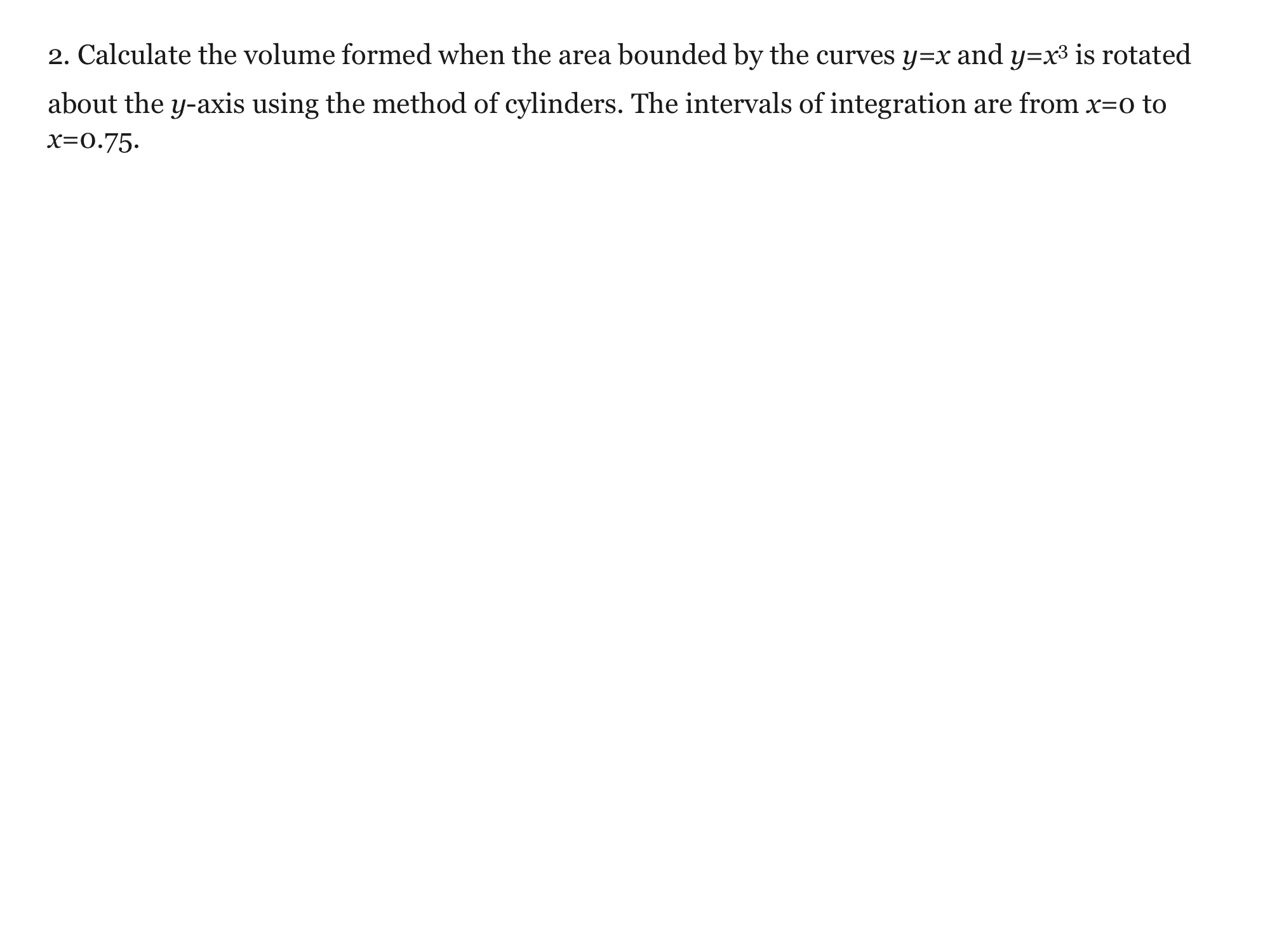
- Calculate the volume formed when the area bounded by the curves y=x and y=x3 is rotated about the y-axis using the method of cylinders. The intervals of integration are from x=0 to x=0.75.
Show your work for Problem 4
Drawing is temporarily unavailable. Work on paper if needed, then record your reasoning here.
Saving written working requires JavaScript. Keep your work on paper or in your own notes; the source problem above remains available.
Show your work for Problem 3
Drawing is temporarily unavailable. Work on paper if needed, then record your reasoning here.
Saving written working requires JavaScript. Keep your work on paper or in your own notes; the source problem above remains available.
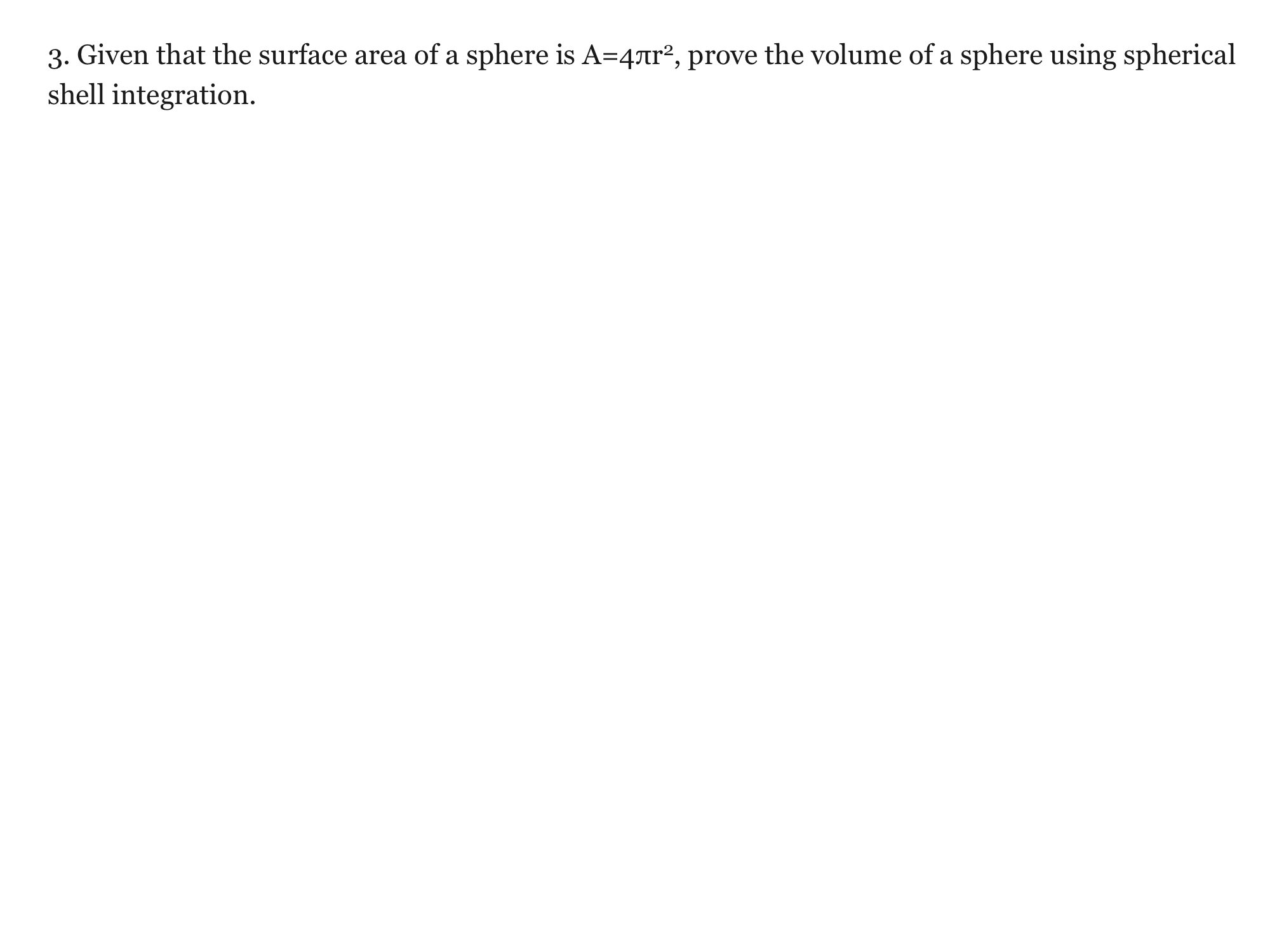
- Given that the surface area of a sphere is A=4πr2, prove the volume of a sphere using spherical shell integration.
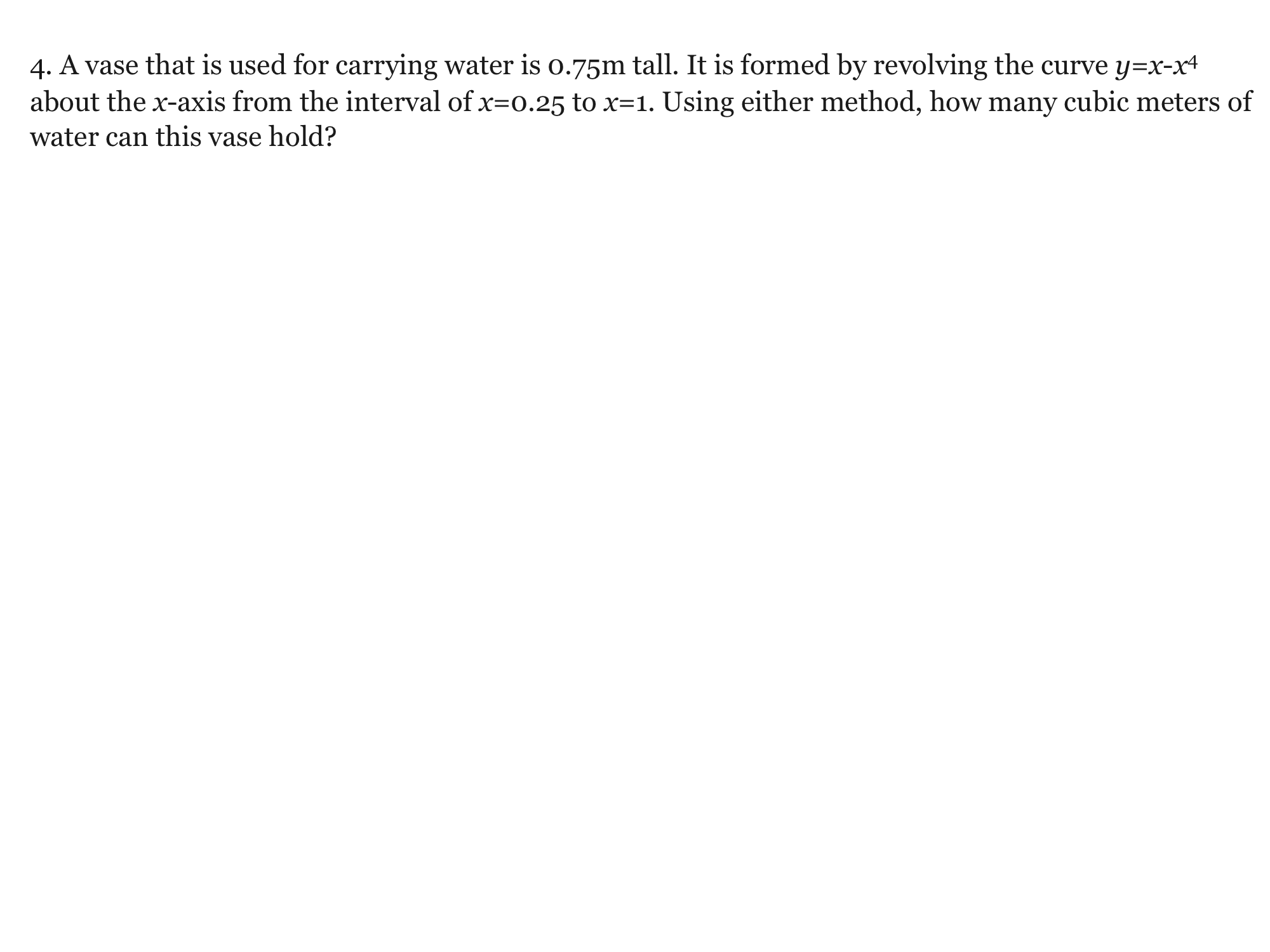
- A vase that is used for carrying water is 0.75m tall. It is formed by revolving the curve y=x-x4 about the x-axis from the interval of x=0.25 to x=1. Using either method, how many cubic meters of water can this vase hold?
Show your work for Problem 5
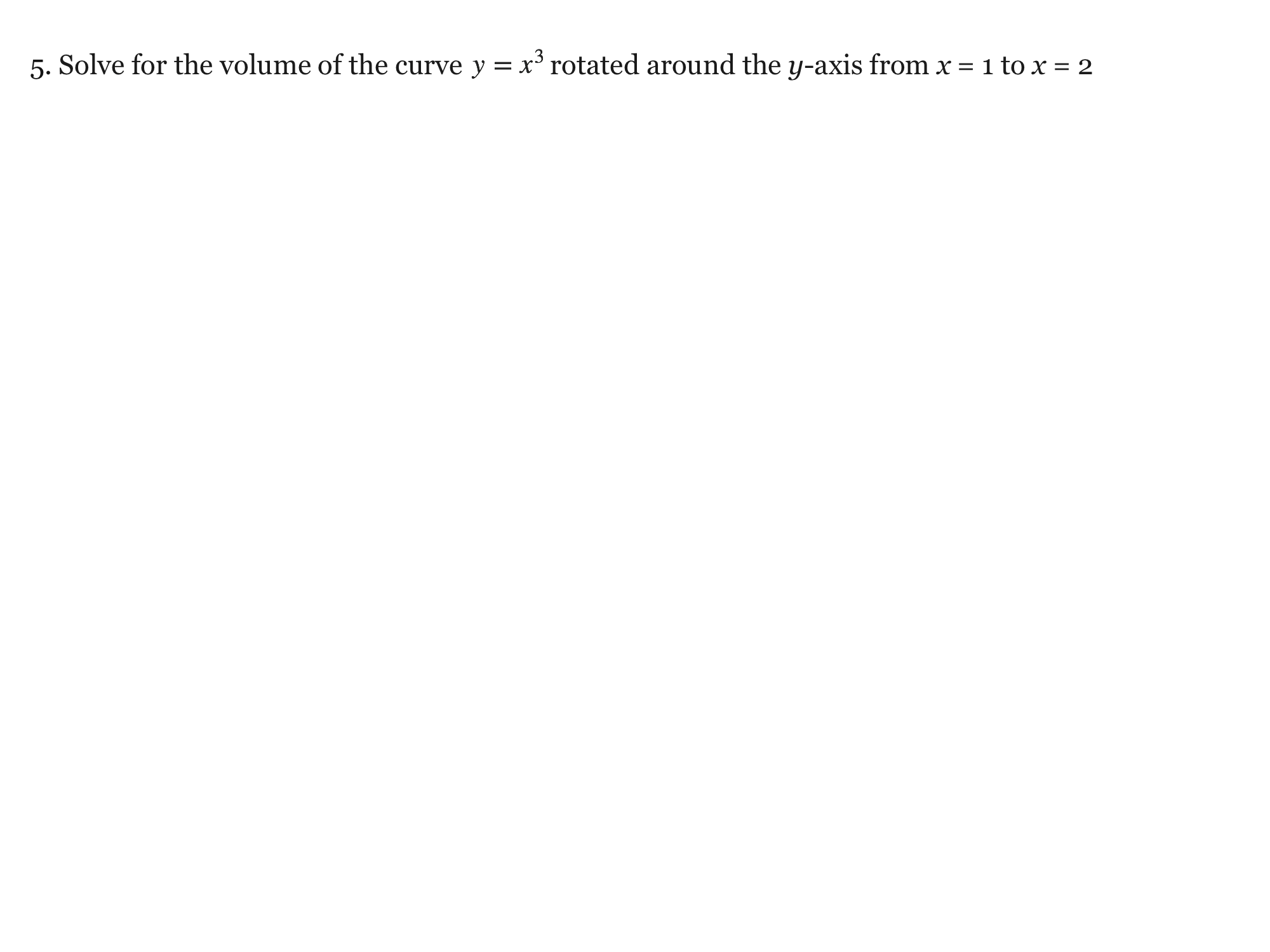
Clarification: Use the region bounded by the y-axis, the curve x=y^(1/3), and the horizontal lines y=1 and y=8, then rotate it about the y-axis.
Drawing is temporarily unavailable. Work on paper if needed, then record your reasoning here.
Saving written working requires JavaScript. Keep your work on paper or in your own notes; the source problem above remains available.
- Solve for the volume of the curve rotated around the y-axis from x = 1 to x = 2
Clarification: Use the region bounded by the y-axis, the curve x=y^(1/3), and the horizontal lines y=1 and y=8, then rotate it about the y-axis.
Show your work for Problem 6
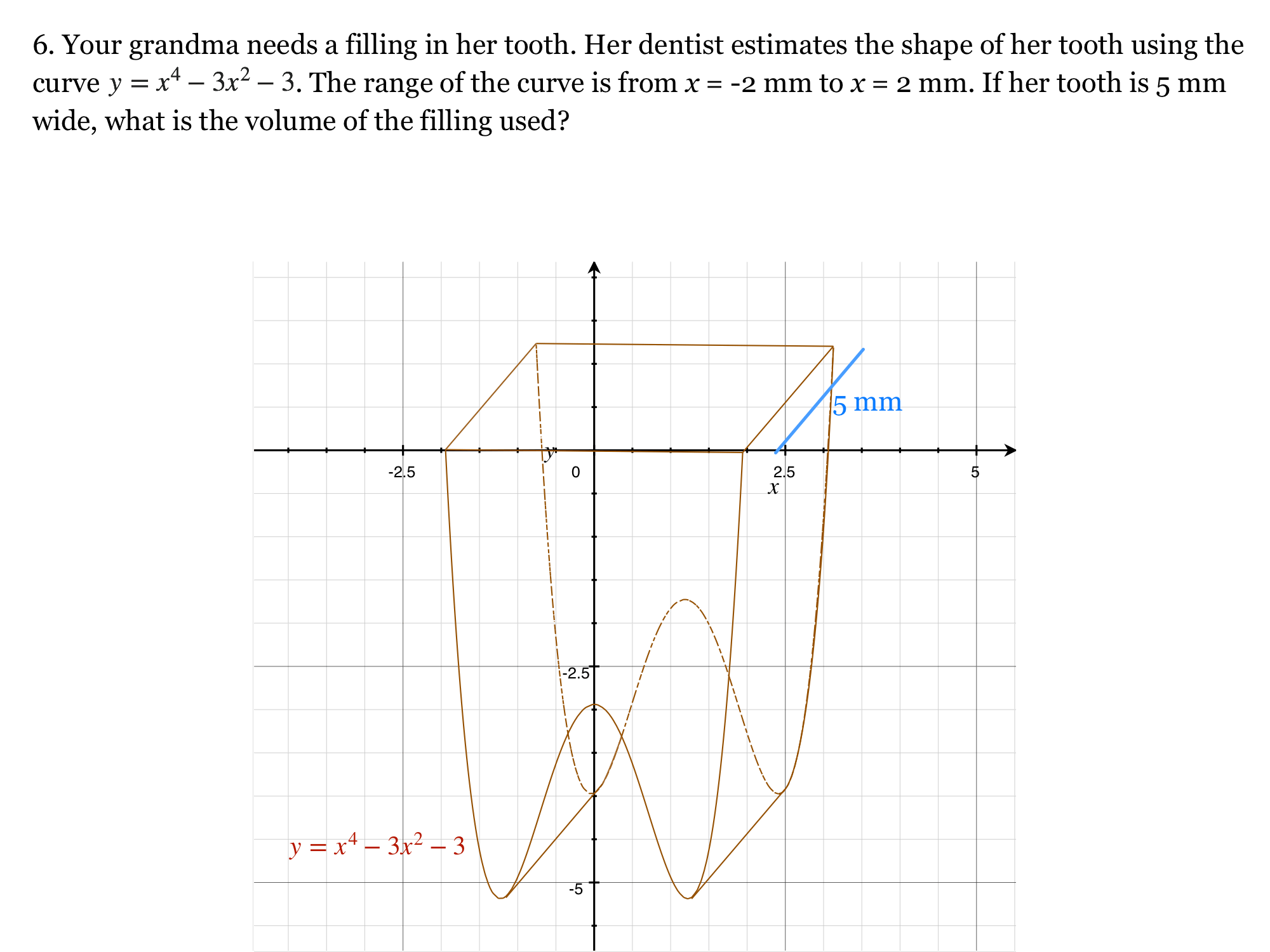
Clarification: The filling is the cavity below the baseline y=0, extruded through a constant width of 5 mm. On −2≤x≤2, use depth max(0,−(x⁴−3x²−3)); exclude the end pieces above y=0.
Drawing is temporarily unavailable. Work on paper if needed, then record your reasoning here.
Saving written working requires JavaScript. Keep your work on paper or in your own notes; the source problem above remains available.
- Your grandma needs a filling in her tooth. Her dentist estimates the shape of her tooth using the curve . The range of the curve is from x=-2mm to x=2mm. If her tooth is 5 mm wide, what is the volume of the filling used?
Clarification: The filling is the cavity below the baseline y=0, extruded through a constant width of 5 mm. On −2≤x≤2, use depth max(0,−(x⁴−3x²−3)); exclude the end pieces above y=0.
Show your work for Problem 8
a) Using cylindrical shells
b) using the washer method
Drawing is temporarily unavailable. Work on paper if needed, then record your reasoning here.
Saving written working requires JavaScript. Keep your work on paper or in your own notes; the source problem above remains available.
- Using the method of washers, find the volume when the region between and , for 0≤y≤1, is rotated about the y-axis.
Clarification: The limits 0 and 1 are y-bounds. Use the y-axis rotation stated in the prose; the source widget’s x-axis label conflicts with it. This strip is not the full enclosed leaf.
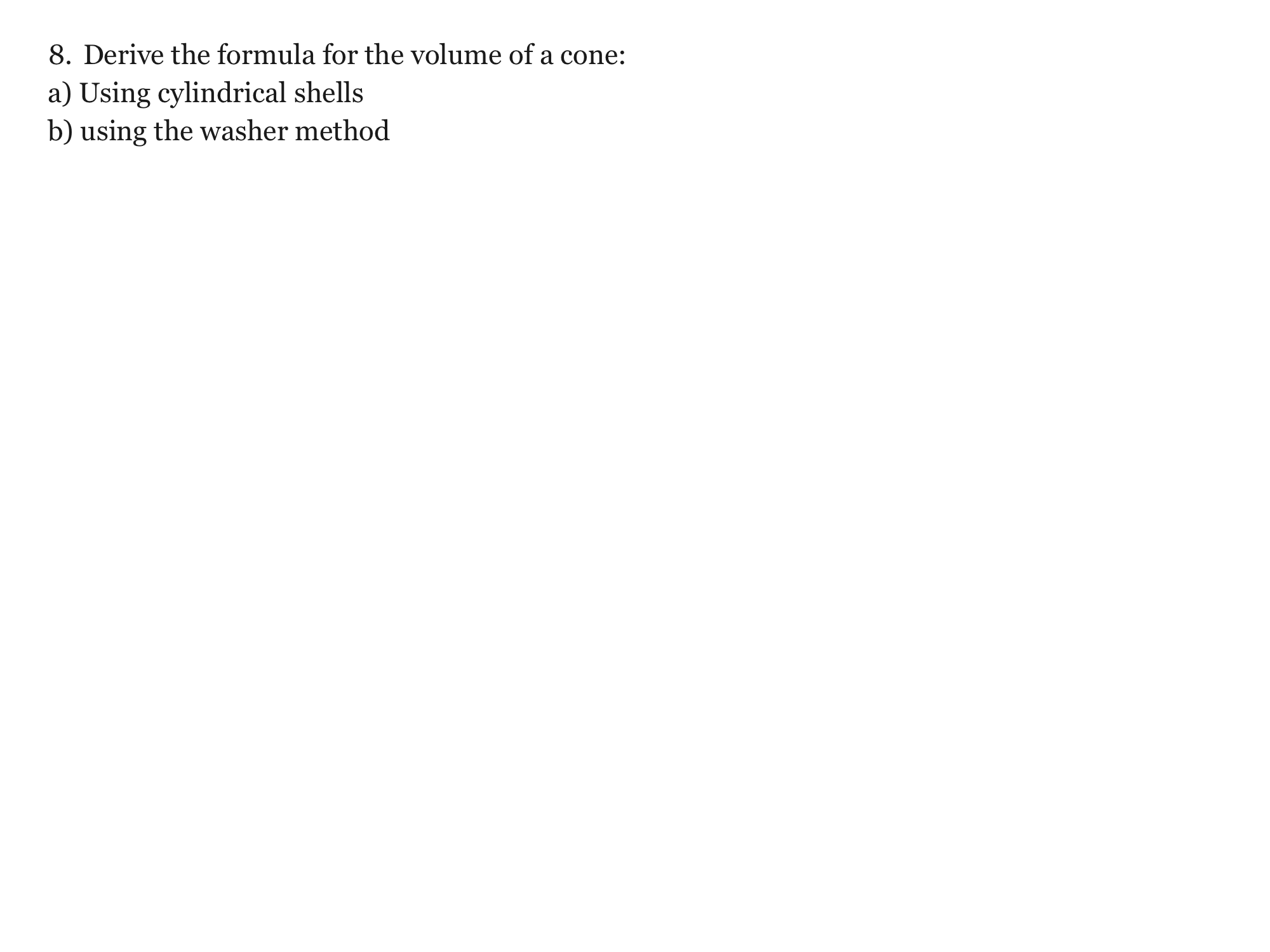
- Derive the formula for the volume of a cone:
a) Using cylindrical shells
b) using the washer method
Show your work for Problem 9
Drawing is temporarily unavailable. Work on paper if needed, then record your reasoning here.
Saving written working requires JavaScript. Keep your work on paper or in your own notes; the source problem above remains available.
Show your work for Problem 10
Shared source instruction or preceding problem:
Problem 10 says to repeat the previous problem with new bounds. Reuse the existing readable Problem 9 statement as context, then keep Problem 10’s own bounds.
Drawing is temporarily unavailable. Work on paper if needed, then record your reasoning here.
Saving written working requires JavaScript. Keep your work on paper or in your own notes; the source problem above remains available.
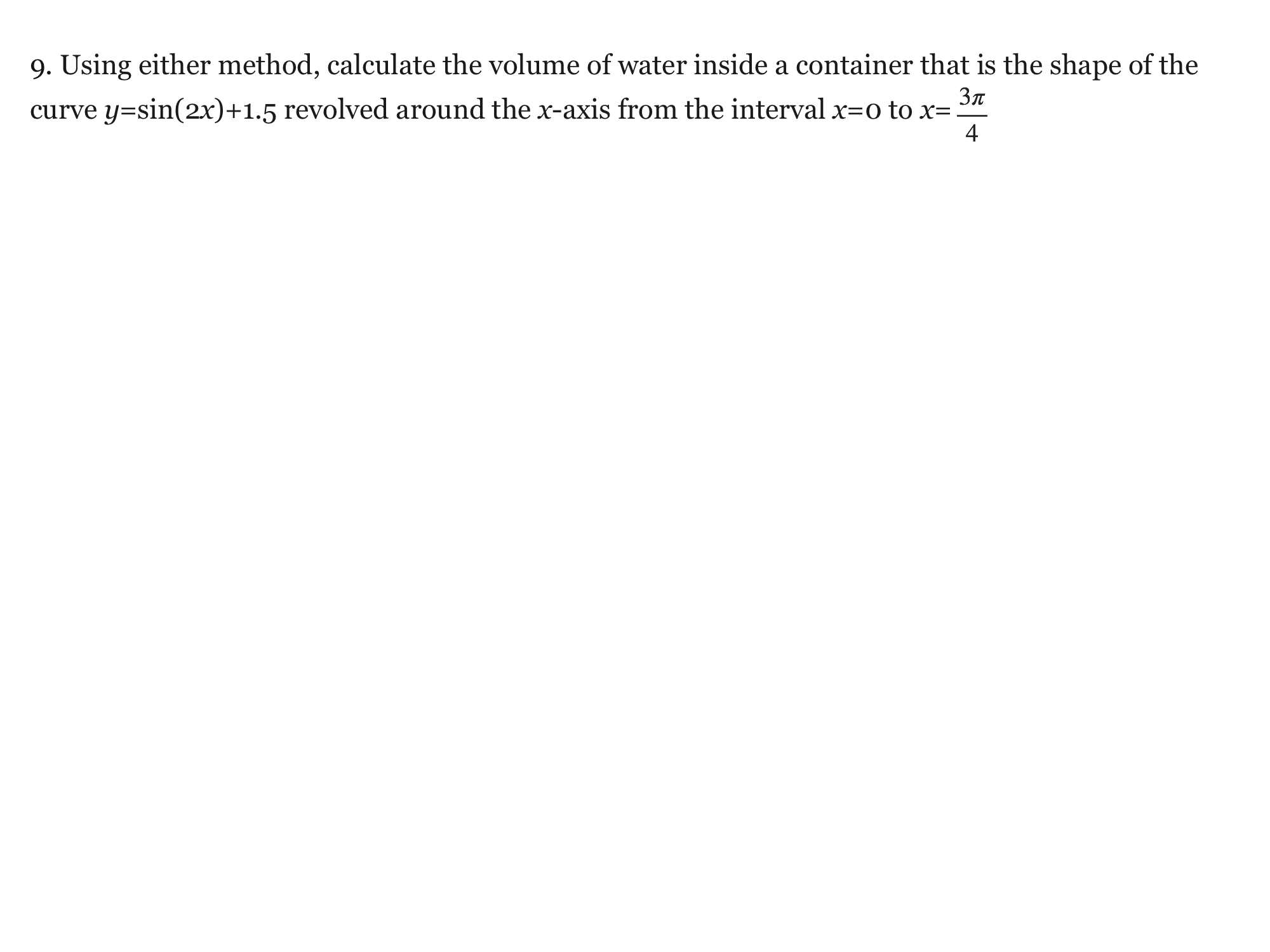
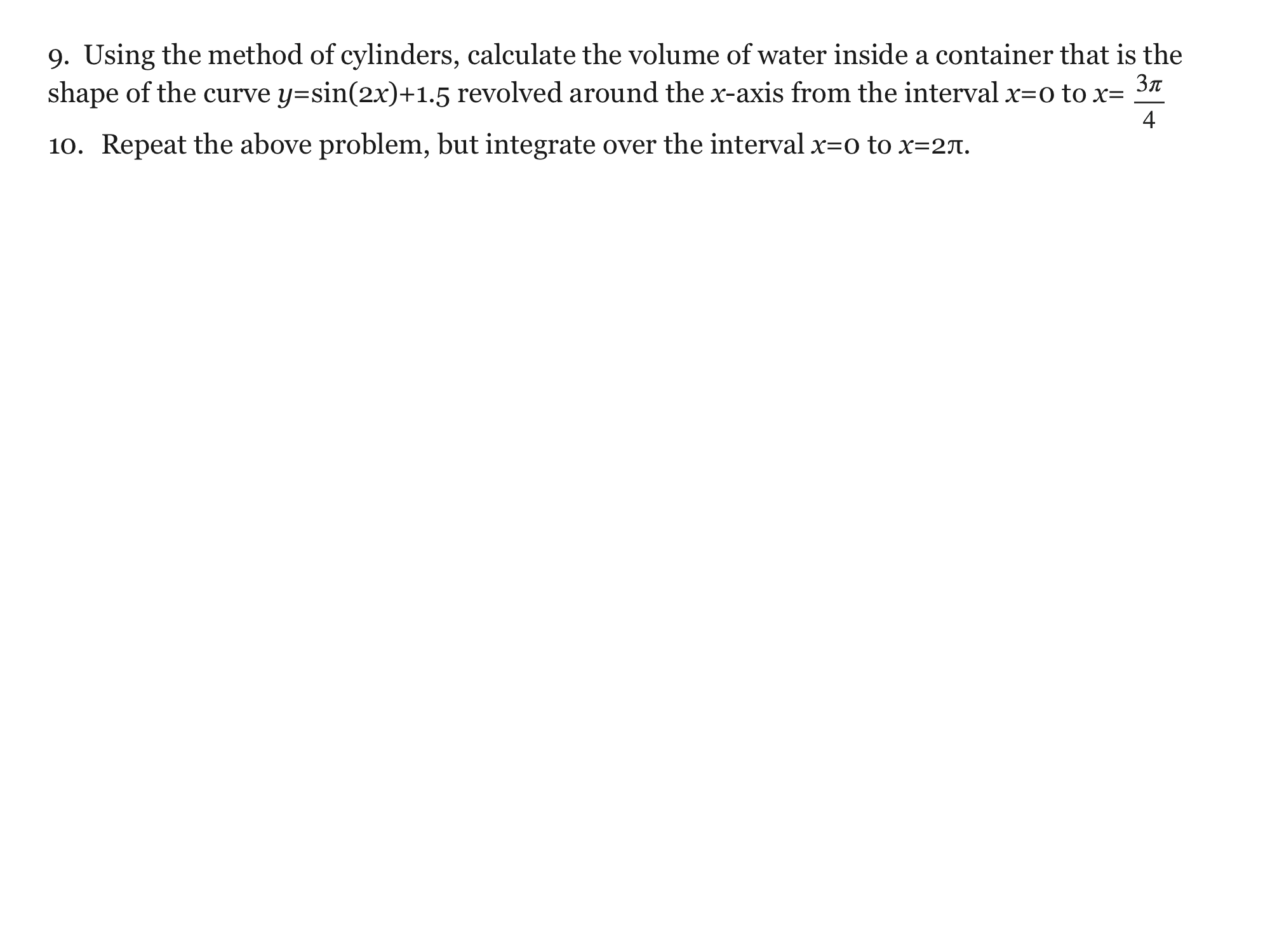
- Using either method, calculate the volume of water inside a container that is the shape of the curve y=sin(2x)+1.5 revolved around the x-axis from the interval x=0 to x=
- Repeat the above problem, but integrate over the interval x=0 to x=2π.
Glossary and deeper reading · 5 refreshers
These editorial refreshers supplement the reading. Definitions and examples are added guidance; original source wording and recorded answers remain in their original context.
-
Disc method
The disc method finds a solid’s volume using circular slices perpendicular to the rotation axis. A slice with radius R has area πR². For example, rotating the region under y=x on [0,1] around the horizontal axis gives volume equal to the integral of πx². If the region leaves a hole around the axis, a washer rather than a full disc is needed.
-
Derivative
A derivative gives the instantaneous rate of change of a function with respect to its input. At a point, it is the finite limit of the difference quotient when that limit exists. For example, the derivative of x² is 2x, so the tangent slope at x=3 is 6. A derivative function collects those rates across the inputs where the function is differentiable.
-
Tangent line
A tangent line at a differentiable point passes through the point and has slope equal to the derivative there. It describes the function’s local linear behavior. For example, y=x² has tangent line y=4+4(x−2) at x=2. A tangent can cross the curve, so touching at exactly one point is not its general definition.
-
Product rule
The product rule differentiates a product of two differentiable functions. It gives (fg)′=f′g+fg′, changing one factor at a time and adding the results. For example, the derivative of x sin x is sin x+x cos x. The product of the two derivatives is generally not the derivative of the product.
-
Function
A mathematical function assigns exactly one output to each input in its domain. Inputs can share an output, but one input cannot have two different outputs. For example, f(x)=x² assigns the output 9 to both 3 and −3. Function notation names the rule and its input; f(3) means the output when the input is 3.