Chapter 10 Solutions
Worked solutions to all thirty problems, with the reason for each step. These explanations were added for this edition; the chapter answer key and original worked examples follow below.
Chapter problems → · Chapter answer key → · Original worked examples →
Problem 1
Original problem · added worked solution
Authored worked explanation for the original source problem.
Source review note: The preserved source answer is 2πb²/a − (2/3)πab². It is not the disc integral of the displayed ellipse and even combines terms with different length dimensions. The reviewed volume is 4πab²/3.
The source diagram gives on . Squaring gives .
Why: The full ellipsoid runs from one end of its major axis to the other, and each perpendicular slice is a circle.
.
Why: The disc area is π times radius squared; integrate that area along the axis.
The upper value is and the lower value is , so .
Why: Subtract both endpoint values. The result also has the expected three powers of length.
Reviewed answer: , for and .
Takeaway: Squaring the radius and using the full axial interval keeps both the geometry and the units right.
Final answer
Problem 2
Original problem · added worked solution
Authored worked explanation for the original source problem.
For , . Each vertical shell has radius and height .
Why: The explicit right cutoff is 0.75, even though the curves meet again at x=1.
.
Why: Shell volume uses circumference times height times thickness.
Evaluation gives , which rounds to .
Why: Apply the specified interval rather than extending the region to its next intersection.
Reviewed answer: cubic units.
Takeaway: A stated vertical cutoff is part of the boundary, even when it is not an intersection.
Final answer
Problem 3
Original problem · added worked solution
Authored worked explanation for the original source problem.
Source review note: The source gives (4/3)πr³+C, a consistent indefinite primitive. For the requested sphere volume, V(0)=0 fixes C=0.
Use a separate shell radius . A thin spherical shell has volume approaching .
Why: For a shell between s and s+Δs, the leading volume term is surface area times thickness; higher-order thickness terms vanish in the integral.
.
Why: Summing outward from zero radius fills the entire sphere.
Equivalently, integrating the area gives , and forces .
Why: A physical volume is fixed by its zero-radius boundary condition, so its constant is not arbitrary.
Reviewed answer: , for .
Takeaway: An indefinite primitive becomes a geometric volume only after its boundary condition is applied.
Final answer
Problem 4
Original problem · added worked solution
Authored worked explanation for the original source problem.
Treat as the vase’s interior radius in meters. It is nonnegative on , and the axial length is m.
Why: Water capacity uses the interior cross section; no wall thickness is specified.
.
Why: Each filled slice is a disc, and squaring the whole radius includes the cross term.
m³.
Why: Subtract the lower endpoint; the source’s 0.333 is the result rounded to three decimal places.
Reviewed answer: m³, or about m³.
Takeaway: A container’s capacity comes from its interior radius and has cubic length units.
Final answer
Problem 5
Original problem · clarified · added worked solution
Clarification: Use the region bounded by the y-axis, the curve x=y^(1/3), and the horizontal lines y=1 and y=8, then rotate it about the y-axis.
Authored worked explanation for the original source problem.
Source review note: The source image repeats the curve-only wording without a shaded region. Its 58.4 matches 93π/5 when the region is closed to the y-axis between y=1 and y=8. Closing under the cubic over x=1..2 instead gives 62π/5. The reviewed answers state these assumptions openly.
Rotating just a curve describes a surface. To reproduce the source’s short answer, close the region against the y-axis and the horizontal lines and .
Why: The stated curve endpoints are (1,1) and (2,8), but the prompt does not say how the enclosed solid is filled.
For that interpretation, is the disc radius, so .
Why: Horizontal discs fill from the rotation axis to the curve.
If instead we close under the curve against and , shells give .
Why: This different bounded region has a hole of radius 1 and cannot be assigned the first region’s volume.
Reviewed answer: If the region is with , then cubic units. If it is under with , then cubic units.
Takeaway: State the filled region before choosing shells or discs; a curve by itself does not specify capacity.
Final answer
Problem 6
Original problem · clarified · added worked solution
Clarification: The filling is the cavity below the baseline y=0, extruded through a constant width of 5 mm. On −2≤x≤2, use depth max(0,−(x⁴−3x²−3)); exclude the end pieces above y=0.
Authored worked explanation for the original source problem.
Source review note: The source gives 15.2 mm³, which equals the signed cross-sectional area numerically and omits the stated 5 mm extrusion width. Its sketch shows a cavity below y=0, but the printed polynomial is positive near x=±2. A below-baseline clipped cavity gives about 76.2594 mm³; the full absolute-area region gives about 76.5187 mm³. The prompt needs a geometric clarification.
Let . The drawing suggests a cavity from the baseline down to the curve, extruded through a constant width of 5 mm. But .
Why: The polynomial rises above the baseline near the stated endpoints, so the drawn below-baseline cavity cannot have depth −f there.
Solve by setting . The positive root is , so the cavity lies on with .
Why: Only the positive u-root produces real endpoints, and f is nonpositive between them.
.
Why: A prismatic slice has area width times depth; symmetry halves the algebra.
Using simplifies this to mm³.
Why: The root relation reduces the fifth-power endpoint expression.
Over the entire printed interval, the signed area is mm². Multiplying by 5 gives 76 mm³, but this subtracts the pieces where f is positive.
Why: A signed integral is not a geometric filling volume when the supposed depth changes sign.
If all area between the curve and baseline is intended, use mm³.
Why: The absolute-value model includes the two above-baseline end pieces, while the clipped cavity excludes them.
Reviewed answer: For the pictured cavity below , mm³, where . The full area-between-curves interpretation on gives about mm³.
Takeaway: Depth must stay nonnegative, and a cross-sectional area must be multiplied by the third dimension.
Final answer
Problem 7
Original problem · clarified · added worked solution
Clarification: The limits 0 and 1 are y-bounds. Use the y-axis rotation stated in the prose; the source widget’s x-axis label conflicts with it. This strip is not the full enclosed leaf.
Authored worked explanation for the original source problem.
Source review note: The prose requests a y-axis rotation and calls the region a bounded leaf, but its 0..1 interval is incompatible with the actual leaf intersections. The source widget text also says x-axis rotation, contradicting the prose. The short answer 0.232 matches none of the stated y-axis interpretations; about 0.232332 is the y=0..1 washer integral before multiplying by π. All reviewed values above identify their own region.
For y-axis washers, invert the curves: from with , and from .
Why: Radii are horizontal distances from the y-axis, so we need x as a function of y.
The enclosed leaf starts at and ends at , where . Its second x-coordinate is .
Why: The curves meet at x=1 and at a second point beyond x=1; they do not enclose a leaf between x=0 and x=1.
On , the outer radius is and the inner radius is . Thus .
Why: Between the intersections, y² is the larger nonnegative distance to the axis.
If the interval instead means , the between-curves region extends down without bound. For it gives discs of radius ; for it gives washers with outer radius and inner radius .
Why: Negative y cannot be inverted through y=√x, so those lower slices have no inner hole.
.
Why: Use an improper lower limit for the unbounded region; its exponentially narrowing slices still have finite volume.
If 0 and 1 are meant as y-bounds, keep only the second integral, obtaining .
Why: Changing which coordinate owns the bounds changes the region and its volume.
Reviewed answer: For the actual enclosed leaf about the y-axis, cubic units. For the printed interval interpreted as , . If the intended bounds are , .
Takeaway: Washer limits belong to the slicing variable, and an inverse curve retains its domain restrictions.
Final answer
Problem 8
Original problem · added worked solution
a) Using cylindrical shells
b) using the washer method
Authored worked explanation for the original source problem.
Place the cone’s tip at , base at , and side at for . The generating triangle lies above that side and below the base.
Why: This orientation gives radius r at height h and zero radius at the tip.
Vertical shells have radius x and height . So .
Why: A shell at radius x spans from the sloping side to the base plane.
For horizontal discs, the radius is . Hence .
Why: A disc is perpendicular to the cone’s axis; its radius grows linearly from the tip.
The disc method is the washer method with inner radius zero. Both integrals describe the same cone.
Why: The two slice families fill the same solid, so they must agree.
Reviewed answer: , for and .
Takeaway: Changing slice direction changes the setup, while the region and its volume stay fixed.
Final answer
Problem 9
Original problem · added worked solution
Authored worked explanation for the original source problem.
Source review note: The preserved source answer is 59π²/16. Squaring the printed radius and integrating on 0..3π/4 instead gives 33π²/16+3π/2; the cross term contributes 3π/2, not another constant multiple of π².
The interior radius is always at least 1/2. Use .
Why: A positive radius gives filled discs throughout this axial interval.
Expand the square to , then use .
Why: The radius square includes the cross term 3 sin(2x).
A primitive of the integrand without π is .
Why: Integrate the constant, cosine, and sine terms with their inside factors.
The endpoint difference is , so multiplying by π gives .
Why: At the upper endpoint cos(3π/2)=0; at zero cos0=1, leaving the extra 3/2.
Reviewed answer: cubic units.
Takeaway: A shifted radius creates a cross term whose definite integral may not vanish.
Final answer
Problem 10
Original problem · added worked solution
Authored worked explanation for the original source problem.
Use the same squared radius: .
Why: Only the axial interval changes from problem 9.
Over this interval, and .
Why: The sine term spans whole periods and cancels; its square has average value 1/2.
.
Why: The constant radius contribution adds to the nonzero average of sine squared.
Reviewed answer: cubic units.
Takeaway: Over whole periods the sine cross term cancels, but its squared term does not.
Final answer
Problem 11
Added problem and worked solution
Use cylindrical shells to find the volume when the region , is revolved about the y-axis.
Authored solution to an added practice problem.
A vertical strip has shell radius x and height on .
Why: The region meets the y-axis and lies above y=0, so these strips rotate into shells without a hole at the center.
.
Why: The shell circumference supplies the factor x before integration.
Reviewed answer: cubic units.
Takeaway: Shell height is the region’s gap, while radius is distance to the axis.
Final answer
Problem 12
Added problem and worked solution
Revolve the region , about the y-axis. Find its volume with shells.
Authored solution to an added practice problem.
The shell radius is x, and its height is on .
Why: This interval stays away from the reciprocal function’s singularity.
.
Why: The height cancels the radius before integration, so no logarithmic primitive is needed.
Reviewed answer: cubic units.
Takeaway: Simplify the complete volume integrand rather than integrating the boundary curve alone.
Final answer
Problem 13
Added problem and worked solution
Use shells for the region , revolved about the vertical line .
Authored solution to an added practice problem.
The axis is to the right of the region, so the shell radius is and its height is .
Why: A radius measures horizontal distance to the actual rotation axis, not always distance to x=0.
.
Why: All radii are positive and each strip produces a distinct shell.
Reviewed answer: cubic units.
Takeaway: A shifted rotation axis changes the radius before it changes any integration.
Final answer
Problem 14
Added problem and worked solution
In the first quadrant, the region is bounded by , , and . Revolve it about the x-axis and find its volume using horizontal shells.
Authored solution to an added practice problem.
At a height , the region runs from to . The shell radius is y and its horizontal length is .
Why: Solving y=x² for nonnegative x gives the endpoint of each horizontal strip.
.
Why: Shells parallel to the x-axis use dy and a radius measured vertically.
A quick disc check is .
Why: At each x the region stretches from y=x² to y=4, giving outer radius 4 and inner radius x².
Reviewed answer: cubic units.
Takeaway: Changing variables for shells means changing both the strip endpoints and the limits.
Final answer
Problem 15
Added problem and worked solution
Use shells to find the volume obtained by revolving the first-quadrant region bounded by , , and about .
Authored solution to an added practice problem.
For , the horizontal strip goes from to . Its distance below is .
Why: The boundary y=x² is inverted on x≥0, and the axis lies above every strip.
.
Why: Multiply circumference by horizontal length, then integrate through the full height range.
Reviewed answer: cubic units.
Takeaway: Shell radius and shell length can depend on the same variable in different ways.
Final answer
Problem 16
Added problem and worked solution
A student uses for the region , revolved about the y-axis. Explain the setup error and find the correct volume.
Authored solution to an added practice problem.
The strip’s radius is x and height is . Its circumference is , so the correct integral is .
Why: A shell uses circumference times height; πx² is a disc area and does not belong in this shell setup.
. The student’s integral gives π/6 instead.
Why: The extra x changes the weighting of the shells and halves the result in this example.
Reviewed answer: cubic units; replace the extra radius factor.
Takeaway: Identify the slice shape before deciding whether the radius is squared.
Final answer
Problem 17
Added problem and worked solution
Find the volume when the region , is revolved about the x-axis. Use washers.
Authored solution to an added practice problem.
The outer radius is and the inner radius is 1 on .
Why: Both boundary curves lie above the x-axis, and the space below y=1 stays empty.
.
Why: Subtract the two circular areas; do not square the gap between the radii.
Reviewed answer: cubic units.
Takeaway: Washer area is the difference of squares, not the square of the difference.
Final answer
Problem 18
Added problem and worked solution
Revolve , about the y-axis. Use horizontal discs to find the volume.
Authored solution to an added practice problem.
At height y, the region extends from the y-axis to , so its disc radius is .
Why: A horizontal slice is perpendicular to the vertical rotation axis.
.
Why: Square the complete radius before taking the primitive.
Reviewed answer: cubic units.
Takeaway: The power in a boundary equation doubles when that boundary becomes a disc radius.
Final answer
Problem 19
Added problem and worked solution
Find the volume generated by revolving , about . Use washers.
Authored solution to an added practice problem.
Distances from are and on .
Why: The lower edge y=0 is one unit from the axis, so there is an inner hole.
.
Why: The constant squares cancel, but the cross term survives.
.
Why: The upper endpoint contributes 8+32/3.
Reviewed answer: cubic units.
Takeaway: Translate both radii to the new axis before forming the washer area.
Final answer
Problem 20
Added problem and worked solution
Use washers to revolve the region , about . Find its volume.
Authored solution to an added practice problem.
Horizontal slices have outer radius and inner radius .
Why: The axis x=−2 lies left of both vertical boundaries, so subtracting its coordinate gives each distance.
.
Why: For a vertical axis, washers advance in the y-direction.
.
Why: At y=2 the radii coincide, so the final washer correctly closes to zero area.
Reviewed answer: cubic units.
Takeaway: The larger horizontal distance is the outer radius, regardless of which curve is algebraically simpler.
Final answer
Problem 21
Added problem and worked solution
Find the volume obtained by revolving the region between and on about the x-axis.
Authored solution to an added practice problem.
For each , the region lies between y=0 and y=x. Its disc radius is .
Why: The boundary is below the axis when x<0, but a geometric radius is still nonnegative.
.
Why: Squaring removes the radius’s sign, and the two symmetric halves add rather than cancel.
Reviewed answer: cubic units.
Takeaway: A below-axis region contributes positive volume; signed area cancellation does not apply to discs.
Final answer
Problem 22
Added problem and worked solution
For , revolve the region about the x-axis. A student subtracts from each cross-sectional area. Explain why that is wrong and find the volume.
Authored solution to an added practice problem.
Each vertical segment runs from y=−1 to and crosses the x-axis. Its rotation fills all radii from zero to .
Why: A segment crossing the axis leaves no empty central circle, and 2+x is always farther from the axis than 1.
Use .
Why: The radius 1 describes already-filled material, so subtracting its area would remove volume that is present.
Reviewed answer: cubic units; the proposed washers should be discs.
Takeaway: A washer’s inner radius comes from a real hole, not merely a second boundary curve.
Final answer
Problem 23
Added problem and worked solution
A sphere of radius is centered at the origin. Use discs to find the volume of the portion between the planes and .
Authored solution to an added practice problem.
At coordinate x, the sphere has disc radius . Keep only .
Why: The sphere equation determines the perpendicular circular cross section; the given planes set its axial bounds.
.
Why: This is a segment of the sphere, so do not integrate over −R..R.
Reviewed answer: , for .
Takeaway: The same cross-sectional formula can describe different solids when its bounds change.
Final answer
Problem 24
Added problem and worked solution
A solid frustum has height and end radii . Its radius varies linearly along its axis. Derive its volume with discs.
Authored solution to an added practice problem.
Let for .
Why: A straight conical side makes the radius interpolate linearly between the two stated end radii.
.
Why: Expanding the radius square gives a constant, a linear term, and a quadratic term; integrate each over the axial length.
Combine the terms to get . When this reduces to the cone formula.
Why: The algebra collects both squared end radii and their cross term; the zero-radius case is a useful check.
Reviewed answer: .
Takeaway: A radius that varies linearly still produces a quadratic cross-sectional area.
Final answer
Problem 25
Added problem and worked solution
A solid has base region between and for , with coordinates in centimeters. Cross sections perpendicular to the x-axis are squares whose sides equal the vertical gap in the base. Find its volume.
Authored solution to an added practice problem.
The boundaries meet at , and the vertical gap is cm between them.
Why: This gap is the stated side length of each square cross section and is nonnegative on the interval.
The cross-sectional area is cm², so .
Why: The solid uses squares rather than circles; their area formula replaces πr².
cm³.
Why: Area times axial thickness has cubic centimeter units.
Reviewed answer: cm³.
Takeaway: The volume principle is still integral of area even when the slices are not circular.
Final answer
Problem 26
Added problem and worked solution
A solid has base disk . Cross sections perpendicular to the x-axis are semicircles whose diameters are the vertical chords of the base disk. Find the volume. You may use semicircle area for diameter d.
Authored solution to an added practice problem.
At each , the base disk has vertical gap .
Why: The full gap is the diameter of the semicircular section, not its radius.
A semicircle has area , so .
Why: Use half of π(d/2)² to account for both the diameter-to-radius conversion and the half circle.
.
Why: Integrate the semicircular areas across the full width of the base.
Reviewed answer: cubic units.
Takeaway: If a problem specifies a diameter, convert it before squaring.
Final answer
Problem 27
Added problem and worked solution
A solid has base region , . Cross sections perpendicular to the x-axis are equilateral triangles with side length equal to the base’s vertical gap. Given triangle area , find the volume.
Authored solution to an added practice problem.
The base’s vertical gap is for . Each triangle therefore has area .
Why: The supplied area formula squares the side length, which removes the boundary’s square root.
.
Why: Sum the triangular areas along the x-axis rather than applying a circle or shell formula.
Reviewed answer: cubic units.
Takeaway: Translate the base gap through the stated cross-sectional shape before integrating.
Final answer
Problem 28
Added problem and worked solution
A solid’s cross-sectional area is m² for and m² for , where x is measured in meters. Find its volume.
Authored solution to an added practice problem.
Split the volume integral where the cross-sectional formula changes: .
Why: A piecewise area must be integrated with the correct formula on each axial interval.
The first part is m³; the second is m³.
Why: The second interval has length two, so its endpoint values cannot be reused from the first piece.
Add the two positive parts: m³.
Why: The solid’s volume is the sum of its nonoverlapping axial pieces; a single jump in area does not affect the integral.
Reviewed answer: m³.
Takeaway: A change in slice formula requires a change in the integral’s pieces.
Final answer
Problem 29
Added problem and worked solution
A solid has measured cross-sectional areas of 4, 7, and 5 cm² at axial positions 0, 1, and 3 cm. Estimate its volume on this interval by a trapezoid between each pair of samples.
Authored solution to an added practice problem.
On the interval from 0 to 1 cm, the trapezoid contributes cm³.
Why: Average the endpoint areas and multiply by that interval’s length.
On the interval from 1 to 3 cm, it contributes cm³.
Why: These samples have unequal spacing; the second slice interval is twice as long.
Add the estimates: cm³.
Why: The table does not specify area between samples, so trapezoids provide an estimate rather than a guaranteed exact value.
Reviewed answer: Trapezoidal estimate: cm³.
Takeaway: Measured areas estimate volume only after they are weighted by their axial spacing.
Final answer
Problem 30
Added problem and worked solution
Revolve the region bounded by and on about the x-axis. Compute its volume once with washers and once with horizontal shells, showing both sets of radii and bounds.
Authored solution to an added practice problem.
The curves and meet at x=0 and x=1, with x above x² between them. Washers about the x-axis have radii x and x².
Why: Both radii are nonnegative, and vertical slices are perpendicular to the axis.
.
Why: Subtract the squared inner radius from the squared outer radius.
At height , a horizontal strip runs from to . Its shell radius is y and length is .
Why: Invert both boundaries on their nonnegative branches before changing the slicing direction.
.
Why: The shell circumference and horizontal length describe the same solid’s volume with dy.
Reviewed answer: cubic units by either method.
Takeaway: Two correct setups can use different variables and still agree because their geometry agrees.
Final answer
Chapter answer key and worked steps
Answers and worked steps for the original problems, including verified corrections where needed.
-
Corrected answer
, for and .Problem 1 → -
Original short answer
Problem 2 → -
Checked answer
, for .Problem 3 → -
Original short answer
Problem 4 → -
Checked answer
cubic units.Problem 5 → -
Corrected answer
For the clarified cavity below , mm³, where .Problem 6 → -
Corrected answer
cubic units.Problem 7 → -
Original short answer
Prove it isProblem 8 → -
Corrected answer
cubic units.Problem 9 → -
Original short answer
Problem 10 →
Source worked examples
These are the book’s example problems and worked steps, with the original explanations.
Example Problem 10.1.1
Conic Paper Co. is coming up with a new design for their disposable paper cups. They came up with this design by taking a piece of the cone formed by revolving the equation y = 2x around the y-axis to form a cone. If the cone’s radius is 2 cm, using the cylindrical shells method, calculate the mass of water that this new paper cup can hold, assuming the density of water is 1 gram per cubic centimeter?
Interactive 10.1.1 Example 10.1.1 visualized
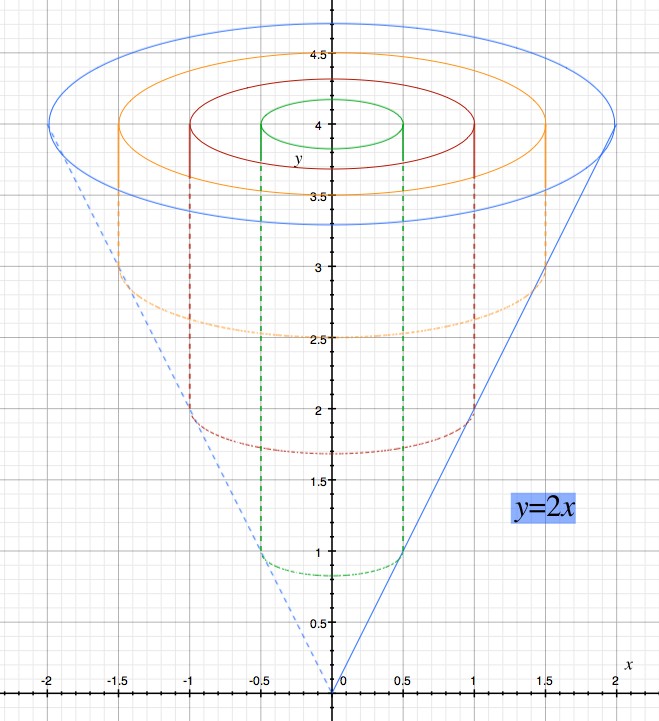
Read all original figure notes
Area of each shell
x ranges from 0 to 2
Height of each shell
Example Problem 10.1.2.
On the interval of 0 to 1, the function is bound by on the bottom. The area between them is rotated around the x-axis. Find the volume of the resulting solid using shells.
Interactive 10.1.2 Example 10.1.2
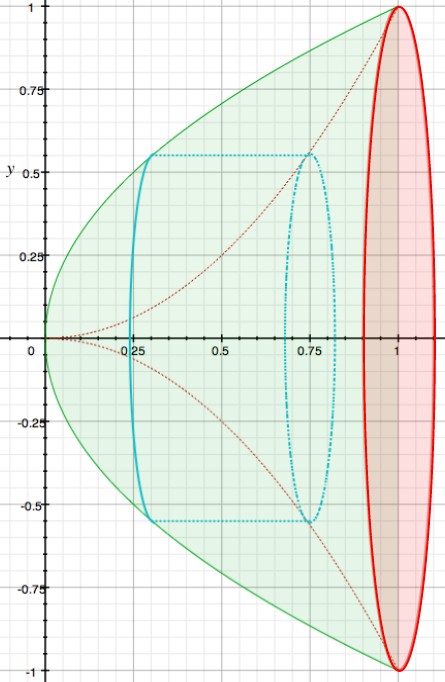
Read all original figure notes
Cylindrical Shell
Lower Bound
Upper Bound
Example Problem 10.2.1
On the interval of 0 to 1, the function is bound by on the bottom. The area between them is rotated around the x-axis. Find the volume of the resulting solid using the method of discs (also known as washers).
Interactive 10.2.2 Example 10.2.1
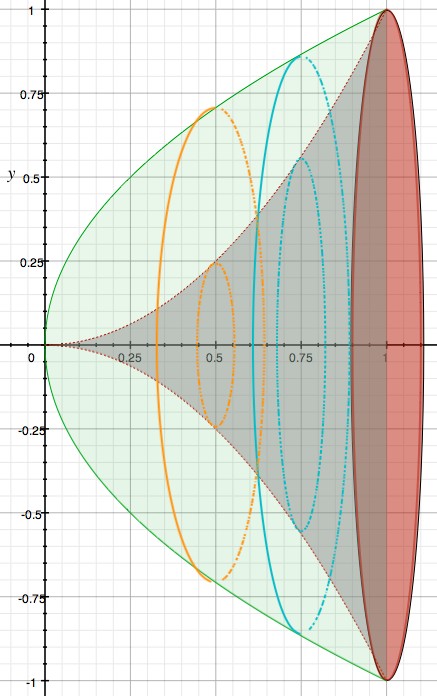
Read all original figure notes
Area of Orange washer/disc
Summation along x-axis
Example Problem 10.2.2
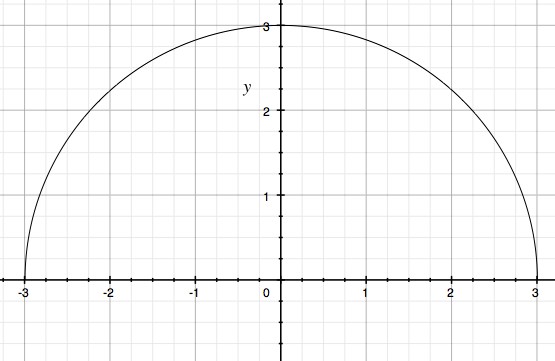
Using the disc method, prove that the volume of a sphere is
Interactive 10.2.2 Example 10.2.1
Read all original figure notes
Area of Orange washer/disc
Summation along x-axis
Interactive 10.2.3 A Hint for Example 10.2.2