Chapter 1 Problems
Thirty chapter problems: 10 from the original book and 20 added for more practice.
Read the chapter problems → · Chapter solutions →
-
Original problem
Calculate . Refer to the unit circle.Show your work for Problem 1
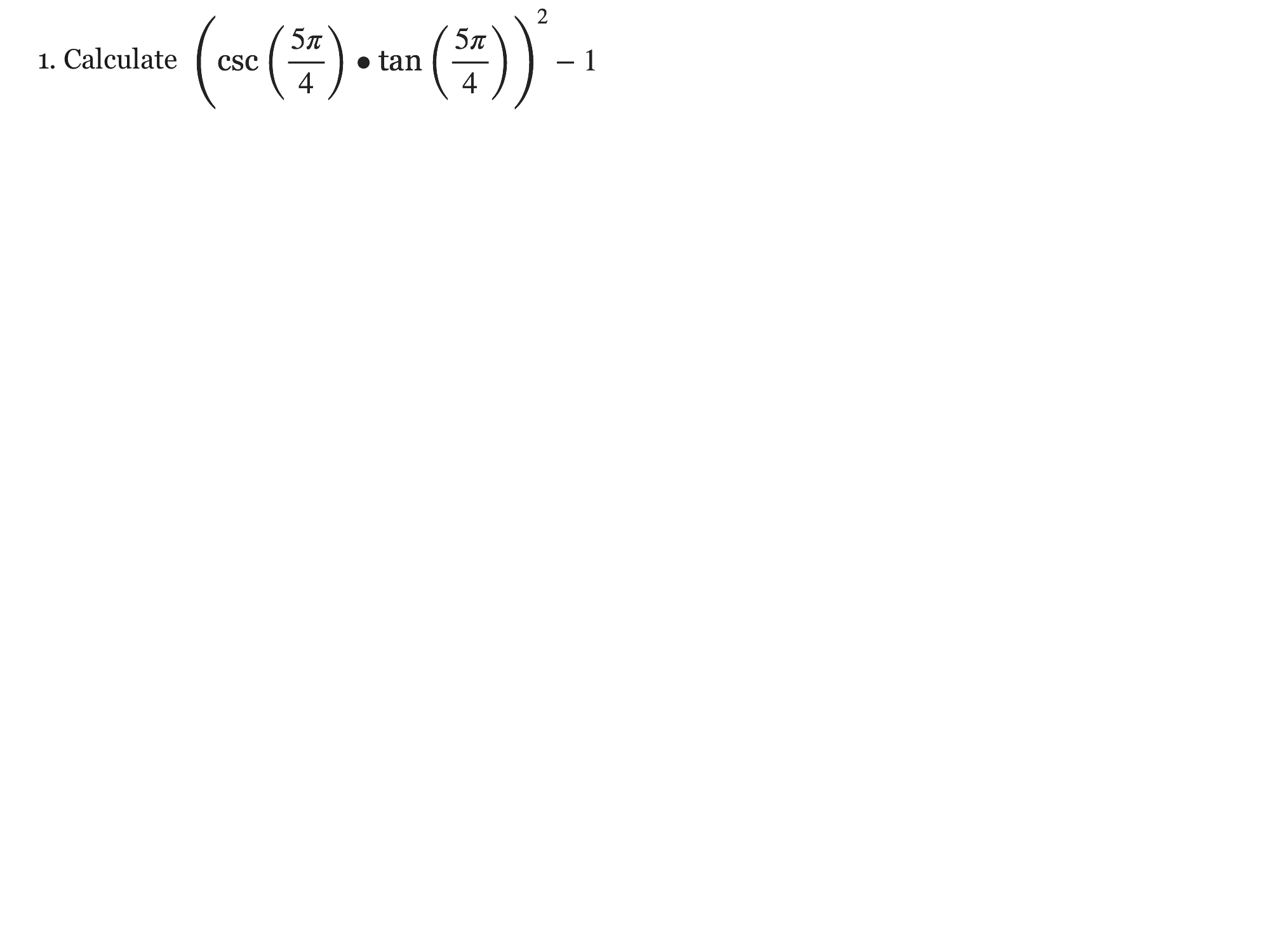
Original source problem image and any figures. Read it together with the accessible problem text and any figure description or source note alongside it. Open the source image at full size. Drawing is temporarily unavailable. Work on paper if needed, then record your reasoning here.
Saving written working requires JavaScript. Keep your work on paper or in your own notes; the source problem above remains available.
-
Original problem
CalculateShow your work for Problem 2
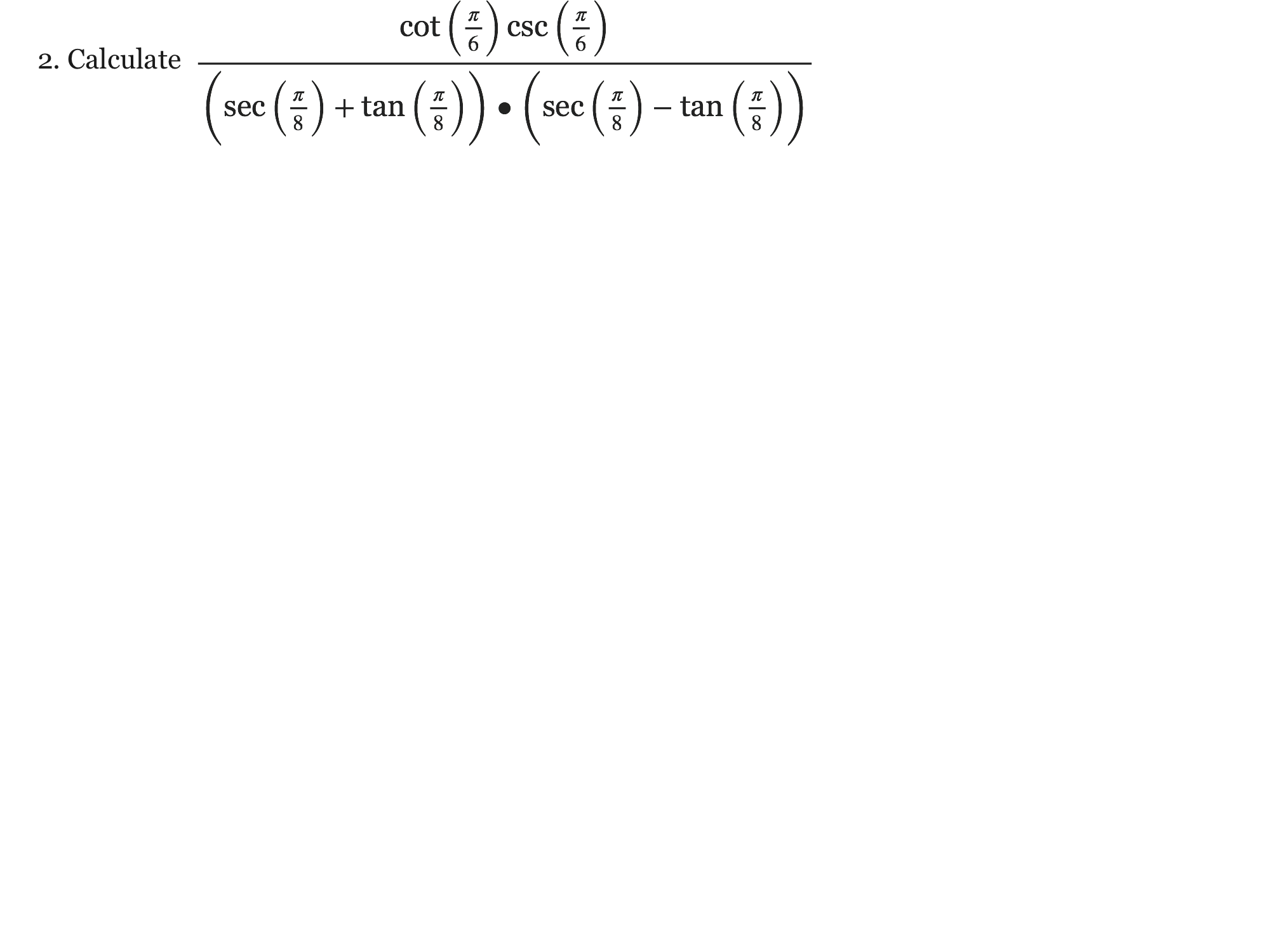
Original source problem image and any figures. Read it together with the accessible problem text and any figure description or source note alongside it. Open the source image at full size. Drawing is temporarily unavailable. Work on paper if needed, then record your reasoning here.
Saving written working requires JavaScript. Keep your work on paper or in your own notes; the source problem above remains available.
-
Original problem
CalculateShow your work for Problem 3
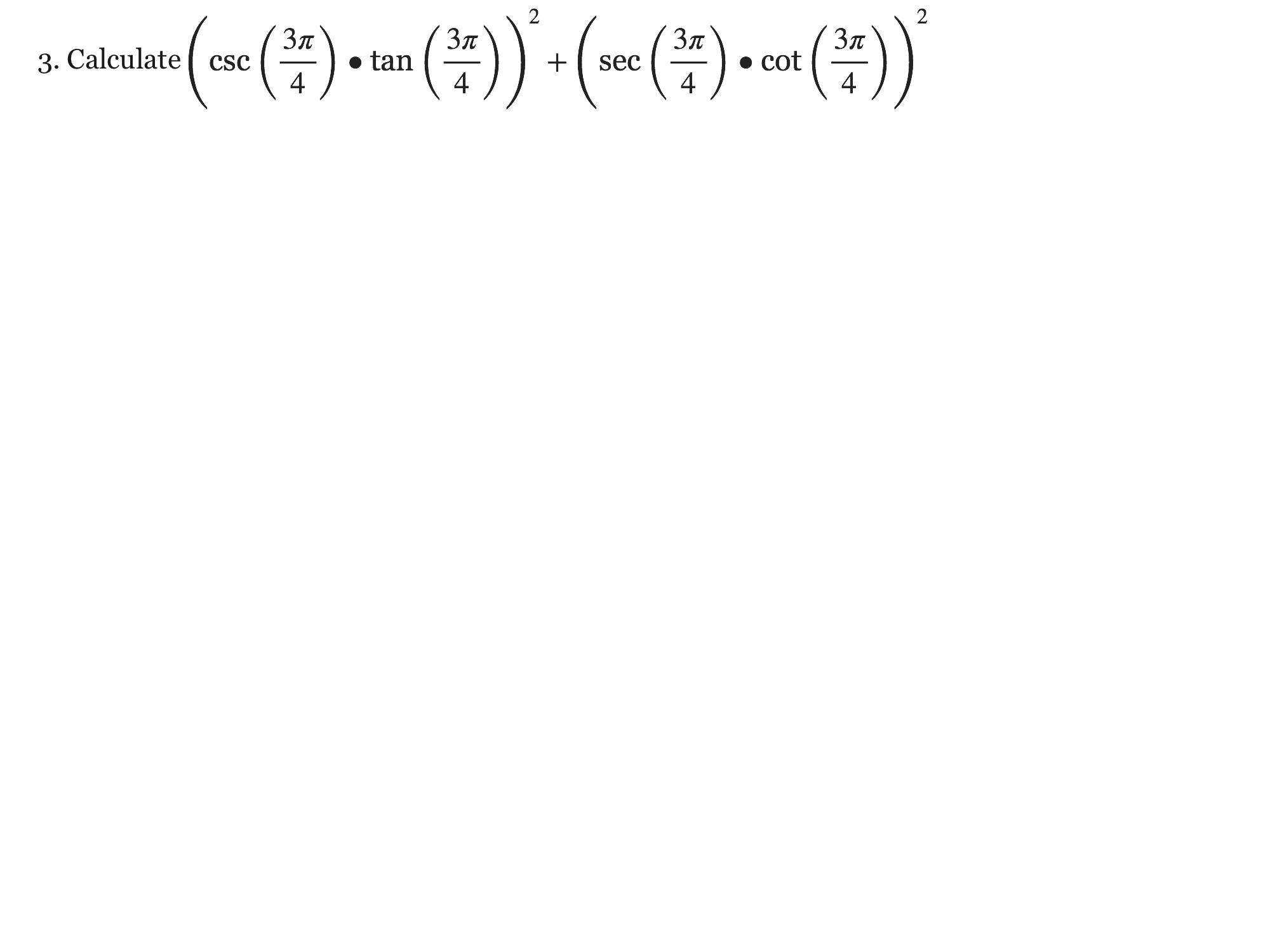
Original source problem image and any figures. Read it together with the accessible problem text and any figure description or source note alongside it. Open the source image at full size. Drawing is temporarily unavailable. Work on paper if needed, then record your reasoning here.
Saving written working requires JavaScript. Keep your work on paper or in your own notes; the source problem above remains available.
-
Original problem
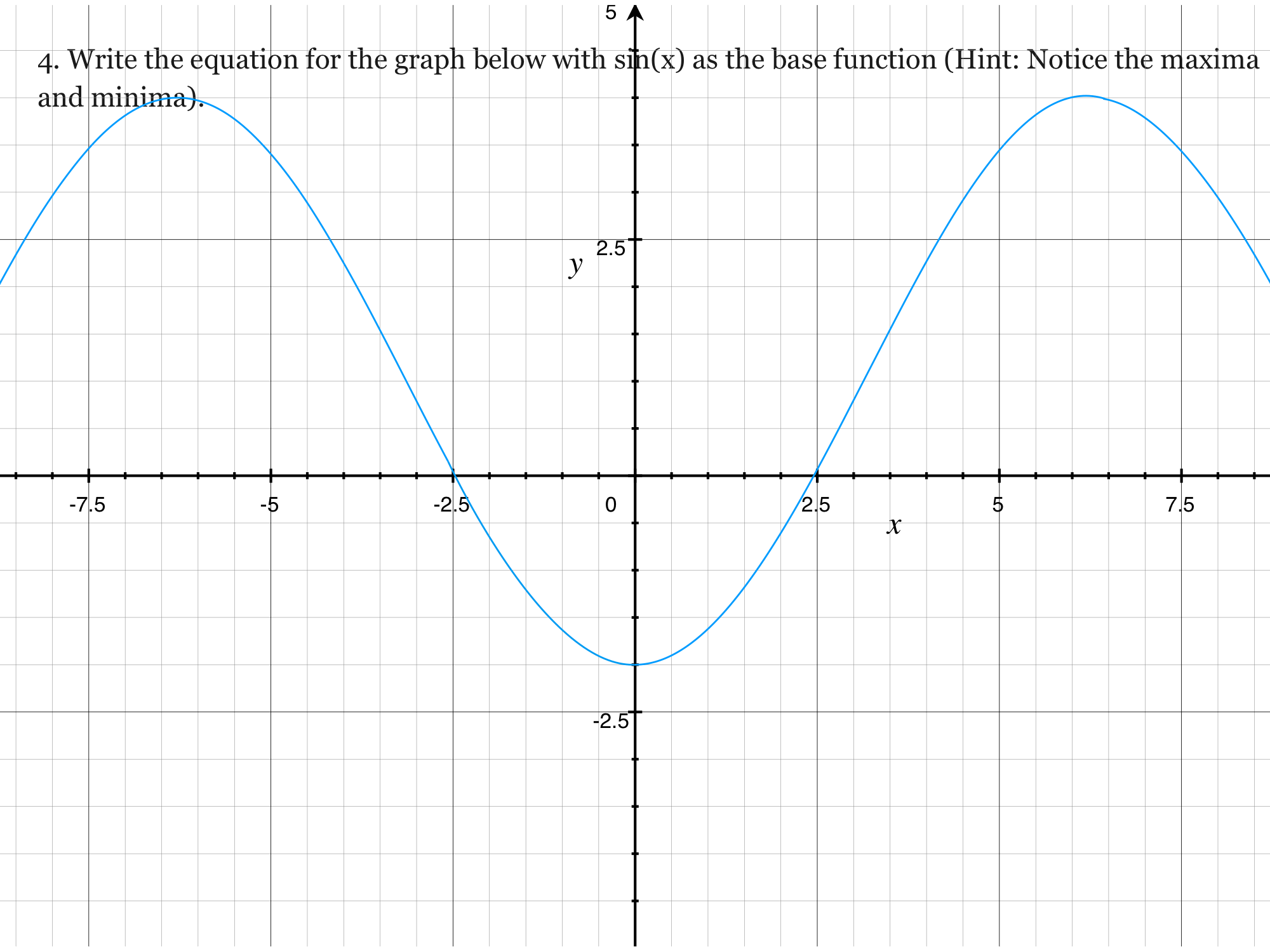
Write the equation for the graph below with sin(x) as the base function (Hint: Notice the maxima and minima).Show your work for Problem 4
Source sinusoidal graph
A blue sinusoidal curve is drawn on a Cartesian grid. The horizontal axis is x and the vertical axis is y. Visible labeled x-values include −7.5, −5, −2.5, 0, 2.5, 5 and 7.5; visible labeled y-values include −2.5, 0, 2.5 and 5.
The curve has a trough on the y-axis at approximately y=−2 and neighboring crests at approximately y=4, near x=−6.3 and x=6.3. It crosses the x-axis near x=−2.5 and x=2.5. The plotted wave is symmetric about the y-axis.
Coordinates not printed next to the extrema are approximate readings from the source raster. No exact symbolic crest positions or period are printed; this description does not supply an unprinted exact period or an equation.
Original source problem image and any figures. Read it together with the accessible problem text and any figure description or source note alongside it. Open the source image at full size. Drawing is temporarily unavailable. Work on paper if needed, then record your reasoning here.
Saving written working requires JavaScript. Keep your work on paper or in your own notes; the source problem above remains available.
-
Original problem
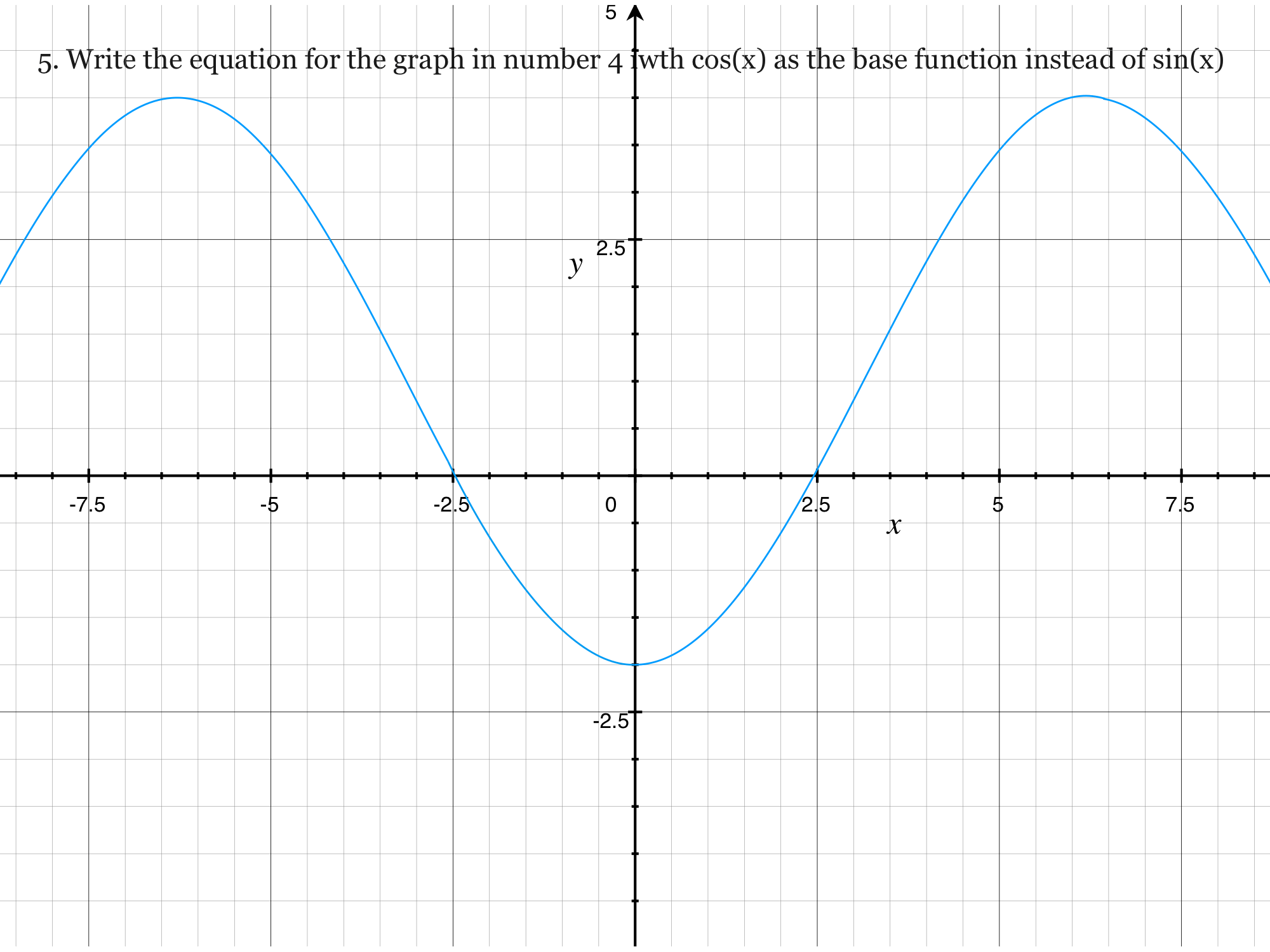
Write the equation for the graph in number 4 with cos(x) as the base function rather than sin(x).Show your work for Problem 5
Source sinusoidal graph
A blue sinusoidal curve is drawn on a Cartesian grid. The horizontal axis is x and the vertical axis is y. Visible labeled x-values include −7.5, −5, −2.5, 0, 2.5, 5 and 7.5; visible labeled y-values include −2.5, 0, 2.5 and 5.
The curve has a trough on the y-axis at approximately y=−2 and neighboring crests at approximately y=4, near x=−6.3 and x=6.3. It crosses the x-axis near x=−2.5 and x=2.5. The plotted wave is symmetric about the y-axis.
Coordinates not printed next to the extrema are approximate readings from the source raster. No exact symbolic crest positions or period are printed; this description does not supply an unprinted exact period or an equation.
Original source problem image and any figures. Read it together with the accessible problem text and any figure description or source note alongside it. Open the source image at full size. Drawing is temporarily unavailable. Work on paper if needed, then record your reasoning here.
Saving written working requires JavaScript. Keep your work on paper or in your own notes; the source problem above remains available.
-
Original problem · clarified
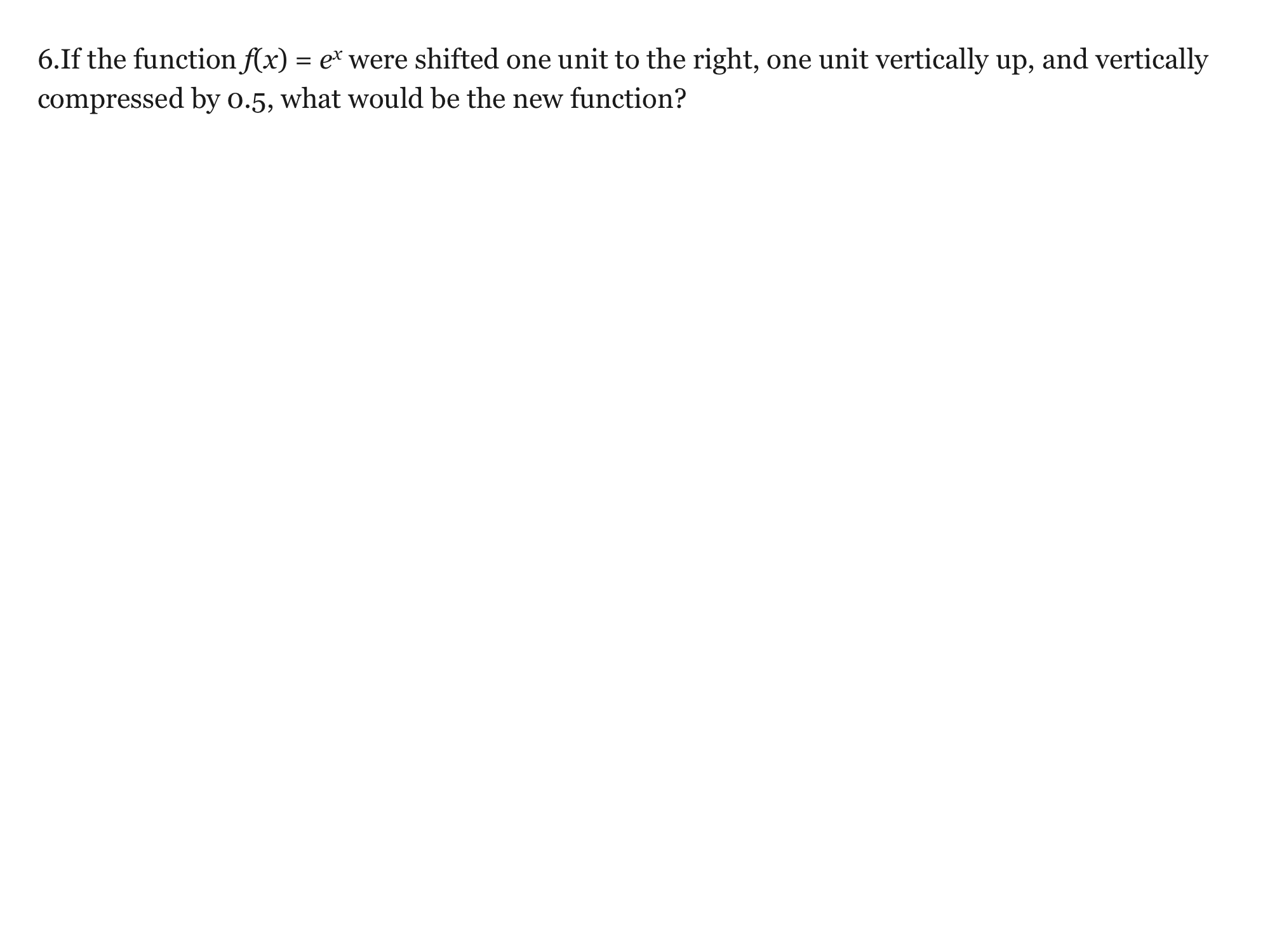
If the function f(x) = were shifted one unit to the right, one unit vertically up, and vertically compressed by , what would be the new function?Clarification: Apply the vertical compression before the upward translation; equivalently use the combined transform g(x)=a f(x−h)+k.
Show your work for Problem 6
Original source problem image and any figures. Read it together with the accessible problem text and any figure description or source note alongside it. Open the source image at full size. Drawing is temporarily unavailable. Work on paper if needed, then record your reasoning here.
Saving written working requires JavaScript. Keep your work on paper or in your own notes; the source problem above remains available.
-
Original problem
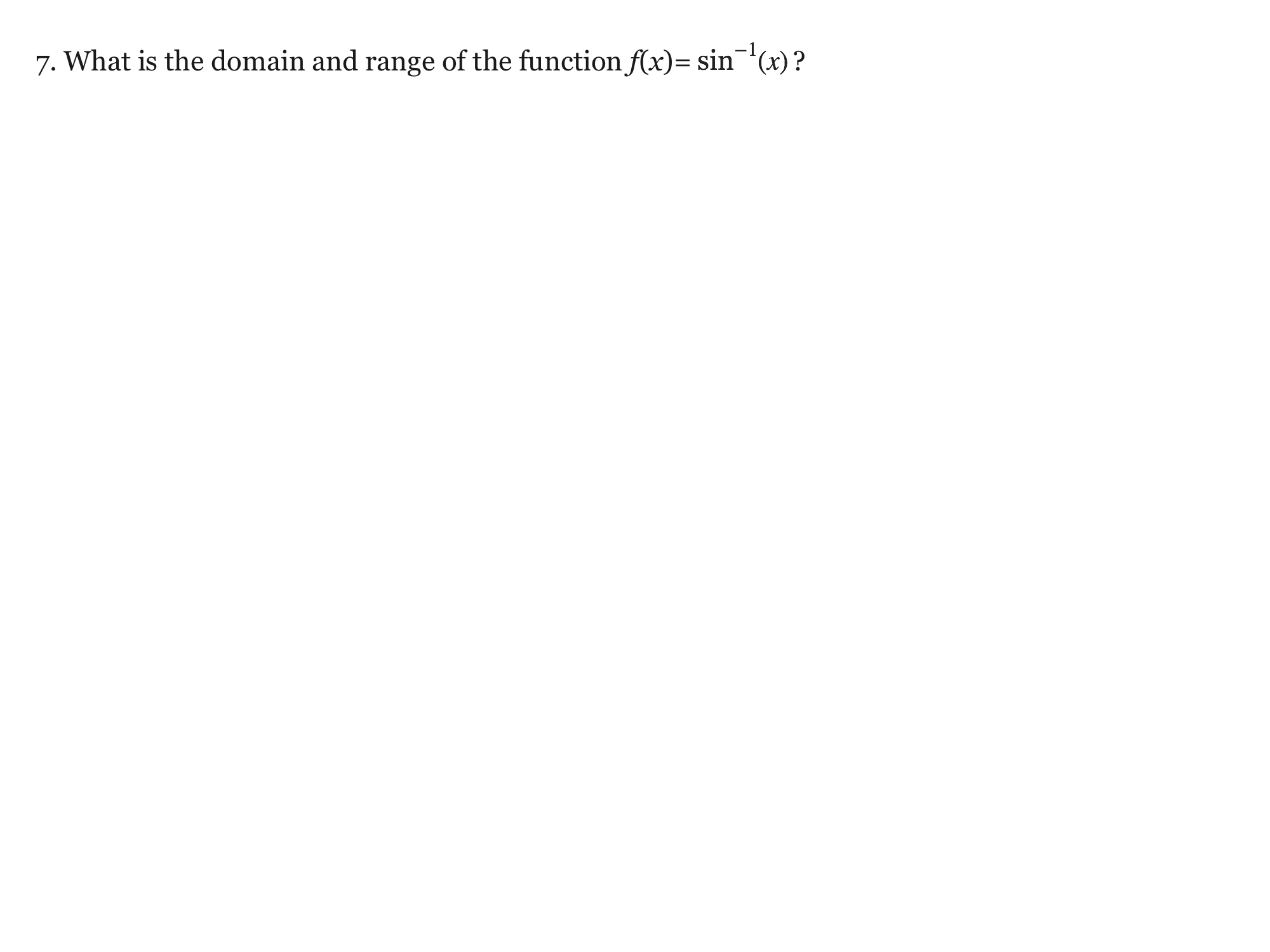
What is the domain and range of the function f(x) = ? Refer to the unit circle.Show your work for Problem 7
Original source problem image and any figures. Read it together with the accessible problem text and any figure description or source note alongside it. Open the source image at full size. Drawing is temporarily unavailable. Work on paper if needed, then record your reasoning here.
Saving written working requires JavaScript. Keep your work on paper or in your own notes; the source problem above remains available.
-
Original problem
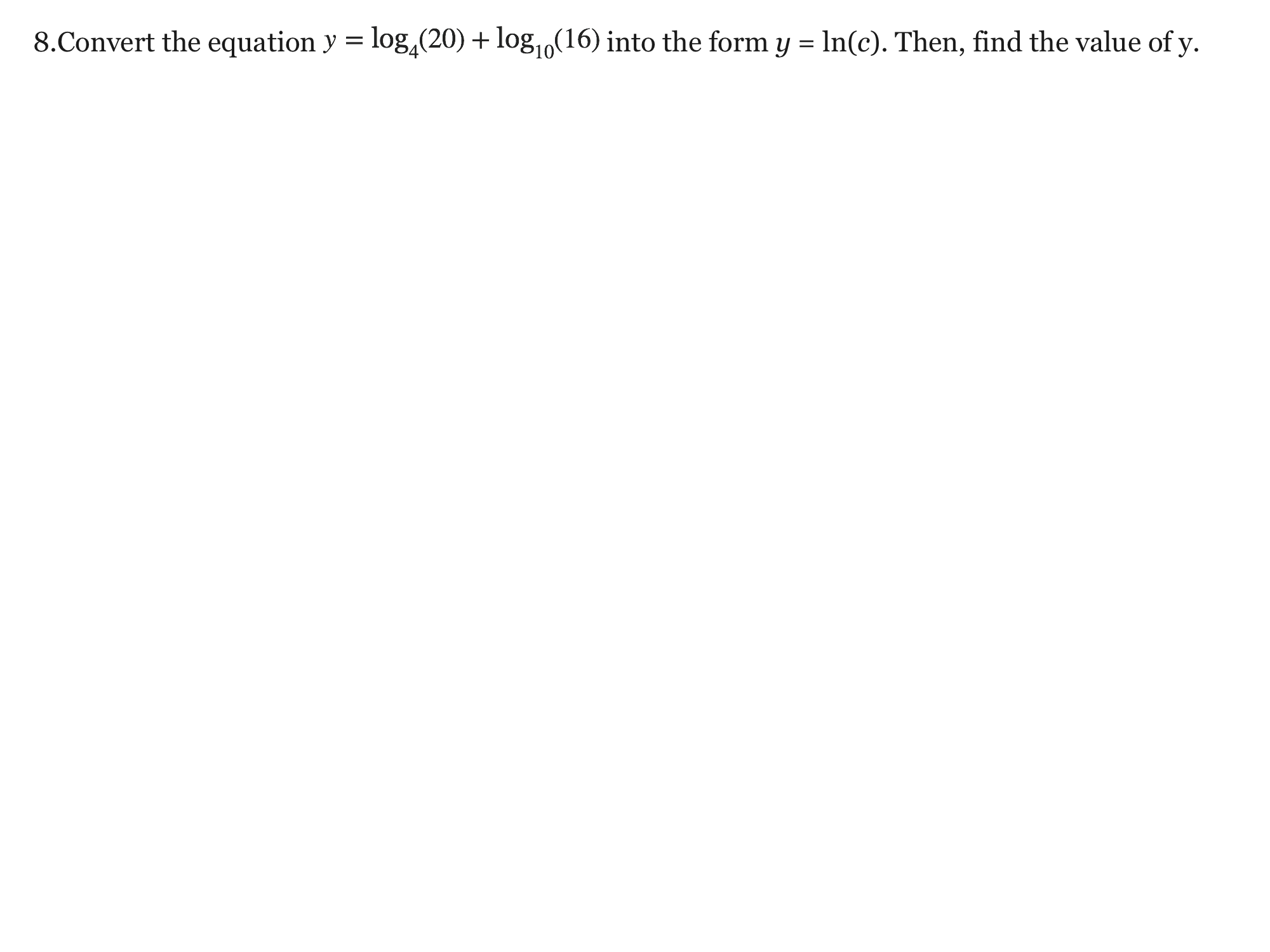
Convert the equation into the form y = ln(c). Then find the value of y. You may want to refer to log rules.Show your work for Problem 8
Original source problem image and any figures. Read it together with the accessible problem text and any figure description or source note alongside it. Open the source image at full size. Drawing is temporarily unavailable. Work on paper if needed, then record your reasoning here.
Saving written working requires JavaScript. Keep your work on paper or in your own notes; the source problem above remains available.
-
Original problem
Simplify such that the argument of the ln function only has one term (ex: . Refer to the log rulesShow your work for Problem 9
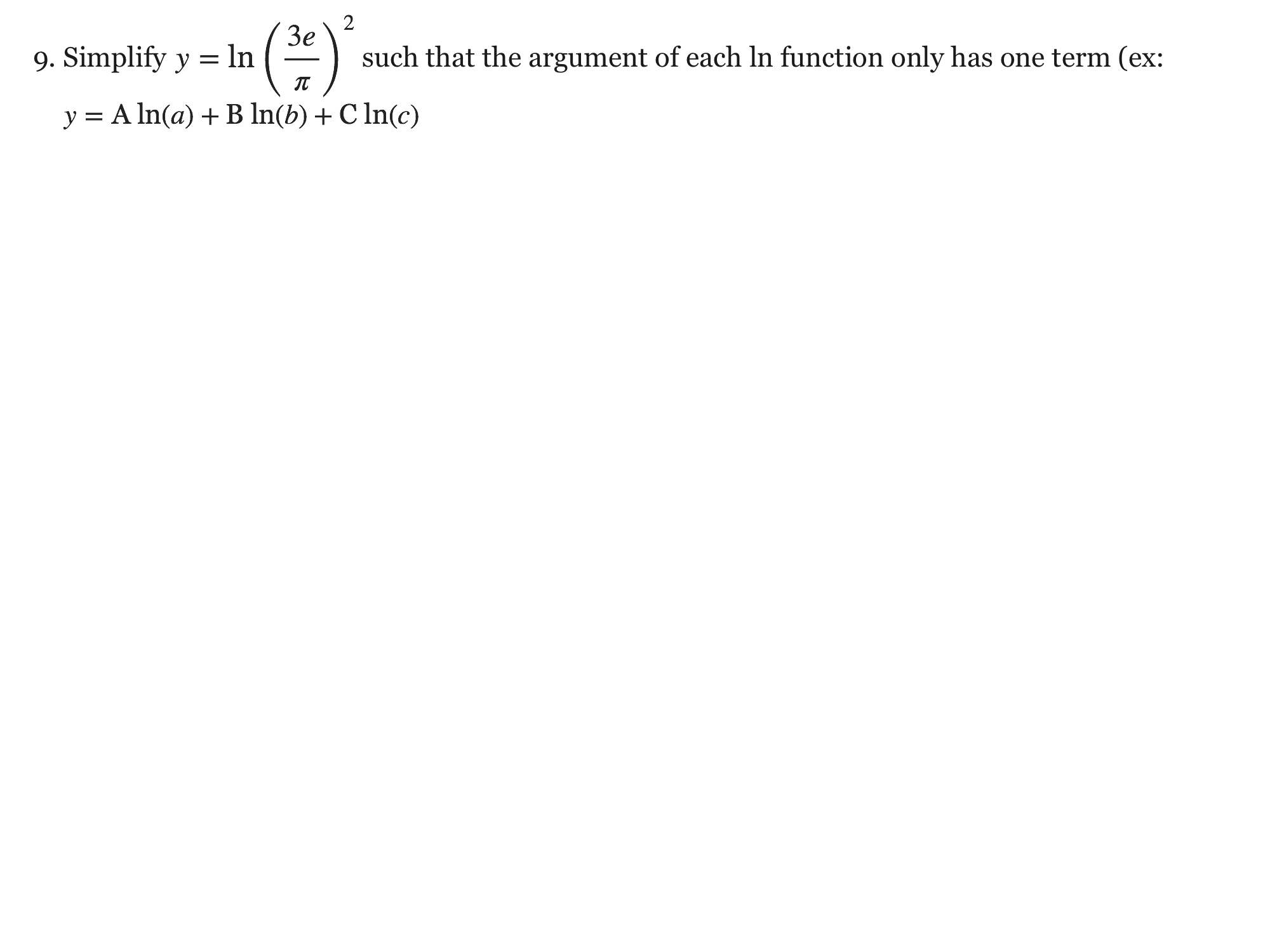
Original source problem image and any figures. Read it together with the accessible problem text and any figure description or source note alongside it. Open the source image at full size. Drawing is temporarily unavailable. Work on paper if needed, then record your reasoning here.
Saving written working requires JavaScript. Keep your work on paper or in your own notes; the source problem above remains available.
-
Original problem · clarified
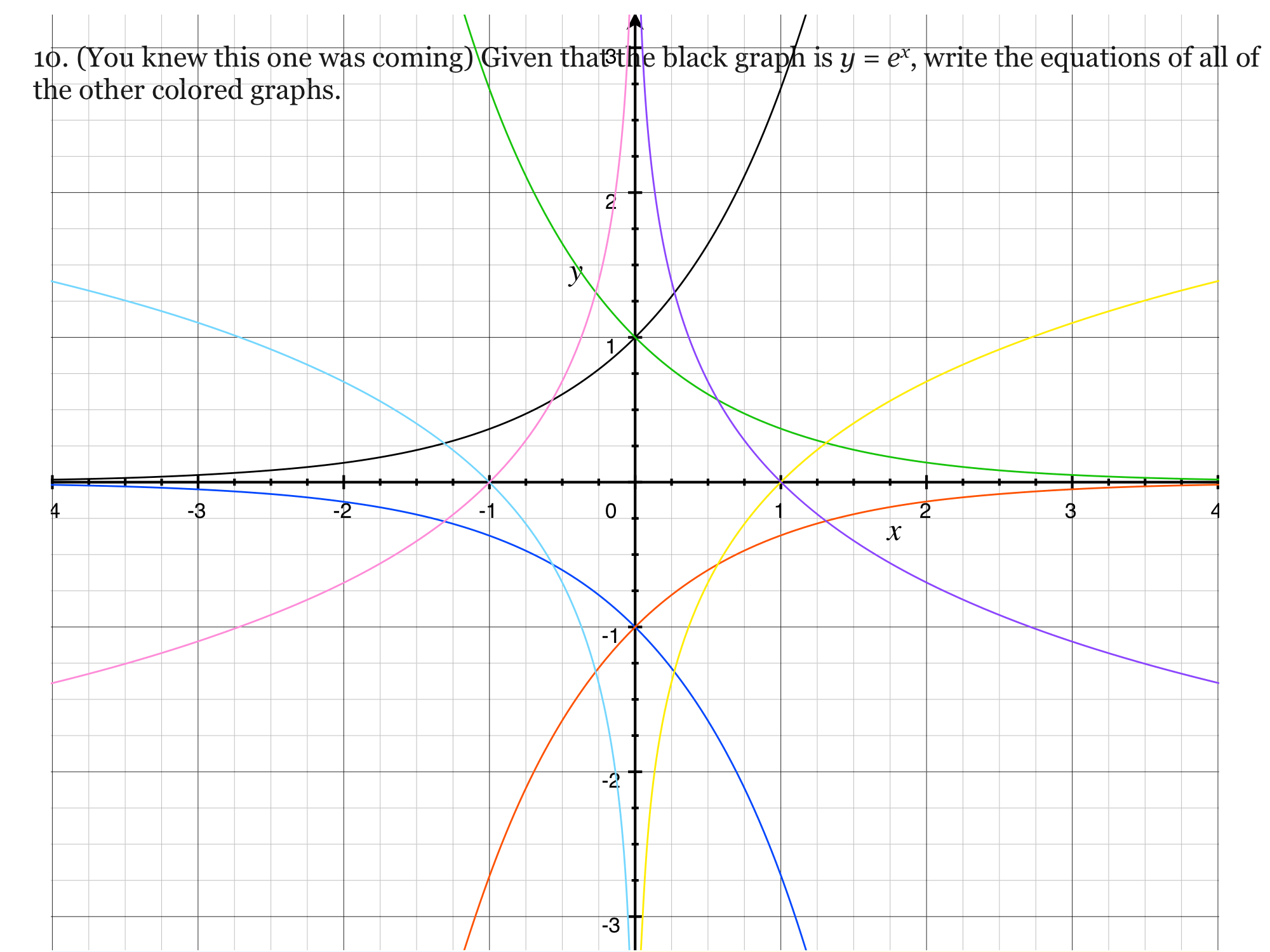
(You knew this one was coming) Given that the black graph is y = , write the equations of all of the other colored graphs.Clarification: Identify the standard exponential/logarithmic reflections that match the labeled raster graph. The equations are inferred from the graph.
Show your work for Problem 10
Source colored-curve graph
A Cartesian plot shows the black reference curve named in the problem, y=e^x, together with seven colored curves. The displayed x-axis is labeled from −4 to 4 and the y-axis includes labels from −3 to 3. The black curve increases through (0,1).
The green curve is positive, decreases through (0,1), and approaches the x-axis toward the right. The blue curve is negative, decreases through (0,−1), and approaches the x-axis toward the left. The orange curve is negative, increases through (0,−1), and approaches the x-axis toward the right.
The pink curve is drawn to the left of the y-axis, increases through (−1,0), and becomes steep upward near that axis. The cyan curve is also drawn to the left of the y-axis, decreases through (−1,0), and becomes steep downward near that axis.
The purple curve is drawn to the right of the y-axis, decreases through (1,0), and becomes steep upward near that axis. The yellow curve is drawn to the right of the y-axis, increases through (1,0), and becomes steep downward near that axis.
Color, side of the axis, plotted intercepts and visible direction describe the raster. No equations for the seven colored curves or numerical values beyond its labeled grid/intercepts are added.
Original source problem image and any figures. Read it together with the accessible problem text and any figure description or source note alongside it. Open the source image at full size. Drawing is temporarily unavailable. Work on paper if needed, then record your reasoning here.
Saving written working requires JavaScript. Keep your work on paper or in your own notes; the source problem above remains available.
-
Added problem
Quick unit-circle check: find exactly.
-
Added problem
Simplify , and keep the original domain restrictions.
-
Added problem
Solve for .
-
Added problem
If and θ is in quadrant II, find .
-
Added problem
List the amplitude, period, midline, and horizontal shift of .
-
Added problem
A sinusoid has maximum 3, minimum −5, and successive peaks at and . Write one equation.
-
Added problem
Move left 3, reflect across the x-axis, stretch vertically by 2, then move up 4. Give the equation, domain, and range.
-
Added problem
A table gives , , and . If , find and .
-
Added problem
Stretch vertically by 3, shift it right 2 and down 1. Give the function, its horizontal asymptote, and its value at .
-
Added problem
Expand assuming .
-
Added problem
Combine into one log. State the original domain.
-
Added problem
Solve over the real numbers.
-
Added problem
Evaluate exactly using change of base.
-
Added problem
For restricted to , find its inverse and the inverse domain.
-
Added problem
Compare and . Explain the difference.
-
Added problem
Let and . Find both compositions and their domains.
-
Added problem
For , state the period and every excluded input.
-
Added problem
You know and . A transformed curve passes through and . Find a and b.
-
Added problem
A friend claims . Find the mistake and give a counterexample.
-
Added problem
Find the inverse of and state its domain.