Worked solutions to all thirty Unit 6 problems. Each solution gives the mathematical steps and the reason for using them. Compare your setup and justification as well as the final answer.
Worked-example retrieval. Reconstruct the lesson reasoning before checking the solution.
Blue is positive change; orange is negative change. The text description carries the same numerical information.A velocity graph (m/s) is a triangle above the time axis on [0,2] with height 3, then a triangle below on [2,4] with depth 2. Find displacement and total distance.
Shared AB/BC problem; the same mathematical solution applies in both courses.
Positive signed area is ½·2·3=3 m; negative signed area is −½·2·2=−2 m. Reason: Rate times time gives meters, with sign from the graph.
Add 3+(−2)=1 for displacement and 3+2=5 for distance. Reason: Displacement is net change; distance integrates speed.
Use the partition 0,2,5 to calculate the left, right, and trapezoidal approximations to ∫₀⁵ f(x)dx. Explain why averaging the three samples and multiplying by 5 is not the trapezoidal rule.
Shared AB/BC problem; the same mathematical solution applies in both courses.
Widths are 2 and 3. Reason: The partition is nonuniform.
Left=1·2+5·3=17; right=5·2+9·3=37. Reason: Use the matching left or right value on each interval.
Trapezoidal=(1+5)·2/2+(5+9)·3/2=27. Reason: Each trapezoid uses average endpoint height weighted by its width; the plain mean would give 25, a different procedure.
Answer: Left = 17, right = 37, trapezoidal = 27. A plain mean weights the samples equally rather than using interval widths.
Final answer
Left = 17, right = 37, trapezoidal = 27. A plain mean weights the samples equally rather than using interval widths.
Let G(x)=∫₀ˣ (t−1)(t−3)dt on [0,4]. Find its absolute maximum value and every point where it occurs.
Shared AB/BC problem; the same mathematical solution applies in both courses.
G′=(x−1)(x−3), so the critical points are 1 and 3; G increases, decreases, then increases. Reason: The Fundamental Theorem and factor signs identify the candidate behavior.
An accumulation formula is G(x)=x³/3−2x²+3x. Reason: Integrate from 0 to x with the starting value zero.
Compare G(0)=0, G(1)=4/3, G(3)=0, G(4)=4/3. Reason: Absolute extrema on a closed interval require endpoint and critical-point values, and ties can occur.
Evaluate ∫₀² (x²+1)/(x+2)dx. Check that the interval is permitted before integrating.
Shared AB/BC problem; the same mathematical solution applies in both courses.
The denominator is positive on [0,2]. Divide to obtain x−2+5/(x+2). Reason: Check continuity on the bounds, then use long division to expose basic antiderivatives.
Use F(x)=x²/2−2x+5ln(x+2). Reason: The rearranged terms use power and logarithm rules.
F(2)−F(0)=−2+5ln4−5ln2=5ln2−2. Reason: The Fundamental Theorem evaluates the definite integral, and logarithm laws combine the ratio.
Compare the setup and the reasoning, as well as the final answer. Use the rubric to find your next step; equivalent correct reasoning earns the same credit.
Estimate a supplied curved graph and qualify the result
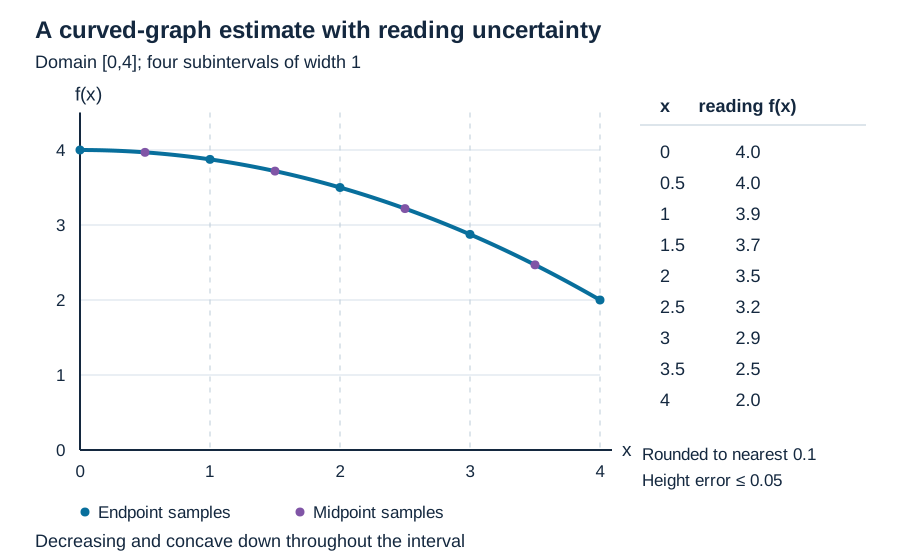
The supplied graph of f is continuous, strictly decreasing and strictly concave down throughout [0,4]. The accessible readings, rounded to the nearest 0.1, are: x = 0,0.5,1,1.5,2,2.5,3,3.5,4; f(x) ≈ 4.0,4.0,3.9,3.7,3.5,3.2,2.9,2.5,2.0 in that order. Each displayed height has at most 0.05 reading error. No formula for this curve is supplied.
Use the displayed readings for numerical estimates; each height has at most 0.05 reading error.Inspect diagram labels
The diagram keeps its full size here. Focus the view and use the arrow keys, or scroll across it, to inspect every label.
Using the supplied curved graph readings, write the partition and width for four equal subintervals of [0,4]. Calculate left, right, midpoint and trapezoidal estimates of ∫₀⁴ f(x) dx, displaying the height-and-width expressions. Explain why these numbers are estimates rather than exact areas.
Partition 0,1,2,3,4; Δx = 1. L₄ = 14.3, R₄ = 12.3, M₄ = 13.4 and T₄ = 13.3. Each is an approximation using rounded graph readings.
The curve is not supplied as exact elementary areas, and the displayed heights are rounded. Use ≈ when identifying any of these sums with the integral.
Scoring criteria
1 point: partition 0,1,2,3,4 and width 1.
2 points: correct left and right height-width sums and results.
2 points: correct midpoint and trapezoidal sums and results.
1 point: explicitly identifies curved-graph quadrature and rounded heights as reasons the integral is not exactly obtained.
Part b
Compute the two-subinterval trapezoidal estimate using x = 0,2,4 and compare it with T₄. State the left/right and trapezoid/midpoint error directions for exact heights, using the supplied monotonicity and concavity. Bound the effect of reading uncertainty on each four-subinterval estimate. Decide whether [13.3,13.4] is a guaranteed interval containing the integral, and whether |T₄ − T₂| is a rigorous error bound.
T₂ = 13.0 and T₄ − T₂ = 0.3. Exact left overestimates, right underestimates, trapezoids underestimate and midpoints overestimate. Each displayed four-subinterval sum can differ from its exact-height version by at most 0.20. Neither [13.3,13.4] nor the refinement difference gives a guaranteed integral bound here.
T₂ = 2[(4.0 + 3.5)/2 + (3.5 + 2.0)/2] = 13.0. Thus the refined estimate is 0.3 larger.
Decreasing behavior places left rectangles above and right rectangles below the curve. Concave-down behavior places chords below the curve and exact midpoint rectangles above its integral on each interval.
The positive weights of each rule total 4. A height error of at most 0.05 therefore changes the rule by at most 4(0.05) = 0.20.
The exact-height trapezoid and midpoint sums bracket the integral, but rounded values 13.3 and 13.4 need not. Refinement difference compares two approximations, not an approximation to the unknown exact integral. A safe monotonicity bound from the rounded left/right sums is 12.1 < ∫₀⁴ f < 14.5.
Scoring criteria
1 point: T₂ = 13.0 with width 2 and difference 0.3.
2 points: all four exact-height error directions tied to the correct monotonicity or concavity condition.
1 point: 0.20 reading-error bound from total weight 4.
2 points: rejects both unqualified interval and refinement-error claims with separate reasons.
Part c
As an analytic transfer, let r(t) = 1 + t² liters per minute for 0 ≤ t ≤ 2. Use two equal midpoint subintervals to approximate the accumulated volume ∫₀² r(t) dt. Use the behavior of r to determine whether that midpoint estimate is an underestimate or overestimate, and check using an exact integral.
M₂ = 4.5 liters, an underestimate of 14/3 liters.
The width is 1 and the midpoint times are 0.5 and 1.5. Their rates are 1.25 and 3.25, so M₂ = 1(1.25 + 3.25) = 4.5 liters.
The rate has r″ = 2 > 0, so its concavity makes the exact midpoint rule an underestimate.
Diagnose an estimate from a verbal rate description
A continuous flow rate is positive and strictly concave up on the entire time interval [0,2] minutes. Its exact values at t = 0,1,2 are 1,2,4 liters per minute. Use one trapezoid on each of [0,1] and [1,2].
Part a
Which choice gives the two-trapezoid estimate of the accumulated volume and a valid comparison with the true integral? Calculate the estimate and justify the direction from the stated whole-interval behavior.
4.5 liters, an overestimate because the graph is concave up.
For a strictly concave-up graph, the straight chord over each interval lies above the curve. Thus these exact-height trapezoids overestimate the integral.
Exact samples do not make a curved graph equal to its chords; positivity does not determine trapezoidal error direction.
Scoring criteria
1 point: selects the first choice and computes 4.5 liters.
1 point: explains overestimate using the stated concavity and chord geometry.
Build an accumulation function from an integrand graph
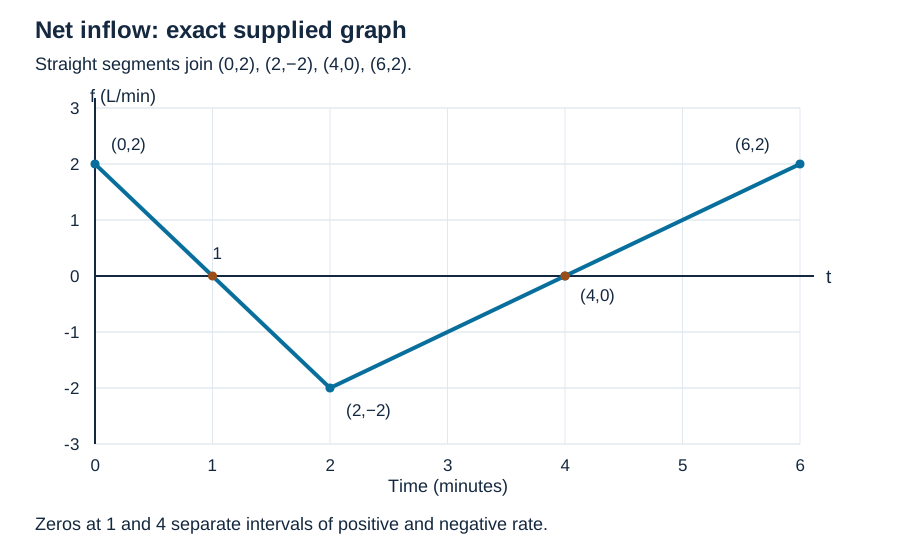
The exact graph of the continuous net inflow rate f is made of straight segments joining (0,2), (2,−2), (4,0) and (6,2), in that order. Time is measured in minutes and f in liters per minute. A tank contains 10 liters at t = 0. Define G to mean net change since time 0, and A to mean the amount in the tank.
The graph gives a signed net inflow rate, including negative rates.Inspect diagram labels
The diagram keeps its full size here. Focus the view and use the arrow keys, or scroll across it, to inspect every label.
Before computing areas or inferring behavior, construct defining definite-integral expressions for G(x) and A(x) for 0 ≤ x ≤ 6. Identify the reference time, the variable endpoint and the role of the initial 10 liters.
G(x) = ∫₀ˣ f(t) dt and A(x) = 10 + ∫₀ˣ f(t) dt for 0 ≤ x ≤ 6.
A net change integrates the signed rate from the fixed reference 0 to the variable endpoint x, giving G(x) = ∫₀ˣ f(t) dt.
The amount adds the initial amount: A(x) = 10 + G(x). Here t is a dummy integration variable, and G(0) = 0 while A(0) = 10.
Scoring criteria
1 point: constructs ∫₀ˣ f(t) dt with fixed lower and variable upper bounds.
1 point: includes initial amount only in A and distinguishes G(0) from A(0).
Part b
Use signed areas from the supplied integrand graph to compute G(0), G(1), G(2), G(4), G(6) and A(6). State the units. Then determine the absolute maximum and minimum of G on [0,6], comparing the endpoint values as well as interior candidates.
G(0) = 0, G(1) = 1, G(2) = 0, G(4) = −2 and G(6) = 0 liters; A(6) = 10 liters. G has absolute maximum 1 liter at x = 1 and absolute minimum −2 liters at x = 4.
The first segment crosses zero at 1. Its positive triangle on [0,1] has area 1; the negative triangle on [1,2] has area −1. Hence G(1) = 1 and G(2) = 0.
The negative triangle on [2,4] has area −(1/2)(2)(2) = −2; the positive triangle on [4,6] contributes 2. Thus G(4) = −2 and G(6) = 0, and A(6) = 10.
Sign changes from positive to negative at 1 and negative to positive at 4 make the interior extreme candidates. Their values 1 and −2 exceed the endpoints 0 in the corresponding directions.
Scoring criteria
2 points: signed triangle computations and all five G values.
1 point: A(6) = 10 liters and coherent rate-times-time units.
2 points: both absolute extrema, locations and endpoint comparison.
Part c
Using the graph of f and the Fundamental Theorem of Calculus, determine where G increases and decreases, where G is concave up and concave down, and every inflection point of G. Explain separately how the sign of f and the increasing/decreasing behavior of f lead to those conclusions. Address the corner of f at x = 2.
G increases on (0,1) and (4,6), decreases on (1,4), is concave down on (0,2), and is concave up on (2,6). It has an inflection point (2,0). G′(2) exists and equals −2; G″(2) is undefined.
Because f is continuous, G′(x) = f(x). The graph is positive on (0,1) and (4,6), and negative on (1,4), giving the monotonicity intervals.
The graph of f decreases on (0,2) and increases on (2,6). Therefore G′ decreases and then increases, so G changes from concave down to concave up at 2.
At 2, the one-sided slopes of f are −2 and 1. Consequently f′(2), and hence G″(2), is undefined, while continuity of f still gives G′(2) = −2. The change of concavity makes (2,G(2)) = (2,0) an inflection point.
Scoring criteria
2 points: correct increase/decrease intervals with sign-of-integrand reasoning.
2 points: correct concavity intervals and inflection point with trend-of-integrand reasoning.
1 point: distinguishes existing G′(2) from undefined G″(2).
Part d
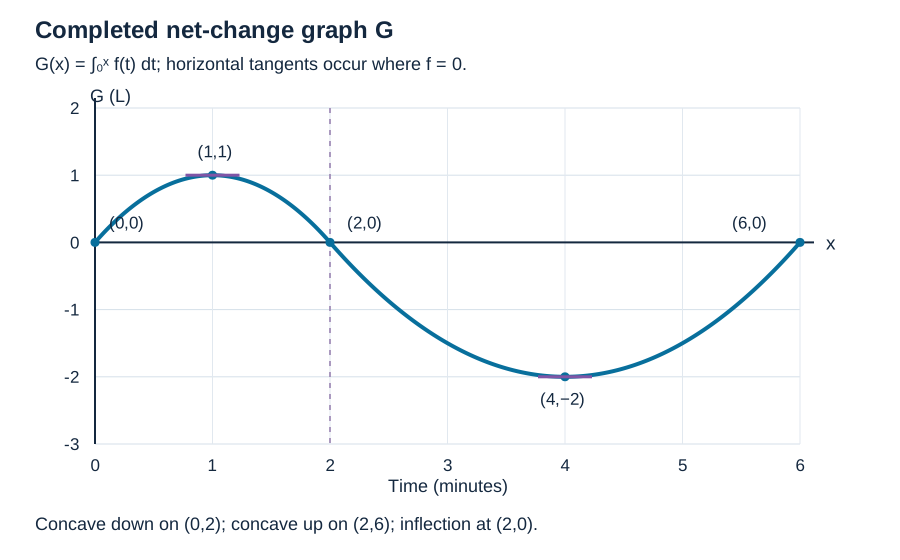
Sketch G on [0,6]. Label the five points found in part b, the horizontal tangents and the inflection point. Make your sketch agree with both the monotonicity and the concavity found in part c; explain why G can increase while its value is negative.
The completed solution figure shows a concave-down arc through (0,0), (1,1), (2,0), followed by a concave-up arc through (4,−2) and (6,0), with horizontal tangents at 1 and 4 and inflection at (2,0). On (4,6), G is negative while f is positive, so G increases toward zero.
Use the signed-area heights from part b as anchor points. Draw G with positive slope where f > 0 and negative slope where f < 0.
Draw a concave-down portion before 2 and a concave-up portion after 2, keeping G and G′ continuous at 2. One exact check is G = 2x − x² on [0,2], and G = x²/2 − 4x + 6 on [2,6].
A negative accumulated net change is a height below the axis, whereas a positive current rate is a positive slope. These coexist on (4,6).
Scoring criteria
2 points: correct labeled anchor points and horizontal tangents at 1 and 4.
2 points: coherent slopes, concavity and inflection at (2,0).
1 point: separates the negative value of G from its positive derivative on (4,6).
A correct sketch combines signed areas, integrand signs and changes in the integrand’s slope.Inspect diagram labels
The diagram keeps its full size here. Focus the view and use the arrow keys, or scroll across it, to inspect every label.
Accumulate a nonuniform rate table under a stated model
A continuous rate is sampled at the exact pairs (t,f(t)) = (0,2), (1,4), (3,−2), (4,0), with time in minutes and rate in liters per minute. For parts a–c, explicitly assume linear interpolation between each pair of consecutive rows; call that rate model f_PL. The net change is measured from time 0.
Part a
Construct the defining definite integral for G(x), the accumulated net change in the piecewise-linear model, for 0 ≤ x ≤ 4. State the reference and variable endpoint. Then compute G(1), G(3) and G(4) from the nonuniform table, showing the width of each interval and explaining why trapezoidal areas are exact for this model.
G(x) = ∫₀ˣ f_PL(t) dt. Widths are 1,2,1 minutes; G(1) = 3, G(3) = 5 and G(4) = 4 liters.
The reference is 0 and endpoint is x, so G(x) = ∫₀ˣ f_PL(t) dt.
The modeled areas are 1(2 + 4)/2 = 3, 2(4 − 2)/2 = 2, and 1(−2 + 0)/2 = −1 liters. Successive accumulation gives 3,5,4.
Linear interpolation makes each graph segment exactly a straight chord, so these signed trapezoid areas are exact for f_PL. The middle width is 2, not 1.
Scoring criteria
1 point: constructs the defining integral of the stated model.
2 points: widths 1,2,1 and correct signed trapezoidal increments.
1 point: cumulative values 3,5,4 liters and exactness tied to linear interpolation.
Part b
Using only the supplied table and the stated linear-interpolation model, locate each zero of f_PL. Determine where G increases and decreases, find its absolute maximum and minimum on [0,4], and determine its concavity intervals and inflection points. Show the interpolated zero calculation and the signed area needed for the interior extreme value.
The zeros are 7/3 and the endpoint 4. G increases on (0,7/3), decreases on (7/3,4), has maximum 17/3 liters at 7/3 and minimum 0 liters at 0. It is concave up on (0,1) and (3,4), concave down on (1,3), with inflection points (1,3) and (3,5).
The middle segment has slope (−2 − 4)/(3 − 1) = −3, so f_PL(t) = 4 − 3(t − 1) there. Its zero solves t − 1 = 4/3, giving t = 7/3. The last row is the endpoint zero at 4.
The model is positive before 7/3 and negative after it until 4. FTC therefore gives increase then decrease for G.
G(7/3) = G(1) + (1/2)(4/3)(4) = 3 + 8/3 = 17/3. Compare this to G(0) = 0 and G(4) = 4 for absolute extrema.
The model’s slopes are 2,−3,2 on the three intervals. Therefore G is concave up, down and up on those intervals. Its concavity changes at 1 and 3 even though G″ is undefined at those corners; the point heights are G(1) = 3 and G(3) = 5.
Scoring criteria
1 point: interpolated zero 7/3 and endpoint zero 4.
1 point: monotonicity tied to modeled signs.
2 points: maximum 17/3 at 7/3 and minimum 0 at 0, with area and endpoint comparison.
2 points: three concavity intervals and both labeled inflection points tied to segment slopes.
Part c
Now remove the interpolation assumption and retain only continuity and the four table rows. Decide which conclusions still hold: G′(1) = 4, the exact value G(4) = 4, increase on the whole interval (0,7/3), and concavity changes at 1 and 3. Explain what sampled values do and do not determine, and identify the status of the sum 3 + 2 − 1.
For G(x) = ∫₀ˣ f(t) dt with continuous f, G′(1) = 4 still holds. The exact accumulated value, full monotonicity interval and specified concavity changes are not established. The trapezoidal sum 4 liters is an estimate for an unknown continuous rate, not an exact value.
Continuity and FTC give G′(1) = f(1) = 4 from that one exact row.
Finite rows do not determine all values between samples, signed areas, zero locations or increasing/decreasing trends. A continuous curve may bend or change sign between the same rows.
Thus the same trapezoidal calculation remains available as a numerical approximation, but its exactness and the model-specific behavior conclusions disappear.
Scoring criteria
1 point: retains G′(1) = 4 with FTC.
2 points: rejects the exact value and whole-interval behavior claims with a between-sample explanation.
1 point: identifies 4 liters as the trapezoidal estimate without interpolation.
Transfer accumulation reasoning to a formula and words
For parts a–b, h(t) = t² − 2t on [0,3] and net accumulation is measured from t = 1. For parts c–d, r is continuous, strictly negative and strictly increasing on the entire interval [2,5]; its numerical values are not supplied.
Part a
First construct H(x) as a definite integral of the supplied formula from the stated reference to x, for 0 ≤ x ≤ 3. Then obtain an explicit expression and compute H(0), H(1), H(2) and H(3). Explain why h(1) and H(1) need not be equal.
H(x) = ∫₁ˣ (t² − 2t) dt = x³/3 − x² + 2/3. Values at 0,1,2,3 are 2/3,0,−2/3,2/3. The integrand value h(1) = −1 is a slope, while H(1) = 0 is accumulation over zero interval.
The reference lower limit is 1 and upper limit is x. Evaluating [t³/3 − t²]₁ˣ gives the constant +2/3.
By definition, H(1) integrates from 1 to 1 and is zero; FTC identifies h(1) with H′(1), not H(1).
Scoring criteria
1 point: constructs the defining integral before evaluating.
1 point: correct explicit expression and reference constant.
2 points: all four values and distinction between integrand value and accumulated value.
Part b
From the analytic integrand h, determine where H increases and decreases, its concavity intervals, all inflection points, and its absolute maximum and minimum on [0,3]. Justify each conclusion through the integrand’s sign or trend and compare endpoints for absolute extrema.
H decreases on (0,2), increases on (2,3), is concave down on (0,1) and concave up on (1,3), and has inflection point (1,0). Its minimum is −2/3 at 2; its maximum is 2/3 at both 0 and 3.
H′ = h = t(t − 2), which is negative for 0 < t < 2 and positive for 2 < t < 3.
h′ = 2t − 2 changes from negative to positive at 1, so H changes from concave down to concave up at (1,H(1)) = (1,0).
The interior minimum value H(2) = −2/3 is less than the endpoint values. Both endpoints equal 2/3, giving two locations of the absolute maximum.
Scoring criteria
1 point: monotonicity intervals from signs of h.
1 point: concavity and inflection from trend of h.
2 points: both absolute extrema and both maximum locations with endpoint comparison.
Part c
For the verbally described rate r, construct S(x), its net accumulation from time 2 to x, for 2 ≤ x ≤ 5. State S(2) and explain why no exact number for S(5) can be obtained from the description alone.
S(x) = ∫₂ˣ r(t) dt, S(2) = 0. The qualitative description gives no precise rate magnitudes, so it cannot determine an exact value for S(5).
The stated reference gives lower bound 2 and variable endpoint x.
The integral over [2,2] is zero. Negativity and increasing behavior constrain signs and slopes, but do not supply the magnitudes needed for a numerical area.
Scoring criteria
1 point: defining integral with correct bounds.
1 point: zero reference value and explanation of missing rate magnitudes.
Part d
Use the whole-interval verbal hypotheses to determine the sign of S(x) for x > 2, whether S increases or decreases, and its concavity. Explain how a negative but increasing integrand can produce the behavior you describe.
For 2 < x ≤ 5, S(x) < 0. S decreases and is concave up: its slopes are negative but becoming less negative.
A strictly negative continuous integrand over a positive-width interval has negative integral, so S(x) < 0.
FTC gives S′ = r < 0, so S decreases. Since r increases, the slopes S′ increase, giving concave-up behavior.
Increasing r does not mean positive r. For example, slopes can rise from −5 to −2 while remaining negative, so S keeps decreasing at a slowing rate.
Scoring criteria
1 point: negative accumulated values after the reference.
1 point: decreasing behavior from r < 0.
1 point: concave-up behavior from increasing r, with distinct value/sign and trend reasoning.
A continuous rate f has exact samples f(0) = 2, f(1) = 4 and f(2) = 6. No interpolation, monotonicity or concavity assumption is supplied. Let G(x) = ∫₀ˣ f(t) dt.
Part a
Which conclusion is justified by these hypotheses? Explain your choice using the defining integral and FTC, and identify why the other claims would need additional information between sampled times.
G(0) = 0 and G′(1) = 4, but the table does not establish that G increases on all of [0,2].
The defining integral gives G(0) = 0, and continuity gives G′(1) = f(1) = 4.
A sample of f is a derivative value of G, not an accumulated value. Thus f(1) = 4 does not give G(1) = 4.
Finite positive, increasing samples do not establish the sign or trend of f between them. For a concrete counterexample, f(t) = 2 + 2t − 100t²(t − 1)²(t − 2)² fits all three rows but f(0.5) = −11.0625. Hence G need not increase throughout the interval.
The two-trapezoid sum is 1(2 + 4)/2 + 1(4 + 6)/2 = 8. It is an estimate, becoming exact only for an appropriate model such as piecewise-linear interpolation.
Scoring criteria
1 point: selects the first choice and cites the zero-width integral and FTC.
1 point: explains the difference between sampled rate and accumulated value.
1 point: identifies missing between-sample information and the approximate status of the trapezoidal sum.