Chapter 8 Solutions
Worked solutions to all thirty problems, with the reason for each step. These explanations were added for this edition; the chapter answer key and original worked examples follow below.
Problem 1
Original problem · added worked solution
Implicitly derive the following functions.


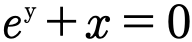
(a)
- The real logarithm requires . Differentiate both sides of with respect to x, treating y as a function of x.
- The chain rule gives .
- Multiply by y and collect y′ terms: .
- Thus wherever the denominator is nonzero. At a zero denominator the relation does not define a finite derivative by this formula.
(b)
- Differentiate . The chain rule gives .
- Collect terms and use .
- The result is where the denominator is nonzero.
(c)
- Differentiate to obtain .
- Therefore . Since , the real curve has x<0 and this is also .
Final answer
(a) ; (b) ; (c) for x<0, with the stated denominator restrictions.
Problem 2
Original problem · clarified · added worked solution
Determine if the given differential equation is linear and state its order.
Clarified version of part (c): the displayed differential expression is set equal to zero. This supplies a complete equation for classification.
(a)
- The highest derivative in is y″, so the equation is second order.
- The y² term is nonlinear in the dependent variable, so the equation is nonlinear.
(b)
- The highest derivative in is y′, so the equation is first order.
- The dependent variable and its derivative occur only to the first power, with coefficients depending on x. This is a linear equation.
(c)
- The highest derivative in is the fifth derivative, so the equation is fifth order.
- The product yy′ is nonlinear in the dependent variable and its derivative. Therefore the equation is nonlinear.
Final answer
(a) Nonlinear, order 2. (b) Linear, order 1. (c) Nonlinear, order 5.
Problem 3
Original problem · added worked solution
Determine if the given function is a solution to the given differential equations.




(a)
- For , differentiation gives and .
- Since , the equation holds for every real x and every constant A.
(b)
- For , differentiation gives and .
- Thus holds for every real x and every constant B.
(c)
- For , both the first and second derivatives are .
- The requested equation would require , impossible for real x because . Therefore this function is not a solution.
(d)
- For , and .
- Substitute: . Thus the function is a solution for every real x.
Final answer
(a) Yes. (b) Yes. (c) No. (d) Yes.
Problem 4
Original problem · added worked solution
Use separation of variables to solve the following differential equations.
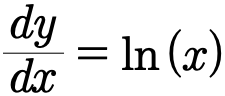
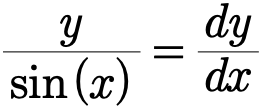
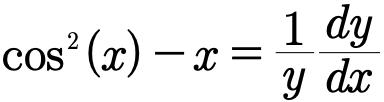
(a)
- The equation is real only for . Write .
- Integrate by parts on the right: .
- Thus on x>0. Differentiation returns ln x.
(b)
- Work on an interval where , since the original right-hand side is .
- For y≠0, separate and integrate: .
- Exponentiating and absorbing the sign into a real constant gives . The constant C=0 also gives the equilibrium solution. The formula is used separately on each interval between consecutive multiples of π.
(c)
- The original equation contains , so y=0 is excluded. Separate .
- Use to integrate: .
- Therefore , with because the printed equation excludes y=0.
Final answer
(a) , x>0. (b) , on intervals avoiding sin x=0. (c) , C≠0.
Problem 5
Original problem · added worked solution
Compute the given partial derivatives.


(a)
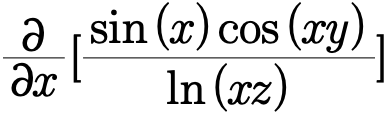
- Treat y and z as constants. Let and . The real domain requires and .
- The product and chain rules give ; the denominator derivative is .
- The quotient rule gives .
(b)
- The logarithmic term has no x dependence. Therefore any mixed derivative containing an x derivative annihilates it, on its real domain .
- Differentiate first in z to get , then in y to get , then in x to get .
- Thus the requested mixed derivative is . The functions are smooth on their domain, so other derivative orders give the same result.
(c)
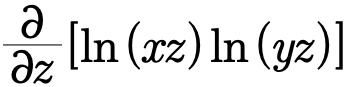
- The real domain requires and . Treat x and y as constants and use the product rule.
- Because and , the answer is .
(d)
- Set , requiring . The first z derivative is .
- Differentiate again: the first term gives , the second gives , and the last gives .
- Collect the terms to obtain .
Final answer
(a) Quotient-rule expression shown. (b) . (c) . (d) .
Problem 6
Added problem and worked solution
Find implicitly for . State where your formula applies.
- Differentiate with respect to x: .
- Solve for the derivative to obtain , valid where y≠0. At y=0 the circle has a vertical tangent.
Final answer
, for y≠0.
Problem 7
Added problem and worked solution
Find implicitly for .
- Differentiate using the product rule: .
- Since the original relation excludes x=0, divide by x to get .
Final answer
, x≠0.
Problem 8
Added problem and worked solution
Implicitly differentiate .
- Differentiate : .
- Collect y′ terms: .
- Divide where to obtain .
Final answer
, where the denominator is nonzero.
Problem 9
Added problem and worked solution
Find implicitly for .
- The real domain of requires , hence x and y are nonzero.
- Differentiate to get .
- Multiplying by xy gives , hence .
Final answer
, on the curve where xy>0.
Problem 10
Added problem and worked solution
Find implicitly for .
- Differentiate : .
- Divide by cos y where it is nonzero. The real relation itself requires .
Final answer
, where cos y≠0.
Problem 11
Added problem and worked solution
State the order and decide whether is linear.
- The highest derivative in is y″, so the order is 2.
- Each dependent-variable term is linear in y or a derivative, and the coefficients depend only on x.
Final answer
Linear, second order.
Problem 12
Added problem and worked solution
State the order and decide whether is linear.
- The highest derivative is y′, so the order is 1.
- The square violates linearity, even though the derivative order remains one.
Final answer
Nonlinear, first order.
Problem 13
Added problem and worked solution
State the order and decide whether is linear.
- The highest derivative is , so the order is 3.
- The dependent variable appears as y², which makes the equation nonlinear.
Final answer
Nonlinear, third order.
Problem 14
Added problem and worked solution
Is a solution of ? Verify by substitution.
- For , the derivative is .
- Substitute into : . This holds for every constant C and every real x.
Final answer
Yes, for every real constant C.
Problem 15
Added problem and worked solution
Solve by direct integration. Include all integration constants.
- Integrate once to obtain .
- Integrate again to obtain . Two independent constants are needed for the second-order equation.
- Differentiate twice to check that every member of this family has second derivative 6x.
Final answer
.
Problem 16
Added problem and worked solution
Solve by separation of variables.
- For y≠0, separate .
- Integration gives , so .
- The equilibrium solution y=0 is also included by C=0; these solutions exist for all real x.
Final answer
, C any real constant.
Problem 17
Added problem and worked solution
Solve and state the restrictions on the solution.
- The original requires y≠0. Multiply by y and separate: .
- Integrating gives , or .
- Thus , with a fixed sign on any interval where . The zero endpoints are excluded from the original equation.
Final answer
, on intervals where x²+C>0.
Problem 18
Added problem and worked solution
Solve .
- For y≠0, separate .
- The substitution gives .
- Hence . Including C=0 restores the equilibrium solution, and 1+x² is positive for all real x.
Final answer
, all real x.
Problem 19
Added problem and worked solution
Solve . Include equilibrium solutions and domain restrictions.
- The equilibrium solutions are y=0 and y=1. For other solutions, separate .
- Use . Integration gives .
- Solving for y yields , on any interval where the denominator is nonzero. This family includes y=1 when C=0; add y=0 separately.
Final answer
wherever the denominator is nonzero, plus y=0.
Problem 20
Added problem and worked solution
Solve and include all equilibrium solutions.
- The equilibrium y=0 solves the equation. For y≠0, separate .
- Integration gives , hence .
- This nonzero family is valid on intervals excluding . Restore the equilibrium y=0 separately.
Final answer
, x≠−C, plus y=0.
Problem 21
Added problem and worked solution
Solve with .
- Separate for nonzero y and integrate: .
- Thus . The initial condition gives C=2.
- The resulting positive function is defined for all real x, and its derivative is xy.
Final answer
.
Problem 22
Added problem and worked solution
Solve . State the interval restriction.
- Divide by the always-positive to separate .
- Integrate to obtain .
- Locally, , on intervals where cosine of the angle is nonzero. The constant can be chosen so the integrated arctangent stays on its principal branch; equivalent constants differ by multiples of π.
Final answer
, on intervals avoiding its poles.
Problem 23
Added problem and worked solution
Solve . An implicit solution is acceptable.
- Multiply through by to separate .
- Integrate to get .
- The left-hand side has derivative with respect to y and ranges over all real values. It therefore defines a unique real y for each x and each C, with no division-by-zero restriction.
Final answer
.
Problem 24
Added problem and worked solution
For , find both first partial derivatives.
- For , treat y as constant when differentiating in x. This gives .
- Treat x as constant when differentiating in y. This gives .
Final answer
, .
Problem 25
Added problem and worked solution
Find both first partial derivatives of .
- When differentiating in x, treat y as constant. The inner derivative is y, giving .
- In the y derivative, x is constant. The inner derivative is x, giving .
Final answer
, .
Problem 26
Added problem and worked solution
Compute both mixed second partial derivatives of .
- Differentiate in x to get , then in y to get .
- Reverse the order: , then .
- The equality is consistent with the polynomial’s continuous second derivatives.
Final answer
.
Problem 27
Added problem and worked solution
Find the first partial derivatives of .
- For , the domain excludes . In the x derivative, the quotient rule gives .
- In the y derivative, the numerator is constant, so .
Final answer
, , for x+y≠0.
Problem 28
Added problem and worked solution
For , find and .
- For , differentiation in x gives .
- Differentiate this in x again, keeping y constant: .
- For the mixed derivative, differentiate in y using the product rule: .
Final answer
, .
Problem 29
Added problem and worked solution
Find the first partial derivatives and domain of .
- The real domain of excludes .
- Using the chain rule gives and .
Final answer
, , away from the origin.
Problem 30
Added problem and worked solution
For , compute the mixed derivative taking one derivative in each of z, y, and x.
- Differentiate in z to get .
- Differentiate this in y to get .
- Finally differentiate in x to obtain . This polynomial is smooth, so any ordering of one derivative in each variable gives the same result.
Final answer
.