Chapter 2 Problems
Thirty chapter problems: 19 from the original book and 11 added for more practice.
Read the chapter problems → · Chapter solutions →
-
Original problem
If the next term of a sequence is either always greater than or always less than the previous term, then it is known as what type of sequence?
-
Original problem
Find the common difference for the sequence
{1, -5, -11, -17, ...}
-
Original problem
Find the common ratio for the sequence

-
Original problem
For questions 4-9, do the following sequences converge or diverge? If it converges, find its limit.
{3n2-n}n=1
-
Original problem
For questions 4-9, do the following sequences converge or diverge? If it converges, find its limit.
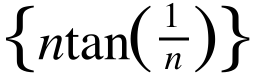 n=1
-
Original problem
For questions 4-9, do the following sequences converge or diverge? If it converges, find its limit.
{2-ne-n}n=1
-
Original problem
For questions 4-9, do the following sequences converge or diverge? If it converges, find its limit.
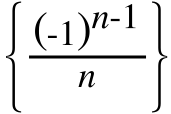 n=1
-
Original problem
For questions 4-9, do the following sequences converge or diverge? If it converges, find its limit.
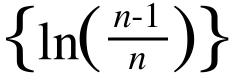 n=2
-
Original problem
For questions 4-9, do the following sequences converge or diverge? If it converges, find its limit.
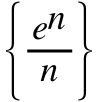 n=1
-
Original problem
Find the 4th partial sum of the sequence
n=1 -
Original problem · clarified
Find the 5th partial sum of the sequence
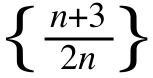 n=1
Correction: the fifth partial sum adds all five terms. The equals sign before a4 in the printed answer is replaced by a plus sign.
-
Original problem
For questions 12-19, determine if the series converges or diverges.
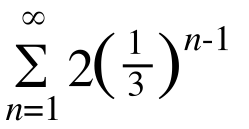
-
Original problem
For questions 12-19, determine if the series converges or diverges.
13.
-
Original problem
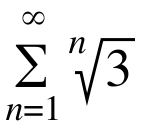
For questions 12-19, determine if the series converges or diverges.
14.
-
Original problem · clarified
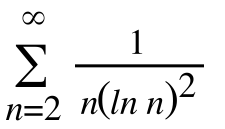
For questions 12-19, determine if the series converges or diverges.
Clarification: this web problem begins at n=3. The source begins at n=1, where its logarithmic term is undefined; n=3 also gives a positive continuous function for the integral-test proof.
-
Original problem
For questions 12-19, determine if the series converges or diverges.
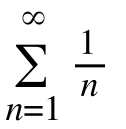
-
Original problem
For questions 12-19, determine if the series converges or diverges.
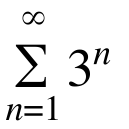
-
Original problem
For questions 12-19, determine if the series converges or diverges.
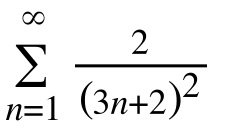
-
Original problem
For questions 12-19, determine if the series converges or diverges.
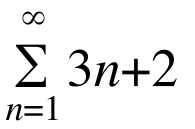
-
Added problem
An arithmetic sequence has and common difference . Find , , and the sum of its first 15 terms.
-
Added problem
Determine whether the sequence , , converges, and find its limit if it does.
-
Added problem
Find .
-
Added problem
Find .
-
Added problem
Let and . Prove that the sequence increases and is bounded, then find its limit.
-
Added problem
A series has partial sums for . Find its nth term and its infinite sum.
-
Added problem
Determine whether converges. State the test you use.
-
Added problem
Use the integral test to determine whether converges.
-
Added problem
Determine whether converges using the integral test.
-
Added problem
Use the integral test to determine whether converges. Verify its hypotheses.
-
Added problem
Find the partial sum formula and infinite sum of .