Chapter 2 Solutions
Worked solutions to all thirty problems, with the reason for each step. These explanations were added for this edition; the chapter answer key and original worked examples follow below.
Chapter problems → · Chapter answer key →
Problem 1
Original problem · added worked solution
If the next term of a sequence is either always greater than or always less than the previous term, then it is known as what type of sequence?
- Compare each term with its predecessor. If every comparison has the same strict direction, the sequence is always increasing or always decreasing.
- Such a sequence is called monotonic; the wording here describes a strictly monotonic sequence.
Final answer
A monotonic sequence (strictly increasing or strictly decreasing).
Problem 2
Original problem · added worked solution
Find the common difference for the sequence
{1, -5, -11, -17, ...}
- Subtract adjacent terms: , , and .
- The same difference occurs each time, so it is the common difference.
Final answer
.
Problem 3
Original problem · added worked solution
Find the common ratio for the sequence

- Divide consecutive terms: , , and .
- The constant quotient is the common ratio.
Final answer
.
Problem 4
Original problem · added worked solution
For questions 4-9, do the following sequences converge or diverge? If it converges, find its limit.
{3n2-n}n=1
- Read the source superscripts: the term is .
- This is a geometric sequence with ratio . Its positive terms increase without bound, so it has no finite limit.
Final answer
Diverges to .
Problem 5
Original problem · added worked solution
For questions 4-9, do the following sequences converge or diverge? If it converges, find its limit.
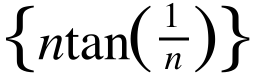 n=1
- Set , so and .
- Rewrite this as . The standard limits are and .
- The product therefore tends to 1.
Final answer
Converges to .
Problem 6
Original problem · added worked solution
For questions 4-9, do the following sequences converge or diverge? If it converges, find its limit.
{2-ne-n}n=1
- Read both source exponents: .
- Its geometric ratio satisfies , so the terms tend to zero.
Final answer
Converges to .
Problem 7
Original problem · added worked solution
For questions 4-9, do the following sequences converge or diverge? If it converges, find its limit.
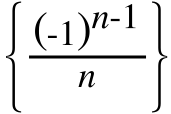 n=1
- The numerator has absolute value 1, so .
- Since , the squeeze theorem shows that both the positive and negative terms approach zero.
Final answer
Converges to .
Problem 8
Original problem · added worked solution
For questions 4-9, do the following sequences converge or diverge? If it converges, find its limit.
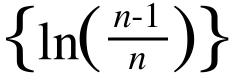 n=2
- For , , so the logarithm is defined.
- The argument tends to 1. Continuity of the logarithm at 1 gives .
Final answer
Converges to .
Problem 9
Original problem · added worked solution
For questions 4-9, do the following sequences converge or diverge? If it converges, find its limit.
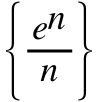 n=1
- The continuous comparison is . It has the form , and L’Hôpital’s rule gives .
- Therefore its integer subsequence tends to , so no finite sequence limit exists.
Final answer
Diverges to .
Problem 10
Original problem · added worked solution
Find the 4th partial sum of the sequence
n=1
- Evaluate the first four terms of : , , , .
- Add them using denominator 12: .
Final answer
.
Problem 11
Original problem · clarified · added worked solution
Find the 5th partial sum of the sequence
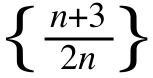 n=1
Correction: the fifth partial sum adds all five terms. The equals sign before a4 in the printed answer is replaced by a plus sign.
- Substitute into to obtain , , , , .
- Add using denominator 40: .
Final answer
.
Problem 12
Original problem · added worked solution
For questions 12-19, determine if the series converges or diverges.
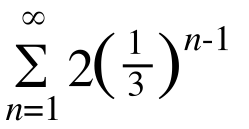
- The displayed series is geometric with first term and ratio .
- Because , the partial sums approach .
- Calculate .
Final answer
Converges to .
Problem 13
Original problem · added worked solution
For questions 12-19, determine if the series converges or diverges.
13. 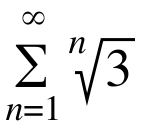
- Write the terms as . Since , .
- A convergent series must have terms tending to zero. This necessary condition fails.
Final answer
Diverges because the terms tend to .
Problem 14
Original problem · added worked solution
For questions 12-19, determine if the series converges or diverges.
14. 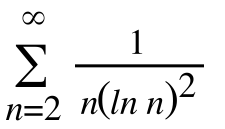
- For , is positive and continuous. Its denominator increases, so is decreasing.
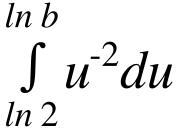
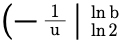
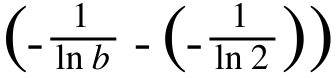
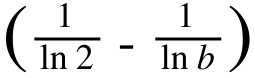
- Set , . Then .
- The improper integral is finite, so the integral test proves convergence. The integral’s value is not being asserted as the series sum.
Final answer
Converges.
Problem 15
Original problem · clarified · added worked solution
For questions 12-19, determine if the series converges or diverges.
Clarification: this web problem begins at n=3. The source begins at n=1, where its logarithmic term is undefined; n=3 also gives a positive continuous function for the integral-test proof.
- For , the function is positive and continuous. Its denominator has derivative , so is decreasing.
- Let , so . Then . Both logarithmic arguments are positive for .
- As , , so the improper integral diverges. The integral test therefore proves that the displayed tail starting at diverges.
Final answer
The clarified tail starting at diverges.
Problem 16
Original problem · added worked solution
For questions 12-19, determine if the series converges or diverges.
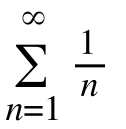
- The function is positive, continuous, and decreasing on .
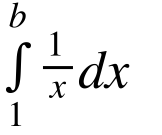
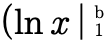
- Its improper integral is . The integral test therefore proves that the harmonic series diverges.
Final answer
Diverges.
Problem 17
Original problem · added worked solution
For questions 12-19, determine if the series converges or diverges.
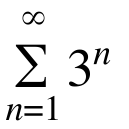
- The terms are , which tend to .
- In particular, they do not tend to zero, so the necessary condition for convergence fails.
Final answer
Diverges.
Problem 18
Original problem · added worked solution
For questions 12-19, determine if the series converges or diverges.
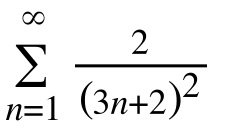
- For , is positive, continuous, and decreasing.
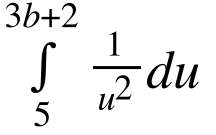
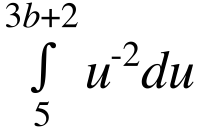
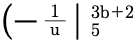
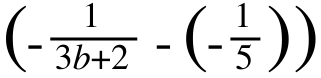
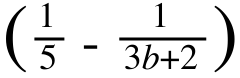
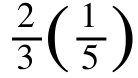
- Use , . Then .
- The finite improper integral proves convergence by the integral test; it is not the exact series sum.
Final answer
Converges.
Problem 19
Original problem · added worked solution
For questions 12-19, determine if the series converges or diverges.
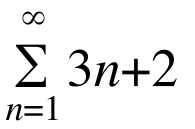
- The term increases without bound as .
- Because the terms do not tend to zero, the series cannot converge.
Final answer
Diverges.
Problem 20
Added problem and worked solution
An arithmetic sequence has and common difference . Find , , and the sum of its first 15 terms.
- The nth term of an arithmetic sequence is . Substitute to get .
- Thus .
- Use : .
Final answer
, , .
Problem 21
Added problem and worked solution
Determine whether the sequence , , converges, and find its limit if it does.
- Take absolute values: .
- Since , these absolute values tend to zero. Alternating signs do not prevent a limit when the magnitudes approach zero.
Final answer
Converges to .
Problem 22
Added problem and worked solution
Find .
- Divide numerator and denominator by : .
- Since , the denominator tends to 3 and the quotient tends to .
Final answer
Converges to .
Problem 23
Added problem and worked solution
Find .
- Multiply by the conjugate: .
- For , divide the denominator and numerator by to get .
- Taking the limit gives .
Final answer
.
Problem 24
Added problem and worked solution
Let and . Prove that the sequence increases and is bounded, then find its limit.
- The first term is less than 2. If , then , so induction proves the upper bound.
- Also , so the sequence increases. A bounded increasing sequence converges.
- Let its limit be . Passing to the limit in the recurrence gives , hence .
Final answer
Increasing, bounded above by , and convergent to .
Problem 25
Added problem and worked solution
A series has partial sums for . Find its nth term and its infinite sum.
- The first term is . For , use .
- Calculate , which also agrees at .
- The series sum is the limit of its partial sums: .
Final answer
and the infinite series sums to .
Problem 26
Added problem and worked solution
Determine whether converges. State the test you use.
- The terms satisfy .
- Since the term limit is not zero, the series diverges by the term test.
Final answer
Diverges.
Problem 27
Added problem and worked solution
Use the integral test to determine whether converges.
- The function is positive, continuous, and decreasing on .
- The integral is finite.
- The integral test therefore proves convergence of the series.
Final answer
Converges.
Problem 28
Added problem and worked solution
Determine whether converges using the integral test.
- For , is positive, continuous, and decreasing.
- Let . Then .
- This grows without bound as , so the integral test proves divergence.
Final answer
Diverges.
Problem 29
Added problem and worked solution
Use the integral test to determine whether converges. Verify its hypotheses.
- Let . For it is positive and continuous, and .
- Integration by parts gives .
- Since , is finite. Apply the integral test.
Final answer
Converges.
Problem 30
Added problem and worked solution
Find the partial sum formula and infinite sum of .
- Factor and decompose: .
- In the partial sum all interior terms cancel: .
- Let . The last two terms vanish, leaving .
Final answer
Converges to .
Chapter answer key and worked steps
Answers and worked steps for the original problems, including verified corrections where needed.
-
Original short answer
Problem 1 →Monotonic sequence
-
Original short answer
Problem 2 →common difference = -6
-
Original short answer
Problem 3 →common ratio = 3
-
Original worked answer
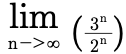
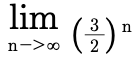
Problem 4 →To determine the convergence, the limit must be evaluated.
= lim (3n2-n)
=
=
= ∞
Since the limit goes to infinity, the sequence diverges.
-
Original worked answer
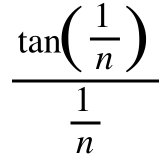
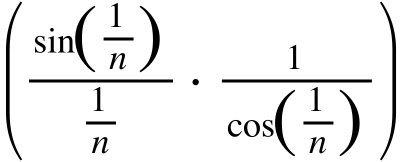
Problem 5 →To determine the convergence, the limit must be evaluated.
=

=
=
=
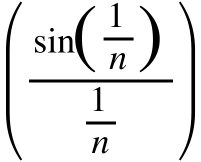 *
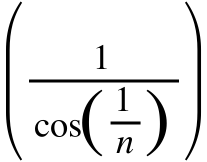
= 1 * 1
= 1
Since the limit is 1, the sequence converges to 1.
-
Original worked answer
Problem 6 →To determine the convergence, the limit must be evaluated.
=
(2-ne-n)=
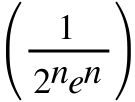
= 0
Since the limit is 0, the sequence converges to 0.
-
Original worked answer
Problem 7 →To determine the convergence, the limit must be evaluated.
=
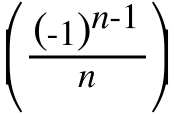
= 0
Since the limit is 0, the sequence converges to 0.
-
Original worked answer
Problem 8 →To determine the convergence, the limit must be evaluated.
=
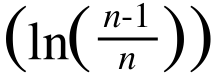
= ln(1)
= 0
Since the limit is 0, the sequence converges to 0.
-
Original worked answer
Problem 9 →To determine the convergence, the limit must be evaluated.
=
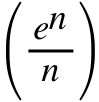
=

As the limit is
, you can apply L'Hôpital’s rule to take the new limit=
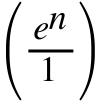
= ∞
Since the limit goes to infinity, the sequence diverges.
-
Original worked answer
Problem 10 →To find the 4th partial sum, the first four terms need to be evaluated.
a1 = 1
a2 =

a3 =

a4 =
 ,
S4 = a1 + a2 + a3 + a4
= 1 +
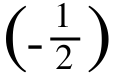 + +
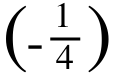
=

-
Corrected worked answer
Problem 11 →To find the 5th partial sum, the first five terms need to be evaluated.
a1 =
 = 2
a2 =
 =

a3 =
 = 1
` a4 =
 =

a5 =
 =
 ,
S5 = a1 + a2 + a3 + a4 + a5
= 2 +
+ 1 + + =

-
Original worked answer
Problem 12 →First put the series through the test for divergence.
Since it is a geometric sequence where r =
 , it converges to
0 and passes the test for divergence.
Going through the sequence of partial sums, the series
converges to 3.
-
Original worked answer
Problem 13 →First put the series through the test for divergence.
=
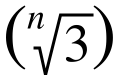
=
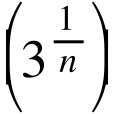
= 1
Since the limit of the series terms is 1 and not 0, the series diverges.
-
Original worked answer
Problem 14 →The series converges through the integral test.
Letting u = ln n...
=

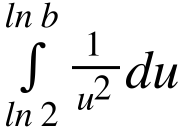
=
=
=
=
=

Because there is a value for the improper integral, the series converges.
-
Corrected worked answer
Problem 15 →- For , the function is positive and continuous. Its denominator has derivative , so is decreasing.
- Let , so . Then . Both logarithmic arguments are positive for .
- As , , so the improper integral diverges. The integral test therefore proves that the displayed tail starting at diverges.
-
Original worked answer
Problem 16 →16. The series diverges through the integral test.
=
=
=
(ln b - ln 1)=
ln b= ∞
Since the value of the improper integral is infinity, the series diverges.
-
Original worked answer
Problem 17 →The series diverges.
3n = ∞The series terms do not converge to 0 and therefore diverges.
-
Original worked answer
Problem 18 →The series converges through the integral test.
Letting u = 3x+2...
=

=
=
=
=
=
=

Because there is a value for the improper integral, the series converges.
-
Original worked answer
Problem 19 →The series diverges.
3n+2 = ∞The series terms do not converge to 0 and therefore diverges.