AP Unit 2 Problems
18 problems for Unit 2. Try the particle picture, chemical setup and explanation before opening the separate worked solution. These are newly authored learning tasks; they are not released College Board exam questions.
Choose your next practice
Find the problems you need.
Mix the choices to focus your practice. Problem numbers and worked-solution links stay the same.
18 of 18 problems shown.
Selection: All topics and practice types.
Printing includes the currently visible selection. Reset filters first to print all 18 problems.
Problem 1
Given electronegativities C = 2.6, H = 2.2, O = 3.4, describe C–H and O–H bonding in methanol. A second sample is a brittle metal–nonmetal solid that conducts only after melting. Give a supported bonding model for it. Do not infer bond energies.
Also explain why representative-element electronegativity generally increases from Mg to S across a period and decreases from O to S down a group. Use shell distance, core shielding and effective nuclear attraction, not just trend arrows.
Finally, compare the single bonds H–Cl and H–Br using H = 2.2, Cl = 3.2 and Br = 3.0. In the qualitative electronegativity model, predict which bond has greater charge separation, greater ionic character and a greater bond dipole. Mark partial-charge directions for both. Explain why a polar covalent bond has some ionic character, yet no single electronegativity difference creates a universal sharp boundary between ionic and covalent bonds. State one limit of predicting an exact dipole from electronegativity alone.
Written working workspace
Drawing is temporarily unavailable. Work on paper if needed, then record your reasoning here.
Saving written working requires JavaScript. Keep your work on paper or in your own notes; the source problem above remains available.
Problem 2
Samples A and B both conduct when molten. Only A conducts as a solid and can be hammered into a sheet; B is brittle. Propose bonding models and explain why molten conductivity alone does not identify them.
Written working workspace
Drawing is temporarily unavailable. Work on paper if needed, then record your reasoning here.
Saving written working requires JavaScript. Keep your work on paper or in your own notes; the source problem above remains available.
Problem 3
Sketch two potential-energy curves with labeled axes and units and a separated-atom reference at zero. Mark minima X: (154 pm, −350 kJ mol−1) and Y: (134 pm, −610 kJ mol−1); show steep short-distance repulsion and approach to zero at large distance. Assign X and Y as plausible C–C and C=C models. Give the energy change for dissociating one mole on curve Y.
Written working workspace
Drawing is temporarily unavailable. Work on paper if needed, then record your reasoning here.
Saving written working requires JavaScript. Keep your work on paper or in your own notes; the source problem above remains available.
Problem 4
Compare idealized ion pairs A (+e, −e, separation r) and B (+2e, −2e, separation 0.80r). Find the ratio of attraction-force magnitudes and explain how this supports a qualitative lattice-strength claim without giving an exact lattice energy.
Written working workspace
Drawing is temporarily unavailable. Work on paper if needed, then record your reasoning here.
Saving written working requires JavaScript. Keep your work on paper or in your own notes; the source problem above remains available.
Problem 5
- Sketch and label a corrected particle model for an ionic solid containing six Al3+ ions. How many O2− ions are required? Explain two features beyond the count that distinguish an ionic lattice from isolated molecular units.
- Use the three particle windows below. Identify the counted entity in A, B and C, and explain which show separate atoms or molecules and which require a formula unit for the extended sample. Give the formulas of B and C. Explain what C’s subscripts describe, why an outlined neighboring Na/Cl pair would not establish a separate NaCl molecule, and whether two macroscopic pieces of pure C would have different Na:Cl ratios or elemental mass percentages.
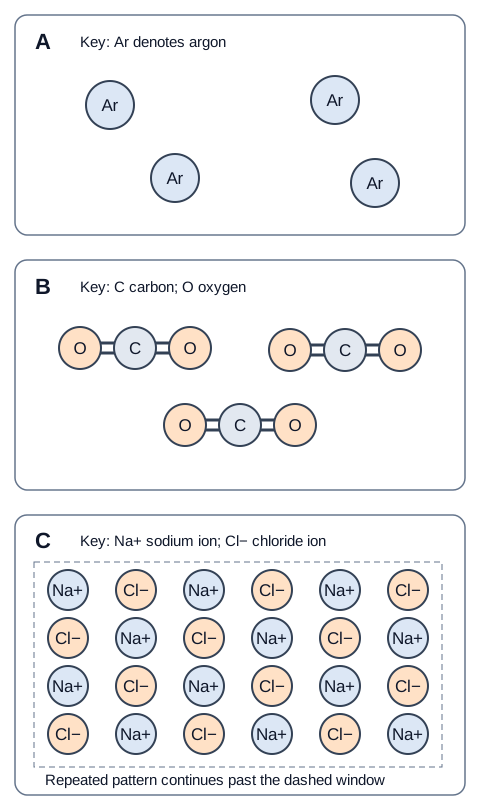
Text equivalent: A has four separated Ar circles and no connecting lines. B has three separated O–C–O groups with no links between groups. C has four rows of six alternating Na+ and Cl− ions, with opposite starting ions in adjacent rows; the repeating arrangement continues beyond all sides of the window. There are twelve of each ion in the window.
Written working workspace
Drawing is temporarily unavailable. Work on paper if needed, then record your reasoning here.
Saving written working requires JavaScript. Keep your work on paper or in your own notes; the source problem above remains available.
Problem 6
A lattice drawing shows alternating unlike-charge layers. Explain how the same model accounts for a solid’s brittleness and its conductivity after melting, and identify one limitation of a two-dimensional picture.
Written working workspace
Drawing is temporarily unavailable. Work on paper if needed, then record your reasoning here.
Saving written working requires JavaScript. Keep your work on paper or in your own notes; the source problem above remains available.
Problem 7
Guest element A has about the same atomic radius as a metal host, while guest B has a much smaller radius. Create two labeled particle sketches for the two likely alloy types, including electron location, and explain why both may conduct.
Written working workspace
Drawing is temporarily unavailable. Work on paper if needed, then record your reasoning here.
Saving written working requires JavaScript. Keep your work on paper or in your own notes; the source problem above remains available.
Problem 8
A steel sample is harder to deform than a specified purer iron comparison but still conducts. Explain both observations using the interstitial model, and state why a drawing alone cannot determine an exact conductivity value.
Written working workspace
Drawing is temporarily unavailable. Work on paper if needed, then record your reasoning here.
Saving written working requires JavaScript. Keep your work on paper or in your own notes; the source problem above remains available.
Problem 9
Construct the Lewis diagram for HCN. State the electron total, bond orders and lone-pair locations. Explain why H cannot be the central atom.
Written working workspace
Drawing is temporarily unavailable. Work on paper if needed, then record your reasoning here.
Saving written working requires JavaScript. Keep your work on paper or in your own notes; the source problem above remains available.
Problem 10
A proposed NH4+ Lewis diagram has four N–H single bonds and one lone pair on N. Evaluate it by electron budget and local electron count; provide the corrected model.
Written working workspace
Drawing is temporarily unavailable. Work on paper if needed, then record your reasoning here.
Saving written working requires JavaScript. Keep your work on paper or in your own notes; the source problem above remains available.
Problem 11
For carbonate, CO32−, construct the equivalent ordinary-octet contributors, give formal charges in one contributor and predict relative C–O bond lengths.
Written working workspace
Drawing is temporarily unavailable. Work on paper if needed, then record your reasoning here.
Saving written working requires JavaScript. Keep your work on paper or in your own notes; the source problem above remains available.
Problem 12
For CO2, compare an octet model O=C=O to an octet model with one C–O single bond and one C≡O triple bond. Give formal charges and identify the better ordinary Lewis contributor.
Written working workspace
Drawing is temporarily unavailable. Work on paper if needed, then record your reasoning here.
Saving written working requires JavaScript. Keep your work on paper or in your own notes; the source problem above remains available.
Problem 13
NO contains 5 + 6 = 11 valence electrons. A student insists it must have only paired electrons and full octets on both atoms. Explain the problem and identify the model limitation.
Written working workspace
Drawing is temporarily unavailable. Work on paper if needed, then record your reasoning here.
Saving written working requires JavaScript. Keep your work on paper or in your own notes; the source problem above remains available.
Problem 14
Using valid Lewis models, compare H2O, BF3 and NH3. Construct and label the NH3 Lewis diagram, including the lone pair. For each species give central domains, electron-domain and molecular geometries, ideal reference angles or expected deviations, hybridization nomenclature and net polarity. Explain why NH3 is not trigonal planar even though three H atoms are bonded to N.
Written working workspace
Drawing is temporarily unavailable. Work on paper if needed, then record your reasoning here.
Saving written working requires JavaScript. Keep your work on paper or in your own notes; the source problem above remains available.
Problem 15
The following central-atom models have (bond domains, lone-pair domains): PCl5 (5,0), SF4 (4,1), ClF3 (3,2), SF6 (6,0), BrF5 (5,1), XeF4 (4,2). Give each molecular shape. Explain favored lone-pair locations in the five-domain and square-planar cases.
Written working workspace
Drawing is temporarily unavailable. Work on paper if needed, then record your reasoning here.
Saving written working requires JavaScript. Keep your work on paper or in your own notes; the source problem above remains available.
Problem 16
- Sketch and label ethyne, H–C≡C–H, showing its linear atom arrangement and bond orders. Give the domain count and hybridization at each carbon, the bond angle, and total σ and π counts.
- Compare the C–C bond lengths and total C–C bond dissociation energies in ethyne, ethene and ethane. Explain both trends using bond order for the same atom pair.
- Explain qualitatively why corresponding head-on σ overlap between the same atoms is generally stronger than sideways π overlap. Does the greater total energy of a C=C bond imply that its individual π contribution is stronger than its σ contribution? Justify your answer.
Written working workspace
Drawing is temporarily unavailable. Work on paper if needed, then record your reasoning here.
Saving written working requires JavaScript. Keep your work on paper or in your own notes; the source problem above remains available.
Problem 17
Why can 2-butene have geometric isomers while ethene cannot, and why does rotating about the C=C require disrupting bonding? Explain with substituents and orbital overlap.
Written working workspace
Drawing is temporarily unavailable. Work on paper if needed, then record your reasoning here.
Saving written working requires JavaScript. Keep your work on paper or in your own notes; the source problem above remains available.
Problem 18
A student calls CH3Cl nonpolar because its central carbon is tetrahedral, and labels SO2 linear because each S=O is a double bond. Evaluate both claims using domains and bond vectors. Use a Lewis model with two S–O bonding domains and one S lone-pair domain for SO2.
Finally, compare the single H–Cl and H–Br bond lengths. Chlorine and bromine are both group 17; Cl is in period 3 and Br in period 4. Predict which halogen has the larger covalent radius and which H–halogen bond is longer. Explain the shell/radius connection and why you must control bond order for this comparison.
Written working workspace
Drawing is temporarily unavailable. Work on paper if needed, then record your reasoning here.
Saving written working requires JavaScript. Keep your work on paper or in your own notes; the source problem above remains available.