AP Unit 2 Solutions
Worked solutions to all 18 Unit 2 problems. These answers and reasons were added for the AP edition. Check the setup, units, assumptions and explanation alongside the final result.
Problem 1
Given electronegativities C = 2.6, H = 2.2, O = 3.4, describe C–H and O–H bonding in methanol. A second sample is a brittle metal–nonmetal solid that conducts only after melting. Give a supported bonding model for it. Do not infer bond energies.
Also explain why representative-element electronegativity generally increases from Mg to S across a period and decreases from O to S down a group. Use shell distance, core shielding and effective nuclear attraction, not just trend arrows.
Finally, compare the single bonds H–Cl and H–Br using H = 2.2, Cl = 3.2 and Br = 3.0. In the qualitative electronegativity model, predict which bond has greater charge separation, greater ionic character and a greater bond dipole. Mark partial-charge directions for both. Explain why a polar covalent bond has some ionic character, yet no single electronegativity difference creates a universal sharp boundary between ionic and covalent bonds. State one limit of predicting an exact dipole from electronegativity alone.
- C–H has a small electronegativity difference and is treated as effectively nonpolar in the AP model.
- O–H is polar covalent with Oδ− and Hδ+.
- The second sample supports an ionic model: ions held in a lattice are immobile as a solid but mobile when molten.
- Across Mg to S, nuclear charge rises while valence electrons enter the same principal shell with broadly similar core shielding; increased effective attraction generally raises electronegativity.
- From O to S, the valence shell is farther from the nucleus and more core-shielded; this generally reduces attraction to shared electron density despite more protons.
- H–Cl has ΔEN = 1.0 and H–Br has ΔEN = 0.8. Both have Hδ+ and the halogen δ−. The model predicts greater charge separation, ionic character and bond dipole for H–Cl; this is a qualitative comparison, not an exact dipole calculation.
- Unequal electron sharing produces partial charge separation, so polar covalent bonds include ionic character. The distribution changes continuously rather than switching at one arbitrary ΔEN cutoff. Bond length and the actual electron distribution are needed to determine an exact dipole; partial charges are not full monatomic-ion charges.
Final answer
C–H effectively nonpolar covalent; O–H polar covalent; the second sample is consistent with ionic bonding.
Across Mg→S, increased effective nuclear attraction generally increases electronegativity; down O→S, greater shell distance and shielding generally decrease it.
H–Cl is predicted to have the greater polarity/ionic character and bond dipole in this comparison. Both bonds remain polar covalent in the molecular model; the partial-charge distribution forms a continuum.
What earns credit
- Credit partial-charge directions.
- Require conductivity mechanism as evidence for the ionic claim.
- Credit separate charge/shielding explanations for the across-period and down-group predictions.
- Credit H–Cl over H–Br using ΔEN and the correct Hδ+/halogenδ− labels; do not award an unsupported bond-energy ranking.
- Require some ionic character in both polar bonds, continuous rather than cutoff-based classification, and an exact-dipole limitation such as bond length.
Watch out: Classifying polarity as a direct dissociation-energy ranking.
Problem 2
Samples A and B both conduct when molten. Only A conducts as a solid and can be hammered into a sheet; B is brittle. Propose bonding models and explain why molten conductivity alone does not identify them.
- A is consistent with a metallic model: delocalized electrons are mobile in the solid and the cohesive metal arrangement tolerates sliding.
- B is consistent with an ionic model: solid ions are fixed, and displaced layers can align like charges and fracture; melted ions carry charge.
- Both can have mobile charge carriers when molten, so that single observation is insufficient.
Final answer
A metallic, B ionic, supported by the combination of solid conductivity and mechanical behavior.
What earns credit
- Credit model assignments with charge-carrier evidence.
- Credit the limitation of a one-property diagnosis.
Watch out: Any substance conducting when molten is a metal.
Problem 3
Sketch two potential-energy curves with labeled axes and units and a separated-atom reference at zero. Mark minima X: (154 pm, −350 kJ mol−1) and Y: (134 pm, −610 kJ mol−1); show steep short-distance repulsion and approach to zero at large distance. Assign X and Y as plausible C–C and C=C models. Give the energy change for dissociating one mole on curve Y.
- Create a graph with internuclear distance in pm horizontally and potential energy in kJ mol−1 vertically. Draw the separated-atom zero reference, steeply rising short-distance regions, the labeled minima X and Y, and curves approaching zero from below at large distance.
- The shorter, deeper curve Y is consistent with greater bond order C=C; X with C–C.
- Dissociation takes Y from −610 to zero: ΔE = +610 kJ mol−1.
Final answer
X: C–C; Y: C=C; dissociation of one mole on Y requires +610 kJ.
What earns credit
- Credit a created graph with axes/units, zero reference, repulsive region and correctly placed/labeled minima.
- Credit both minimum position and depth plus energy sign.
Watch out: Calling the deeper negative value an exothermic bond break.
Problem 4
Compare idealized ion pairs A (+e, −e, separation r) and B (+2e, −2e, separation 0.80r). Find the ratio of attraction-force magnitudes and explain how this supports a qualitative lattice-strength claim without giving an exact lattice energy.
- The charge-product ratio is 4.
- The inverse-square distance factor is 1/(0.80)², so FB/FA = 4/0.64 = 6.25.
- This pairwise force comparison supports stronger interactions in B. Lattice energy is an energy involving all interactions and structure, so it is not the force ratio multiplied by an arbitrary energy.
Final answer
B’s pairwise attraction magnitude is 6.25 times A’s in this model; its ionic cohesion is qualitatively stronger.
What earns credit
- Credit charge product and squared separation.
- Credit force-versus-lattice-energy limitation.
Watch out: Applying a force ratio directly as an exact crystal energy.
Problem 5
- Sketch and label a corrected particle model for an ionic solid containing six Al3+ ions. How many O2− ions are required? Explain two features beyond the count that distinguish an ionic lattice from isolated molecular units.
- Use the three particle windows below. Identify the counted entity in A, B and C, and explain which show separate atoms or molecules and which require a formula unit for the extended sample. Give the formulas of B and C. Explain what C’s subscripts describe, why an outlined neighboring Na/Cl pair would not establish a separate NaCl molecule, and whether two macroscopic pieces of pure C would have different Na:Cl ratios or elemental mass percentages.
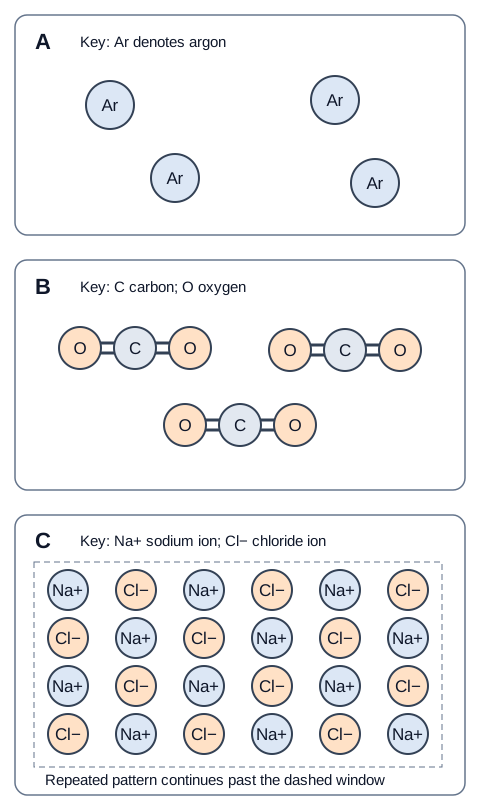
Text equivalent: A has four separated Ar circles and no connecting lines. B has three separated O–C–O groups with no links between groups. C has four rows of six alternating Na+ and Cl− ions, with opposite starting ions in adjacent rows; the repeating arrangement continues beyond all sides of the window. There are twelve of each ion in the window.
- Six Al3+ ions contribute +18 charge units; nine oxide ions contribute −18. The sketch must label six Al3+ and nine O2− ions in an extended arrangement, favor unlike-charge contacts, and state that the picture is a slice of a three-dimensional structure. Do not draw separate Al2O3 molecules.
- A represents separate Ar atoms. B represents discrete CO2 molecules: each separated group contains one C and two O atoms joined within that group.
- C represents an extended ionic sample with a 1:1 Na+:Cl− ratio. Its formula is NaCl; the formula unit records that simplest ratio, not a separable two-ion molecule. Each ion interacts with more than one neighbor, and the repeated structure continues across any arbitrarily drawn pair boundary.
- Two macroscopic pieces of pure C have the same 1:1 elemental number ratio and the same elemental mass percentages. Changing sample size changes total mass and ion counts, but not the proportions of a pure compound. Equal Na/Cl counts do not imply equal Na/Cl masses because their atomic masses differ.
Final answer
(a) Nine O2− ions balance six Al3+ ions in an extended array. (b) A: Ar atoms; B: CO2 molecules; C: NaCl formula units describing a repeated 1:1 ionic ratio. Pure pieces of C retain the same elemental composition.
What earns credit
- Credit 2:3 Al:O ratio and neutrality.
- Require a created ionic sketch with labels, extended structure and a slice limitation; a verbal count alone is insufficient.
- Require separate-atom, discrete-molecule and extended-ionic distinctions for A/B/C, correct formulas, and the formula unit as a ratio rather than a molecule.
- Credit unchanged pure-sample atom ratio and mass percentages across macroscopic pieces, while distinguishing number ratio from mass ratio.
Watch out: Using six oxide ions because the total number of circles should match.
Problem 6
A lattice drawing shows alternating unlike-charge layers. Explain how the same model accounts for a solid’s brittleness and its conductivity after melting, and identify one limitation of a two-dimensional picture.
- Sliding layers can place like charges close together, causing repulsion and fracture.
- Melting releases ions from fixed lattice sites, allowing charge transport.
- A two-dimensional picture omits many three-dimensional neighbors and cannot establish an exact crystal structure.
Final answer
Brittleness follows repulsive contacts after displacement; molten conductivity follows mobile ions. The slice omits three-dimensional contacts.
What earns credit
- Credit both causal mechanisms.
- Credit a specific representation limit.
Watch out: Molten conductivity results from newly created electrons.
Problem 7
Guest element A has about the same atomic radius as a metal host, while guest B has a much smaller radius. Create two labeled particle sketches for the two likely alloy types, including electron location, and explain why both may conduct.
- In the first created sketch, represent A replacing some host sites: substitutional alloy.
- In the second created sketch, represent B in gaps between host cores: interstitial alloy.
- Include delocalized valence electrons throughout both solids; those mobile electrons carry current.
Final answer
A substitutional, B interstitial; both generally retain mobile metallic electrons.
What earns credit
- Credit position/size connection.
- Credit electrons as shared mobile carriers.
- Credit two created sketches with host/guest labels, relative radius, guest placement and a delocalized-electron region.
Watch out: Treating the small guest as a replacement solely because it is another element.
Problem 8
A steel sample is harder to deform than a specified purer iron comparison but still conducts. Explain both observations using the interstitial model, and state why a drawing alone cannot determine an exact conductivity value.
- Small carbon atoms in spaces between iron cores impede rearrangement of layers and increase rigidity.
- Delocalized electrons remain available for charge transport.
- Exact conductivity also depends on composition, electron scattering, temperature and material structure; the schematic model predicts behavior qualitatively.
Final answer
Interstitial obstacles reduce deformation while retained delocalized electrons support conduction. Exact conductivity needs additional data.
What earns credit
- Credit separate mechanical and electrical mechanisms.
- Credit a quantitative-model limitation.
Watch out: Hardness proves that valence electrons are immobile.
Problem 9
Construct the Lewis diagram for HCN. State the electron total, bond orders and lone-pair locations. Explain why H cannot be the central atom.
- Count 1 + 4 + 5 = 10 valence electrons.
- Use H–C–N connectivity. A C≡N triple bond plus H–C single bond spends eight electrons; place the remaining lone pair on N.
- H has two local electrons, C and N each have an octet. H cannot connect two atoms while retaining its ordinary duet.
Final answer
H–C≡N: with one N lone pair and no C lone pairs; 10 total valence electrons.
What earns credit
- Credit connectivity and electron budget.
- Credit triple bond, lone pair and H duet.
Watch out: H can be central because it is the least electronegative atom.
Problem 10
A proposed NH4+ Lewis diagram has four N–H single bonds and one lone pair on N. Evaluate it by electron budget and local electron count; provide the corrected model.
- Available electrons = 5 + 4 − 1 = 8. Four bonds already use all eight.
- The additional lone pair would give ten total electrons and ten around second-period N, violating both the budget and N’s ordinary octet.
- Remove the lone pair; bracket four single N–H bonds with overall + charge.
Final answer
Correct NH4+ has four bonds and no N lone pair.
What earns credit
- Credit both independent checks.
- Credit net-ion charge notation.
Watch out: Using a familiar NH3 lone pair without recalculating the ion’s budget.
Problem 11
For carbonate, CO32−, construct the equivalent ordinary-octet contributors, give formal charges in one contributor and predict relative C–O bond lengths.
- There are 4 + 3(6) + 2 = 24 valence electrons. Each contributor has one C=O and two C–O bonds; the double bond can occupy each of three equivalent positions.
- C formal charge is 4 − 0 − 4 = 0; double-bonded O is 0; single-bonded O atoms each are −1. Sum is −2.
- Equivalent contributors give average order 4/3 for each C–O position.
Final answer
Three equivalent contributors; charges 0 on C and double O, −1 on each single O. All three actual C–O bonds are equivalent and intermediate in length.
What earns credit
- Credit all equivalent locations and charge sum.
- Credit hybrid-based equal-length prediction.
Watch out: Predicting one shorter C–O bond from only one contributor.
Problem 12
For CO2, compare an octet model O=C=O to an octet model with one C–O single bond and one C≡O triple bond. Give formal charges and identify the better ordinary Lewis contributor.
- O=C=O gives FC(C) = 4 − 4 = 0 and each O = 6 − 4 − 2 = 0.
- In the single/triple model, C has four bond lines and FC = 0. Single O has three lone pairs: −1; triple O has one lone pair: +1.
- Both obey ordinary octets and the net zero charge, but the equal-double-bond model avoids unnecessary charge separation.
Final answer
O=C=O is better by the stated ordinary Lewis criteria; the alternative has −1 and +1 on the oxygens.
What earns credit
- Credit formal charges.
- Credit a comparison that uses both octets and charge separation.
Watch out: Rejecting a valid contributor solely because it looks unfamiliar.
Problem 13
NO contains 5 + 6 = 11 valence electrons. A student insists it must have only paired electrons and full octets on both atoms. Explain the problem and identify the model limitation.
- Eleven is an odd electron total, so not all electrons can be arranged in pairs.
- A simple Lewis diagram must accommodate an unpaired electron, and cannot give both atoms ordinary complete paired-electron octets while preserving this budget.
- Lewis octet rules are useful but have known odd-electron limitations.
Final answer
The insistence violates the electron budget; NO is an odd-electron species requiring an unpaired electron in the simple model.
What earns credit
- Credit parity argument.
- Credit an explicit limitation rather than adding an electron.
Watch out: Adding an electron to make the neutral species fit an octet rule.
Problem 14
Using valid Lewis models, compare H2O, BF3 and NH3. Construct and label the NH3 Lewis diagram, including the lone pair. For each species give central domains, electron-domain and molecular geometries, ideal reference angles or expected deviations, hybridization nomenclature and net polarity. Explain why NH3 is not trigonal planar even though three H atoms are bonded to N.
- H2O has two bonds and two lone pairs: four domains, tetrahedral electron geometry, bent atom geometry, angle below 109.5°, sp3. O–H dipoles do not cancel.
- BF3 has three bonds and no central lone pair: three domains, trigonal-planar electron and atom geometry, 120°, sp2. Equal planar B–F bond vectors cancel.
- NH3 has 5 + 3 = 8 valence electrons. Three N–H bonds use six, leaving one lone pair on N. Four domains give tetrahedral electron geometry and sp3 nomenclature; considering only the three atom positions gives trigonal-pyramidal molecular geometry. Lone-pair repulsion compresses the H–N–H angles below 109.5° (about 107°).
- NH3 has a net dipole because its N–H bond contributions do not cancel in the pyramidal arrangement. Three bonded atoms do not imply three total domains when a lone pair is present.
Final answer
H2O: bent/polar/sp3; BF3: trigonal planar/nonpolar/sp2; NH3: tetrahedral electron geometry, trigonal-pyramidal molecular geometry, polar/sp3, with angles below 109.5°.
What earns credit
- Credit the learner-created NH3 Lewis diagram with three N–H bonds and one lone pair from an eight-electron budget.
- Credit domains and distinct electron/atom geometry for all three species, including trigonal-pyramidal NH3.
- Credit angle deviations, hybridization nomenclature and vector-based polarity; shape naming alone is insufficient.
Watch out: Counting only bonded atoms and labeling water linear.
Problem 15
The following central-atom models have (bond domains, lone-pair domains): PCl5 (5,0), SF4 (4,1), ClF3 (3,2), SF6 (6,0), BrF5 (5,1), XeF4 (4,2). Give each molecular shape. Explain favored lone-pair locations in the five-domain and square-planar cases.
- Five-domain cases use a trigonal-bipyramidal arrangement: PCl5 trigonal bipyramidal; SF4 seesaw; ClF3 T-shaped. Equatorial lone pairs have fewer 90° close contacts.
- Six-domain cases use an octahedral arrangement: SF6 octahedral; BrF5 square pyramidal; XeF4 square planar.
- For XeF4, the two lone pairs occupy opposite directions, leaving four coplanar atom positions.
Final answer
Shapes as listed; favorable lone-pair placement minimizes close repulsive contacts.
What earns credit
- Credit each geometry family.
- Credit repulsion rationale; no d-hybridization credit required.
Watch out: Calling every five-domain case trigonal bipyramidal molecular geometry.
Problem 16
- Sketch and label ethyne, H–C≡C–H, showing its linear atom arrangement and bond orders. Give the domain count and hybridization at each carbon, the bond angle, and total σ and π counts.
- Compare the C–C bond lengths and total C–C bond dissociation energies in ethyne, ethene and ethane. Explain both trends using bond order for the same atom pair.
- Explain qualitatively why corresponding head-on σ overlap between the same atoms is generally stronger than sideways π overlap. Does the greater total energy of a C=C bond imply that its individual π contribution is stronger than its σ contribution? Justify your answer.
A suitable structural sketch is H–C≡C–H in a straight line, with the C–C connection labeled one σ + two π and each C–H labeled one σ. The shown separation is schematic, not a measured length.
- Each carbon has two domains, one C–H direction and one C≡C direction: a linear sp model with 180° angles. A multiple bond still occupies one overall direction.
- The triple bond has one σ and two π; two C–H bonds each add one σ. Total: three σ and two π.
- For this same C–C pair, higher bond order gives shorter, stronger bonding: length ethyne < ethene < ethane, while total C–C dissociation energy ethyne > ethene > ethane. These trends do not rank arbitrary bonds between different atom pairs.
- Head-on σ overlap places more overlapping density along the line between nuclei than corresponding side-by-side π overlap. Greater overlap generally gives greater stabilization and a larger individual bond-energy contribution in this model.
- No. A double bond contains both σ and π contributions, so its larger total energy does not establish that π alone is stronger than σ. The π contribution is ordinarily weaker than the corresponding σ contribution, even while adding π bonding strengthens the total connection. These are qualitative model comparisons, not exact independent bond-energy measurements.
Final answer
(a) Two domains per C; sp, 180°; 3 σ and 2 π. (b) C≡C < C=C < C–C lengths, with the reverse total C–C dissociation-energy order. (c) Greater corresponding head-on overlap supports stronger σ than π bonding; adding a π contribution still makes the whole multiple bond stronger.
What earns credit
- Require a created, labeled linear structural sketch with the triple bond counted as one domain.
- Credit σ/π counts and both same-pair length and total-energy orderings with bond-order reasoning.
- Require head-on versus sideways overlap and the greater-overlap→greater-stabilization reasoning; restating “σ is stronger” is insufficient.
- Credit the distinction between an individual π contribution and the combined energy of a multiple bond.
Watch out: Three shared pairs mean three VSEPR domains.
Problem 17
Why can 2-butene have geometric isomers while ethene cannot, and why does rotating about the C=C require disrupting bonding? Explain with substituents and orbital overlap.
- A C=C includes side-to-side pi overlap as well as sigma overlap. Free rotation disrupts that pi overlap.
- Each carbon in 2-butene is attached to H and CH3, two different groups; distinct same-side and opposite-side arrangements are possible.
- Each ethene carbon has two identical H substituents, so swapping the apparent sides produces the same arrangement.
Final answer
Restricted rotation from π overlap permits geometric isomers only when each double-bond carbon has two different substituents; 2-butene qualifies, ethene does not.
What earns credit
- Credit pi-overlap mechanism.
- Credit both substituent comparisons.
Watch out: All double bonds automatically imply two distinct geometric isomers.
Problem 18
A student calls CH3Cl nonpolar because its central carbon is tetrahedral, and labels SO2 linear because each S=O is a double bond. Evaluate both claims using domains and bond vectors. Use a Lewis model with two S–O bonding domains and one S lone-pair domain for SO2.
Finally, compare the single H–Cl and H–Br bond lengths. Chlorine and bromine are both group 17; Cl is in period 3 and Br in period 4. Predict which halogen has the larger covalent radius and which H–halogen bond is longer. Explain the shell/radius connection and why you must control bond order for this comparison.
- CH3Cl has four central domains and an sp3 model, but its four substituents are not equivalent; the C–Cl dipole does not cancel the other bond contributions.
- SO2 has three central domains; each multiple bond is one domain. Its electron arrangement is trigonal planar and its molecular shape is bent, with an sp2 descriptor in this simple model.
- The bent S–O bond dipoles give a nonzero vector.
- Br has its valence shell at a higher principal level and generally a larger covalent radius than Cl. With the same H partner and single-bond order, the larger bonded radius supports a longer H–Br bond than H–Cl. Controlling bond order matters because multiple bonding also shortens bonds; radius alone cannot rank arbitrary bond lengths or bond energies.
Final answer
Both claims fail: CH3Cl is polar despite tetrahedral geometry; SO2 is bent and polar in the stated model.
Br has the larger covalent radius, so the single H–Br bond is longer than the single H–Cl bond in this comparison.
What earns credit
- Credit asymmetry for CH3Cl.
- Credit SO2 lone-pair count and vector argument.
- Credit Br’s higher valence shell and larger radius, H–Br as the longer single bond, and a same-partner/same-order qualification.
Watch out: Shape name alone determines molecular polarity.