AP Unit 4 Solutions
Worked solutions to all 18 Unit 4 problems. These answers and reasons were added for the AP edition. Check the setup, units, assumptions and explanation alongside the final result.
Problem 1
Two clear aqueous samples are mixed. The temperature falls 3 °C, but no solid or gas appears. A student says a chemical reaction is proved. Evaluate the claim and propose one additional type of evidence that would distinguish chemical change from physical mixing.
- A temperature change establishes energy transfer, but mixing or dissolution can also cause cooling.
- Evidence for a chemically distinct product, from a supplied spectrum or composition measurement, would distinguish formation of new species from unchanged species in a mixture.
Final answer
The claim is not proved by cooling alone; determine whether new chemical species formed.
What earns credit
- Credit alternative explanation and specific distinguishing evidence.
Watch out: Treating every energy change as chemical reaction.
Problem 2
A sealed container holds liquid water and water vapor. Heating increases the vapor amount while the total mass stays fixed. State a particle prediction and classify the change. Contrast it with decomposition of water into H2 and O2.
- During vaporization the H2O units remain intact, with more units in the gas phase.
- During decomposition the atoms regroup into H2 and O2; new species form. Both conserve atoms in a sealed boundary.
Final answer
Vaporization is physical; decomposition is chemical.
What earns credit
- Credit conserved molecular identity for vaporization and new species for decomposition.
Watch out: Confusing conserved total mass with unchanged chemical identity.
Problem 3
Given that CaCO3 is sparingly soluble, write molecular, complete ionic, and net ionic equations for CaCl2(aq) mixed with Na2CO3(aq). Identify spectators and verify charge.
- Molecular: CaCl2 + Na2CO3 → CaCO3(s) + 2NaCl, with (aq) on all other species.
- Complete ionic: Ca2+ + 2Cl− + 2Na+ + CO32− → CaCO3(s) + 2Na+ + 2Cl−, with (aq) on ions.
- Cancel identical sodium and chloride terms; +2 and −2 sum to zero on the left and the solid is neutral.
Final answer
Ca2+(aq) + CO32−(aq) → CaCO3(s).
What earns credit
- Credit each equation form separately; preserve the solid.
Watch out: Splitting the precipitate or dropping an ion charge.
Problem 4
Write (a) the dissolution of K2SO4(s) in water, and (b) neutralization of weak acid HF(aq) by NaOH(aq), as a net ionic equation. Explain why HF is treated differently from dissolved potassium sulfate.
- Dissolution: K2SO4(s) → 2K+(aq) + SO42−(aq); charge is zero on each side.
- NaOH supplies aqueous OH−; Na+ is spectator. HF is a weak acid and is retained.
- HF(aq) + OH−(aq) → F−(aq) + H2O(l); both sides have charge −1.
Final answer
The ionic salt dissociates into its ions; weak HF is not assumed fully ionized.
What earns credit
- Credit 2K coefficient, intact HF, and charge consistency.
Watch out: Confusing ion dissociation with weak-acid ionization.
Problem 5
For the model reaction 2A2 + B2 → 2A2B, a closed whole-sample box starts with seven A2 and three B2 molecules. The reaction proceeds completely until one reactant is exhausted; A and B denote different neutral atoms.
- Construct a labeled before-and-after particle diagram. Use the same atom key and icon scale on both sides. Show bonds within each molecule, every product molecule and every unreacted molecule. Counts are the complete model sample, not equal-volume windows. Particle positions need not represent measured coordinates.
- Identify the limiting reactant and verify both A-atom and B-atom counts before and after. Explain why coefficients give reacting proportions rather than forcing all starting particles to react.
Draw on paper or in the workspace. An accessible alternative is a coordinate construction identifying each bonded molecular group and its atom labels in the two panels. A final inventory alone does not replace constructing the representation.
- Construct a before panel with seven separate bonded A–A pairs and three separate bonded B–B pairs. In the after panel, create six separate molecules each with two A atoms and one B atom connected within that molecular group; retain one intact A–A pair. Keep the original A/B symbols and scale. No B₂ molecule remains. The equation does not specify detailed molecular geometry, so do not grade a particular bond angle.
- Three B₂ require six A₂, so B₂ is limiting. Before: 14 A atoms and 6 B atoms. After: 6 × 2 + 2 = 14 A atoms and 6 × 1 = 6 B atoms. All model species are neutral, so charge stays zero. Coefficients specify the 2:1 reacting ratio; the extra A₂ remains rather than being erased or split into atoms.
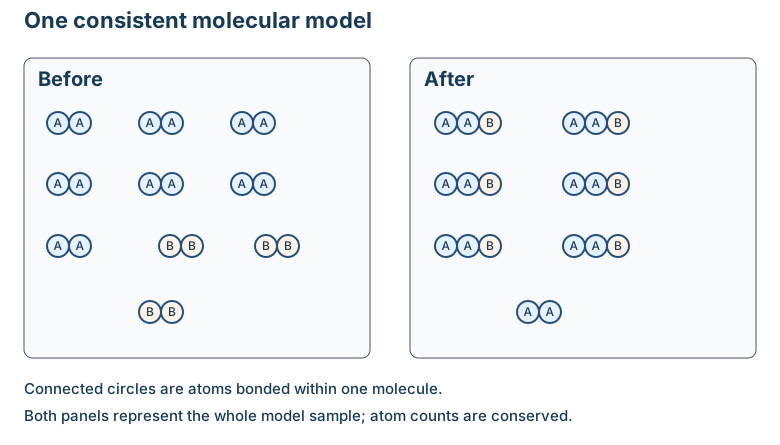
For a text coordinate construction, assign separate positions to seven A–A pairs and three B–B pairs in the before panel, then to six A–A–B groups and one A–A pair in the after panel. State that connections group atoms into molecules, not into one continuous network.
Final answer
Construct six A₂B molecules and retain one A₂ molecule after reaction. The model conserves 14 A atoms and 6 B atoms; B₂ is limiting.
What earns credit
- Require both constructed panels or equivalent coordinate layouts, with the same atom key/scale and correct bonds grouping each molecule.
- Credit six product molecules, one intact excess A₂ and no B₂; do not require an unspecified molecular geometry.
- Verify both conserved atom inventories and explain reacting proportions rather than deleting every reactant.
Watch out: Removing all reactants even when the starting ratio is not stoichiometric.
Problem 6
A whole-sample solution model initially contains two Mg2+, four NO3−, six Na+ and six OH− ions. Mg(OH)2 is sparingly soluble. For this particle-count model, assume precipitation consumes all available Mg2+; ignore the small equilibrium dissolved Mg2+ amount and any competing reaction.
- Write the balanced net ionic equation. Construct labeled before-and-after particle diagrams with one unchanged ion key. In the before panel show separate aqueous ions. In the after panel show a single labeled ionic-solid array plus every remaining aqueous ion, including spectators and any excess reagent. Keep OH− and NO3− intact. Water may be omitted if the legend says so.
- Verify Mg, O, H, N and Na atom counts and the total charge in each panel. Identify spectators and explain why cancellation from a net ionic equation does not erase them from the solution.
Draw on paper or in the workspace. An accessible alternative specifies coordinates and labels for each aqueous ion plus a connected solid-region layout containing its constituent ions; include phase labels and the same before/after inventory. A list of counts without a represented solid region and dispersed aqueous region is insufficient.
- Mg²⁺(aq) + 2OH⁻(aq) → Mg(OH)₂(s). Two Mg²⁺ consume four OH⁻. The before panel shows all 18 supplied ions dispersed, with no bonded nitrate/sodium or magnesium/hydroxide molecules. The after panel has one solid array containing two Mg²⁺ and four intact OH⁻ units; draw these together in the labeled solid region rather than as two isolated Mg(OH)₂ molecules. Aqueous solution retains six Na⁺, four NO₃⁻ and two excess OH⁻. State that water is omitted.
- The atom inventory is the same before/after: Mg 2, O 18 (12 in nitrate + 6 in hydroxide), H 6, N 4 and Na 6. In the final model, four hydroxide O/H units are in the solid and two remain aqueous. Before charge = 2(+2) + 4(−1) + 6(+1) + 6(−1) = 0. Solid charge = 2(+2) + 4(−1) = 0; final aqueous charge = 6(+1) + 4(−1) + 2(−1) = 0. Sodium and nitrate are spectators with unchanged counts and identities; cancelling them records the net chemical change, not physical removal.
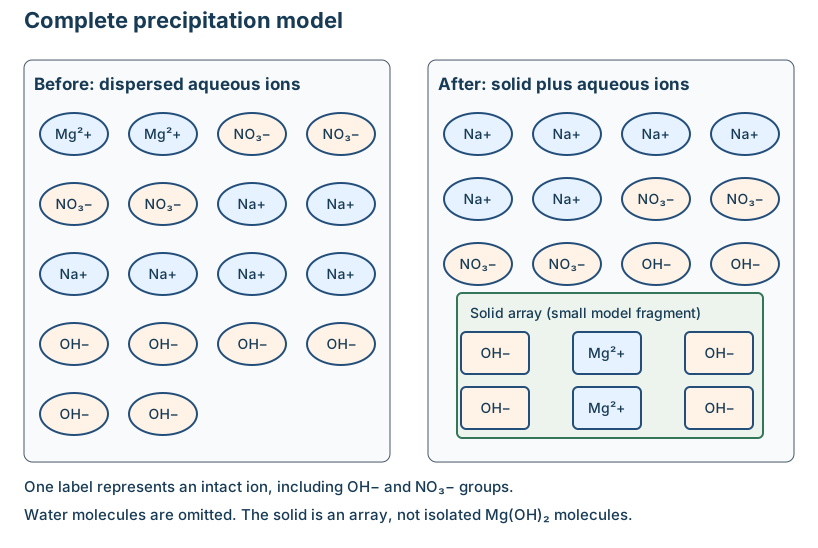
A text coordinate answer should place all initial ion labels at separate aqueous positions, place two Mg²⁺ and four OH⁻ labels in one final solid region, and place six Na⁺, four NO₃⁻ and two OH⁻ at separate final aqueous positions. The layout is a schematic inventory, not a crystallographic structure or hydration simulation.
Final answer
Construct one Mg(OH)₂ solid fragment containing 2 Mg²⁺ and 4 OH⁻, plus aqueous 6 Na⁺, 4 NO₃⁻ and 2 OH⁻. Conserve all five element counts and zero total charge.
What earns credit
- Require both particle constructions or equivalent coordinate layouts, with a consistent ion key, phase regions and declared solvent omission.
- Credit the 1 Mg²⁺:2 OH⁻ stoichiometry, one solid array, retained spectators and two excess hydroxide ions.
- Keep nitrate and hydroxide intact; do not replace an ionic precipitate with isolated neutral molecules.
- Verify each element inventory and charges before/after, including neutral solid and neutral remaining solution.
- Accept the stated complete-consumption approximation only for this model; do not claim a sparingly soluble solid has exactly zero equilibrium dissolved ions.
Watch out: Drawing a neutral MgOH molecule or erasing spectator ions.
Problem 7
A student says “evaporation and NaCl dissolution are physical, so no bonds or attractions change.” Evaluate each process at the particle level and explain the limitation of the student’s rule.
- Evaporation leaves covalent bonds intact while intermolecular attractions are overcome.
- Dissolution separates lattice ions and forms ion–dipole hydration interactions; water interactions reorganize.
- The physical/chemical label alone does not specify every interaction; salt dissolution is a boundary case that needs a stated criterion.
Final answer
Both processes involve changing interactions; water covalent bonds need not break in either.
What earns credit
- Credit each interaction account and recognition of the classification boundary.
Watch out: Equating physical change with no energy or interaction change.
Problem 8
For N2 + 3H2 → 2NH3, 0.400 mol N2 and 0.900 mol H2 react as far as possible. Find NH3 produced and excess reactant remaining. Then predict the product if H2 alone is increased to 1.80 mol.
- Nitrogen could support 0.800 mol NH3; hydrogen supports 0.900 ×2/3 =0.600 mol. Hydrogen limits.
- N2 used =0.900/3 =0.300 mol; 0.100 mol remains.
- At 1.80 mol H2, nitrogen now limits; maximum NH3 is 0.800 mol, rather than 1.20 mol.
Final answer
Initially 0.600 mol NH3 and 0.100 mol N2 remain; revised product 0.800 mol.
What earns credit
- Credit comparison, remaining amount, and changed limiting reagent.
Watch out: Extending proportionality past a new limiting reagent.
Problem 9
30.0 mL of 0.120 M BaCl2 is mixed with 20.0 mL of 0.150 M Na2SO4. BaSO4 is sparingly soluble; assume complete precipitation and additive volumes. Find solid moles and the concentration of excess Ba2+.
- Ba moles =0.0300 ×0.120 =0.00360; sulfate moles =0.0200 ×0.150 =0.00300.
- The ratio is 1:1; sulfate limits and gives 0.00300 mol BaSO4.
- Excess Ba moles =0.000600; final [Ba2+] =0.000600/0.0500 =0.0120 M.
Final answer
0.00300 mol solid; 0.0120 M Ba2+.
What earns credit
- Credit mole conversion, limiting logic, and total volume.
Watch out: Subtracting concentrations directly instead of reacting moles.
Problem 10
A 0.0150 mol sample of CaCO3 reacts completely with excess acid: CaCO3(s) + 2H+(aq) → Ca2+(aq) + CO2(g) + H2O(l). CO2 is collected over water at 298 K and total pressure 1.000 atm; water vapor pressure is 0.0313 atm. With R =0.08206 L atm mol−1 K−1, find gas volume and explain the bias if water vapor pressure is ignored.
- Stoichiometry gives 0.0150 mol CO₂. Its partial pressure is 1.000 −0.0313 =0.9687 atm.
- V =nRT/P =0.0150 ×0.08206 ×298/0.9687 =0.379 L.
- If total pressure 1.000 atm is incorrectly treated as CO₂ pressure, the predicted volume is 0.0150 ×0.08206 ×298/1.000 =0.367 L. At fixed gas moles and temperature, an overestimated product pressure gives an underestimated predicted volume.
- A different question—inferring CO₂ moles from a fixed measured volume—would instead overestimate moles. Here the requested quantity is volume, so the bias is low.
Final answer
V =0.379 L. Ignoring water vapor gives a predicted volume about 0.367 L, an underestimate.
What earns credit
- Credit partial pressure, mole ratio and calculated volume.
- Credit volume underestimate with fixed-n reasoning; do not substitute a fixed-volume moles-inference answer.
Watch out: Using total wet-gas pressure as CO₂ pressure.
Problem 11
A 25.00 mL sample of monoprotic acid HA is titrated by 0.1250 M NaOH. Buret readings are 1.35 mL initially and 19.75 mL at the indicator endpoint, assumed to match equivalence. Calculate [HA]. On a graph of indicator signal versus added base volume, state the x-axis quantity and where the equivalence estimate belongs.
- Delivered volume =19.75 −1.35 =18.40 mL.
- HA + OH− → A− + H2O; acid amount =0.01840 ×0.1250 =0.002300 mol.
- [HA] =0.002300/0.02500 =0.09200 M. Label x-axis added NaOH volume (mL); mark transition/equivalence near 18.40 mL.
Final answer
[HA] =0.09200 M; equivalence estimate at 18.40 mL delivered base.
What earns credit
- Credit reading difference, 1:1 ratio and graph labeling.
Watch out: Using final buret reading as delivered volume.
Problem 12
A titration of an unknown acid uses known base concentration. Three endpoints agree closely, but all are reached after adding a little excess base. Explain the effect on calculated acid concentration and why repeated trials do not remove this error.
- Excess base increases the recorded titrant moles. The calculation attributes them all to analyte consumption.
- Calculated acid moles and concentration are too high.
- Consistent overshoot is systematic; close repeats demonstrate precision, not correct equivalence. Use a more appropriate endpoint signal or analyze the transition around equivalence.
Final answer
Acid concentration is biased high despite good repeatability.
What earns credit
- Credit causal direction and precision/accuracy distinction.
Watch out: Treating agreement of replicates as proof of accuracy.
Problem 13
Classify and justify: (i) NH4+ + OH− → NH3 + H2O; (ii) 2Mg + O2 → 2MgO; (iii) Ba2+ + SO42− → BaSO4(s), given low BaSO4 solubility. Include oxidation-number changes and total electron transfer where applicable.
- (i) NH4+ transfers H+ to OH−; acid–base. N remains −3, O remains −2 and H +1.
- (ii) Mg goes 0→+2; two Mg lose four electrons total. Two O atoms go 0→−2 and gain four total: redox.
- (iii) Solvated ions make a sparingly soluble solid; Ba stays +2 and sulfate retains its internal oxidation numbers: precipitation.
Final answer
(i) acid–base; (ii) redox, four electrons; (iii) precipitation.
What earns credit
- Credit classification plus identifying change; do not award a bare label as full justification.
Watch out: Assigning phase change as evidence for electron transfer.
Problem 14
For C2H6 + O2 → CO2 + H2O, balance complete combustion and find the oxidation-number change per carbon and electrons transferred per two ethane molecules.
- Balance C and H first: 2C2H6 + 7O2 → 4CO2 + 6H2O.
- Hydrogen is +1, so each equivalent carbon in ethane is −3; in CO2 carbon is +4.
- Each carbon increases by seven; four carbons give 28 electrons. Fourteen oxygen atoms each decrease by two, balancing 28.
Final answer
Carbon: −3→+4; 28 electrons transferred in the equation as written.
What earns credit
- Credit balanced equation, per-atom accounting, and total electrons.
Watch out: Reporting the sum for all oxygen atoms as the oxidation number of each oxygen.
Problem 15
In CH3COOH + H2O ⇌ CH3COO− + H3O+, label acids, bases and conjugate pairs. Given that H3O+ is a stronger acid than CH3COOH, predict which side is favored and compare the bases.
- Acetic acid donates to water. Pairs are CH3COOH/CH3COO− and H3O+/H2O.
- H3O+ is the stronger acid; its conjugate base water is weaker than acetate.
- The left side contains the weaker acid and weaker base, so reactants are favored.
Final answer
Acid: CH3COOH; base: H2O; products are conjugate base/acid; left favored.
What earns credit
- Credit both pairs, water role and strength reasoning.
Watch out: Assuming every acid fully ionizes in water.
Problem 16
Two diagrams show water reacting: model I, H2O becomes H3O+ while HX becomes X−; model II, H2O becomes OH− while B becomes BH+. Explain water’s role in each, write both equations and account for charge.
- I: HX + H2O → X− + H3O+; water accepts a proton and is the base.
- II: B + H2O → BH+ + OH−; water donates a proton and is the acid.
- Both start neutral and finish with +1 and −1, conserving total charge. Arrow direction describes the shown event rather than claiming completion for every acid/base.
Final answer
Water is a base in I and an acid in II.
What earns credit
- Credit proton direction and balanced charge.
Watch out: Treating water as a spectator in every aqueous reaction.
Problem 17
Use half-reactions to balance Cr2O72− + I− → Cr3+ + I2 in acidic solution. Verify total charge.
- Reduction: Cr2O72− + 14H+ + 6e− → 2Cr3+ + 7H2O.
- Oxidation: 2I− → I2 + 2e−; multiply by three.
- Add and cancel six electrons. Reactant charge =−2 +14 −6 =+6; product charge =2×3 =+6.
Final answer
Cr2O72− + 14H+ + 6I− → 2Cr3+ + 7H2O + 3I2.
What earns credit
- Credit each half, matched electrons and final check.
Watch out: Multiplying only electron terms rather than the whole half-reaction.
Problem 18
Balance Cl2 → Cl− + ClO− in basic aqueous solution using half-reactions. Explain why one element can be both oxidized and reduced.
- Reduction: Cl₂ +2e⁻ →2Cl⁻. Each Cl atom is reduced from 0 to −1.
- For oxidation, balance first in acidic bookkeeping form: Cl₂ +2H₂O →2ClO⁻ +4H⁺ +2e⁻. Waters balance O, protons balance H and electrons balance charge.
- Add 4OH⁻ to both sides. The right-side H⁺ and OH⁻ make 4H₂O; cancel 2H₂O to obtain Cl₂ +4OH⁻ →2ClO⁻ +2H₂O +2e⁻.
- Add the reduction half, cancel 2e⁻, and divide the entire equation by two: Cl₂ +2OH⁻ →Cl⁻ +ClO⁻ +H₂O. Atom counts and charge −2 match. Different Cl atoms are oxidized 0→+1 and reduced 0→−1.
Final answer
Cl2 + 2OH− → Cl− + ClO− + H2O.
What earns credit
- Credit both halves or equivalent valid electron bookkeeping, medium and charge.
Watch out: Assuming every atom of one element must undergo the same oxidation-number change.