Chapter 2 Source Answers and Examples
Chapter problems → · Original reading →
Reviewed solution to Problem 9
New reviewed response for this exact prompt.
PureCO mass=3.00×0.965=2.895g; n(CO)=2.895/28.01=0.10336mol. H₂ amount=5.0/2.016≈2.48mol, well above2n(CO)≈0.207mol. CO limits the reaction; theoreticalCH₃OH=0.103mol. The unrelated original preceding purity problem remains in source provenance and is not a dependency of this revised task.
Reviewed solution to Problem 13
New reviewed response for this exact prompt.
First step contributes0.1000molH⁺; second contributes0.0100mol, total0.1100mol. Formal hydrogen mass=0.1100×1.008=0.11088g; formal mass percent=100×0.11088/1000=0.011088%. Aqueous protons are solvated; the requested mass is explicit bookkeeping.
Reviewed solution to Problem 17
New independently computed answer.
n(glucose)=5.550745mol; n(O₂)=33.304469mol; n(air)=n(O₂)/0.210=158.592712mol. Air mass=4575.5678g and volume=mass/(1.20gL⁻¹)/1000=3.81297m³.
Reviewed solution to Problem 18
New independently computed answer.
m(CO₂)=1465.7297g; m(H₂O)=600.0133g; m(N₂)=3509.8248g. Total=5575.5678g. CO₂ mass percent=26.28844%. Nitrogen remains part of the product mixture.
Reviewed solution to Problem 19
New independently computed answer.
Exactly stoichiometricO₂ is fully consumed in the supplied complete-reaction model, so its final molecular mole fraction is0. Oxygen atoms remain inCO₂ andH₂O. This explicit revised question countsO₂ molecules, replacing the original ambiguous oxygen-atom mole-fraction request.
Reviewed solution to Problem 20
New independently computed answer.
Incoming-air oxygen mass percent=23.29204%. Glucose adds532.8715g oxygen atoms, so product oxygen mass percent=28.67178%. The change is+5.37974percentage points. Oxygen mass is conserved for air plus glucose; comparing air alone with all products changes the mixture basis.
Worked examples and reviewed revisions
Example Problem 2.1.1
Original example and steps
Example Problem 2.1.1
a) The problem asks for weight in grams instead of amu, so we will need: the atomic weight (AW) of Lithium, and Avogadro’s Number (to calculate the relationship between atom and weight).

This would read as: how many grams of Li are there? = 1 Li atom is related to 6.94 grams of Li per 1 mol of Li (6.02 x 10²³ Li atoms).
b) The process of calculating molarity is very similar. We know molarity = moles of solute / liters of solution. Since we already calculated the amount of Li in grams, we will convert that into moles, and then use the amount of liters of solution (given in the question) to calculate M, molarity.

Clearly, this number is very small, but that is because we are calculating the molarity for a single atom of Lithium in a lot of solution relative to its size. Normal calculations for molarity usually result in much more approachable numbers.
Example Problem 2.1.2
Original example and steps
Example Problem 2.1.2
How much does one molecule of water weigh?
A molecule of water is made of 2 hydrogen and 1 oxygen atoms (H2O):
2 H atoms = 2 x 1.01 amu = 2.02 amu
1 O atom = 1 x 16.00 amu = 16.00 amu
1 H2O molecule = 18.02 amu
So the molecular weight of one H2O molecule is 18.02 amu. If we had 1 mol of H2O, that would weigh 18.02 grams.
Example Problem 2.1.3
Worked example
AP edition reviewed replacement.
A 60.0 mL final NaCl solution has analytical concentration 0.200 mol L⁻¹. Find the dissolved NaCl mass and the number of formula units represented. Use M(NaCl)=58.44 g mol⁻¹ and Nₐ=6.02214076×10²³ mol⁻¹. Assume complete dissociation when counting each ion species.
New independently computed worked answer.
n=cV=(0.200)(0.0600)=0.0120 mol NaCl. m=nM=(0.0120)(58.44)=0.70128 g≈0.701 g. Formula units represented: 0.0120Nₐ=7.226568912×10²¹≈7.23×10²¹. Complete dissociation gives the same number of Na⁺ ions and Cl⁻ ions, or twice that number of individual ions in total. A dissolved ion is not a NaCl molecule.
Gallery 2.1.1 Dimensional Analysis
Original illustrated example
Gallery 2.1.1 Dimensional Analysis
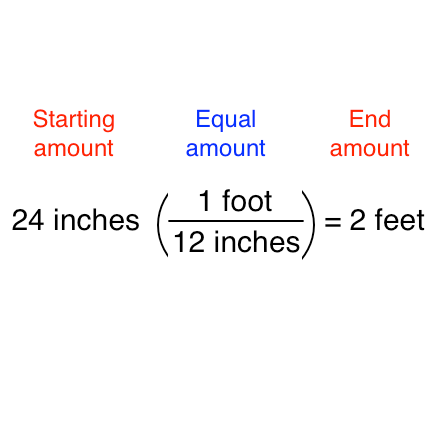
This is a simple example of how to correctly setup a dimensional analysis problem.
Read all original image captions
Image 1
This is a simple example of how to correctly setup a dimensional analysis problem.
Image 2
The blue lines show how we go from unit to unit, and the red lines show the units that end up cancelled.
Example Problem 2.2.1
Original example and steps
Example Problem 2.2.1
Balance the equation: C2H4 + O2 → CO2 + H2O
This is the combustion (reaction of a hydrocarbon with oxygen) of ethylene. To balance the equation, we have to have equal numbers of C, H, and O on both sides. The best way to decide which element to start balancing first is to look at what is present only once on both sides. In this case, it’s either carbon or Hydrogen (Oxygen is present in both CO2 and H2O). Let’s choose Carbon first.
C2H4 + O2 → 2CO2 + H2O
Balance the Carbon (C) by multiplying Carbon Dioxide (CO2) by a coefficient of 2. When balancing reactions, it is generally a good idea to balance elements that only appear once on each side, in this case Carbon
C2H4 + 3O2 → 2CO2 + 2H2O
Balance the Oxygen (O) by analyzing the product side. Since we have 5 oxygen atoms (an odd number), we will add a coefficient of 2 to Water (H2O) to achieve an even number of 6 Oxygen atoms on the product side. We can now easily balance the reactant Oxygen by multiplying by a coefficient of 3 to achieve the same 6 atoms. This step also ended up balancing the Hydrogen (H) so our balanced equation is:
C2H4 + 3O2 → 2CO2 + 2H2O
Example Problem 2.3.1
Original example and steps
Example Problem 2.3.1
Using the same balanced equation: How many grams of C6H6 are needed to react with 5.00 g of 96.5% pure O2?
We are presented with something we haven’t encountered before, percent purity of a compound. If no other information is given, we can make a simple assumption:
Since a percent is a part of a whole, or 100, we can assume we have 100 g of sample. After this relation, the problem is more or less the same we have been doing.

We start again with what is given, then we convert 96.5% into a fraction - 96.5 / 100 (with the 100 g of sample assumption).


Go from amount of O2 to mols of O2 using its molar mass. Then go to mols of C6H6 using the coefficients of the balanced equation, then finally the molar mass of C6H6 to find its yield in grams.
Example Problem 2.4.1
Original example and steps
Example Problem 2.4.1
If 9 car chassis and 28 tires are available, how many cars can be made?
We set up two stoichiometry problems:


We pick the smallest number. That means we can only make 7 cars. That also means the tires are the limiting reactants and the chassis are the excess reactants.
The tires will be used up completely in the “reaction” and nothing will remain unused. But there were 2 extra chassis that were leftover.
Example Problem 2.4.2
Original example and steps
Example Problem 2.4.2
In the exhaust of a car, 15.8 grams of carbon monoxide reacts with 7.4 grams of oxygen gas. How much carbon dioxide is formed, and how much excess gas is left unreacted?
The limiting reactant is Oxygen, which yields 20.35 grams of carbon dioxide. That means some Carbon Monoxide is left over after the reaction. Let us now calculate the amount of CO that was actually used, then find how much was unused:

That means that 15.8 g CO - 12.95 g CO = 2.85 grams of CO was unused - it is leftover and is much like a product.
Production of carbon monoxide is toxic to the environment and therefore further precautions are taken to prevent this in car emissions.
Example 9.1.2
Worked example
Example 9.1.2
What is the final concentration of Na+, Cl–, H+, and OH– ions in the solution when 5 g of lye (NaOH) are added to 1 L of a 0.1 M HCl solution?
Note: The way the reaction is written might seem confusing at first, but recognize that I have just broken up each compound into its ions. After the periodic trends and orbitals chapter, this will make more sense. Chemists write the reaction this way because this is actually how a beaker looks if you were to zoom in reeeeeeally close into the molecules. You would not see a NaOH molecule, you would see Na+ ions and OH– ions.
The fact that the Sodium and Chloride ions do not react is very important because that tells us that the initial and final concentrations of sodium and chloride ions stay the same. What about Hydrogen and Hydroxide ions? One of them has to be the limiting reactant. Before finding out their concentration, let’s get the easy part out of the way and calculate the concentrations of Cl– ions and Na+ ions.
[Cl–] = 0.1M
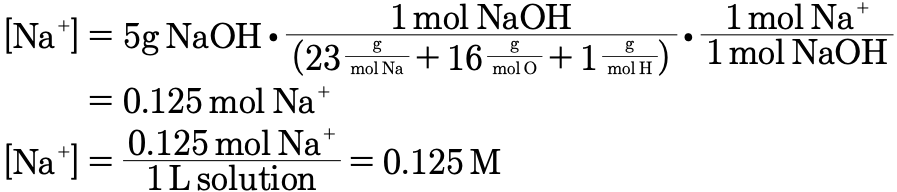 In short, [Na+] = 0.125 M
You probably could have skipped a few steps, but showing the whole process helps with understanding all of the different components that go into finding the concentration, when given the mass.
Next, we compare the moles of our limiting reactants.
Recognize that since OH– ions come from the same compound as the Na+ ions, the initial moles of Na+ and OH– are the same! We already calculated the initial moles of Na+ to be 0.125, moles of OH–=0.125 moles
To calculate the moles of H+ is easy, because we just multiply the concentration of the solution by the volume. So, H+ = 0.1M • 1L = 0.1 moles
Which one is the limiting reactant? It is H+ because there is less of it.
Since H+ is the limiting reactant, we know that all of it will react with the OH–, so there will be some OH– left over. The question is how much, and what is its final concentration as a result?
The added acid is the limiting reagent, so the stoichiometric bookkeeping leaves no excess added acid. That is not the same as a literal zero hydronium concentration: water remains in acid/base equilibrium. Use the excess hydroxide concentration for the equilibrium estimate at 25 °C.
At 25 °C, using the ideal dilute-solution model and [OH⁻]=0.025 M, [H⁺]=Kw/[OH⁻]=1.0×10⁻¹⁴/0.025=4.0×10⁻¹³ M. The amount of unreacted added strong acid is zero in the stoichiometric model, while equilibrium hydronium is small and nonzero.
Now we calculate how many moles of OH– are left over. This is simply the initial moles minus the moles that reacted with H+, or 0.125 – 0.1 = 0.025 moles OH– left over.
Since the volume of the solution stays the same, the final concentration of OH– ions is 0.025 moles/ 1 L. [OH–]=0.025M