Light
Original textbook reading.
Enrichment beyond the AP course.
This original chapter is extra exploration beyond the supplied AP Physics 1 course. Keep it if you're curious about where these ideas go next.
Electromagnetic waves, including light, can propagate through vacuum without a material medium. Mechanical waves such as sound require a medium.
Light has wave properties and exchanges energy in discrete quanta called photons. A photon is not a tiny object following a sinusoidal trajectory. In an electromagnetic wave, the fields vary in space and time.
Wave speed, frequency, and wavelength are related by v = fλ. In vacuum, all electromagnetic waves have speed c.
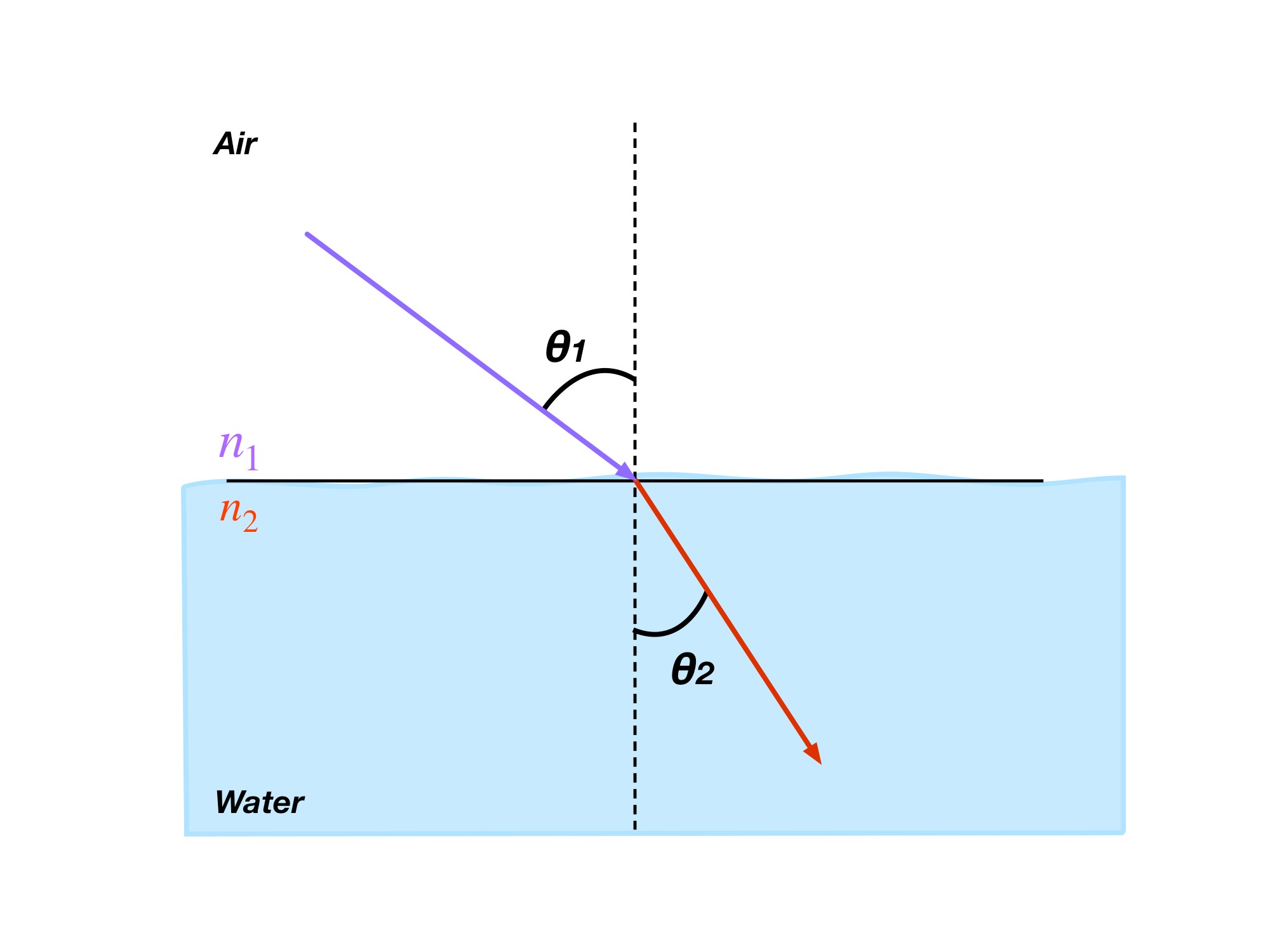
Figure 9.3.1 Refraction at an Air–Water Boundary
For light, the velocity will always be a factor of the constant , which is the speed of light in a vacuum.
The actual speed of light in some medium (i.e. not a vacuum) is calculated using the equation:
is the constant, is the speed of light in some medium, and is that medium’s refractive indexⓘ.
This idea of a refractive index is what causes refraction of light. The refraction of light is the change in the angle of light as it passes from one medium to another. This is why when you put a pencil in water; it appears ‘broken’ at the water’s surface.
Snell’s Law↗ is used for this situation and it states:
The refractive indices refer to the two media, and both angles in Snell’s law are measured from the normal to the interface.
Another aspect of light is color. The term light refers to a specific type of electromagnetic radiation. This electromagnetic radiation refers to any wave-particle instance of a photon. The only reason that we see this radiation as light is due to the wavelength of that photon. A diagram of the electromagnetic spectrumⓘ is shown in the figure.
Figure 9.3.2 Electromagnetic Spectrum
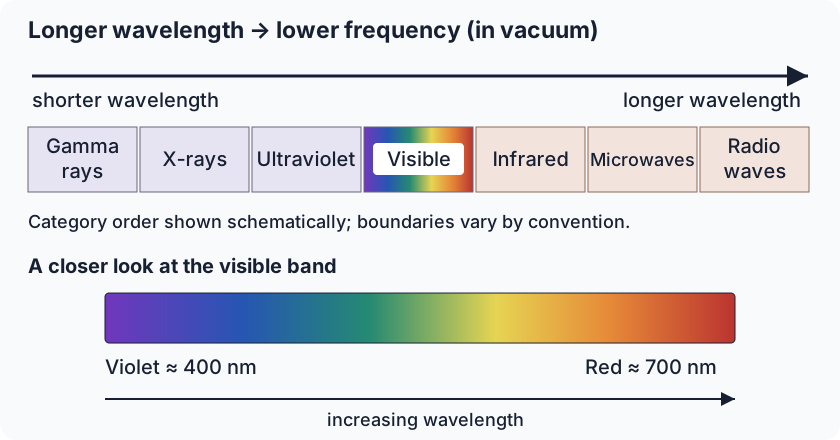
Wavelength increases from left to right. In the visible band, violet has shorter wavelength than red. The category overview is schematic; the visible strip is a separate enlargement. Electromagnetic spectrum.
The small range of around is the only part that we can see of this visible light spectrum. There are cameras that will take other wavelengths and convert them into visible light, allowing us to ‘see’ the other parts of the spectrum. That is actually what a thermal camera does. Heat generates infrared light, and the thermal cameras detect that light and convert it into video we can see.
The wavelength of light is dependent on the light’s frequency. We covered before that light’s velocity varies depending on the medium it’s in. Typically, you will encounter light in air, which has a refractive index of . This means that we can approximate the speed of light in air to be equal to .
Therefore, we can calculate the light’s wavelength as:
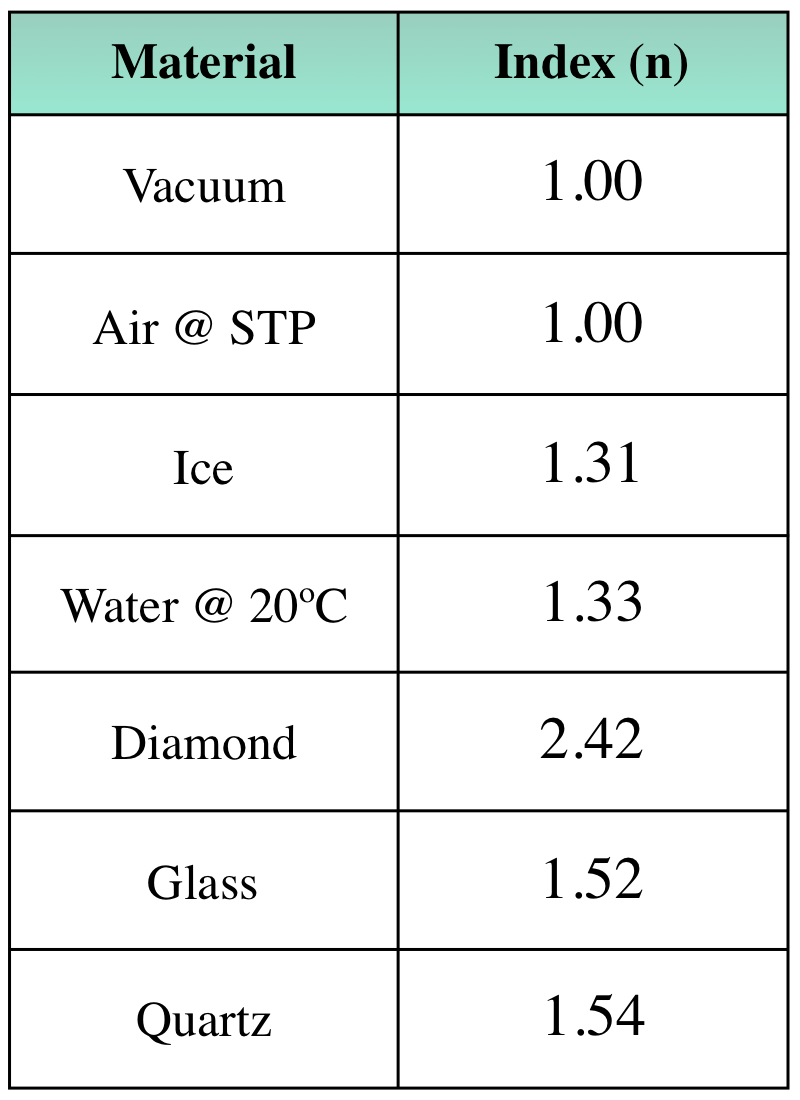
The table in the next column is a list of different mediums with their respective refractive indices which you can use for referencing when encountering problems dealing with light refraction.
Table 9.3.1: Refractive Indexes of Different Mediums
Example Problem 9.3.1
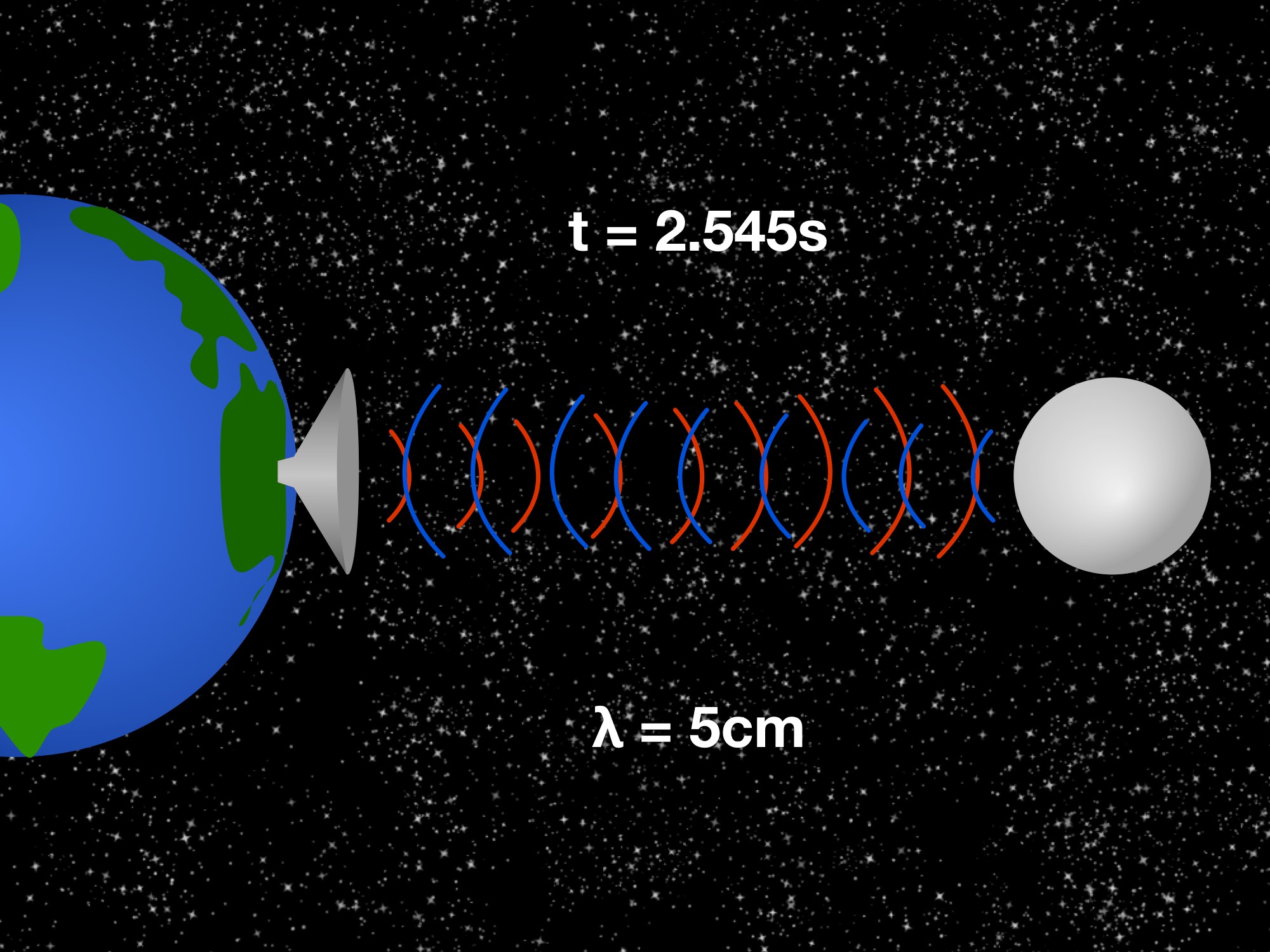
A radar system that broadcasts electromagnetic radiation with attempts to determine the distance from the earth to the moon. They bounce radar waves off of the moon and determine the time it takes for them to return. If that time is , determine the distance to the moon. Also determine the frequency of the radar used.
Step 1. Determine the length the light traveled
As we can assume that the light is traveling at (which we treat as the velocity), then the distance it travels is given by:
Step 2. Approximate the distance to the moon
The path that the radar waves took was from the radar center to the moon and back. This means that the distance it traveled was twice the distance from the earth to the moon. Therefore, the distance from the earth to the moon is approximated by halving our answer from step 1:
Step 3. Determine the frequency of the radar
The equation we use for this step is Equation 9.3.4. As we know that the wavelength is , or , we get:
A photon of frequency f carries energy E = hf. For N photons of that frequency, total energy is Nhf. Total beam energy therefore depends on both photon frequency and photon number.
This lead to the Planck-Einstein equation:
In this equation, is the wave’s frequency, and is the Planck Constantⓘ, . This can be re-written by using the definition of frequency:
In the photoelectric effect, incident light can eject electrons from a material. The work function is the minimum photon energy needed for ordinary single-photon emission from that surface; K_max = hf − φ when hf ≥ φ.
A model carbon surface is assigned a work function 7.686 × 10⁻¹⁹ J. Find the threshold photon frequency and corresponding maximum wavelength for photoelectric emission. Classify this radiation.

Reviewed physics notes (12)
These corrections keep the original lesson’s purpose while fixing errors in the source edition.
- Removes the suggestion that light “prefers” a medium as a physical mechanism. — Reference 1
- Photons do not move along wave-shaped paths. — Reference 1
- Corrects the asserted speed of a photon moving “along its wave.” — Reference 1
- The normal convention is essential to the later diagrams. — Reference 1
- Separates energy per photon from total energy and removes the claim of photon paths along a wave. — Reference 1
- Adds the emission threshold and correct surface-work-function terminology. — Reference 1
- A surface work function is not the atomic ionization energy of carbon; the source’s numerical threshold is retained as a stipulated model value. — Reference 1
- The depicted change in ray angle is refraction, not diffraction. — Reference 1
- The displayed X-ray range is overly narrow; boundaries are approximate. — Reference 1
- The source’s 10⁻⁶ to 10⁻⁵ m is infrared rather than visible light. — Reference 1
- The source’s 0.01–0.1 m range is only a subset of microwaves, and “Micowaves” is misspelled. — Reference 1
- Recession means redshift, but an arbitrary object does not necessarily appear literally red. — Reference 1
Glossary and deeper reading · 12 refreshers
These editorial refreshers supplement the reading. Definitions and examples are added guidance; original source wording and recorded answers remain in their original context.
-
Electromagnetic wave
An electromagnetic wave contains oscillating electric and magnetic fields that transport energy. In the plane-wave vacuum model, both fields are perpendicular to each other and to the propagation direction. For example, visible light and radio waves can both travel through empty space.
-
Wave
A wave is a propagating disturbance that can transfer energy without transporting the medium as a whole. Mechanical waves require a material medium, while electromagnetic waves can propagate through vacuum. For example, a pulse travels along a rope while individual rope segments move locally around their equilibrium positions.
-
Photon
A photon is a quantum of electromagnetic radiation with energy proportional to its frequency. It has zero rest mass and no electric charge but carries energy and momentum. For example, increasing light’s frequency increases the energy of each photon, while increasing the number of same-frequency photons increases the total energy.
-
Frequency
Frequency is the number of complete repeating cycles per unit time. It is measured in hertz, meaning cycles per second, and is the reciprocal of the period. For example, a vibrating string with a higher frequency produces more cycles each second.
-
Wavelength
Wavelength is the spatial distance between neighboring points at the same phase of a periodic wave. It connects propagation speed and frequency through speed equal to frequency times wavelength. For example, neighboring crests of a sinusoidal water wave are separated by one wavelength.
-
Velocity
Velocity describes how position changes with time and includes direction. Instantaneous velocity describes one moment, while average velocity is displacement divided by elapsed time. For example, a car turning a corner can change velocity while maintaining the same speed.
-
Refractive index
Refractive index is the ratio of light’s speed in vacuum to its speed in the material at the relevant frequency. It is dimensionless and can depend on wavelength. For example, glass usually has a larger refractive index than air, so visible light travels more slowly through the glass.
-
Refraction
Refraction is a change in wave propagation at a boundary where wave speed changes. For light entering a new medium, frequency stays fixed while speed and wavelength can change, and the direction generally bends unless incidence is normal. For example, a light ray entering water obliquely from air bends toward the normal.
-
Snell’s law
Snell’s law relates the incidence and refraction angles to the refractive indices of two media. Both angles are measured from the normal to the boundary, rather than from the surface. For example, entering a higher-index material at oblique incidence bends a light ray toward the normal.
-
Electromagnetic spectrum
The electromagnetic spectrum is the continuous range of electromagnetic-wave frequencies and wavelengths. Increasing frequency corresponds to decreasing vacuum wavelength, from radio toward gamma-ray wavelengths. For example, infrared light has a longer wavelength and lower frequency than visible violet light.
-
Heat
Heat is energy transferred between systems because of a temperature difference. It describes a transfer rather than a substance or energy store contained in an object. For example, when a warmer mug transfers energy to a cooler hand, the mug loses internal energy and the hand gains it.
-
Planck’s constant
Planck’s constant relates the energy of a photon to its frequency. It also sets the scale connecting particle momentum to de Broglie wavelength. For example, two photons of different frequencies have energies in the same ratio as their frequencies because the constant is the same for both.